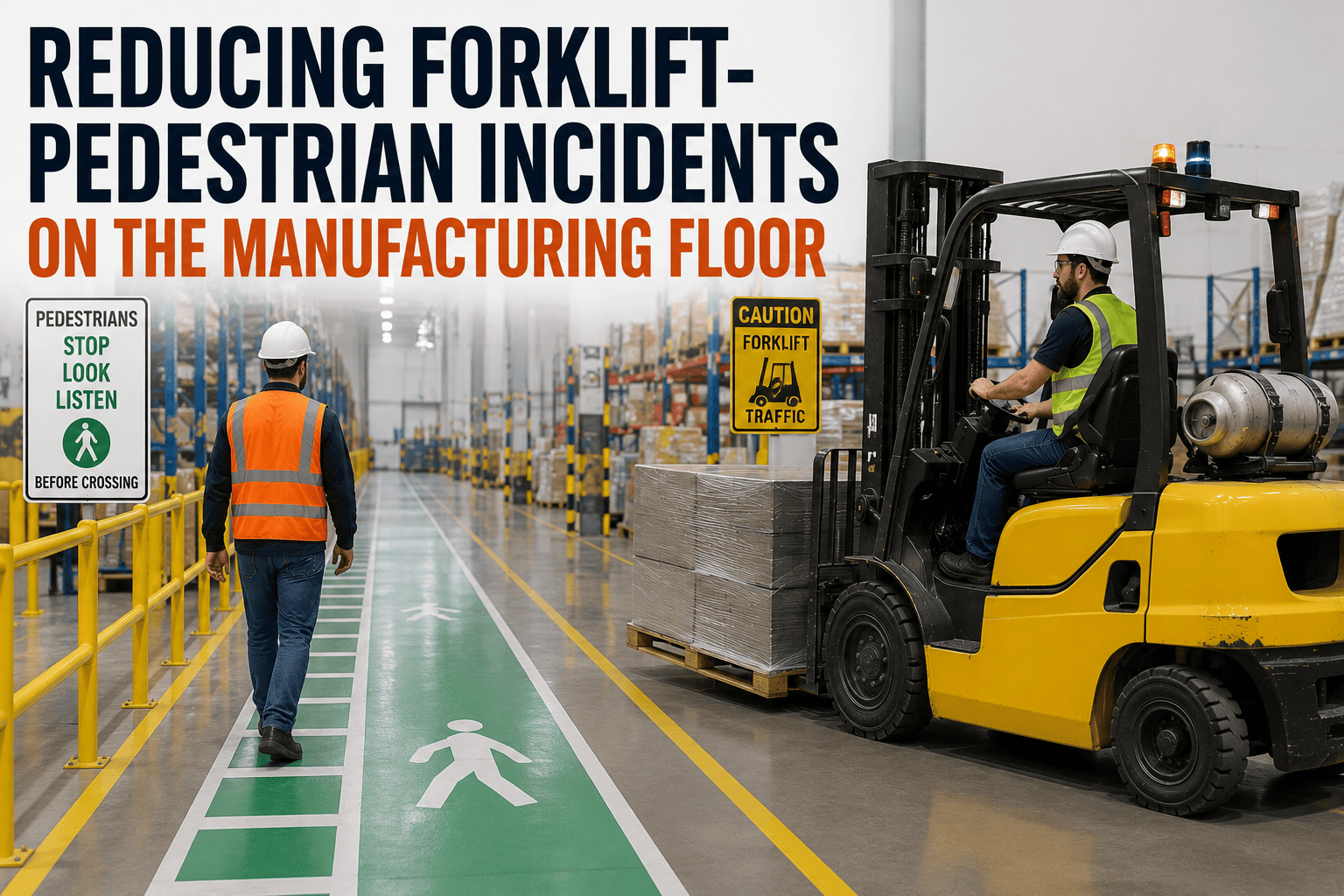
Forklifts make up a small fraction of the equipment on a manufacturing floor, yet they're tied to a disproportionate share of the most serious injuries a plant will ever report. Pedestrian struck-by incidents sit at the center of that problem. Workers on foot have no protective structure around them, and a forklift operator's view is often partially blocked by the very load they're carrying.
The good news is that struck-by incidents follow patterns. They cluster around specific zones, specific times, and specific conditions, which means they're largely preventable with the right visibility into where and how they happen. This guide breaks down where forklift-pedestrian risk concentrates on a manufacturing floor and how FleetRabbit uses location, impact, and zone data to target the conditions behind these collisions before they turn into injuries.
Pedestrian struck-by incidents are consistently cited as a leading cause of forklift-related fatalities, with industry data pointing to pedestrians being involved in roughly a third of forklift deaths. These incidents concentrate around blind corners, intersections, and loading dock areas, where visibility is limited and vehicle-pedestrian paths cross most often. Tracking where and when these high-risk interactions happen gives plants the data needed to redesign traffic patterns and target training before an incident occurs, not after.
Why Pedestrian Struck-By Incidents Are So Dangerous
A forklift operator is protected by an overhead guard, a seatbelt, and a structured cab. A pedestrian standing in the wrong spot at the wrong time has none of that. When a collision happens, the outcome is rarely minor, which is why safety data consistently ranks pedestrian struck-by incidents among the top causes of forklift-related fatalities, alongside tip-overs.
Blocked Sightlines Are A Constant Factor
Many pedestrian incidents happen when the operator's view is partially or fully blocked by a raised load, especially near racking, doorways, and tight corners where there's little time to react even with full visibility.
Shared Space Without Clear Separation
Areas where foot traffic and forklift traffic cross without dedicated lanes, marked crossings, or barriers create the conditions for a collision every time both are present at once. The more frequently paths cross, the higher the cumulative risk.
Where Risk Concentrates On The Floor
Struck-by incidents rarely happen randomly across a facility. They cluster around a small number of predictable zones.
Find Out Where Your Risk Actually Concentrates
FleetRabbit captures location and zone data across your fleet so you can see exactly which aisles, docks, and intersections carry the most pedestrian risk, instead of guessing.
Common Causes And What Actually Reduces Them
| Common Cause | Why It Happens | What Reduces It |
|---|---|---|
| Obstructed operator view | Raised loads block forward visibility, especially on tall pallets | Travel with loads lowered and reversed where visibility is limited |
| No dedicated pedestrian paths | Foot traffic and forklift routes overlap without marked separation | Establish and mark clear pedestrian lanes away from primary forklift routes |
| Blind intersections | Racking and walls block sightlines at aisle crossings | Install convex mirrors and require horn use at every blind corner |
| Repeat near-misses going unreported | Close calls are rarely logged unless an injury actually occurs | Track near-miss and impact data by zone to catch patterns before an injury happens |
| Inconsistent speed control | Forklifts moving too fast through high-traffic zones | Set and monitor zone-specific speed limits with location tracking |
Building A Pedestrian Safety Program That Actually Works
Posters and one-time training sessions rarely change behavior on their own. The plants that reduce struck-by incidents treat it as an ongoing, data-driven program.
Map Your High-Risk Zones First
Before changing anything, identify where forklift and pedestrian paths actually cross most often. This is often different from where managers assume the risk is highest, which is why location data matters more than instinct.
Separate Traffic Wherever Physically Possible
Marked pedestrian lanes, physical barriers, and dedicated crossings at high-traffic intersections remove the guesswork from who has the right of way and when.
Track Impacts And Near-Misses, Not Just Incidents
Waiting for a reportable injury to reveal a problem zone means the plant is always reacting after the fact. Logging every impact event, even minor ones, surfaces the pattern long before someone gets hurt.
Reinforce Horn And Speed Discipline At Blind Spots
A consistent rule requiring horn use and reduced speed at every marked blind corner closes one of the most common gaps between operator awareness and pedestrian awareness.
Review Zone Data On A Regular Cadence
Monthly review of impact and near-miss data by location helps confirm whether changes are actually reducing risk in the zones that needed it most, rather than just assuming the problem is solved.
This is exactly where a connected platform changes the outcome. FleetRabbit captures location, impact, and zone-level data across your forklift fleet, giving safety teams a clear view of exactly where pedestrian risk concentrates instead of relying on anecdotes after an incident. If your plant is serious about reducing struck-by risk, it's worth seeing this in action on your own floor layout, and you can book a demo to walk through it.
Target The Conditions Behind Struck-By Incidents
FleetRabbit turns location, impact, and zone data into a clear picture of where pedestrian risk lives on your floor, so you can act before an incident happens, not after.
Frequently Asked Questions
Every Struck-By Incident Was Preceded By A Pattern. See Yours Before It Escalates.
FleetRabbit gives plant and safety managers the location, impact, and zone data needed to identify pedestrian risk on the floor and act on it before an injury happens.