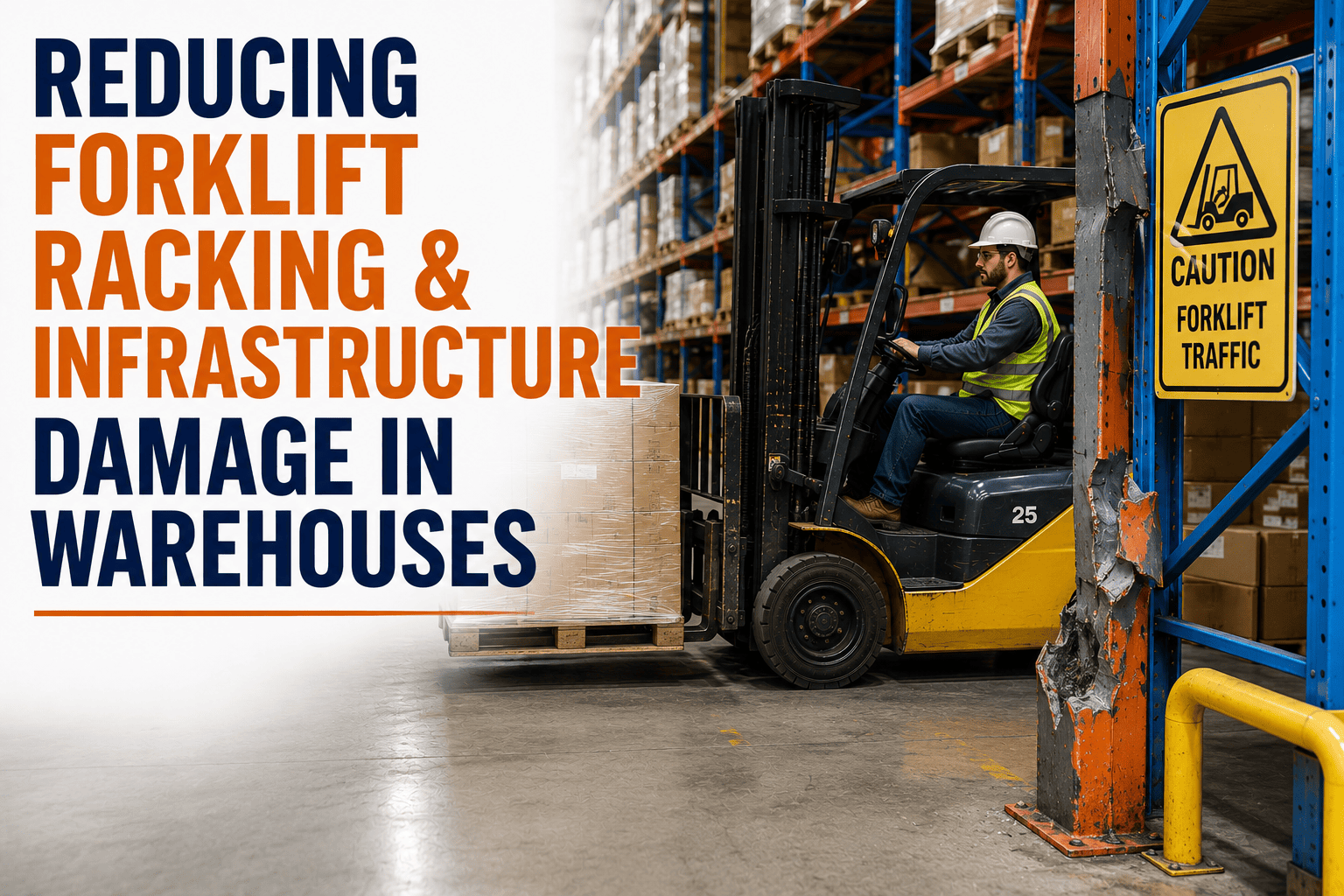
Walk any busy warehouse floor for an hour and you will hear it: the scrape of a fork against an upright, the dull thud of a load clipping a beam. Most operators barely notice. Racking looks fine. Nobody files a report. But every one of those small hits chips away at the structural integrity of the storage system holding thousands of pounds above your team's heads, and the bill for ignoring them arrives eventually, usually as a collapse, an audit failure, or a six-figure replacement project.
A single forklift-to-rack collision causes roughly 10000 dollars in property damage on average, and most go unreported. Warehousing and transportation injuries linked to material handling equipment cost employers over 4 billion dollars annually across the industry. Fleets using impact monitoring and telematics cut collision frequency by around 35 percent, protecting both racking and people.
Why Racking Damage Is a Bigger Problem Than It Looks
Pallet racking is engineered to carry exact loads within exact tolerances. A bent column, a cracked weld, or a loosened base plate does not need to look dramatic to change that math. Even a glancing hit from an outrigger or a fork can shift a beam connector just enough to reduce its rated capacity by a significant margin. The danger is that damaged racking usually keeps standing and keeps holding product right up until the moment it does not.
The Hidden Cost Beneath the Dent
Warehouse operators tend to think of racking damage as a maintenance line item, but the real cost sits underneath. Damaged uprights force partial or full aisle shutdowns for inspection, pausing picking and replenishment in that zone. Insurance carriers increasingly ask for documented impact logs before renewing coverage, and a poor record can raise premiums. Non-fatal injuries tied to material handling equipment already cost the warehousing and transportation sector more than 84 million dollars per week, and racking failures sit squarely inside that figure.
Where the Impacts Actually Happen
Damage clusters in predictable spots: end-of-aisle turns, narrow cross-aisles near loading docks, and upper beam levels where operators lose depth perception. Reach trucks working double-deep racks frequently strike the first beam level because drivers use it as a visual depth guide. Outriggers catch column base plates in tight footprints, especially in facilities using reinforced anchoring. None of this is random, which is exactly why it is preventable with the right data.
FleetRabbit logs every hard impact by vehicle, operator, and zone so you know exactly where racking risk is building before a collapse forces you to find out the hard way. Sign up free and start capturing impact data today.
Where the Damage Comes From
Forklifts damage infrastructure through a small number of repeatable mechanisms, and understanding which one is happening in your facility determines which fix actually works. Forks strike beams during pallet placement. Masts contact upper rack levels during lifts in narrow aisles. Outriggers clip base plates and column footings during turns. Dock doors and levelers take hits from trucks backing in too fast or misjudging clearance. Each mechanism points to a different combination of layout, training, or technology fix.
| Damage Type | Typical Repair Cost | Root Cause | Prevention Strategy |
|---|---|---|---|
| Bent or Cracked Upright | 1500 to 4000 dollars | Fork or mast contact during placement, tight aisle turns | Impact sensors, aisle-end mirrors, operator speed alerts |
| Damaged Beam Connector | 400 to 1200 dollars | Overhead reach contact, misjudged lift height | Height-guided lift assist, camera systems on reach trucks |
| Base Plate or Anchor Damage | 300 to 900 dollars | Outrigger contact on tight turns near column footings | Rack-end protectors, wider turning clearance in layout design |
| Dock Door or Leveler Strike | 800 to 3000 dollars | Fast backing approach, poor visibility during docking | Dock sensors, speed governors near dock zones |
| Full Rack Section Collapse | 15000 to 40000 dollars | Repeated undetected impacts weakening structural connections | Impact logging, scheduled inspection triggers, damage escalation rules |
Turning Impact Data Into Fewer Collisions
The fleets that get racking damage under control do not rely on operators self-reporting hits, because most hits never get reported. Instead they capture every impact automatically and route it to a maintenance and safety workflow before it becomes a pattern. Telematics-based impact sensors mounted on the vehicle chassis flag hard contacts in real time, tagging the location, the operator, and the severity of the hit. Facilities using this kind of monitoring see collision frequency drop by around 35 percent, largely because operators change behavior once they know impacts are visible to management.
Building an Impact Response Workflow
Detection alone does not fix racking. What matters is what happens in the minutes after a hit registers. A strong workflow flags the affected bay for inspection automatically, notifies a supervisor, and locks the zone from further loading until a technician clears it. Facilities that skip this step often leave visibly undamaged but structurally weakened racking in service, which is how a minor scrape from three weeks ago becomes this month's collapse.
Coaching Operators With Real Numbers
Operator scorecards built from impact data change behavior faster than generic safety training. Showing a driver their personal impact count next to the fleet average, along with the specific aisles where hits cluster, makes the problem concrete instead of abstract. Teams that pair this feedback with brief coaching sessions typically see the highest-impact operators cut their hit rate the most within the first month.
FleetRabbit pairs impact detection with automated inspection workflows and operator scorecards, so damage gets caught and fixed instead of buried under next week's picking targets. Explore how it fits your facility with a live walkthrough.
Layout and Equipment Fixes That Reduce Contact
Technology catches damage after it happens; layout design prevents it from happening at all. Widening cross-aisles near high-traffic dock zones, adding rack-end protectors on exposed columns, and installing mirrors at blind turns all reduce the physical chance of contact. Facilities running double-deep racking benefit from marked depth guides so operators stop using the first beam level as a reference point. None of these fixes require new equipment purchases, only a walkthrough of where impacts are already clustering.
Quick Wins Worth Auditing This Month
Check whether column protectors exist at every exposed corner within ten feet of a dock door. Confirm aisle widths meet the turning radius of the largest vehicle using that aisle, not just the average one. Review whether damaged beams from the last twelve months share a common aisle or shift, which usually points to a layout or training gap rather than bad luck.
Benchmarking Your Facility Against Industry Norms
Most warehouse managers underestimate how much racking damage their facility is actually absorbing because so little of it gets logged. A useful starting benchmark is impacts per 1000 forklift operating hours, tracked by zone and by operator. Facilities with strong impact monitoring typically report a steady decline in this number over the first two quarters of use, while those relying on manual reporting usually discover their real damage rate is far higher than what appears on paper once sensors are installed.
Insurance and compliance reviews increasingly expect documented inspection and impact records rather than a verbal assurance that racking is checked periodically. A facility that can produce a digital log showing every impact, the resulting inspection, and the corrective action stands in a much stronger position during an audit or after an incident than one relying on memory and paper logs.
Key Takeaways on Reducing Racking and Infrastructure Damage
Racking damage is rarely dramatic when it happens, which is exactly why it becomes dangerous over time. Small, unreported hits accumulate into weakened structures, and the industry-wide cost of forklift-related incidents already runs into the billions annually. Facilities that put impact detection and inspection workflows in place stop relying on luck and start catching problems while they are still cheap to fix. Layout adjustments, operator coaching, and consistent documentation round out a program that protects both product and people.
The fleets seeing the biggest improvement are not the ones with the strictest verbal safety policy. They are the ones capturing real impact data and acting on it every week. If your current racking inspection process depends on someone remembering to walk the aisles, it is worth comparing that against what automated monitoring reveals.
FleetRabbit tracks every forklift impact against racking and infrastructure in real time, so your team catches damage while it is still a repair instead of a collapse. Get started with no credit card required.