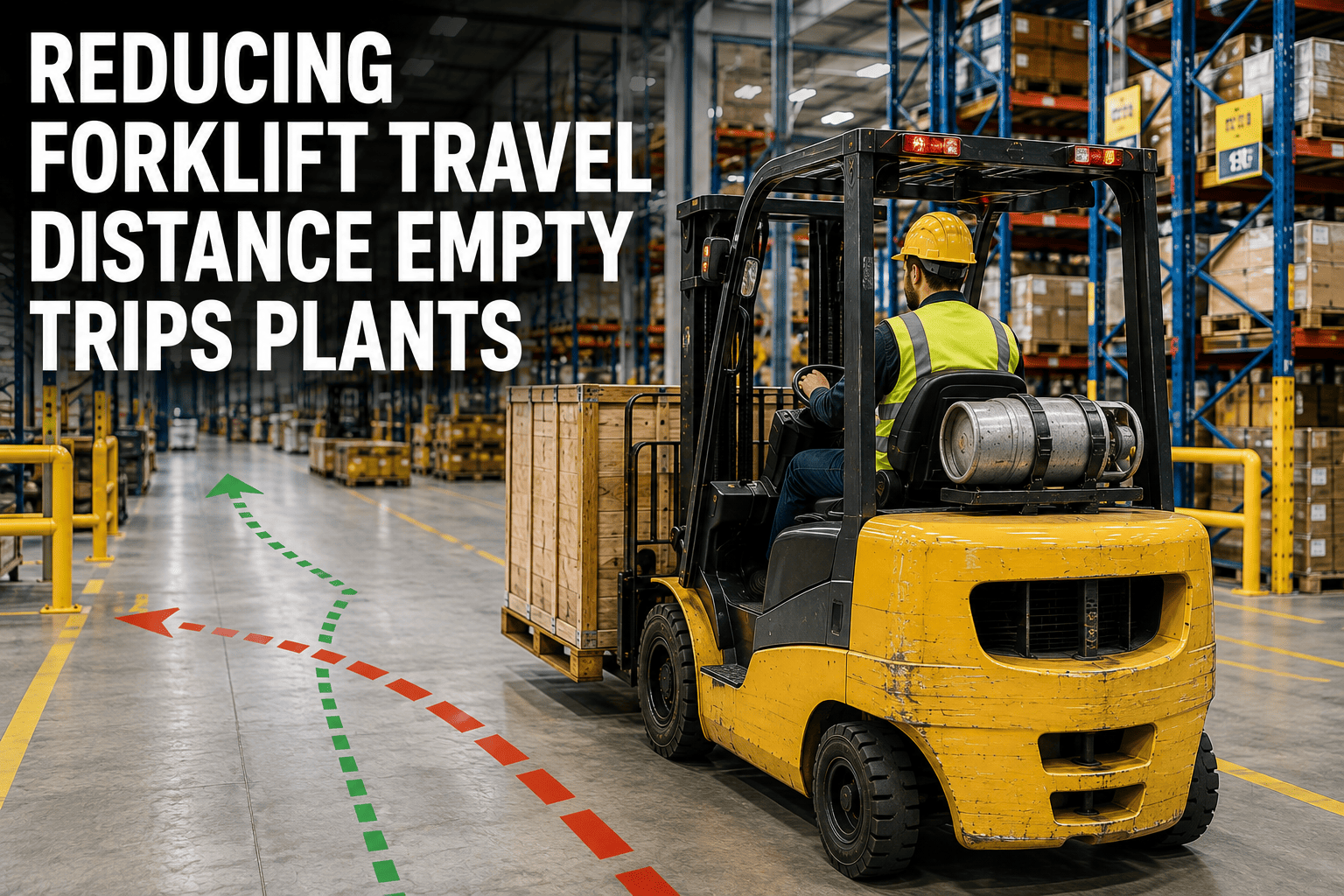
Watch a forklift for a full shift and you'll notice something plant managers rarely track: it spends a surprising chunk of that time driving with nothing on the forks. Not lifting, not placing, just moving from wherever the last task ended to wherever the next one happens to be. That's called empty travel, and in plants running on radio calls and paper instructions, it can eat close to half a shift. The forklift isn't idle, so nobody flags it as a problem. But every empty foot it drives still burns battery, adds wear, and delays the next task in line.
Empty forklift travel happens when a truck finishes a task and drives back across the plant instead of picking up nearby work. It's invisible on a shift report but shows up as wasted battery, faster wear, and slower material flow. Movement data lets plants see exactly where empty trips happen and route trucks so nearby tasks get grouped instead of scattered.
The Trip Nobody Accounts For
Every forklift move falls into one of two categories: loaded travel, which moves product and earns its keep, and empty travel, which is pure cost. The problem is that from the floor, both look identical. A truck driving across the plant looks busy whether or not it's carrying anything, so empty travel hides inside a shift that otherwise looks productive.
Why Empty Travel Builds Up Without Anyone Noticing
Empty trips rarely come from one big mistake. They build up from dozens of small ones across a shift, and each one looks minor in isolation.
Tasks are assigned one at a time
A truck finishes a putaway and radios in for its next job. If dispatch doesn't know what's waiting nearby, the truck gets sent wherever the loudest request is, even if that means crossing the whole plant.
Return trips run empty by default
After a delivery, the natural move is to drive straight back to a staging area or wait for the next call, instead of picking up a nearby pallet on the way. Without visibility into what's waiting along the route, that opportunity gets missed every time.
Layout changes outlive the routing logic
Plants expand, aisles shift, and new lines get added, but the mental map operators and dispatchers use for "the fastest way there" often doesn't get updated for years.
FleetRabbit's movement data separates loaded travel from empty travel for every truck in your fleet, so you can see exactly where routes are wasting distance. Sign up and connect your fleet to see your real numbers, not an estimate.
How Movement Data Closes the Gap
Cutting empty travel doesn't require redesigning the plant floor. It requires knowing, trip by trip, where the empty miles are actually happening, then changing how tasks get grouped and assigned.
Every Trip Gets Tagged Loaded or Empty
Movement data records not just where a truck goes, but whether it was carrying a load at the time. That single distinction turns a vague sense that "trucks seem busy" into an exact empty-travel percentage per vehicle, per shift, per zone.
Nearby Tasks Get Grouped Instead of Scattered
This is the practice known as task interleaving: instead of sending a truck back empty after a drop-off, the system checks whether a pickup is waiting nearby and routes it there first. The truck still completes both jobs, it just does it without the empty leg in between.
Repeated Routes Reveal the Real Opportunity
A long route driven once a week matters far less than a short route driven five hundred times a shift. Movement data surfaces which origin-and-destination pairs repeat the most, so plants can fix the routes with the biggest cumulative payoff first.
| Travel Pattern | What Causes It | How Movement Data Fixes It |
|---|---|---|
| Return-Empty Trips | Truck drives straight back after a delivery with no return load assigned | Flags nearby pending tasks so a pickup gets added to the return leg |
| Cross-Plant Detours | Task assigned to whichever truck answers the radio, not the closest one | Shows live position so the nearest available truck gets the call |
| Repeated Short Hauls | The same origin-destination pair driven hundreds of times a shift | Ranks routes by frequency so the highest-volume paths get fixed first |
| Outdated Layout Routes | Routing habits that never updated after an aisle or line change | Rebuilds the route map from actual GPS trips instead of memory |
What Cutting Empty Travel Actually Saves
Reducing empty travel isn't just a battery statistic. It changes how a shift feels on the floor, because trucks spend more of their time doing the work that moves product and less of it repositioning for the next call.
Battery and Fuel Last Longer
Every empty foot of travel still draws power or burns fuel with nothing to show for it. Cutting empty travel stretches the useful range of every charge or tank across a shift.
Wear Slows Down Across the Fleet
Tires, brakes, and drivetrain components wear based on distance traveled, not on whether a load was on the forks. Fewer empty miles means components last longer before the next service interval.
Zones Stop Competing for the Same Truck
When routes are grouped intelligently, trucks naturally spread coverage across zones instead of clustering around whichever area calls in the most often, so wait times even out across the plant.
Plants that want to see this measured against their own layout can book a demo and walk through a real route breakdown before committing to anything.
Signs Your Plant Is Losing Distance to Empty Trips
A few patterns tend to show up consistently in plants carrying more empty travel than they realize.
Operators Mention "Driving Back Empty" Often
If drivers casually describe heading back across the floor with nothing on the forks as just part of the job, that's a routing gap, not an unavoidable cost.
Battery Swaps or Refueling Happen Earlier Than Expected
Trucks running out of charge or fuel faster than their rated cycle usually means more total distance is being driven per task than the layout should require.
Some Zones Wait Longer Than Others for No Clear Reason
If certain areas of the plant consistently wait longer for a truck, it's often because routing habits favor other zones, not because those zones actually generate less work.
Empty travel doesn't show up on a shift report, but it shows up in battery costs, wear, and slower material flow. FleetRabbit's movement data shows exactly where your fleet is driving empty so you can route smarter with the trucks you already have.