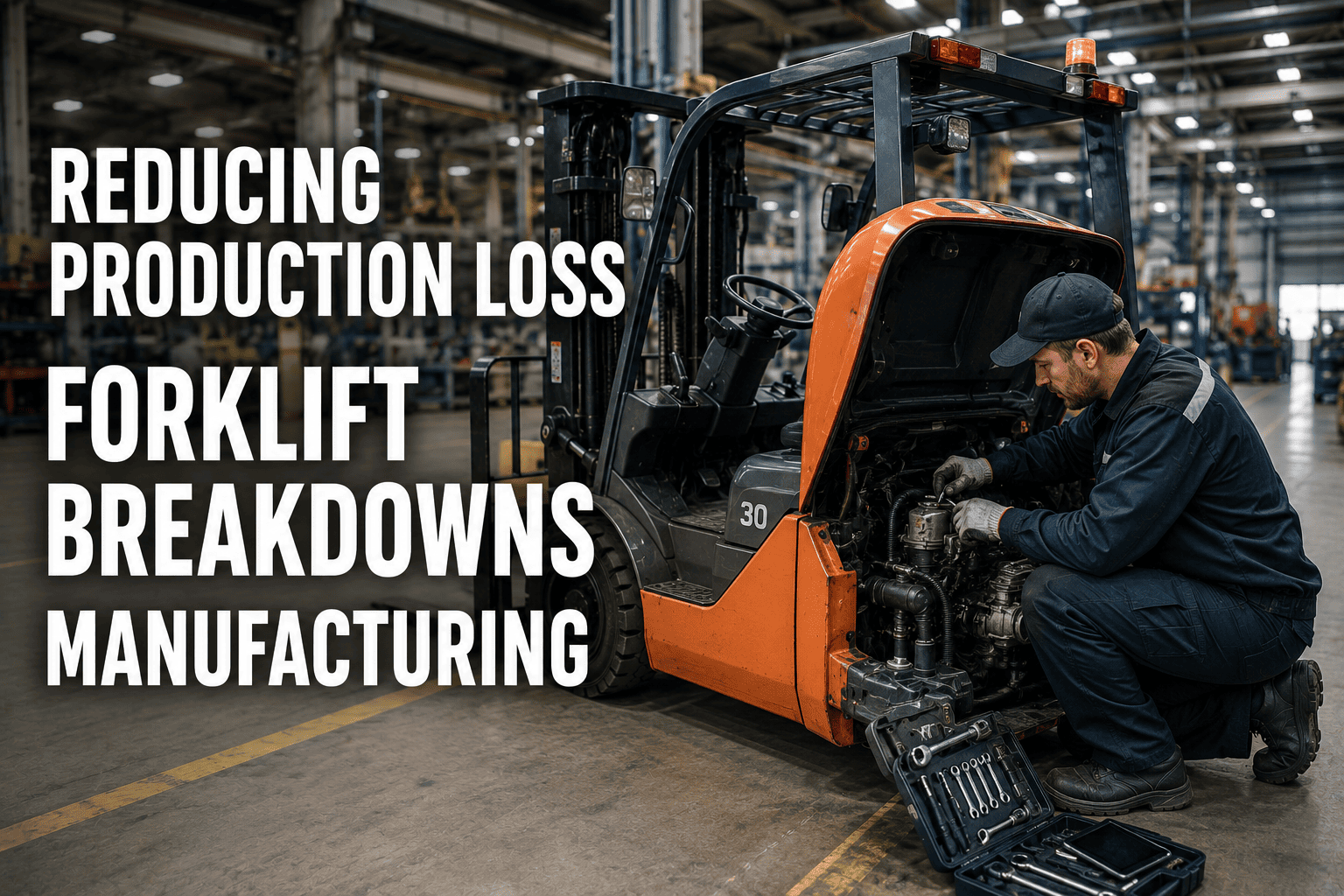
A forklift breaking down never feels like a $20,000 problem. It feels like one truck, parked at an angle, with a hazard light blinking near the loading dock. But on a manufacturing floor running on takt time, that one truck is the only thing standing between your line and the next pallet of components. Within minutes, a stalled forklift stops being a maintenance issue and becomes a production issue, and production issues are the expensive kind.
A forklift breakdown rarely costs what the repair invoice says. The real cost is the line waiting on parts, the overtime to catch up, and the cascade that follows a single 45-minute failure into the next shift. Predictive maintenance catches the early warning signs — leaks, heat, vibration, pressure drops — before the truck ever strands the line. FleetRabbit builds that visibility directly into your fleet.
The Chain Reaction Nobody Budgets For
A breakdown does not create a clean, contained delay. It sets off a sequence, and each link in that sequence adds cost the original repair estimate never accounts for.
The Truck Fails Mid-Route
A hydraulic hose bursts, a battery dies, or a mast jams — usually mid-shift, usually with a load still on the forks.
The Line Waits on Materials
Work cells running on a fixed replenishment cycle empty out fast. Within minutes, operators are standing idle waiting for parts that never arrive.
Supervisors Improvise a Fix
A spare truck gets pulled off another task, routes get reshuffled, and operators make sub-optimal moves just to keep material flowing somewhere.
The Schedule Slips Into the Next Shift
Overtime gets approved to recover lost throughput, and a 45-minute breakdown quietly turns into hours of knock-on disruption.
What a Stopped Forklift Really Costs Your Line
The dollar figure depends heavily on what your line produces, but the pattern is consistent everywhere: the repair invoice is almost always the smallest number on the page.
FleetRabbit tracks the early warning signs — pressure drops, heat spikes, battery decline, unusual vibration — and flags them days before a truck strands your line. Start your free trial and see what your fleet's failure warnings look like before they cost you a shift.
Why Predictive Beats Reactive on the Plant Floor
Reactive Maintenance Waits for Failure
A truck runs until something breaks, then gets pulled from service mid-shift. By the time the failure is visible, the line has usually already started waiting.
Predictive Maintenance Catches the Warning First
Sensor data on hydraulic pressure, battery health, engine temperature, and impact events flags degrading components while the truck is still fully operational, so the repair happens on your schedule, not the truck's.
Scheduled Repairs Protect the Line, Not Just the Truck
A repair booked for a planned changeover window costs less, takes less time, and never touches your production schedule. The same repair done as an emergency mid-shift costs more in parts, labor, and lost output combined.
Building a Maintenance Program That Protects Production
Reducing production loss is less about buying more spare trucks and more about seeing problems earlier than your current process allows.
Track Condition, Not Just Calendar Intervals
A truck due for service in two weeks can still fail tomorrow. Condition-based alerts catch the trucks that are actually degrading, regardless of where they sit on the maintenance calendar.
Match Spare Capacity to Your Riskiest Routes
Not every truck carries equal risk to your line. Identify which routes feed the tightest, most failure-sensitive work cells and prioritize monitoring and backup coverage there first.
Review Near-Misses, Not Just Breakdowns
A truck that almost failed but got caught in time is exactly the kind of save that should shape your maintenance schedule. Reviewing those catches shows you where your program is actually working.
Plants that book a demo with FleetRabbit typically start by mapping their highest-risk routes against real fleet condition data, which is usually enough to show exactly where the next breakdown was heading before it happened.
Every unmonitored truck is a possible line stoppage waiting for the wrong moment to happen. FleetRabbit gives your maintenance team the early warning to fix it on your schedule, not the truck's, before it ever touches your production output.