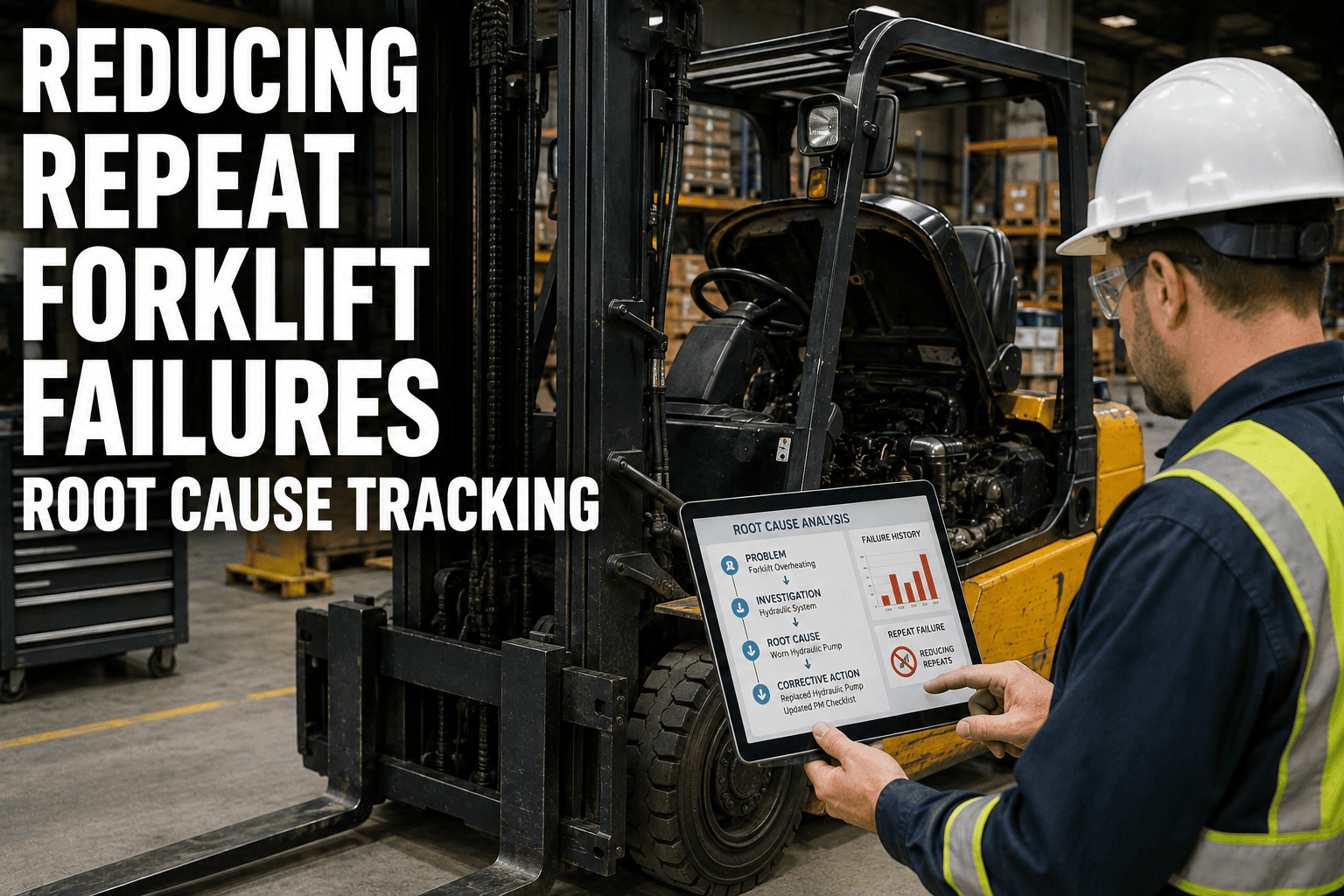
In a fast-paced manufacturing plant, a forklift that breaks down repeatedly is a massive drain on productivity and budget. The same forklift fails the same way because the root cause never gets fixed. Mechanics replace the broken part, but the underlying issue remains. Reducing repeat forklift failures requires strict root-cause tracking. FleetRabbit links failure history so plant techs root-cause repeat failures instead of repeating repairs. You can sign up for FleetRabbit to modernize your maintenance, or book a demo to see our platform.
Repeat forklift failures occur because mechanics fix the symptom, not the disease. Over 40 percent of forklift repairs are recurring issues. Without a connected failure history database, techs replace the same parts blindly. Implementing root-cause tracking reduces repeat failures by 60 to 80 percent, saving manufacturing plants thousands in redundant labor and parts.
The True Cost of Recurring Forklift Failures
The true cost of recurring forklift failures extends far beyond the immediate price of the replacement part. When a forklift suffers the same breakdown repeatedly, the financial damage ripples across the entire manufacturing operation. The immediate repair cost is obvious, but the secondary costs are what destroy profitability. A truck that keeps going down pulls a mechanic away from preventative maintenance on other assets, creating a snowball effect of neglect. Furthermore, the production line reliant on that forklift stalls, backing up outbound shipments and delaying the entire plant's output.
Why Mechanics Repeat Repairs
Mechanics repeat repairs because they are pressured by production to get trucks back on the floor as fast as possible. When a forklift reports a dead battery, the mechanic charges it and sends it out, ignoring the underlying alternator failure. Without a system that forces them to document the root cause and view the truck's failure history, they are flying blind. They treat every work order as an isolated incident rather than a symptom of a larger, recurring issue. This lack of visibility is the exact reason why the same trucks end up in the shop every month.
The Danger of Symptom-Fixing
The danger of symptom-fixing is that it creates a false sense of resolution. A mechanic replaces a leaking hose, marks the work order as complete, and the truck goes back to work. However, if the hose is rubbing against a sharp bracket because a mount is loose, the new hose will rub through and leak next month. Without fixing the bracket (the root cause), the repair was a waste of money. To stop this, you can sign up for FleetRabbit to modernize your maintenance, or book a demo to see our platform.
FleetRabbit links failure history to every forklift, forcing techs to find the disease, not just the symptom. Stop paying for the same repair twice and keep your manufacturing floor moving. Start your free trial today to track your root causes.
Strategies for Root-Cause Tracking
Effective root-cause tracking requires a fundamental shift in how maintenance work orders are handled. The first strategy is implementing a failure history database. When a mechanic opens a work order, they must instantly see the last three repairs done on that truck. The second strategy is enforcing root-cause documentation. Before a work order can be closed, the mechanic must categorize the failure and identify the root cause, not just the symptom. The third strategy is using data to stop the cycle, flagging any truck that fails the same way twice for a deep diagnostic review.
| Failure Type | Symptom Fix (Temporary) | Root Cause (Permanent) | FleetRabbit Solution |
|---|---|---|---|
| Dead Battery | Jump-start or replace battery | Faulty alternator or parasitic draw | Links battery failure to electrical history |
| Blown Fuse | Replace the fuse | Frayed wire shorting against the frame | Flags repeat fuse replacements for deep review |
| Leaking Hose | Replace the hydraulic hose | Broken mount causing friction | Enforces root-cause documentation on close |
| Overheating | Refill coolant | Clogged radiator or failing water pump | Tracks fluid loss patterns over time |
| Chain Skip | Tension the mast chain | Worn mast guides or bent carriage | Alerts when a PM does not solve the issue |
Implementing a Failure History Database
Implementing a failure history database is the most critical step in eliminating repeat failures. A failure history database links every work order ever written for a specific forklift to that asset's permanent profile. When a mechanic is assigned a new ticket, they do not just see "brake failure." They see that this is the third time this year the truck has had a brake failure. This context immediately shifts their diagnostic approach from a quick fix to a deep root-cause investigation. Without this historical context, mechanics are doomed to repeat the mistakes of the past.
Enforcing Root-Cause Documentation
Enforcing root-cause documentation means changing the way mechanics close work orders. In a traditional system, a mechanic writes "replaced fuse" and closes the ticket. With FleetRabbit, the system requires the mechanic to categorize the repair and identify the root cause. Was it a part failure, an environmental issue, or operational misuse? If they just write "replaced fuse," the system will not let them close the ticket. They must document that they found and fixed the frayed wire. This forces accountability and ensures that the root cause is addressed every single time.
Using Data to Stop the Cycle
Using data to stop the cycle means analyzing failure patterns across the fleet. FleetRabbit's dashboard analyzes work order data to find recurring issues. If a specific model of forklift across the plant is experiencing the same chain skip, the data proves it is a systemic issue, not an isolated event. This allows the maintenance director to order a fleet-wide fix, such as upgrading the mast guides on all those trucks, permanently ending the cycle of repeat failures. To implement this, you can sign up for FleetRabbit to modernize your maintenance, or book a demo to see our platform.
How FleetRabbit Eliminates Repeat Breakdowns
FleetRabbit is engineered to connect the maintenance bay directly to historical data. Our platform combines work order management, failure history databases, and root-cause enforcement into a single dashboard. We understand that a repeat failure is a failure of the system, not just the machine. Our system tracks the true root cause of every breakdown, ensuring that mechanics are held accountable for permanent fixes. By connecting the tech to a centralized database, FleetRabbit eliminates the blind spots that lead to repeat repairs.
Connected Asset Histories
Connected asset histories mean that a mechanic never works in a vacuum. When a work order is generated, the FleetRabbit mobile app instantly pulls up the truck's complete repair history. The mechanic can see that the transmission was rebuilt six months ago, and that the truck has had three hydraulic leaks this year. This context is invaluable for accurate diagnostics. Instead of guessing, the mechanic can immediately look at the known weak points of that specific truck, saving hours of diagnostic time and preventing a symptom-fix.
Automated Root-Cause Alerts
Automated root-cause alerts ensure that maintenance directors catch systemic issues before they become expensive. If a specific forklift receives a third work order for the same component failure within 90 days, FleetRabbit automatically sends an alert to the director. The system flags the truck for a deep engineering review, forcing the team to stop putting band-aids on the issue and find the true root cause. This automated oversight prevents the slow budget drain of repeat repairs and keeps the fleet running at maximum reliability.
Key Takeaways for Forklift Reliability
Reducing repeat forklift failures is the most critical step in maximizing manufacturing uptime and protecting the maintenance budget. Relying on symptom-fixing and disconnected paper logs is a guaranteed way to waste labor hours and stall production lines. A data-driven, root-cause approach to repair ensures that every fix is a permanent fix. Fleets that fix this process see a massive reduction in repair costs and a huge boost in asset availability.
Implementing a comprehensive platform like FleetRabbit links failure history to every asset, enforces root-cause documentation, and automates alerts for recurring issues. The return on investment is immediate, not just in saved parts and labor, but in eliminated line downtime and extended asset lifecycles. Manufacturing plants demand reliability, and FleetRabbit provides the exact digital tools needed to deliver it.
The path forward is clear. Evaluate your current repair process and ask how many times the same truck has been in the shop for the same issue this year. If you are relying on symptom-fixing, you are losing money. Plant managers who address root-cause tracking systematically protect their profitability and operational reliability. You can sign up for FleetRabbit to modernize your maintenance, or book a demo to see our platform.
Frequently Asked Questions About Forklift Failures
Every repeat failure is a drain on your maintenance budget and a stall on your production line. FleetRabbit links failure history and enforces root-cause tracking, permanently ending the cycle of repeat repairs. See an 80 percent reduction in repeat failures within weeks. Start your free trial today with no credit card required.