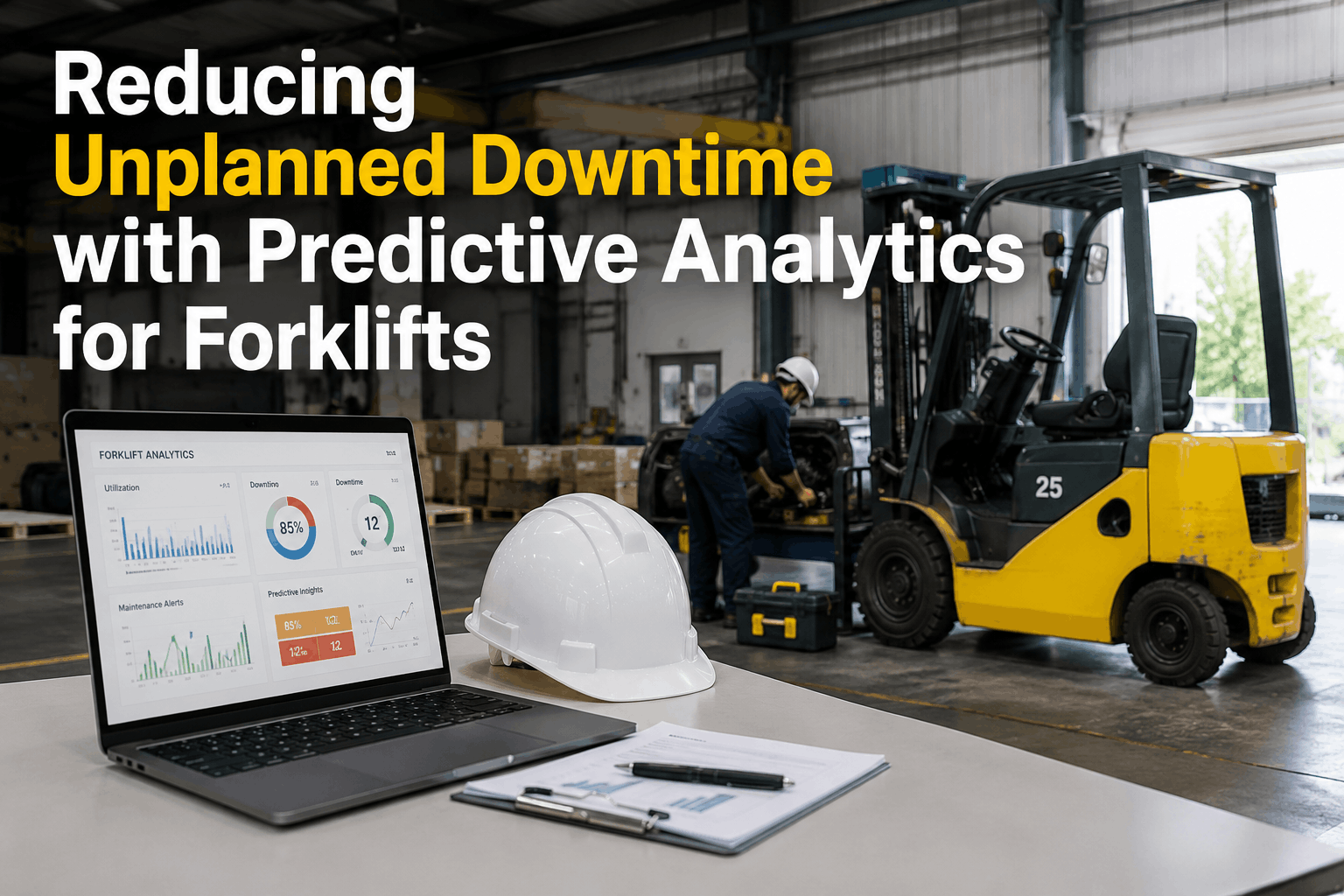
Reducing Unplanned Downtime with Predictive Analytics for Forklifts
Every unplanned forklift breakdown is a crisis that was visible in the data weeks before it happened. A hydraulic pressure reading trending outside normal range, a battery charge cycle taking 18% longer than baseline, a drive motor drawing 11% more current on a route it's handled for two years—these are not random failures. They are predictable events that manufacturing operations fail to intercept because they're running on reactive maintenance models designed in an era before forklift sensor data existed. For warehouse and distribution operations, unplanned downtime doesn't just cost the repair bill. It costs the stopped production line, the delayed shipment, the overtime labor scramble, and the customer penalty clause that follows. Start turning your forklift data into early warnings or talk to our team about predictive fleet analytics today.
Predictive Analytics for Manufacturing Fleets — 2026 Edition
Reducing Unplanned Downtime with Predictive Analytics for Forklifts
Discover how manufacturing and warehouse operations use forklift telematics, IoT sensor data, and predictive maintenance analytics to stop failures before they idle production lines—and how FleetRabbit delivers this intelligence from day one.
45%Avg. downtime reduction with predictive maintenance
3–5×Indirect vs. direct cost ratio per breakdown event
3.8×Average ROI within 12 months of deployment
Why Reactive Maintenance Is Costing Your Operation More Than You Think
The break-fix maintenance model is the default for 52% of manufacturing forklift fleets—and it is the single most expensive way to operate mobile equipment. When a forklift fails mid-shift, the repair bill is only the beginning. Production lines halt. Operators stand idle. Emergency parts ship at premium freight rates. Overtime labor is dispatched. Shipments are delayed. Customer SLA penalties activate. And somewhere in a spreadsheet, none of this is being accurately attributed to the forklift that failed. Book a Demo to see how FleetRabbit's predictive analytics change this equation entirely.
Why Forklift Downtime Costs Are Systematically Underestimated
No Early Warning System
52%
More than half of manufacturing fleets have no sensor-based fault detection. Operators report problems only after performance degrades enough to notice—often hours into a failure cascade.
Impact: Failures surface at worst possible moment
Calendar-Only PM Schedules
38%
Time-based maintenance ignores actual equipment condition. A forklift running two shifts a day degrades far faster than one running half-shifts — yet both receive identical service intervals.
Impact: 30–40% of PM labor wasted on healthy components
Siloed Maintenance Records
44%
Repair histories stored in paper logs or disconnected systems mean technicians can't identify recurring failure patterns. The same component fails repeatedly because root cause is never surfaced.
Impact: Repeat failures consume 2.3× more labor per event
Hidden Utilization Imbalance
31%
Without telematics, fleet managers don't know which forklifts are over-stressed and which sit idle. Over-utilised assets fail earlier; under-utilised assets represent capital waste that's invisible without data.
Impact: 20–35% fleet oversizing due to ghost asset blindness
No Operator Behaviour Visibility
29%
Aggressive acceleration, hard braking, and excessive load travel speeds accelerate drivetrain and hydraulic wear but remain invisible without telematics. High-wear operators drain fleet life silently.
Impact: Up to 40% shorter asset lifespan from abuse patterns
Understanding Predictive Analytics for Forklift Fleets
Predictive maintenance for forklifts is not a theoretical concept — it is a proven methodology deployed in leading manufacturing operations globally. It works by collecting continuous sensor data from forklift systems, applying machine learning models to identify deviation patterns that precede failures, and generating actionable alerts for maintenance teams days or weeks before a breakdown would otherwise occur. FleetRabbit operationalises this entire process through an integrated telematics and analytics platform purpose-built for industrial truck fleets.
The Three Layers of Forklift Predictive Intelligence
Layer 1: Sensor Data Collection
Real-Time Equipment Telemetry
Engine hours, load cycles, and operating speed per shift
Hydraulic pressure, oil temperature, and battery voltage
Drive motor current draw and transmission fluid temp
Impact events, tilt angles, and braking frequency
Battery state of health and charge cycle deviation
Data streams continuously from every asset on every shift — no manual input required
Layer 2: Anomaly Detection & Pattern Recognition
ML-Powered Fault Identification
Baseline performance profiles established per asset and route
Statistical deviation alerts triggered before threshold breach
Failure signature matching against known fault patterns
Multi-variable correlation — not single-metric monitoring
Alert severity scoring to prioritise technician response
Catches failures 7–21 days before breakdown — within the intervention window
Layer 3: Actionable Maintenance Dispatch
From Alert to Work Order to Resolution
Automated work order generation on alert confirmation
Parts pre-ordering triggered before technician dispatched
Maintenance scheduled in planned downtime windows
Root cause documentation linked to asset history
MTBF and MTTR tracked and improved over time
Maintenance happens on your schedule — not the forklift's failure timeline
What FleetRabbit's Predictive Analytics Platform Does for Manufacturing Fleets
FleetRabbit is purpose-built for industrial truck fleets operating in manufacturing, warehousing, and distribution environments — not adapted from a generic IoT platform. Every analytics module is calibrated to the specific failure modes of forklifts, reach trucks, order pickers, and counterbalance equipment. The result is a predictive intelligence layer that works from day one of deployment, not after months of data accumulation.
Forklift Telematics + Industrial Equipment IoT + Forklift Sensor Data
✓ Continuous engine hours, cycle counts, and operating parameter logging
✓ Battery health telemetry including state-of-charge deviation tracking
✓ Impact event detection, tilt monitoring, and operator behaviour scoring
FleetRabbit aggregates telematics from all major forklift OEMs and aftermarket sensor systems into a single data layer — no manual data entry, no disconnected spreadsheets. Every asset streams its condition in real time.
✓ Asset-specific performance baselines updated continuously per shift
✓ Multi-variable anomaly detection across hydraulic, electrical, and drivetrain systems
✓ Alert severity scoring with recommended intervention timeline
FleetRabbit's predictive engine doesn't wait for a fault code — it identifies the parameter drift patterns that precede failure and alerts your maintenance team within the actionable intervention window, typically 7–21 days before breakdown.
✓ PM triggers fired by engine hours, cycle counts, and condition data — not just calendar
✓ Automated work order creation with parts pre-ordering integration
✓ MTBF and MTTR dashboards to track and improve fleet reliability over time
Condition-based maintenance eliminates the over-servicing and under-servicing failures of calendar-only PM. Every service event is triggered by what the forklift's data says it needs — extending component life and reducing labour spend simultaneously.
✓ Utilisation heatmaps by asset, shift, zone, and operator
✓ Ghost asset identification and fleet right-sizing recommendations
✓ Total cost of ownership modelling and replacement timing forecasts
✓ Operator behaviour scoring with coaching intervention data
Predictive analytics isn't just about preventing the next breakdown — it's about knowing which assets to replace, which operators need coaching, and where your fleet is working too hard or not enough. FleetRabbit turns this data into decisions.
See FleetRabbit's Predictive Analytics Platform in Action
Our team will walk you through a live demo calibrated to your fleet type, facility layout, shift patterns, and maintenance objectives — real data, real failure scenarios, real ROI modelling for your operation.
The Data That Prevents Forklift Failures Before They Happen
Predictive maintenance is only as powerful as the data feeding it. FleetRabbit captures and analyses the specific signal categories that reliably precede the most common and costly forklift failure modes — hydraulic system failures, electrical faults, drivetrain degradation, and battery health collapse. Each signal stream is analysed against the asset's own historical baseline, not generic industry averages. Book a Demo to see how this works on your specific fleet.
Critical Forklift Data Streams FleetRabbit Monitors for Failure Prediction
Hydraulic & Mechanical Signals
Monitored Continuously:
Hydraulic pressure deviation from operational baseline
Mast lift and tilt response time trending
Oil temperature exceedance patterns by load cycle
Pump motor current draw and efficiency ratio
Without Predictive Monitoring:
Hydraulic seal failure discovered mid-lift cycle
Emergency repair at 3× standard component cost
Load dropped — potential injury and product damage
6–18 hour production halt while parts are sourced
Hydraulic failure is the #1 unplanned downtime cause in electric forklift fleets.
Electrical & Battery Health Signals
Monitored Continuously:
Battery voltage and charge cycle duration trending
State-of-health degradation rate vs. fleet average
Drive motor current draw anomalies under load
Charger efficiency drop and cell temperature variance
Without Predictive Monitoring:
Battery failure during peak shift with no backup available
Premature battery replacement at full capital cost
No visibility into which batteries need attention first
Battery-related failures account for 28% of electric forklift downtime events.
Operator Behaviour & Abuse Signals
Monitored Continuously:
Impact event frequency and severity scoring per operator
Speed violations and aggressive braking event counts
Overload incidents and mast tilt angle extremes
Idle time abuse and unauthorised zone entry events
Without Predictive Monitoring:
Structural damage discovered only at annual inspection
High-wear operators never identified or coached
Safety incidents with no data to reconstruct the cause
Asset lifespan cut 30–40% by undetected abuse patterns
Operator coaching from behaviour data reduces impact-related repairs by 38%.
The FleetRabbit Predictive Analytics Implementation Journey
FleetRabbit's predictive intelligence platform implements in a structured sequence that layers data collection, baseline establishment, and predictive alerting without disrupting active production schedules. Most manufacturing operations achieve full predictive coverage within 30 to 60 days of onboarding — and see first measurable results from the initial anomaly alerts within the first two weeks.
From Reactive Breakdown to Predictive Uptime: The FleetRabbit Journey
How manufacturing fleets build predictive maintenance capability with FleetRabbit
01
Fleet Asset Onboarding & Telematics Activation
Every forklift, reach truck, order picker, and counterbalance unit registered in FleetRabbit with make, model, serial number, current hours, and maintenance history. Telematics connections established with OEM systems or aftermarket sensors. Real-time data streams confirmed active for all assets before moving to baseline phase.
Week 1–2
02
Performance Baseline Establishment
FleetRabbit's analytics engine captures normal operating parameters for each asset across all shift patterns and routes. Hydraulic pressure norms, battery discharge curves, motor current profiles, and operator behaviour baselines established per asset — not generic averages. Anomaly detection thresholds calibrated to your specific operating environment and load profiles.
Week 2–3
03
Predictive Alert & PM Workflow Deployment
Anomaly detection goes live across all monitored parameters. First predictive alerts generated and routed to maintenance teams. Automated PM scheduling configured by engine hours, cycle counts, and condition data replacing calendar-only triggers. Work order automation tested end-to-end from alert to parts requisition to technician assignment.
Week 3–4
04
Utilisation Optimisation & Operator Analytics
Fleet utilisation heatmaps go live showing asset deployment by shift, zone, and operator. Ghost assets identified and marked for redeployment or disposal analysis. Operator behaviour scoring activated with management reporting. First fleet right-sizing recommendations generated based on 30 days of actual utilisation data from your facility.
Day 30–60
05
Continuous Intelligence & ROI Compounding
Monthly MTBF and MTTR reviews against pre-FleetRabbit baseline. Predictive model accuracy refined as more asset history accumulates. TCO and replacement timing forecasts updated quarterly. Leadership ROI dashboard updated with downtime cost avoidance, maintenance spend reduction, and asset life extension data. Predictive intelligence compounds in value as your fleet data matures.
Ongoing
Stop Waiting for Forklifts to Fail. Start Predicting and Preventing.
FleetRabbit replaces reactive breakdown cycles with continuous predictive intelligence — giving your maintenance team the lead time to intervene before the production line stops and the emergency repair bill arrives.
What Manufacturing Operations Leaders Say About FleetRabbit
"
We operate 67 forklifts across three manufacturing shifts and were averaging four unplanned breakdowns per week. Our maintenance team was permanently in firefighting mode — no time for anything proactive. After deploying FleetRabbit across the fleet, our unplanned downtime dropped 48% in the first 90 days. The first time the system flagged a hydraulic pressure anomaly on a reach truck and we found a failing seal two days before it would have caused a dropped load, the entire investment paid for itself. We haven't had an emergency parts order in four months.
— VP of Operations, Tier 1 Automotive Parts Manufacturer, 67-forklift fleet across 3 facilities
48%
Reduction in unplanned downtime events within first 90 days
$94K
Average annual savings per fleet from downtime and maintenance cost reduction
32%
Average maintenance cost reduction within 12 months of full deployment
3.8×
Average ROI delivered within 12 months across FleetRabbit manufacturing customers
The manufacturing operations that lead their category on uptime, output reliability, and maintenance cost efficiency are not running more expensive equipment — they are running smarter data systems. FleetRabbit gives your fleet the predictive intelligence layer that converts raw sensor data into early warnings, early warnings into scheduled maintenance, and scheduled maintenance into uninterrupted production. Start your free trial today and discover what your forklift fleet's data has already been trying to tell you.
The Complete Predictive Analytics Platform for Manufacturing Forklift Fleets.
FleetRabbit gives warehouse and manufacturing operations one platform for forklift telematics, fault prediction, condition-based PM scheduling, utilisation analytics, and operator behaviour management. Stop reacting. Start predicting. Keep production running.
How does FleetRabbit's predictive analytics actually detect forklift failures before they happen?
FleetRabbit continuously collects telematics data from forklift sensors — including hydraulic pressure, battery voltage and charge cycle duration, motor current draw, operating temperatures, and impact events. The platform establishes a normal performance baseline for each individual asset, then applies statistical anomaly detection and machine learning pattern recognition to identify parameter drift that historically precedes specific failure modes. When deviation crosses the predictive alert threshold, FleetRabbit notifies your maintenance team with severity scoring and a recommended intervention timeline — typically 7–21 days before the component would fail under continued operation.
What types of forklifts and industrial trucks does FleetRabbit support for predictive maintenance?
FleetRabbit supports all major forklift categories including electric counterbalance forklifts, internal combustion forklifts (LPG, diesel, and CNG), reach trucks, order pickers, turret trucks, rough-terrain forklifts, and tow tractors. The platform integrates with OEM telematics systems from major manufacturers and supports aftermarket sensor installation for older assets that lack factory telematics. Each asset class receives customised fault detection models calibrated to its specific failure patterns and operating environment.
How long does it take to see results from FleetRabbit's predictive analytics deployment?
Most manufacturing operations receive their first actionable predictive alerts within 14–21 days of telematics activation, as the system identifies assets already showing early-stage deviation from normal parameters. Measurable downtime reduction is typically reported within 60–90 days as the first predicted failures are intercepted and resolved in planned maintenance windows. Full fleet-wide ROI — including maintenance cost reduction, parts spend optimisation, and utilisation improvements — typically compounds to 3.8× within 12 months of full platform deployment.
Does FleetRabbit integrate with our existing ERP or CMMS system?
Yes. FleetRabbit offers native integrations with leading ERP platforms and CMMS tools, as well as API-based connections for custom environments. Work orders, parts requisitions, labour hours, and maintenance cost data can flow bidirectionally — eliminating duplicate data entry and ensuring your finance team receives accurate fleet cost attribution within their existing reporting infrastructure. Contact our team to confirm integration availability for your specific systems.
Is FleetRabbit suitable for smaller forklift fleets, or is it only for large manufacturing operations?
FleetRabbit is designed for manufacturing and warehouse fleets of all sizes. Smaller operations with 10–30 forklifts typically see faster ROI because each asset represents a higher proportion of total uptime capacity — a single unplanned breakdown has proportionally greater impact. Larger enterprise operations benefit from multi-site benchmarking, fleet-wide pattern analysis, and standardised compliance protocols across dozens of facilities. The platform scales from a single warehouse to a multi-site national distribution network from the same dashboard.