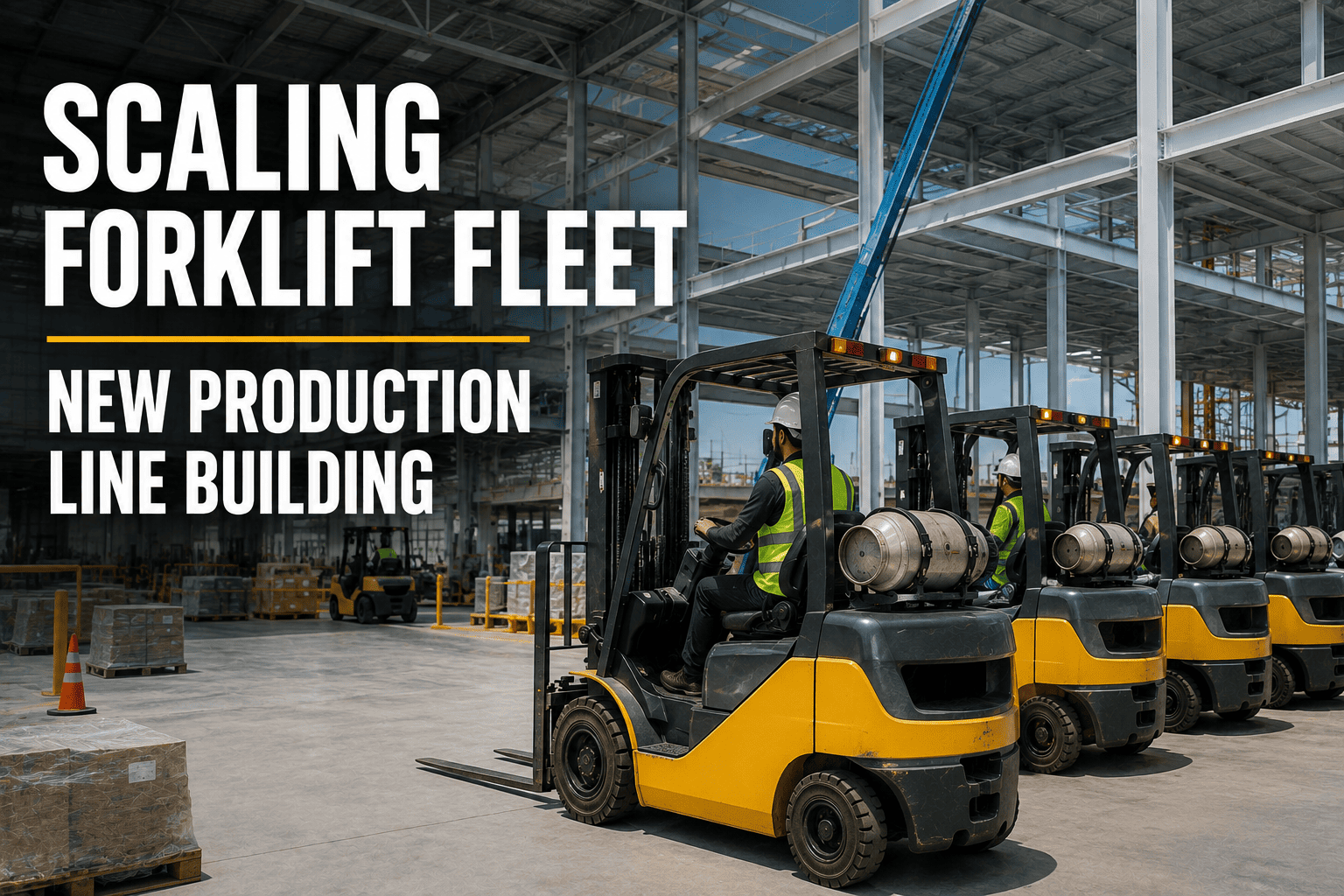
A new production line is going in, or a new building is opening up down the road, and someone just asked the obvious question: how many forklifts do we actually need over there. Most plants answer with a guess based on square footage or what the last facility used. It is an understandable shortcut, and it is also how fleets end up either stalled by too few trucks in the first month or sitting on expensive idle equipment a year later.
Quick Answer
Right-sizing a fleet for a new line or building comes down to pallet volume, shift pattern, and travel distance, not square footage or a copy-paste from your last facility. About 63 percent of businesses acquire a new forklift every 12 to 24 months, and roughly half of those purchases are for expansion rather than replacement, which makes getting the number right the first time a meaningful capital decision, not a rounding error.
The Guessing Game Most Plants Play
When fleet sizing is not backed by data, plants tend to land on one of two expensive mistakes, and both are common enough that most operations leaders have lived through one of them firsthand.
Overbuying "Just in Case"
Ordering extra trucks to be safe locks up capital in lease payments, batteries, and charging infrastructure for equipment that sits idle most of the day, quietly dragging down fleet-wide utilization.
Underbuying and Bottlenecking Day One
Sizing the new area too lean stalls the production ramp, forces overtime and rush deliveries, and pushes operators to overwork the trucks they do have from the very first shift.
Size It Right the First Time
Data-Driven Fleet Planning
FleetRabbit's utilization data shows exactly what your existing fleet can absorb before you add a single new truck. Sign up free and start planning your expansion with real numbers.
63%
Of Businesses Buy Every 12-24 Months
~50%
Of Purchases Are for Expansion
What Actually Determines Fleet Size
Square footage tells you almost nothing about how many forklifts a new line or building needs. The number comes from a handful of operational factors that change from facility to facility.
✓
Pallet volume per shift. The total pallets moved daily, and how that volume is expected to grow, sets the baseline workload the fleet needs to carry.
✓
Travel distance and layout. Wider aisles, longer dock-to-storage runs, and multi-zone layouts all increase the time each pallet move actually takes.
✓
Shift pattern. Moving from one shift to two or three does not simply multiply your truck count, since equipment fatigue, battery cycles, and wear accelerate with every added shift.
✓
Truck type and specialization. A mix of reach trucks, counterbalance units, and pallet trucks tailored to the new area often outperforms simply duplicating your current fleet mix.
A Simple Formula to Start With
Before finalizing an order, run the numbers using data from your current operation as a baseline. It will not replace a full utilization audit, but it gives you a realistic starting range.
1
Estimate Daily Pallet Volume
Use projected production output for the new line or building, not a guess based on the size of the space alone.
2
Time an Average Move
Measure how long a typical pallet move takes in a comparable layout, including travel, lift, and placement time.
3
Apply Your Shift Pattern
Adjust for multi-shift wear and redundancy needs rather than assuming a straight multiple of single-shift numbers.
4
Check Against Existing Fleet Capacity
Compare the estimate to real utilization data from your current trucks before assuming every unit needs to be new.
Why Utilization Data Beats a Fresh Guess
Most plants already have forklifts running well below full capacity somewhere in the operation. Before ordering new equipment for an expansion, a true utilization review across the existing fleet often reveals underused trucks that can be reassigned to the new line or building, cutting the actual number of new units required.
Lease, Buy, or Reallocate
Once you know roughly how many trucks the new area needs, the next decision is where those trucks come from.
Reallocate Existing Trucks
Move underutilized forklifts from other areas of the operation into the new line or building, using real usage data to confirm which trucks are actually available to move.
Lease for the Ramp-Up Period
Bring in leased trucks to cover the early production ramp while volume is still uncertain, avoiding a large capital commitment before demand is proven.
Buy for Long-Term Volume
Purchase new trucks once projected volume for the new area is stable and sustained, when ownership costs less over the equipment's working life than ongoing leases.
Whichever route you take, the decision is only as good as the data behind it. If you want a clear read on which of your existing trucks have room to take on more work before you commit to buying or leasing anything new, you can sign up for a free trial and pull utilization data across your whole fleet, or book a demo to plan your expansion with our team.
QHow do I estimate how many forklifts a new production line needs?
Start with projected daily pallet volume, average time per move, and your planned shift pattern, then divide that workload by the hours a single operator and truck can realistically cover in a shift.
QCan I just copy the forklift count from my existing building?
Not reliably. Layout, aisle width, travel distance, and shift pattern all vary between facilities, so a count that works in one building can easily be wrong for another.
QDoes adding a second or third shift mean doubling or tripling the fleet?
No. Multi-shift operations need to account for equipment fatigue, battery cycling, and redundancy, which means fleet size does not scale in a simple straight line with added shifts.
QShould I buy or lease forklifts for a new facility?
Leasing suits an uncertain ramp-up period where volume is still proving out, while buying tends to make more sense once projected volume for the new area is stable and sustained long term.
QHow do I know if I can reallocate trucks instead of buying new ones?
Utilization data from your current fleet shows which trucks are running well below capacity and could be reassigned to the new line or building instead of purchasing additional equipment.
QWhat is the biggest mistake plants make when scaling a fleet?
Sizing the new area off square footage or habit instead of real pallet volume and utilization data, which leads to either expensive overbuying or a bottlenecked production ramp.
Plan Your Expansion With Real Data, Not a Guess
Whether you are opening a new line or a new building, the right fleet size comes from utilization data, not square footage. See what your current fleet can absorb and what the new area actually needs before you commit to a single new truck.
August 8, 2026
By John
All Posts