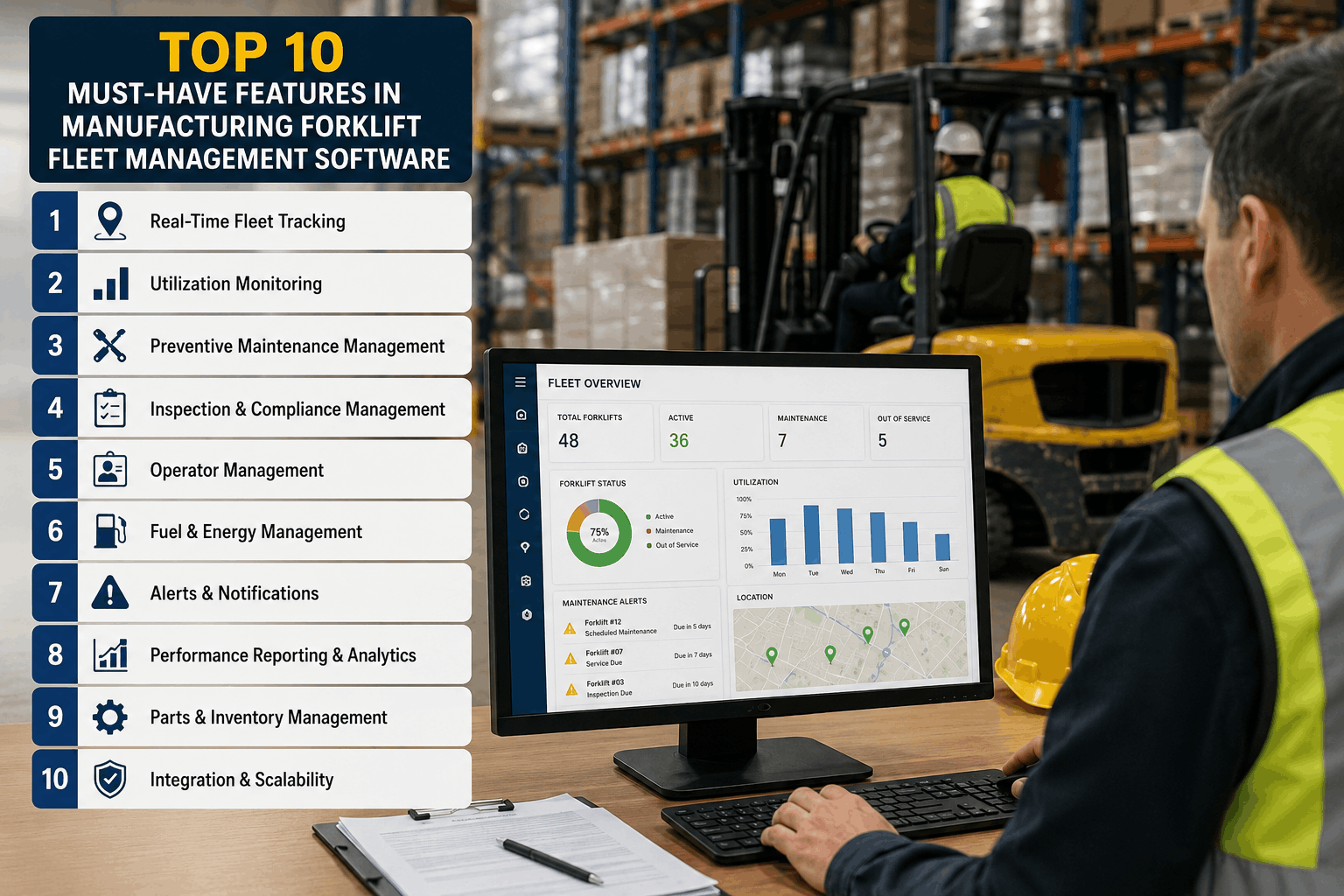
Top 10 Must-Have Features in Manufacturing Forklift Fleet Management Software
Manufacturing plants rely on forklift fleets to keep operations moving—yet most facilities manage these critical assets with spreadsheets, paper checklists, and reactive maintenance cycles that silently drain productivity and inflate costs. When a forklift breaks down mid-shift, the ripple effect touches production schedules, safety compliance, and operator accountability across the entire floor. The right forklift fleet management software transforms that chaos into a controlled, data-driven operation that prevents downtime before it starts.
Yet not all fleet management platforms are built for manufacturing reality. Facilities need software that handles predictive maintenance, digital inspection workflows, operator certification tracking, ERP integration, and utilization analytics—not generic asset trackers retrofitted for forklifts. This guide breaks down the 10 must-have features that separate world-class manufacturing fleet software from expensive spreadsheet replacements. Facilities ready to modernize can start their free trial today.
Complete Guide 2026
Top 10 Must-Have Features in Manufacturing Forklift Fleet Management Software
The essential features manufacturing plants need: predictive maintenance, digital inspections, operator certification, ERP integration, and utilization tracking for maximum ROI. This guide gives plant managers, safety directors, and operations leaders the complete feature checklist for evaluating and selecting forklift fleet software that delivers measurable results.
$13K+Average Cost Per Forklift Breakdown Incident
85%Of Forklift Injuries Involve Operator Error or Uncertified Operators
30%Maintenance Cost Reduction with Predictive Software
$7,000OSHA Fine Per Uncertified Forklift Operator Violation
Why Manufacturing Fleets Need Purpose-Built Software
Generic asset management tools weren't designed for the unique pressures of manufacturing forklift operations—multi-shift usage, OSHA operator certification mandates, ISO compliance requirements, and the direct impact of fleet downtime on production output. The right software doesn't just track assets; it enforces safety protocols, predicts failures before they happen, and feeds operational intelligence directly into your ERP. Book a Demo.
The 10 Must-Have Features: At a Glance
These ten features represent the non-negotiable capabilities that distinguish enterprise-grade forklift fleet management software from generic asset trackers. Each feature directly impacts safety compliance, operational uptime, and measurable ROI for manufacturing facilities.
01
Predictive Maintenance Engine
AI-driven failure forecasting using usage hours, sensor telemetry, and historical repair data
Core Feature
02
Digital Pre-Shift Inspections
OSHA-compliant mobile checklists with photo capture, defect flagging, and automatic work order creation
Safety Critical
03
Operator Certification Tracking
OSHA 1910.178 compliance with digital license records, expiry alerts, and access lockouts for uncertified operators
Compliance Critical
04
ERP & WMS Integration
Bidirectional sync with SAP, Oracle, and leading WMS platforms for unified cost and inventory visibility
Integration
05
Utilization & Downtime Analytics
Real-time dashboards showing fleet utilization rates, idle time, shift performance, and downtime root causes
Analytics
06
ISO 9001 Compliance Audit Trail
Immutable maintenance records, timestamped inspection logs, and one-click ISO audit report generation
Compliance
07
Automated Work Order Management
Trigger-based work order creation from inspection defects, sensor alerts, or scheduled PM intervals with technician assignment
Operations
08
Parts & Inventory Management
Integrated spare parts tracking with reorder triggers, vendor management, and cost-per-unit analytics by asset
Inventory
09
Total Cost of Ownership Reporting
Per-asset TCO calculations spanning fuel, maintenance, operator time, and downtime losses to support lease-vs-buy decisions
Financial
10
Mobile-First Technician App
Offline-capable iOS and Android app for work order execution, parts lookup, inspection completion, and digital signature capture
Mobile
Feature Deep Dives: What to Look for in Each Capability
Understanding that a software has "predictive maintenance" or "digital inspections" is not enough. Manufacturing plants must evaluate the depth, configurability, and integration quality of each feature before committing to a platform. Here's what best-in-class looks like for each capability.
01
Predictive Maintenance Engine
AI-driven failure forecasting for manufacturing environments
Highest ROI Feature
Best-in-class predictive maintenance doesn't rely solely on fixed PM schedules—it combines usage hours from telematics, vibration and temperature sensor data, historical failure patterns by make/model, and operator behavior scoring to calculate individual failure probability for every asset in the fleet. Manufacturing-grade platforms alert maintenance teams 72–96 hours before predicted failures, enabling planned downtime instead of production-stopping breakdowns. Look for platforms that show confidence scores on predictions and allow maintenance teams to calibrate models based on facility-specific failure history.
IoT/telematics sensor integrationPer-asset failure probability scoringAutomated PM interval optimizationFailure pattern library by OEM model
02
Digital Pre-Shift Inspections
OSHA 1910.178(q) compliance with zero paper
Safety Critical
OSHA requires documented pre-shift inspections before every forklift operation. Paper-based inspection logs create compliance gaps, illegible records, and zero actionability when defects are found. Digital inspection platforms must capture photo evidence of defects, create immediate work orders for safety-critical findings, and enforce an out-of-service lock when a forklift fails inspection—preventing the vehicle from being assigned until repairs are certified complete. Look for configurable checklists by forklift type (counterbalance, reach truck, order picker) and the ability to embed OSHA-specific inspection points that can't be bypassed.
Configurable checklists by vehicle typePhoto evidence capture per defectAutomatic out-of-service flaggingInspection history by VIN/asset ID
03
Operator Certification Tracking
OSHA 1910.178 compliance with automated enforcement
Compliance Critical
OSHA requires initial and refresher forklift training every three years—and operators must be certified on each equipment type and configuration they operate. Plants with dozens of operators across multiple shifts cannot track this manually without compliance gaps. The software must store digital certification records, trigger renewal alerts at 90/60/30-day intervals, automatically block uncertified operators from being assigned to forklifts they're not qualified for, and generate audit-ready reports in minutes when OSHA investigators arrive. The best platforms integrate with telematics to prevent physical forklift operation via key lockout when certification has lapsed.
Certification by equipment class/typeAutomatic assignment blocking for lapsesOSHA audit report generationTelematics-based key lockout integration
04
ERP & WMS Integration
Bidirectional data flow for unified operational intelligence
Operational Efficiency
Fleet management software that operates as a silo—disconnected from SAP, Oracle, or your WMS—forces manual data reconciliation that wastes hours weekly and introduces costly errors. Bidirectional ERP integration means maintenance costs flow automatically into cost center accounting, work order completions trigger inventory consumption updates, and demand forecasts from the WMS inform fleet utilization planning. Look for pre-built connectors to common manufacturing ERPs and open API documentation for custom integrations, not just one-way data exports.
SAP, Oracle, and Microsoft Dynamics connectorsBidirectional (not just export) data syncAPI-first architecture for custom integrationsCost center and GL code mapping
05
Utilization & Downtime Analytics
Real-time intelligence for right-sizing and productivity gains
ROI Maximizer
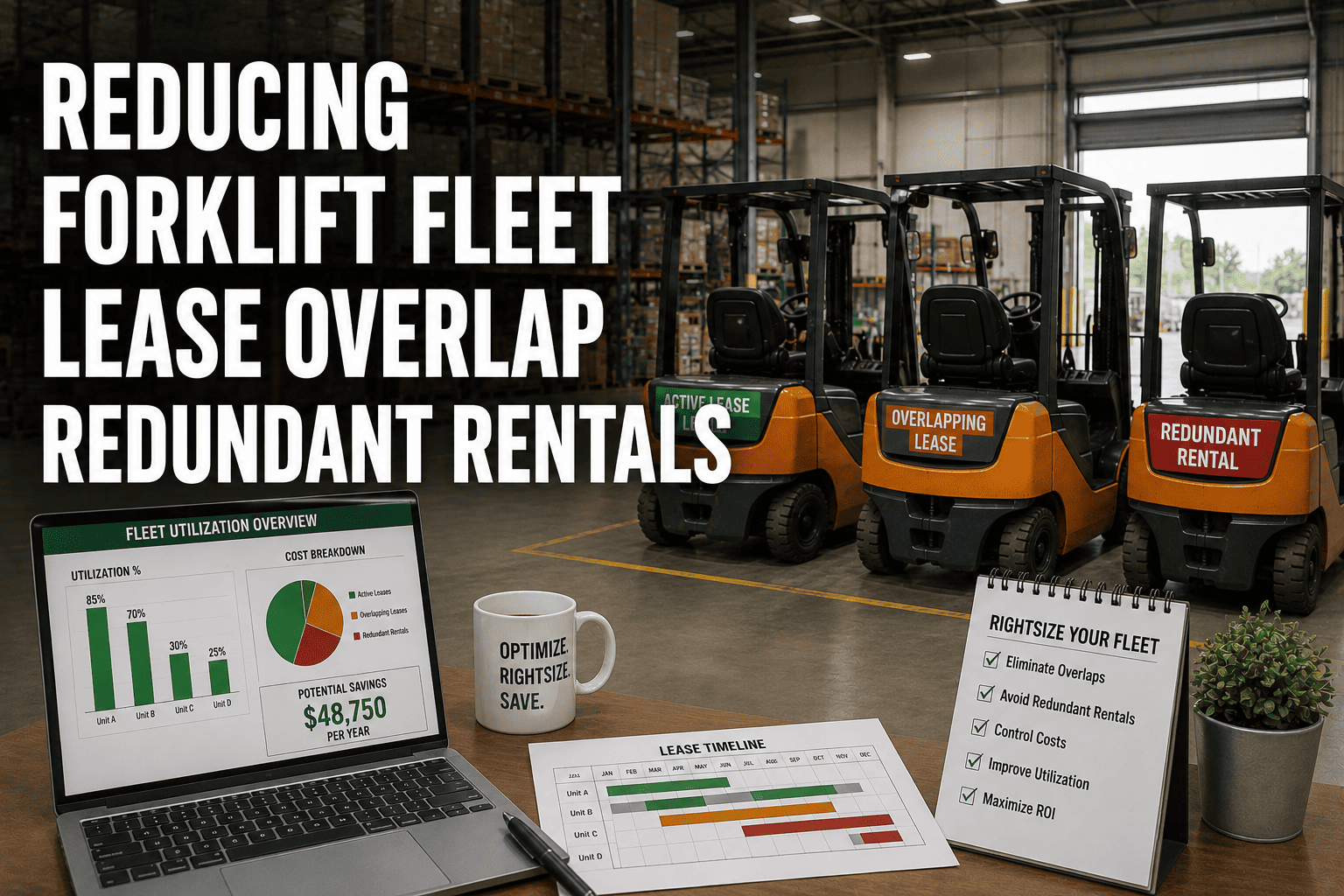
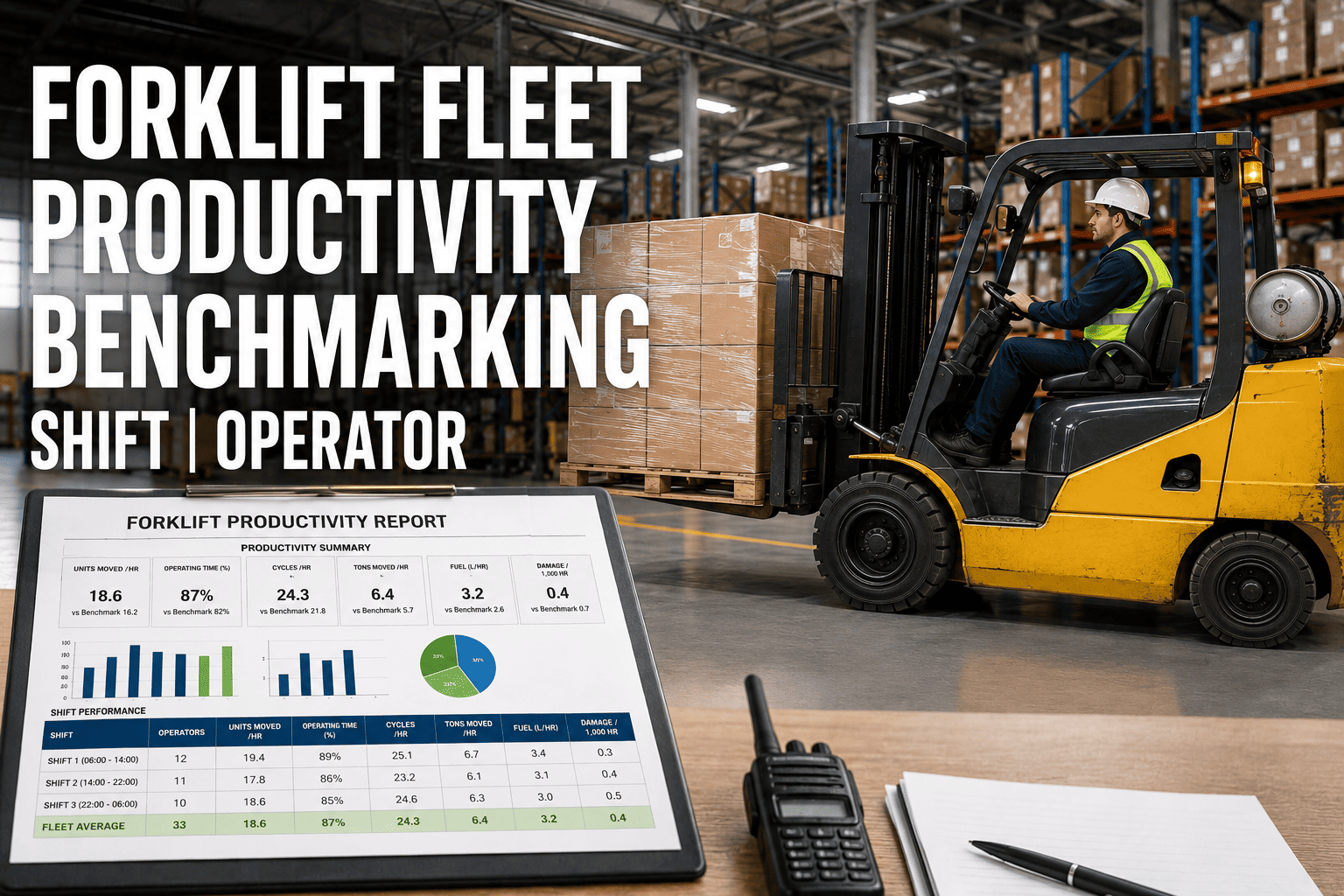
Most manufacturing plants are operating oversized or undersized fleets because they lack accurate utilization data. Best-in-class analytics platforms deliver per-shift utilization heatmaps, idle-time percentages by operator and location zone, planned vs. unplanned downtime breakdowns, and fleet right-sizing recommendations based on actual usage patterns. When a plant discovers that three forklifts are idle 60% of each shift while two others are running 95% utilization, fleet consolidation decisions become data-driven rather than political.
Per-shift utilization heatmapsIdle time by operator and zonePlanned vs. unplanned downtime splitFleet right-sizing recommendations
Compliance Coverage Matrix: Features vs. Regulations
Manufacturing forklift fleets operate under multiple overlapping regulatory frameworks—OSHA equipment standards, ISO 9001 quality management requirements, and facility-specific safety protocols. The right software must cover all of them without requiring separate systems for each regulatory domain.
FleetRabbit gives manufacturing plants predictive maintenance, digital inspections, operator certification enforcement, ERP integration, and utilization analytics—all in one platform purpose-built for industrial forklift operations. No spreadsheets. No compliance gaps. No production-stopping surprises.
Feature Priorities by Manufacturing Operation Type
Not all manufacturing facilities have the same fleet management priorities. A high-throughput distribution warehouse prioritizes utilization tracking and operator productivity. A chemical plant prioritizes compliance documentation and safety inspections. Understanding your operation type helps identify which features to evaluate most rigorously during software selection.
High fleet density and multi-shift operations require utilization data to right-size and eliminate idle asset costs
Chemical / Process Plants
ISO Compliance Audit Trail (critical)Inspection DocumentationOperator CertificationIncident Reporting
Regulatory scrutiny is highest; immutable documentation and OSHA-defensible audit trails are the primary software requirement
Fleet Management Program Health BenchmarksTarget KPIs for a best-in-class manufacturing forklift fleet operation
100%
Inspections Digital
Zero paper inspection forms in operation
100%
Operators Certified
No lapsed certifications in active fleet
90%+
Fleet Utilization
Target active use rate per operating shift
95%+
PM Compliance
Scheduled maintenance completed on time
ZERO
OSHA Violations
Fleet-related compliance citations per year
<2%
Unplanned Downtime
Target unplanned downtime as % of operating hours
Frequently Asked Questions
Q. What is the difference between preventive and predictive maintenance in forklift fleet software?
Preventive maintenance runs on fixed schedules—every 250 hours or every 90 days—regardless of actual asset condition. Predictive maintenance uses telematics data, sensor readings, and failure pattern models to forecast when a specific forklift is likely to fail, allowing maintenance to be scheduled based on actual need rather than a calendar. In practice, predictive maintenance reduces both over-servicing (which wastes labor and parts) and under-servicing (which causes unplanned failures). Manufacturing plants typically see 25–35% maintenance cost reductions when moving from purely preventive to predictive programs. The best forklift fleet software supports both: preventive schedules as a baseline safety net, with predictive alerts layered on top for higher-value, higher-risk assets.
Q. How does forklift fleet software help with OSHA operator certification compliance?
OSHA 1910.178(l) requires forklift operators to be trained and evaluated on each type of truck they operate, with refresher training required when an operator is observed operating unsafely, after an accident or near-miss, or at least every three years. Fleet management software automates the compliance burden by storing digital certification records for every operator, tracking expiry dates for each equipment class, sending automated alerts to supervisors at 90/60/30 days before certification lapses, and blocking expired operators from being assigned to forklift work orders. Advanced platforms integrate with telematics systems to physically prevent vehicle operation via key/PIN lockout when the assigned operator's certification has expired.
Q. Does forklift fleet management software need to integrate with our ERP system?
ERP integration is optional but delivers significant operational value for manufacturing facilities. Without integration, maintenance cost data must be manually reconciled between systems, spare parts consumption isn't automatically reflected in inventory, and fleet TCO data is unavailable for financial reporting. With bidirectional ERP integration, work order completions flow into cost centers automatically, parts usage triggers reorder in inventory management, and fleet cost data appears in management dashboards without manual data entry. For plants already running SAP, Oracle, or Microsoft Dynamics, ERP integration typically reduces administrative overhead by 60–80% for fleet-related financial processing.
Q. How does ISO 9001 compliance affect forklift fleet management requirements?
ISO 9001:2015 requires documented evidence of maintenance activities (Clause 7.5), controlled processes for equipment management (Clause 8.1), and traceability of parts and repairs (Clause 8.5). For forklift fleets, this means every PM activity, inspection, and repair must be documented with timestamps, technician identification, parts used, and outcomes achieved. Paper-based systems create significant audit risk because records can be incomplete, illegible, or missing. Fleet management software creates immutable, timestamped records for every action taken on every asset, making ISO audits a documentation export exercise rather than a weeks-long records search.
Q. What should we look for when evaluating mobile apps in forklift fleet software?
Manufacturing environments often have poor Wi-Fi coverage in warehouse aisles, loading docks, and outdoor storage areas. The mobile app must function in offline mode, queuing inspection completions, work order updates, and photo captures until connectivity is restored—without losing data. Beyond offline capability, evaluate the inspection workflow design: can technicians complete a pre-shift inspection in under three minutes with one hand on a mobile device? Does photo capture integrate directly into defect reporting without multiple taps? Can technicians look up parts, add labor time, and close work orders from the shop floor? Apps that require 15-step workflows create adoption resistance that undermines the entire digital transformation.
Ready to Eliminate Forklift Downtime and Compliance Risk?
FleetRabbit brings all 10 must-have features into a single platform designed specifically for manufacturing environments—with predictive maintenance AI, OSHA-enforcing digital inspections, automated operator certification management, and ERP connectors that eliminate manual reconciliation. Start your free trial or talk to a manufacturing fleet specialist today.