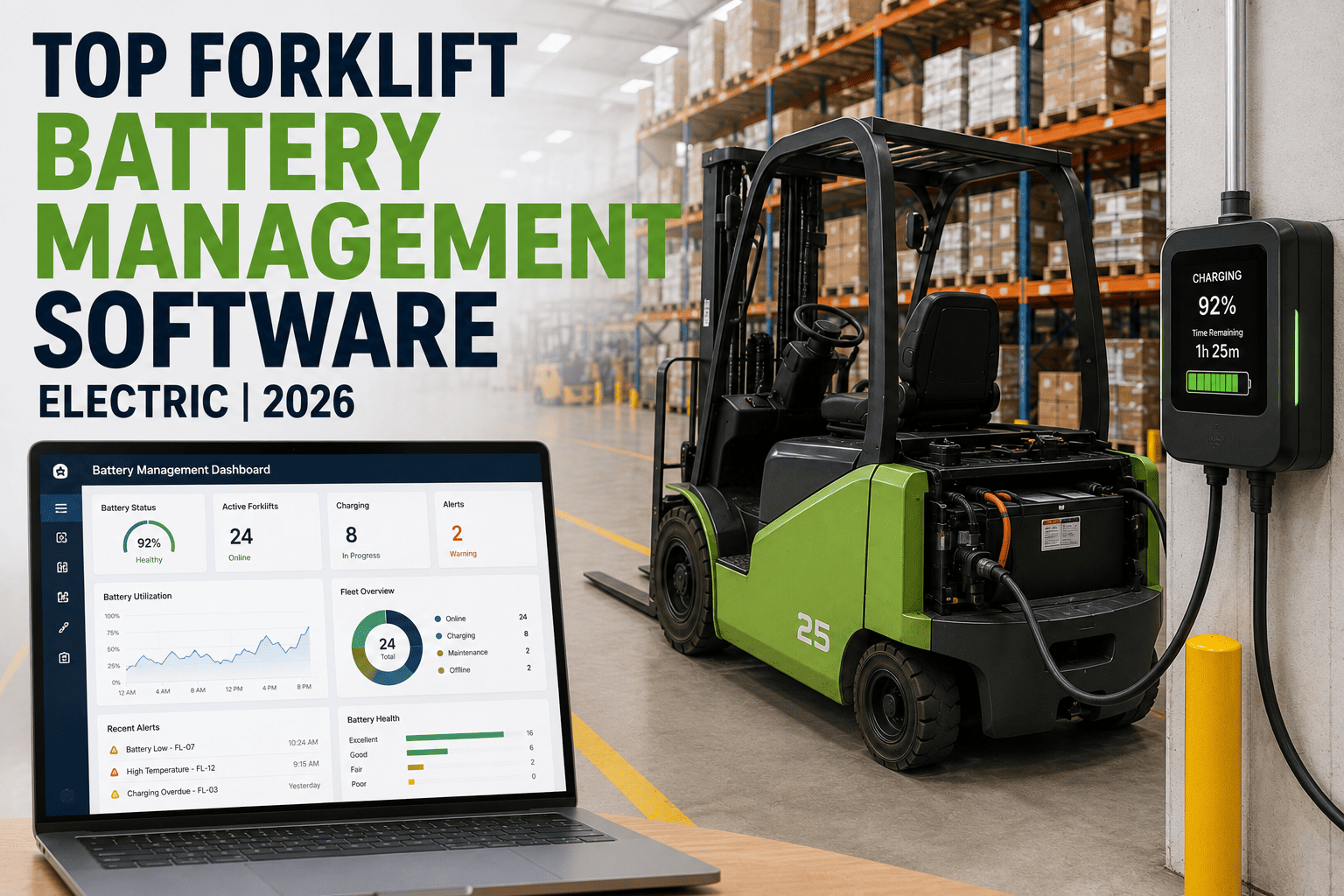
Electric forklift fleets are only as reliable as the batteries powering them, yet most warehouse and manufacturing teams still manage battery health with a clipboard and a guess. A forgotten watering cycle, an opportunity charge taken at the wrong moment, or a battery pulled mid-shift because nobody tracked its state of charge can stall production for hours. Choosing the right forklift battery management software is no longer a nice-to-have for electric fleets. It is the difference between batteries that last six years and batteries that fail in three, between smooth multi-shift operations and mid-shift scrambles for a charged unit.
The best forklift battery management software combines real-time state-of-charge and state-of-health monitoring, automated charge scheduling, watering and equalization tracking, and fleet-wide analytics in one dashboard. Standalone battery room trackers cover basic rotation, while integrated platforms like FleetRabbit connect battery data directly to maintenance and fleet operations, extending battery life by 20 to 30 percent and cutting unplanned downtime significantly.
What Forklift Battery Management Software Actually Does
Forklift battery management software connects sensors on the battery, charger, and truck to a central dashboard that tracks charge level, temperature, cycle count, and maintenance history in real time. Instead of a battery room attendant manually checking specific gravity or watering levels, the system flags exactly which batteries need attention and when. For fleets running lead-acid batteries, this means tracking watering intervals, equalization charges, and temperature during charging. For fleets running lithium-ion, the priority shifts to depth-of-discharge management, thermal monitoring, and battery management system diagnostics reported directly from the pack.
Why Manual Battery Tracking Falls Short
Spreadsheet-based battery logs and paper watering charts depend entirely on staff consistency across every shift. A missed watering cycle on a lead-acid battery accelerates plate sulfation. An opportunity charge squeezed in during a short break interrupts the full charge and equalization cycle a battery needs to stay healthy. Multiply these small lapses across a fleet of 20, 50, or 100 trucks running two or three shifts, and the cumulative damage shows up as batteries needing replacement two to three years earlier than their rated life.
The Shift Toward Connected Battery Intelligence
Warehouses and manufacturing plants electrifying their fleets are increasingly pairing telematics-equipped forklifts with cloud-based battery dashboards. This shift mirrors what happened in over-the-road trucking a decade ago, where telematics turned reactive maintenance into predictive maintenance. Teams ready to see this in action can start a free trial and connect their first battery within a day.
FleetRabbit gives you live state-of-charge and state-of-health data across your entire electric forklift fleet, automated charge scheduling, and maintenance alerts before a battery ever strands a truck on the floor.
Comparing the Categories of Forklift Battery Management Software
Not every battery management tool is built the same way, and picking the wrong category for your fleet size and battery chemistry can leave real capability on the table. Most solutions on the market today fall into four broad categories, each suited to a different stage of fleet maturity.
| Software Category | Best Fit | Core Strength | Common Limitation |
|---|---|---|---|
| OEM Telematics Add-Ons | Fleets running a single forklift brand | Deep integration with that manufacturer's trucks and batteries | Limited or no visibility into mixed-brand fleets |
| Standalone Battery Room Trackers | Large lead-acid battery rooms with frequent change-outs | Strong watering, rotation, and change-out workflow tools | Little connection to broader fleet maintenance or truck data |
| Lithium Battery Cloud Dashboards | Fleets that have fully converted to lithium-ion power | Detailed cell-level health and charge cycle reporting | Usually tied to one battery manufacturer's hardware |
| Integrated Fleet and Battery Platforms | Mixed fleets across multiple sites, brands, or battery types | One dashboard spanning battery health, truck maintenance, and utilization | Requires initial data integration across existing systems |
Why Integrated Platforms Are Gaining Ground
Facilities that operate mixed fleets, more than one site, or a combination of lead-acid and lithium-ion batteries are increasingly moving toward integrated platforms rather than juggling three separate logins. A single dashboard that shows battery health next to truck maintenance history and utilization data lets fleet managers make decisions with the full picture instead of piecing together reports from different systems. If your team is comparing options, it is worth mapping your current battery mix and site count before you book a demo to see which category fits.
Core Features to Evaluate Before You Buy
Beyond charge tracking, the features below separate genuinely useful battery management platforms from digitized checklists that simply move paper logs onto a screen.
Charge Cycle and Equalization Tracking
The software should automatically log every charge cycle and flag when a lead-acid battery is due for its weekly equalization charge, preventing the sulfation that quietly eats into capacity.
What good tracking looks like
Automatic cycle counts, equalization reminders tied to actual usage rather than a fixed calendar, and an audit trail maintenance teams can review during compliance checks.
Thermal Monitoring During Charging
Overheating during charge is one of the fastest ways to shorten battery life and, for lithium-ion packs, a genuine safety concern. Real-time temperature alerts let staff intervene before a hot battery becomes a bigger problem.
Right-Sizing and Utilization Reporting
Many fleets carry more spare batteries than they actually need. Utilization reporting shows exactly how many batteries are required to support your shift pattern, often revealing that a fleet can retire several spares and redirect that capital elsewhere.
Common right-sizing outcome
Facilities that review utilization data for the first time frequently discover 10 to 20 percent more spare batteries in rotation than their actual shift coverage requires.
Mobile Access for Battery Room Staff
Battery room operators need a simple mobile or tablet view showing which battery is next in the rotation, what maintenance is due, and where each unit physically sits in the racking system, without requiring a desktop login.
FleetRabbit brings charge tracking, health analytics, watering schedules, and utilization reporting into a single view built for mixed electric forklift fleets. See where your batteries stand against industry benchmarks in your first week.
Lead-Acid vs Lithium-Ion Management Needs
The right software should adapt to your battery chemistry rather than force a single workflow onto both. Lead-acid batteries need close attention to watering intervals, specific gravity checks, and equalization cycles, since neglecting any of these accelerates capacity loss. Lithium-ion batteries remove watering entirely but shift the priority to depth-of-discharge management, thermal behavior, and reading diagnostics directly from the battery management system embedded in the pack. A platform built for one chemistry alone will leave gaps if your fleet runs both, which is increasingly common as facilities convert truck by truck rather than all at once.
Frequently Asked Questions
FleetRabbit gives your team live visibility into every forklift battery's charge, health, and maintenance status across every site and brand. See the difference in your first week with no credit card required.