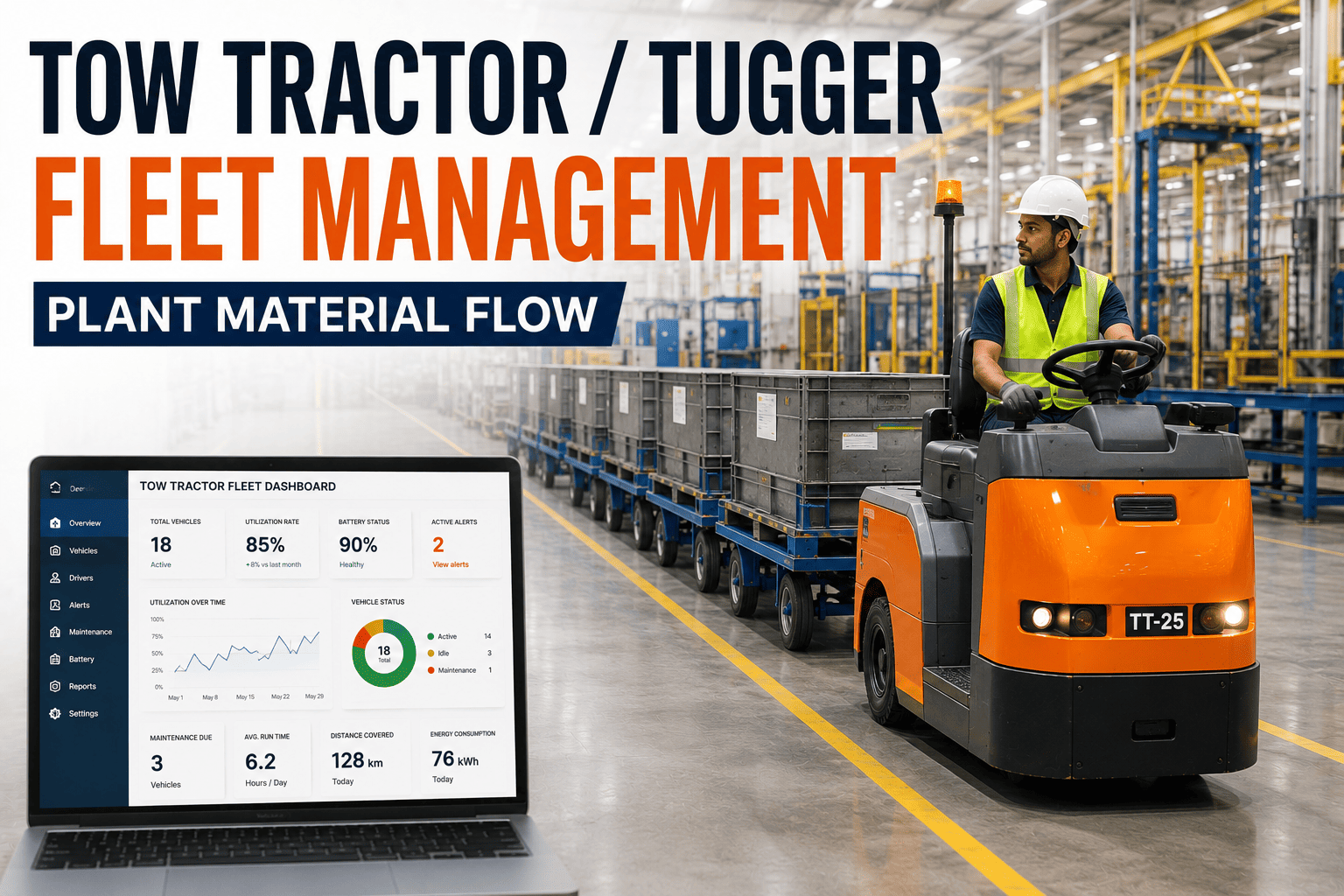
A tugger train doesn't just move parts around a plant, it keeps a production line breathing. Every loop follows a fixed schedule called a milk run, delivering exactly the components each work cell needs, exactly when takt time calls for them. When a tow tractor misses even one lap, whether from a dead battery, a coupling fault, or a flat tire, the effect isn't a delayed delivery somewhere in a warehouse. It's an empty flow rack on the line, and an assembly cell that has to slow down or stop. Managing a tugger fleet well means treating on-time route completion as seriously as the production schedule itself. Sign up for FleetRabbit to start tracking your tugger routes and maintenance in one place, or book a demo to see how plants keep tow tractor fleets on schedule.
Tow tractors and tugger trains run fixed milk-run loops that replenish work cells on a timed cycle matched to takt time, often every 15 to 60 minutes depending on the line. A single missed loop from a breakdown can trigger a line-side parts shortage within minutes, and a full production line stoppage can cost thousands of dollars per hour. Plants that track tugger battery health, coupling condition, and route cycle times proactively cut missed-loop incidents by 30 to 40 percent.
What Makes a Tugger Fleet Different From Other Material Handling Equipment
A forklift moves one load at a time and can usually be rerouted or delayed a few minutes without consequence. A tugger train is built around the opposite idea: a single tow tractor pulls a chain of mother and daughter carts along a repeating loop, dropping off exactly the parts each work cell needs on a schedule tight enough to match the pace of the assembly line. That precision is what makes tugger systems so efficient, and it's also why a breakdown hits differently. The tractor isn't just late, the entire timed loop collapses, and every stop downstream of the failure point goes unserved until a replacement run gets underway.
Why a Single Missed Loop Escalates So Fast
Work cells fed by a tugger train are usually designed to hold only enough parts for one or two cycles, since that's the whole point of a lean, just-in-time supply model. There's no deep buffer stock sitting beside the line to absorb a delay. If a tow tractor breaks down mid-route, every stop past that point runs out of the parts on hand within minutes, not hours, and the line either slows to match available inventory or stops outright while a spare tractor or manual cart run gets organized.
FleetRabbit tracks battery charge, coupling condition, and route cycle time for every tow tractor in your fleet, flagging a tractor before it misses a loop instead of after a line stops. Sign up free and get your first three tuggers connected in minutes.
What a Stalled Tugger Route Actually Costs a Plant
The cost of tugger downtime rarely shows up on the maintenance invoice. It shows up on the production report, in the form of a line that ran below rate or stopped completely while a replacement tow tractor got dispatched. A single automotive assembly line stoppage can cost anywhere from 1,000 to 20,000 dollars per hour depending on the vehicle and line, and even a smaller general manufacturing line commonly loses several hundred to a few thousand dollars per hour once labor, overhead, and missed output are counted.
Where Tugger Downtime Cost Actually Comes From
| Cost Driver | Typical Range | Why It Happens |
|---|---|---|
| Line-Side Stockout | Line rate loss within 5 to 20 minutes | Work cells hold only one or two cycles of parts, so a missed loop empties the flow rack fast |
| Production Line Slowdown or Stop | 300 to 20,000 dollars per hour | Depends heavily on line type, with automotive assembly at the high end of the range |
| Coupling and Hitch Repair | 200 to 700 dollars | Frequent coupling and uncoupling of carts wears connection points faster than expected |
| Battery and Charging Faults | 300 to 1,200 dollars | Multi-shift tugger fleets cycle batteries hard, and a fault mid-route strands the whole train |
| Emergency Manual Cart Run | 150 to 400 dollars per incident | Staff pull carts by hand or by forklift to bridge the gap until a tractor is repaired |
A Fast Way to Estimate Your Own Exposure
Take your line's hourly output value and multiply it by the average minutes a stalled loop takes to resolve, converted to hours. A line worth 2,000 dollars an hour that slows for 20 minutes while a spare tractor is dispatched loses roughly 670 dollars in that single incident, before counting the repair cost or the labor spent organizing a manual bridge run.
Tugger Fleets Look Different Across Plant Types
Automotive assembly plants run some of the tightest tugger schedules anywhere, often on loops under 30 minutes feeding sequenced parts directly to the line, which means downtime tolerance is close to zero. General manufacturing plants with slightly more line-side buffer can absorb a short delay without stopping, but repeated missed loops still erode efficiency and eventually force a schedule change. Distribution centers using tugger trains for order picking and consolidation feel downtime differently, since a stalled train usually slows outbound processing rather than stopping a physical production line, but it still cascades into missed shipping cutoffs during peak volume.
Automotive and Sequenced Assembly Lines
Sequenced parts delivery means the tugger train isn't just bringing generic stock, it's delivering the exact part in the exact order the line needs it. A missed loop here can stop the line almost immediately, making tow tractor reliability a direct production metric rather than a maintenance side note.
General Manufacturing and Distribution Operations
With more buffer stock at each work cell, these operations can typically absorb a short tugger delay without a full stop. That said, repeated missed loops still add up, forcing supervisors to either add buffer inventory (undoing the lean benefit tuggers were meant to deliver) or accept a slower, less predictable line.
Metrics That Actually Predict Tugger Reliability
Standard forklift uptime metrics don't capture what matters most for a tugger fleet. Route cycle time adherence, how consistently a tow tractor completes its loop within the scheduled window, is the single best early warning sign of a developing problem, since a tractor that's gradually running slower is usually heading toward a full breakdown. Coupling fault frequency matters uniquely to tugger trains because of how often carts get connected and disconnected during a shift, wear that a general maintenance schedule often misses. Battery state of charge at the start of each shift predicts whether a tractor will make it through a full day of multi-loop runs or strand mid-route during a busy afternoon cycle.
FleetRabbit tracks route cycle time, coupling wear, and battery state of charge across your whole tugger fleet in one dashboard built for plant material flow. Most fleets see missed-loop frequency drop within the first 90 days. Book a 30-minute demo to walk through your own route data.
Building a Tugger Maintenance Program Around the Schedule, Not Just the Machine
A maintenance plan built for tugger fleets has to start from the route, not the tractor. Every loop has a scheduled cycle time, and a maintenance program's real job is making sure every tractor can hit that cycle time reliably, shift after shift. That means checking coupling mechanisms on their own schedule separate from general inspections, since cart connection points wear from repetition rather than mileage. It means tracking battery charge patterns across a full multi-shift day rather than a single spot check. And it means keeping at least one spare, pre-configured tow tractor ready near high-consequence lines, so a breakdown becomes a quick swap instead of a scramble.
What FleetRabbit Adds to Plant Material Flow
FleetRabbit was built to track equipment the way plants actually run it, on schedules and routes rather than just hours and mileage. It logs route cycle time per tugger so a slowly drifting loop shows up before it becomes a missed delivery. It tracks coupling and hitch wear as its own maintenance category instead of folding it into a generic inspection. And it keeps battery charge history visible across shifts, so a fleet manager knows exactly which tractor is at risk of stranding mid-route before the next loop even starts.
Keeping the Line Fed, Loop After Loop
Tugger trains and tow tractors run some of the tightest schedules in any plant, and their value comes precisely from how little slack they carry. That same precision means downtime doesn't stay contained to the equipment, it moves straight to the production line within minutes. Plants that manage tugger fleets well treat route cycle time, coupling condition, and battery health as production metrics, not just maintenance line items, catching a slowing tractor before it becomes a missed loop.
If you want to see what that looks like for your own plant, sign up for FleetRabbit and start tracking your tugger fleet today, or book a demo to walk through your routes and schedule with our team.
FleetRabbit tracks route cycle time, coupling wear, and battery health across your tow tractor and tugger fleet, so a slowing loop gets caught before it becomes a stopped line. Protect the just-in-time flow your plant depends on.