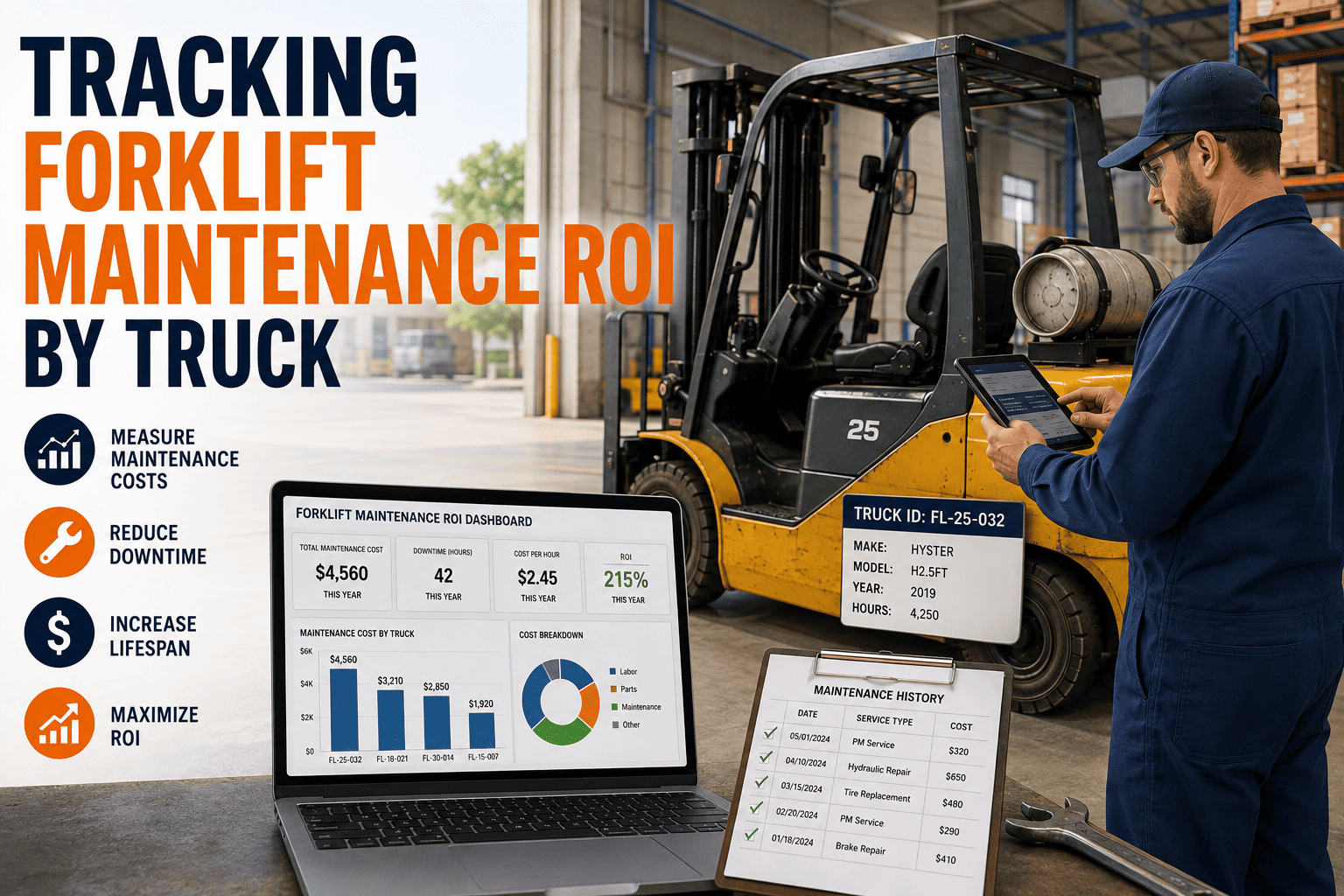
Ask most plant managers what their forklift fleet costs to maintain and you will get a single number for the whole year. Ask which specific truck is dragging that number up, and the room usually goes quiet. Fleet-wide maintenance totals hide the real story, because two forklifts bought on the same day, running the same shifts, can end up costing wildly different amounts to keep on the floor. Tracking return on maintenance investment truck by truck is what turns that guesswork into a defensible budget conversation.
Forklift maintenance ROI is best measured through cost per hour, calculated by dividing total operating costs by total hours run for that specific unit. Industry benchmarks sit around 15 to 25 dollars per hour for internal combustion trucks and 10 to 20 dollars per hour for electric models. When a truck's maintenance cost per hour climbs past roughly 4 dollars and keeps rising year over year, that trend line is the clearest signal that continued repair spend is no longer paying off.
The Formula That Actually Reveals Maintenance ROI
Cost per hour is the single metric that turns scattered repair invoices into a comparable number across your entire fleet. It accounts for maintenance labor, parts, and downtime-related expense divided by the hours that specific truck actually worked, which means a heavily used forklift and a lightly used one can be judged fairly against each other.
Why a Single Fleet Average Hides the Real Problem
A fleet-wide average maintenance cost can look perfectly reasonable while one or two trucks are quietly pulling that number upward. If ten forklifts average 3 dollars per hour but two of them are actually running at 6 dollars per hour, blending them into one figure buries the exact units that need attention, and the budget conversation ends up defending spend on trucks that are not the actual problem.
Why Hours Matter More Than the Invoice Total
A repair bill on its own tells you almost nothing about value. A 2,000 dollar repair on a truck that runs 2,000 hours a year is a very different story than the same repair on a truck that only runs 800 hours. Dividing by actual hours worked is what makes the comparison fair, and it is the step most fleets skip entirely.
| Truck | Hours Run (Year 1) | Maintenance Spend | Cost Per Hour | ROI Signal |
|---|---|---|---|---|
| Forklift A | 2,000 hours | 3,700 dollars | 1.85 dollars per hour | Healthy, maintenance spend paying off |
| Forklift B | 1,976 hours | 5,700 dollars | 2.88 dollars per hour | Watch closely, spend rising faster than use |
| Forklift C (Year 3 of use) | 1,500 hours | 3,750 dollars | 2.50 dollars per hour | Trending upward from under 1 dollar in Year 1 |
FleetRabbit calculates cost per hour automatically for every forklift in your fleet, so you can see exactly which units are still paying for themselves and which ones are quietly draining the budget.
Reading the Trend Line, Not Just the Number
A single year of cost-per-hour data tells you where a truck stands today. Three consecutive years tell you where it is headed, and that direction is what actually drives a replacement or continued-investment decision.
Tracking ROI Truck by Truck, Not Fleet by Fleet
Once you accept that a fleet average hides the real signal, the next step is building a simple, repeatable way to track every unit individually. You can sign up for FleetRabbit to automate this tracking instead of rebuilding a spreadsheet every quarter.
Assign a Cost Owner Per Unit
Designate one person responsible for logging every maintenance cost and every operating hour against a specific truck ID, not a general fleet bucket. Without a clear owner, costs quietly get lumped together and the per-truck picture disappears within a few months.
Example: Catching a Problem Truck Early
A plant tracking five forklifts individually notices one unit's cost per hour climbed from 1.40 dollars to 2.60 dollars in a single year, while its four sister trucks stayed flat. Because the data was tracked per truck rather than fleet-wide, the team caught the trend after one season instead of waiting three years for a fleet average to eventually reflect it.
Review Cost Per Hour on a Fixed Schedule
Evaluate every truck's cost per hour on the same annual or quarterly schedule, rather than only when a big repair forces the conversation. A consistent review cadence is what turns cost per hour from a reactive metric into a genuine planning tool. To see this dashboard built around your own fleet, you can book a demo with the FleetRabbit team.
What Maintenance ROI Data Should Justify
Tracking cost per hour by truck is not just a reporting exercise. It should directly justify two kinds of decisions that plant managers face every budget cycle.
FleetRabbit tracks cost per hour for every forklift in your fleet automatically, turning scattered repair invoices into a clear, defensible picture of maintenance ROI by truck.