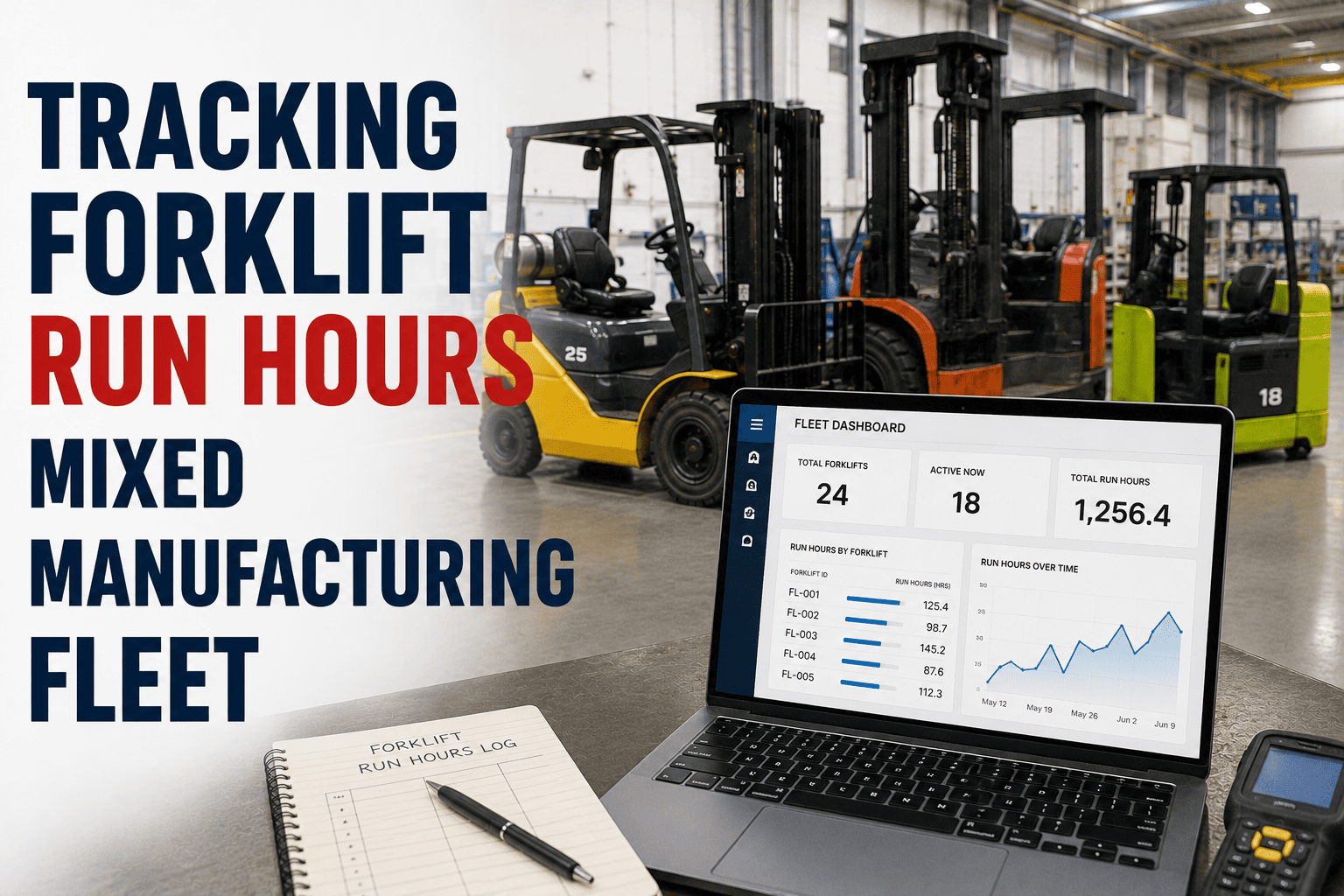
Ask five maintenance supervisors how they track forklift hours and you will likely get five different answers, a clipboard, a spreadsheet, an OEM app for the Toyota units, another app for the Hyster units, and someone's memory for the two old Crown trucks in the back corner. Run hours are what actually trigger forklift maintenance, but the moment a plant mixes brands, fuel types, and shift patterns, that one simple number gets a lot harder to trust.
Forklift manufacturers build service intervals around hour-meter readings rather than the calendar, similar to how aircraft are maintained by flight hours. Typical intervals include oil and filter service every 200 to 250 hours, transmission service every 1000 to 1500 hours, and hydraulic system service around every 2000 hours, with electric units instead tracked against 1500 to 2000 battery charge cycles. In a mixed fleet, every brand reports those hours a little differently, which is exactly where maintenance schedules quietly fall apart.
Why Mixed Fleets Break Hour-Based Maintenance
Hour-based maintenance works well in theory: service the truck when it has actually worked enough to need it, not when a date on a calendar arrives. The problem shows up the moment a plant runs more than one forklift brand or fuel type side by side. Toyota, Yale, Hyster, Crown, and Mitsubishi units each build their service intervals around their own hour-meter logic, and OEM telematics portals are typically built for one manufacturer's fleet, not a mixed one. A plant running Toyota, Hyster, and Crown trucks together ends up checking three different apps, or worse, trusting three different sets of assumptions about how those hours were counted.
Engine Hours Versus Operating Hours
Propane and diesel forklifts count engine hours, the time the motor is actually running, which can include idle time at a dock waiting between moves. Electric forklifts instead track true operating hours, since there is no idling engine to measure. Mixing the two without accounting for the difference means comparing wear on two fundamentally different clocks, which quietly throws off maintenance timing across the fleet.
Run Hours Versus Idle Hours
Even within a single fuel type, raw hour meter totals can be misleading. A truck parked at a dock with the engine running racks up hours without doing any actual work, while a truck cycling constantly through tight aisles wears components faster per hour logged. Calibrated hour tracking that separates true run time from idle time gives a far more accurate picture of when service is genuinely due.
FleetRabbit pulls hour data from every make and model into a single dashboard, so a mixed fleet of Toyota, Hyster, and Crown trucks reads on one shared clock. Start your free trial and see your whole fleet's hours in one place.
Service Intervals By The Hours That Actually Matter
Regardless of brand, most forklift components wear on predictable hour bands. Knowing these bands is the first step to building a schedule that fires on real usage instead of a rough monthly guess.
| Service Item | Typical Interval | Applies To | Cost Of A Missed Interval |
|---|---|---|---|
| Oil And Filter | 200 to 250 hours | Propane and diesel engines | Accelerated engine wear and reduced service life |
| Mast Chain Inspection | Around 100 hours | All forklift types with chain-driven masts | Chain stretch, uneven lift, and potential load safety issues |
| Transmission Service | 1000 to 1500 hours | Propane, diesel, and hydrostatic drive units | 3000 to 8000 dollar transmission failure and repair |
| Hydraulic System Service | Around 2000 hours | All forklift types | Lift function failure and load handling risk |
| Battery Replacement Planning | 1500 to 2000 charge cycles | Electric forklifts | Reduced runtime and unplanned mid-shift power loss |
Bringing Every Brand Onto One Clock
The fix for mixed-fleet hour tracking is not asking every plant to standardize on a single forklift brand. It is pulling hour data from every make into one shared format so maintenance triggers work the same way regardless of what logo is on the mast. Standards like ISO 15143-3 exist specifically to let telematics from different manufacturers speak a common language, which is what makes brand-agnostic tracking possible without ripping and replacing your existing fleet.
What Unified Hour Tracking Actually Looks Like
In practice, unified tracking means every forklift, regardless of brand or fuel type, feeds its hour meter into the same dashboard, on the same interval logic, generating the same kind of work order when a threshold is hit. A supervisor overseeing 40 mixed-brand trucks should be able to see which units are approaching their 250-hour or 2000-hour mark without opening a separate app for each manufacturer.
Why This Matters More As Fleets Grow
A five-truck fleet of one brand can survive on a spreadsheet. A fifty-truck fleet spanning five brands, three fuel types, and multiple shifts cannot, because the volume of manual meter readings and the inconsistency between OEM systems makes it statistically likely that something gets missed. The bigger and more mixed the fleet, the more a unified view stops being a nice-to-have and starts being the only realistic way to keep every truck serviced on time.
FleetRabbit is built brand agnostic for manufacturing fleets, so hour thresholds trigger work orders automatically no matter which OEM made the truck. Book a demo and see how it reads across your actual mixed fleet.
Getting Started With Accurate Run Hour Tracking
Begin by auditing how each truck in your fleet currently reports hours, whether through an OEM telematics module, a manual hour meter, or an operator log. Note which units already have digital tracking and which still rely on someone walking over and reading a dial. Next, map your actual service intervals by hour band for each equipment type in your fleet, since a reach truck, a counterbalance forklift, and an electric pallet jack do not wear on the same schedule even if they are all measured in hours. Finally, connect every unit's hour data into a single system so thresholds trigger work orders automatically instead of depending on someone remembering to check.
Common Mistakes To Avoid
The most common mistake is treating all hour meters as equally accurate without accounting for idle time, engine hours versus operating hours, or meters that have rolled over on older analog units. The second most common mistake is running a mixed fleet on the OEM portal of whichever brand happens to be the majority, leaving the minority brands undertracked simply because nobody built a process for them.
Frequently Asked Questions
Mixed fleets fall behind on maintenance when hour data lives in five different systems instead of one. FleetRabbit unifies run hours across every brand and fuel type so service triggers on real wear, not calendar guesswork. Start your free trial today, or book a demo to see your fleet's hours in one dashboard.