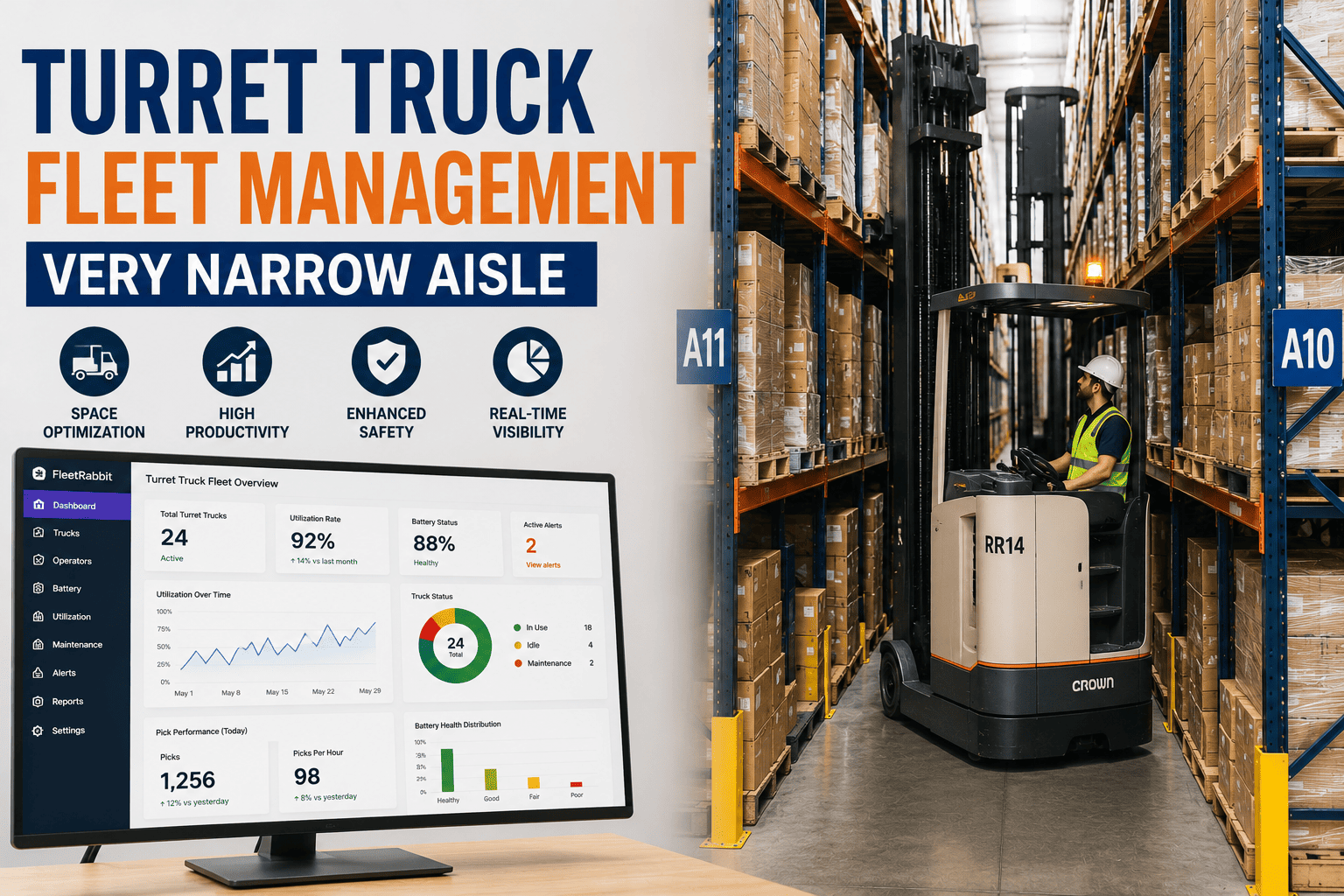
Very narrow aisle warehouses squeeze every inch of value out of a building, and turret trucks are the machines that make it possible. Racking climbs to 40 or 50 feet, aisles shrink to under 6 feet, and a single turret truck glides through spaces a standard forklift could never enter. That density is exactly why turret truck downtime hurts so much more than ordinary forklift downtime. When the one machine built to work your tightest, tallest aisle goes down, there is often no backup that fits the space, and picking, replenishment, and outbound orders stall until it's fixed. Fleet managers running VNA operations need a maintenance strategy built around that reality, not a generic forklift program borrowed from a wide-aisle warehouse. Sign up for FleetRabbit to start tracking turret truck health today, or book a demo to see how VNA fleets use predictive maintenance to protect uptime.
Turret trucks let warehouses run aisles as narrow as 66 to 72 inches instead of the 10 to 12 feet a standard forklift needs, recovering 40 to 60 percent more usable floor space. But because they operate in guide rails or wire guidance with tight tolerances, a single turret truck failure can freeze an entire aisle's picking activity, costing 500 to 1,200 dollars per hour in stalled throughput. Fleets that monitor battery health, guidance systems, and mast components proactively cut unplanned turret truck downtime by 30 to 45 percent.
Why Turret Trucks Break the Rules of Normal Fleet Management
A turret truck isn't just a taller forklift. It carries an articulating head that rotates up to 180 degrees so the operator can place and retrieve pallets on either side of the aisle without turning the chassis, and it often runs on wire guidance or rail guidance to stay centered in an aisle just a few inches wider than the truck itself. That precision is what unlocks the space savings VNA racking is known for, but it also means the truck depends on several interlocking systems working perfectly at once: mast alignment, guidance sensors, hydraulic lift, and battery power. A wide-aisle counterbalance forklift with a flat tire can often limp to a shop. A turret truck with a guidance fault usually can't move safely at all.
The Guidance System Is the Weak Link Worth Watching
Most turret truck fleets rely on either wire guidance embedded in the floor or rail guidance bolted to the racking to keep the truck centered as it travels. Both systems depend on sensors, connectors, and alignment tolerances that drift slowly before they fail suddenly. A guidance fault doesn't just slow the truck down, it can stop it from entering the aisle at all, since safety interlocks are designed to prevent operation when the truck can't confirm its position. Tracking guidance sensor performance over time, rather than waiting for an outright fault code, is one of the highest-value habits a VNA maintenance program can build.
FleetRabbit tracks guidance system health, battery cycles, mast condition, and maintenance history for every turret truck in your fleet, so a small drift never turns into a frozen aisle. Sign up free and connect your first three trucks in minutes.
What a Turret Truck Failure Actually Costs a VNA Warehouse
Because a single turret truck is often the only equipment rated to work a given aisle configuration, its downtime cost isn't limited to the repair invoice. Picking, replenishment, and put-away for every SKU in that aisle stop until the truck returns or a spare unit is repositioned and re-commissioned with guidance calibration. In high-throughput fulfillment centers, that stalled activity can cost 500 to 1,200 dollars per hour depending on order volume and SLA penalties, on top of repair costs that typically run 1,500 to 4,000 dollars for an unplanned mast, hydraulic, or guidance repair.
Where the Cost Actually Comes From
| Cost Driver | Typical Range | Why It Happens |
|---|---|---|
| Frozen Aisle Throughput | 500 to 1,200 dollars per hour | No alternate truck can enter the same aisle, so picking and replenishment stop completely |
| Guidance Recalibration | 300 to 900 dollars | Wire or rail guidance sensors need precise re-alignment after a fault or repair |
| Mast and Hydraulic Repair | 1,500 to 4,000 dollars | Tri or quad-stage masts operating at height see high stress on seals, chains, and rollers |
| Battery Replacement or Service | 400 to 1,800 dollars | Deep-cycle batteries degrade faster under continuous multi-shift VNA use |
| Operator Reassignment | 150 to 400 dollars per shift | Trained turret truck operators are reassigned to manual picking at lower productivity |
A Quick Way to Estimate Your Own Exposure
Multiply your average hourly throughput value for the affected aisle by the hours the truck is typically down, then add average repair cost. A facility processing 900 dollars an hour in order value that loses a turret truck for 8 hours faces roughly 7,200 dollars in stalled throughput plus 2,000 to 3,000 dollars in repair costs, a single incident easily exceeding 9,000 dollars.
Turret Truck Fleets Across Different Facility Types
Not every VNA operation feels downtime the same way. Cold storage facilities running turret trucks in freezer aisles see battery performance degrade faster in low temperatures, and a stalled truck in a freezer aisle risks product temperature excursions on top of lost throughput. E-commerce fulfillment centers with tight same-day and next-day SLAs treat any frozen aisle as a direct hit to promised delivery windows, sometimes triggering customer service penalties. Manufacturing parts warehouses with lower pick velocity feel downtime less acutely per hour but often run older turret truck fleets with fewer spare units, so a breakdown can stretch into multi-day disruption while parts are sourced.
Cold Storage and Freezer Warehouses
Sub-zero environments accelerate battery wear and can stiffen hydraulic seals, making cold storage turret truck fleets prone to a higher rate of unplanned faults than ambient-temperature operations. Scheduled battery health checks and seal inspections matter more here than almost anywhere else in a VNA fleet.
High-Volume E-Commerce Fulfillment
With order cutoffs measured in hours, not days, a frozen aisle in a fulfillment center can directly threaten same-day shipping commitments. These operations benefit most from real-time alerts that flag a developing fault before it becomes a full stoppage during a peak picking wave.
Metrics That Actually Predict Turret Truck Reliability
Generic forklift uptime benchmarks don't translate cleanly to VNA fleets because the failure modes are different. Guidance system fault frequency is a leading indicator that's largely unique to turret trucks, and tracking it separately from general mechanical faults reveals problems weeks before a full stoppage. Battery cycle count and depth of discharge patterns predict when a battery will start causing intermittent power faults, often the root cause behind trucks that "just stop" mid-aisle. Mast component wear, especially chain elongation and roller condition, predicts the mast and hydraulic failures that make up the largest share of unplanned repair cost in most VNA fleets.
FleetRabbit combines guidance sensor data, battery cycle tracking, and mast wear indicators into one dashboard built specifically for very narrow aisle equipment. Most VNA fleets see fault frequency drop within the first 90 days. Book a 30-minute demo to walk through your own fleet data.
Building a Turret Truck Maintenance Program That Actually Works
An effective VNA maintenance program treats the turret truck as a system of interdependent parts rather than a single asset with one maintenance schedule. Guidance sensors deserve their own inspection cadence separate from general mechanical service, since a drifting sensor can look fine on a visual check but fail intermittently under load. Batteries need cycle-based rather than purely calendar-based service, especially in multi-shift or cold storage operations where use patterns vary widely between trucks. Spare unit strategy matters too: because turret trucks are aisle-specific, having even one properly configured spare per zone can turn a full-day stoppage into a 30-minute swap.
What FleetRabbit Adds to a VNA Program
FleetRabbit's platform was built to handle exactly this kind of equipment-specific complexity. It separates guidance system alerts from general mechanical faults so maintenance teams can prioritize the failures most likely to freeze an aisle. It tracks battery cycles and depth of discharge automatically, flagging batteries approaching end of useful life before they start causing intermittent faults. And it keeps a full maintenance and repair history per truck, making it easy to spot a unit that's becoming a repeat offender before it becomes a recurring cost center.
Protecting Every Inch of Density You've Built
Very narrow aisle racking gives a warehouse more storage capacity in the same footprint, but that advantage only holds if the turret trucks running those aisles stay reliable. A single unplanned failure can undo weeks of throughput gains in a single frozen shift. The fleets that stay ahead treat guidance systems, batteries, and mast components as connected parts of one maintenance strategy rather than isolated repair line items, catching small faults before they turn into aisle-wide stoppages.
If you're ready to see what that looks like for your own operation, sign up for FleetRabbit and start monitoring your turret truck fleet today, or book a demo to walk through your fleet's specific configuration with our team.
FleetRabbit was built to handle the equipment-specific complexity of turret truck fleets, from guidance sensor health to battery cycle tracking to mast wear alerts. Protect the storage density you've already built and stop losing shifts to frozen aisles.