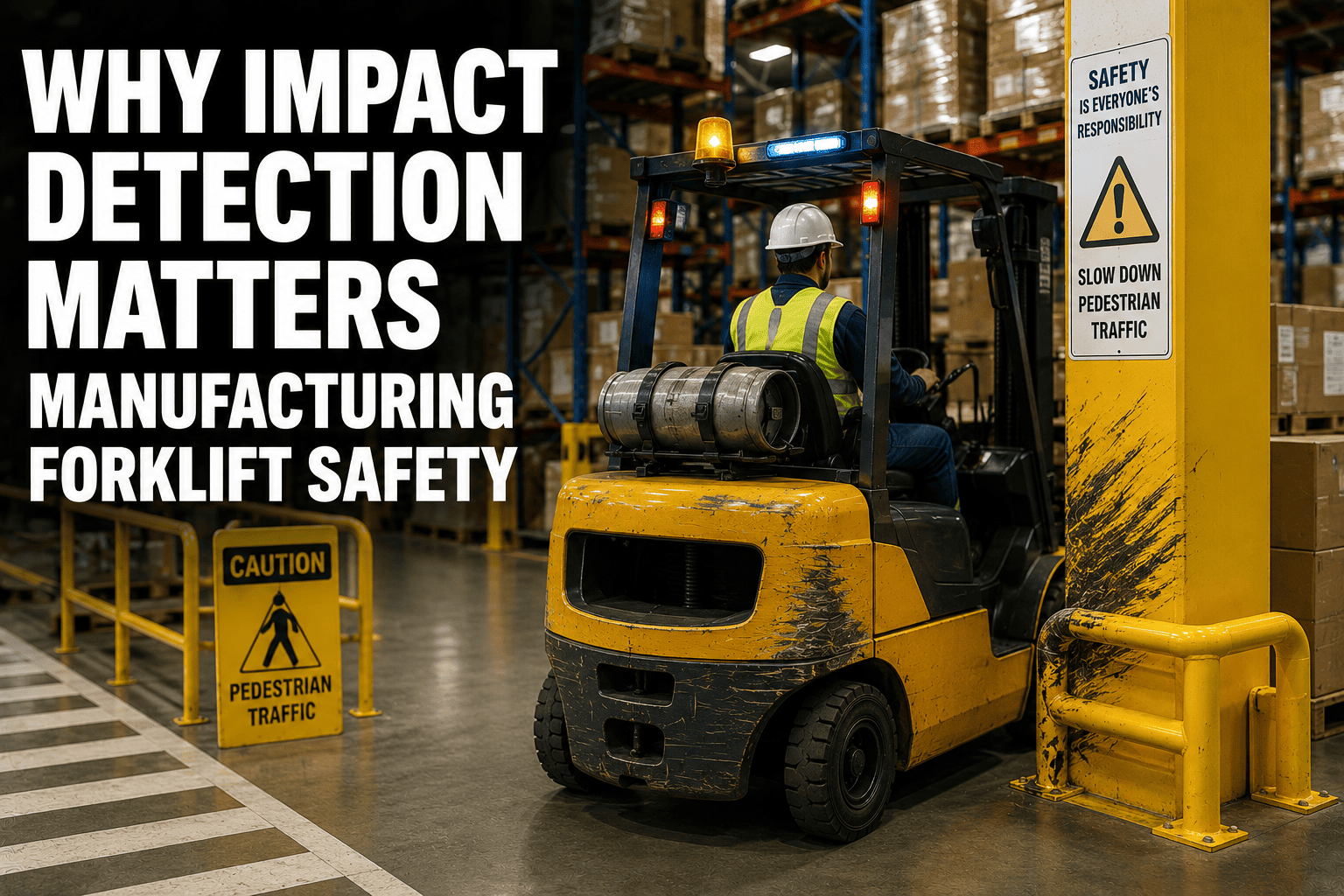
Every manufacturing floor supervisor has heard the same phrase after a forklift clips a rack, dents a door frame, or sideswipes a production line barrier. Nothing happened. The operator drives away, the shift continues, and the damage sits undiscovered until a subsequent impact in the same weakened spot sends a rack collapsing onto a work area. Unreported forklift impacts are not minor incidents that resolve themselves. They are progressive structural failures that compound silently. Each undocumented collision weakens rack integrity, damages facility infrastructure, and normalizes a culture where operators believe minor impacts are acceptable. The difference between a near-miss conversation at shift change and a workplace injury investigation often comes down to whether that first impact was detected, logged, and addressed or ignored until consequences made it impossible to ignore.
Studies across manufacturing facilities reveal that for every 1 reported forklift impact, between 8 and 12 go unreported. Each unreported impact leaves structural damage that averages 400 to 2000 dollars in hidden repair costs. Facilities implementing impact detection systems reduce unreported incidents by 70 to 85 percent and cut forklift-related injury rates by 30 to 45 percent within the first year.
go unreported
The True Cost of Unreported Forklift Impacts
When a forklift impact goes unreported, the cost does not disappear. It transforms into a different category of expense that is harder to track, harder to budget for, and far more likely to escalate. A visible dent in a rack upright might seem cosmetic, but that same impact has likely shifted the upright's alignment, reduced its load-bearing capacity by 15 to 30 percent, and created a stress point that will fail under less load than the rack was designed to handle. The next forklift that loads inventory onto that damaged section may never know the section is compromised until the rack deflects, buckles, or collapses.
The financial cascade from a single unreported rack impact typically follows a predictable pattern. The initial structural damage costs 200 to 800 dollars if repaired immediately by a rack specialist. Left undetected for weeks, the same damage may progress to the point where the entire bay requires replacement at 3000 to 8000 dollars. If a partial collapse occurs before discovery, costs jump to 15000 to 50000 dollars for emergency structural repair, inventory loss, production area shutdown, and incident investigation. If anyone is injured in that collapse, the cost escalates into six figures through medical expenses, OSHA citations, workers compensation claims, and potential litigation. Every step in that escalation chain is preventable if the original impact had been detected and the damage assessed immediately.
Hidden Damage Categories in Manufacturing Facilities
Unreported impacts damage more than just racking systems. Manufacturing facilities contain a dense infrastructure of conduits, fire suppression systems, door frames, dock levelers, production equipment, and building columns that forklifts interact with constantly. Each infrastructure type carries different hidden damage risks. A forklift that clips a fire suppression pipe may not trigger a visible leak immediately, but the pipe connection has been stressed and may fail under system pressure during an actual fire event. A door frame impact that seems superficial has likely shifted the frame alignment, causing the door to drag, seals to fail, and climate-controlled zones to lose their environmental integrity. These are not hypothetical risks. They are documented failure modes that manufacturing plants deal with regularly, often without connecting the failure back to the original unreported forklift impact that caused it.
Why Operators Do Not Report Low-Severity Impacts
Understanding why operators fail to report impacts is essential to solving the problem. The reasons fall into four categories, and none of them involve malicious intent. Most operators genuinely believe a minor impact caused no meaningful damage. They feel the bump, check their surroundings, see no obvious deformation, and conclude the impact was beneath the reporting threshold. This judgment error is understandable because most operators lack the structural engineering knowledge to assess what internal stress an impact has created in a rack upright, a building column, or a pipe connection. What appears undamaged externally may have sustained significant internal compromise.
The second reason is fear of consequences. Even in facilities with no-penalty reporting policies, operators worry that reporting an impact will affect their performance reviews, their standing with supervisors, or their assignment to preferred equipment. This fear persists because many facilities have historically used impact reports punitively rather than constructively. The third reason is production pressure. Operators know that reporting an impact may trigger an inspection that takes their forklift out of service, creating delays in their assigned tasks. When shift production targets feel more immediate than a potential rack failure weeks later, the short-term pressure wins. The fourth reason is normalization. In facilities where impacts happen frequently and nothing visibly bad has resulted, operators develop a false sense that impacts are a normal part of the job that does not warrant reporting. You can sign up for FleetRabbit to eliminate the human reporting dependency entirely through automated impact detection that works regardless of operator behavior.
FleetRabbit installs impact sensors on each forklift that detect and log every collision automatically. No operator reporting required. Every impact is captured with timestamp, location, operator ID, and severity level. Alerts route to supervisors in real-time so damage is assessed before the next shift starts.
How Impact Detection Technology Works in Manufacturing
Modern impact detection for forklifts uses accelerometer-based sensors mounted on the forklift chassis that measure g-force events in three axes. When the forklift experiences a sudden deceleration or lateral force that exceeds a configured threshold, the sensor logs the event with precise timestamp, g-force magnitude, duration, and directional data. This raw sensor data is transmitted wirelessly to a central platform where it is correlated with the specific forklift, the assigned operator, and the facility location based on zone-based positioning or indoor positioning system integration. The result is a complete impact record that requires zero operator input and cannot be omitted, forgotten, or downplayed.
Severity Classification and Response Protocols
Not all impacts require the same response. A forklift that bumps a floor-level rack protector at 0.3G while traveling at 2 miles per hour creates a very different risk profile than a forklift that strikes a building column at 2.5G while traveling at 8 miles per hour. Impact detection systems classify events into severity tiers that trigger differentiated response protocols. Low-severity events below 0.5G are logged for trend analysis but do not require immediate response. Medium-severity events between 0.5G and 1.5G generate a notification to the shift supervisor with a recommendation to inspect the impact area before the end of the current shift. High-severity events above 1.5G trigger an immediate alert that requires the forklift to be taken out of service until both the forklift and the impacted structure are inspected and cleared.
Calibrating Thresholds for Your Facility
Impact detection is only as useful as its threshold calibration. Thresholds set too low generate excessive alerts that create notification fatigue, causing supervisors to start ignoring the system entirely. Thresholds set too high miss genuine impacts that should trigger inspections. Proper calibration requires a two-week baseline period where the system logs all g-force events without generating alerts. During this period, safety personnel review the event log and categorize each event as normal operation or genuine impact based on context from camera footage or operator discussion. The 90th percentile of normal operation events becomes the low-severity threshold, the 95th percentile becomes the medium-severity threshold, and events exceeding the 99th percentile become high-severity alerts. This data-driven calibration ensures your detection system is tuned to your specific facility conditions, forklift types, and operational patterns rather than using generic manufacturer defaults that may not match your environment.
What Impact Data Reveals About Your Operation
Impact detection data delivers insights that transform how manufacturing facilities manage forklift safety. The most immediate insight is a heat map showing exactly where impacts occur most frequently across your facility. Most plants discover that 60 to 70 percent of all impacts concentrate in 15 to 20 percent of their floor space. These impact hot spots typically correspond to tight aisle transitions, blind corners, congested staging areas, and intersections where pedestrian and forklift traffic paths cross. Knowing where impacts cluster allows targeted infrastructure improvements like wider aisles, better visibility mirrors, guard rail installations, and floor marking enhancements that address the root cause of repeated impacts in those locations.
Operator-level impact data reveals performance patterns that are invisible without measurement. Most facilities discover that a small percentage of operators account for a disproportionately large share of impacts. The typical distribution shows 10 to 15 percent of operators generating 40 to 50 percent of all impact events. This is not a reason to punish those operators but rather an opportunity to provide targeted coaching that addresses their specific driving patterns. An operator generating frequent low-speed lateral impacts likely needs training on spatial awareness and mirror usage. An operator generating fewer but higher-severity impacts likely needs speed management coaching and route planning guidance. The data makes these coaching conversations specific and productive rather than generic and dismissive.
| Impact Pattern | Likely Root Cause | Recommended Intervention | Expected Reduction |
|---|---|---|---|
| Frequent low-speed lateral impacts | Poor spatial awareness, narrow aisles, inadequate mirrors | Spatial awareness training, aisle widening, additional mirrors | 40-55% reduction in that pattern |
| High-severity frontal impacts | Excessive speed, distracted operation, blocked sight lines | Speed limiting, sight line clearance, attentiveness coaching | 50-65% reduction in that pattern |
| Repeated impacts at same location | Infrastructure design flaw, inadequate clearance, poor lighting | Physical barrier installation, layout modification, lighting upgrade | 70-90% reduction at that location |
| Impacts concentrated on specific shifts | Rushed production targets, inadequate staffing, fatigue | Shift scheduling review, staffing adjustment, production pacing | 30-45% reduction on affected shifts |
| Rear impacts during reversing | No spotter use, poor rear visibility, noisy environment masking alerts | Rar camera installation, spotter requirement enforcement, alarm upgrade | 55-70% reduction in reversing impacts |
Equipment-Level Insights From Impact Data
Impact data also reveals equipment-specific patterns that affect maintenance and replacement decisions. A forklift that accumulates impacts at a rate significantly higher than fleet average may have steering issues, brake problems, or ergonomic deficiencies that make it harder to control. A forklift with a pattern of high-severity impacts may be operating beyond its designed capacity for the loads being handled. Equipment-level impact data helps maintenance teams identify mechanical issues before they cause more serious incidents and helps fleet managers verify that each forklift is appropriately matched to its assigned tasks. When impact data shows a particular forklift model consistently generates fewer impacts than others in the same application, that data supports future procurement decisions with objective performance evidence rather than just purchase price comparisons.
Connecting Impacts to Near-Miss and Injury Data
The most powerful analytical application of impact detection data comes from correlating it with near-miss reports and injury records. When you overlay impact event locations with reported near-miss locations, patterns emerge that neither dataset reveals alone. A location where forklift impacts occur frequently but near-misses are never reported may indicate that pedestrians have learned to avoid that area entirely, which is not a sustainable safety strategy. A location where impacts and near-misses both cluster represents an acute risk that warrants immediate infrastructure intervention. Over time, facilities that correlate impact data with incident data can predict where injuries are most likely to occur and intervene proactively rather than waiting for an injury to force action. If you want to see how impact-injury correlation works with your facility data, book a demo with FleetRabbit and we will walk through the analytics dashboard with your specific operational context.
Building a Response Protocol Around Impact Detection
Installing impact detection sensors without a response protocol is like installing a fire alarm without an evacuation plan. The technology identifies the event, but without a defined process for what happens next, the data sits unused and the value diminishes rapidly as operators and supervisors realize nothing happens when impacts are detected. An effective response protocol defines five elements for each severity tier. Who receives the alert. What inspection is required. How quickly the inspection must occur. What documentation is needed. What corrective actions follow based on inspection findings. These five elements transform raw impact data into a closed-loop safety process where every detected impact leads to a documented assessment and appropriate follow-through.
Integrating Impact Detection With Existing Safety Programs
Impact detection does not replace your existing forklift safety program. It amplifies it. Pre-shift inspection requirements remain essential because they catch issues that impact sensors cannot detect, such as fluid leaks, tire condition, and mast operation. Operator training programs continue to provide the foundational driving skills that prevent most impacts. What impact detection adds is a measurement layer that validates whether your training and inspection programs are actually working. If you invested in a new training program three months ago and impact rates have not changed, the training is not producing the expected behavioral improvement. That insight is only available when you have baseline and post-training impact data to compare. Without measurement, safety investments are made on faith. With impact detection, they are made on evidence.
OSHA Compliance and Impact Documentation
OSHA's general duty clause requires employers to provide a workplace free from recognized hazards. When a forklift impact damages a rack system and the damage goes undetected until a failure occurs, OSHA investigators will ask what systems were in place to identify and address impact damage before it became hazardous. A facility with documented impact detection and response protocols demonstrates due diligence in identifying and mitigating structural hazards. A facility without impact detection has no documentation showing awareness of impacts occurring, no evidence of inspection responses, and no timeline connecting impacts to the eventual failure. The difference in how OSHA views these two scenarios during an investigation is substantial. Impact detection documentation has become increasingly relevant in OSHA proceedings related to storage rack collapses, with citations focusing on whether the employer had reasonable mechanisms to detect the damage that led to the failure.
FleetRabbit maintains a permanent record of every detected impact with severity classification, inspection results, and resolution documentation. When OSHA asks what systems you have in place to detect structural hazards, your impact detection log provides a complete, auditable answer. No gaps, no missing records, no explanations required.
Measuring Impact Detection ROI in Manufacturing
The return on investment for impact detection in manufacturing facilities comes from four measurable sources. First, avoided damage costs from early detection and repair of impacts that would otherwise progress to major structural failures. A facility experiencing 200 unreported impacts annually with an average hidden damage cost of 800 dollars per impact is absorbing 160000 dollars in undocumented repair liability. Impact detection that catches 80 percent of those impacts while damage is still in the 200 to 400 dollar repair range saves 80000 to 120000 dollars annually. Second, reduced injury costs from the 30 to 45 percent injury rate reduction that impact detection and the resulting coaching interventions produce. Even one avoided forklift-related injury typically saves 30000 to 80000 dollars in direct and indirect costs.
Third, reduced equipment repair costs from identifying forklifts that are accumulating impacts due to mechanical issues. Catching a steering problem after 5 impacts instead of 25 impacts prevents premature component failures that cost 2000 to 5000 dollars in accelerated repairs. Fourth, improved operational efficiency from reduced forklift downtime. When impacts cause progressive damage that eventually requires major forklift repairs, those repairs take forklifts out of service for days. Early detection of damage trends allows scheduled minor repairs during planned downtime windows rather than emergency repairs during production hours. For a facility with 15 to 20 forklifts, the combined ROI from these four sources typically pays for the impact detection system within 6 to 10 months.
The Facility That Knows Every Impact Is the Facility That Prevents Every Preventable Injury
Manufacturing safety has historically operated on a reactive model where incidents drive action. An injury occurs, an investigation follows, root causes are identified, and corrective measures are implemented. This model works, but it requires someone to get hurt before the system learns. Impact detection flips this model by providing the data that would have prevented the incident if it had been available beforehand. When you know that a specific rack section has been struck three times in the past month, you do not need to wait for a collapse to justify inspecting and reinforcing that section. When you know that a particular operator has generated twice the fleet-average impact rate, you do not need to wait for that operator to be involved in a recordable incident to provide targeted coaching.
The manufacturing facilities leading in forklift safety today share a common characteristic. They measure what was previously unmeasurable. They have replaced the assumption that no news is good news with the knowledge that no detected impact means no impact occurred. They have replaced subjective operator reports with objective sensor data. They have replaced post-incident investigations with pre-incident interventions. The technology to achieve this exists today, the ROI is measurable and rapid, and the alternative is continuing to operate with 90 percent of your forklift impacts going undetected and unaddressed. Every day without impact detection is a day where hidden damage is accumulating, risk is increasing, and your facility is flying blind toward an incident that your data could have prevented.
Nine out of ten forklift impacts in your facility are going unreported right now. Hidden damage is accumulating in your racking, your infrastructure, and your equipment. FleetRabbit's impact detection sensors capture every collision automatically with the operator, location, and severity data you need to act before damage becomes danger. Start your free trial and see your first impact data within days of sensor installation.