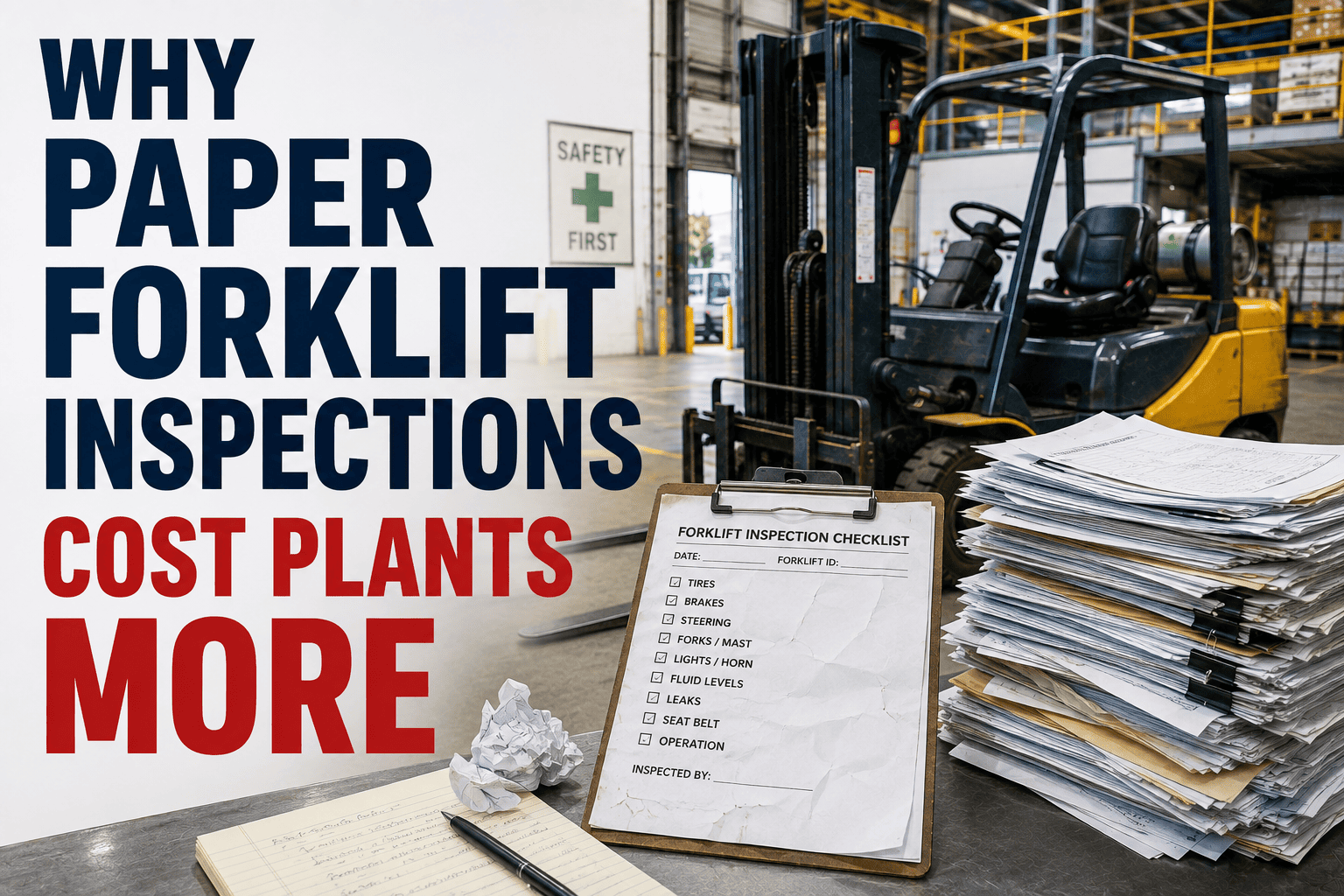
A paper forklift checklist looks free. No software fee, no login, just a clipboard hanging by the charging station. But that binder is quietly one of the most expensive tools on your plant floor. It cannot verify that an inspection happened, it cannot alert a supervisor when a truck fails a check, and it cannot follow a forklift when it rolls from Building A to Building B between shifts. By the time anyone opens that binder, the defective truck has usually already been driven for a full shift, or three.
Paper forklift inspections cost plants more than they save because they cannot be verified in real time, are easy to falsify through pencil whipping, and disconnect defect findings from maintenance action. Digital inspections flag problems the moment they happen and create an audit-ready record automatically. Sign up for a free trial or book a demo to see how FleetRabbit replaces the binder with instant, verified inspections.
What Actually Happens Inside That Binder
OSHA 1910.178(q)(7) requires a documented inspection before every forklift is placed in service, and in practice that requirement is meant to be a legal safeguard, not a formality. A signed paper form is the only evidence an inspection occurred, and a piece of paper cannot tell anyone where the operator was standing, whether they actually walked around the truck, or whether the same handwriting appears on thirty identical forms filled out in one sitting.
FleetRabbit timestamps every inspection, requires photo evidence for defects, and routes findings straight to maintenance the moment they are logged. Start your free trial and digitize your first checklist today, or book a demo to see the workflow live.
Paper Versus Digital, Side By Side
The real comparison is not about which method takes longer to complete on a given shift. It is about what happens to the finding after the checklist is signed, and whether the record can survive scrutiny.
| Factor | Paper Checklist | Digital Inspection |
|---|---|---|
| Proof Of Completion | A signature only, no time or location verification | Timestamped and geofenced, cannot be backdated |
| Defect Routing | Manually carried to maintenance, often hours later | Work order generated instantly, routed automatically |
| Pencil Whipping Risk | High, no verification layer exists | Reduced through randomized questions and photo requirements |
| Audit Readiness | Binder may be missing, incomplete, or hard to search | Searchable by truck, operator, or date in seconds |
| Fleet Movement | Record stays at the building where it was completed | Follows the truck across every building and shift |
Three Signs Your Paper Process Is Already Failing
Identical Handwriting Across Many Shifts
If a supervisor reviewing a month of forms notices the same pen pressure and spacing across dozens of entries, it usually means someone sat down and filled out several days of checklists in one sitting rather than inspecting the truck each shift.
Defects That Reappear Without Repair Records
When the same fault gets written down week after week with no matching work order, the finding is not reaching maintenance. The paper trail exists, but the corrective loop is broken.
Nobody Can Answer Where A Truck Was Last Inspected
If a supervisor cannot produce, within a minute, the last inspection record for a specific forklift, the plant is running on hope rather than a verifiable safety system.
What A Violation Actually Costs
Companies face an estimated $135 million in direct costs each year from forklift-related accidents across the country, and a single willful OSHA violation can carry a fine north of $161,000. Against numbers like that, the cost of switching to a verified digital inspection system is small change, not an expense to defer.
FleetRabbit connects every inspection finding directly to a work order, so nothing sits unread until it becomes a breakdown or a citation. Sign up free to try it on your own fleet, or book a demo and bring your current binder to the call.
Frequently Asked Questions
Every unverified checklist, every delayed defect, and every missing record is a cost your plant is already paying, just not on an invoice. FleetRabbit turns your forklift inspection into a verified, timestamped record that routes straight to maintenance and stands up to any audit.