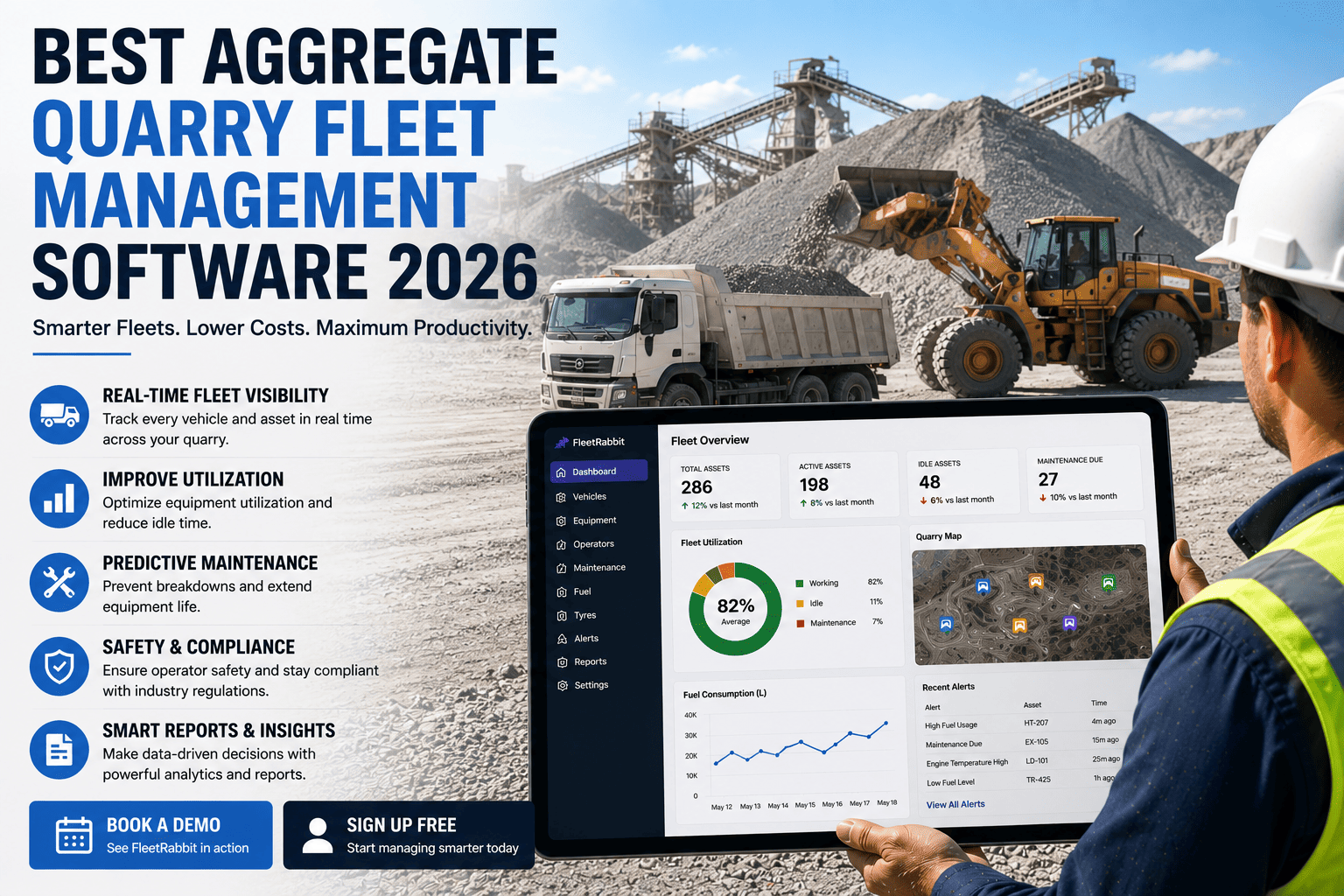
Best Aggregate & Quarry Fleet Management Software in 2026

best-aggregate-quarry-fleet-management-software-2026

Walk any quarry and you'll notice the same thing: everything eventually funnels through one machine. Loaders can keep feeding material, haul trucks can keep running cycles, but if the crusher goes down, the entire site backs up within the hour. Trucks queue with nowhere to dump, stockpiles run low, and a day's tonnage target quietly slips away while everyone stands around a machine that a paper inspection sheet should have flagged days earlier. Aggregate and quarry operations live or die on uptime across a handful of critical assets, and the fleet management software running behind them either catches that risk early or finds out about it the same way the crew does, after the belt stops moving.

Quarry Fleet Management Reality

Crusher liner and wear part replacement alone commonly runs 200,000 to 500,000 dollars a year at a mid-size quarry, making tons-per-crushing-hour one of the most closely watched numbers on site. Unmanaged fleets across mining and quarry operations lose an estimated 127,000 dollars a year on average to missed maintenance, emergency repairs, and poor utilization visibility combined. Real-time equipment tracking with geofenced zones for the loading face, crusher, and fuel station typically improves utilization by 35 to 50 percent compared to radio calls and paper logs.

1
Loading Face
Loaders fill haul trucks. Idle time here means every downstream stage waits too.
2
Haul Road
Cycle times compound fast. A single slow haul truck can throttle the whole shift's tonnage.
3
Crusher & Screens
The single point of failure. Unplanned downtime here stops the entire production chain.
4
Stockpile & Dispatch
Weighbridge and load-out data close the loop on cost per ton and daily production totals.

Why Crusher Downtime Is the Costliest Failure Point in a Quarry

A crusher isn't just another piece of equipment on site, it's the choke point every other machine feeds into. When it goes down unexpectedly, loaders slow down because there's nowhere for material to go, haul trucks stack up waiting, and dispatch has nothing to load out. That cascading effect is what makes crusher reliability worth more attention than almost any other asset class in an aggregate operation.

Wear Parts Are a Bigger Line Item Than Most Budgets Assume

Crusher liners, jaw plates, and screen media wear down steadily with every ton processed, and replacing them reactively after a failure costs far more than swapping them on a planned schedule tied to actual tonnage throughput. Tracking tons-per-crushing-hour against wear part condition is what turns replacement from a surprise into a scheduled event.

Paper Inspection Sheets Miss Developing Problems

A crusher bearing running hot or a conveyor belt starting to fray rarely announces itself loudly at first. Digital pre-shift inspections with photo evidence catch these signals while they're still cheap to fix, instead of relying on someone remembering to mention it during shift handover.

Emergency Repairs Cost More Than the Repair Itself

An emergency crusher repair carries premium parts pricing and overtime labor, but the bigger cost is almost always the queued haul trucks and idle loaders sitting behind it, a cost that never shows up on the repair invoice itself.

Catch Crusher Problems Before The Line Backs Up
Digital Inspections Tied To Tons Processed

FleetRabbit tracks wear part condition against real tonnage throughput and routes defects straight to work orders, so crusher maintenance gets scheduled instead of discovered mid-shift. You can sign up here to see it running on your own equipment, or book a demo built around your quarry.

By Tonnage
Wear Part Tracking
Auto-Routed
Defect To Work Order

Equipment Coverage a Quarry Fleet Platform Needs

A quarry's fleet is a mix of mobile equipment and fixed processing assets, and the best software tracks both instead of treating the crusher as an afterthought bolted onto a mobile-equipment tool.

Equipment Type Role On Site What To Track
Wheel Loaders Loading haul trucks at the face or feeding the crusher directly Cycle times, idle time, bucket wear, hour-based service intervals
Haul Trucks Moving material between the face, crusher, and stockpile Payload per cycle, tire condition, engine-hour PM, GPS cycle timing
Crushers & Screens Reducing and grading material into finished product Liner and wear part condition, tons-per-crushing-hour, vibration and bearing checks
Conveyors Moving material between processing stages Belt condition, roller inspection, idler wear, alignment checks
Weighbridge & Dispatch Recording load-out weight and closing the production loop Tons dispatched, cost per ton by material grade, load accuracy

Core Capabilities the Best Quarry Fleet Software Needs

01

Geofenced Zone Tracking

Automatic arrival and departure alerts for the loading face, crusher, fuel station, and shop, so cycle time and utilization are measured, not estimated.

02

Tonnage-Linked Maintenance

Wear part and PM scheduling tied to actual tons processed or engine hours instead of a fixed calendar date.

03

Digital Pre-Shift Inspection

Mobile checklists per equipment type with mandatory defect photos, working fully offline in low-signal pit areas.

04

Cost Per Ton Reporting

Fuel, maintenance, and downtime rolled into one figure by material grade, showing which product lines are actually profitable.

05

Automatic Defect Routing

A logged issue on a loader, crusher, or conveyor becomes a scheduled work order immediately, not a note that gets lost by shift change.

Turning Utilization Data Into Cost Per Ton

Once cycle times, idle time, and crusher throughput are all visible in one place, cost per ton stops being a monthly estimate and becomes a live number that shifts as fast as conditions on site do. That's what lets a plant manager catch a slipping loader cycle or a crusher running below its normal tons-per-hour rate the same day it starts happening, not at the end of the month.

Why This Matters at Renewal and Bid Time

Knowing the real cost per ton by material grade changes how a quarry prices contracts and decides which product lines to push. A grade that looks profitable on paper can quietly be losing money once crusher wear, haul distance, and downtime are factored in properly.

See Cost Per Ton In Real Time
One Platform For Mobile And Fixed Assets

FleetRabbit connects loaders, haul trucks, crushers, and weighbridge data into a single view of utilization and cost per ton. Start free and connect your first assets today, or book a walkthrough to see your own production numbers.

Live
Cost Per Ton View
35-50%
Typical Utilization Gain

What Quarries Typically See After Implementation

Equipment Utilization
Geofenced, real-time tracking of key zones commonly lifts utilization by 35 to 50 percent compared to radio calls and paper logs.
Wear Part Spend
Tonnage-linked replacement scheduling reduces the emergency premium that comes with reactive crusher liner and screen media failures.
Annual Loss Avoided
Small and mid-size operations commonly avoid a large share of the roughly 127,000 dollar average annual loss tied to unmanaged fleets.

Frequently Asked Questions

QWhy does crusher downtime matter more than downtime on other equipment
Because every other machine on site feeds into it. A crusher failure stops loaders, backs up haul trucks, and halts dispatch all at once, unlike a single loader or truck going down.
QWhat does tonnage-linked maintenance actually mean
Instead of scheduling wear part replacement or service by a fixed calendar date, maintenance triggers off real tons processed or engine hours, matching the schedule to actual equipment wear.
QHow much do crusher wear parts typically cost per year
Liner and wear part replacement commonly runs 200,000 to 500,000 dollars a year at a mid-size quarry, making tons-per-crushing-hour one of the most important numbers to track closely.
QCan this kind of software track cost per ton by material grade
Yes. Rolling fuel, maintenance, and downtime into a per-ton figure by grade shows which product lines are genuinely profitable once every cost is accounted for. Sign up to see your own cost per ton.
QDoes geofencing work in a quarry with unreliable cell signal
Yes, well-built platforms are designed to keep tracking and logging data even in low-signal pit areas and sync automatically once connectivity returns. Book a demo to see it work on a live site.
QIs this practical for a small quarry operation
Yes. Smaller operations often have less room to absorb a crusher outage or a chronically underused loader, so the same visibility that helps a large site can matter even more for a smaller one.

The Bottom Line For Aggregate And Quarry Fleet Management

An aggregate operation is only as reliable as its slowest link, and in most quarries that link is the crusher. The best aggregate and quarry fleet management software in 2026 treats mobile equipment and fixed processing assets as one connected system, ties maintenance to actual tonnage instead of a calendar guess, and turns cost per ton from a monthly estimate into a live number the whole team can act on. That combination is what keeps trucks moving, stockpiles full, and production targets within reach.

Keep Every Ton Moving Through Your Site

Every hour of unplanned crusher downtime and every reactive wear part failure is a cost your quarry doesn't have to keep absorbing. FleetRabbit connects loaders, haul trucks, crushers, conveyors, and weighbridge data into one live view of utilization and cost per ton. Sign up free and connect your first assets today, or book a short demo to see it built around your specific site.
Quarry Fleet Software Crusher Maintenance Cost Per Ton Aggregate Production Equipment Utilization

July 22, 2026 By John
All Posts

Best Aggregate & Quarry Fleet Management Software in 2026

best-aggregate-quarry-fleet-management-software-2026

Every ton of crushed stone, sand, or gravel that leaves a quarry gate has to pass through the same chain: a loader fills a haul truck, the truck cycles to the crusher or stockpile, and the load gets weighed and ticketed. If any link in that chain slows down, cost per ton climbs immediately. Aggregate and quarry fleet management software exists to keep that chain moving, catch equipment problems before they stop production, and give operators a real number for what every haul truck, loader, and crusher feeder is actually costing and producing.

Quarry Fleet Software Snapshot

A single idle haul truck on a mid-size quarry site costs 300 to 600 dollars per hour in lost tonnage and standby labor. Unplanned crusher feeder or loader downtime can stall an entire production line, costing 8000 to 20000 dollars per incident once cycle delays and overtime are included. Quarries using automated maintenance scheduling and cycle-time tracking cut cost per ton by 8 to 15 percent within the first two quarters.

Why Cost Per Ton Depends On Fleet Visibility

Cost per ton is the number every quarry manager gets judged on, and it is driven almost entirely by how efficiently equipment moves material from face to stockpile. A haul truck sitting idle waiting on a loader, a crusher feeder down for an unplanned belt repair, or a wheel loader burning excess fuel on a worn undercarriage all quietly push that number up. Most quarries only discover the damage weeks later when the monthly production report comes in below target, by which point the underlying equipment issue has usually already caused a second, more expensive failure.

Fleet management software closes that visibility gap by tracking engine hours, cycle counts, and maintenance status for every asset in real time, from the primary crusher feed trucks down to the water trucks keeping haul roads compliant. Instead of reacting to a production shortfall at month end, site managers see the exact machine and the exact hour that started dragging down output. Teams that want to see this working against their own equipment list can book a demo and walk through a live dashboard built around their actual haul routes.

Haulage
Idle Haul Truck Cost
A haul truck waiting on a loader or a blocked crusher feed costs 300 to 600 dollars per hour in lost tonnage, and idle time on unmanaged quarry fleets commonly runs 20 to 30 percent of total shift hours.
Processing
Crusher And Feeder Downtime
An unplanned crusher or feeder belt failure can halt the entire production line, costing 8000 to 20000 dollars per incident once every truck queued behind it is factored into the delay.
Recovery
Cost Per Ton Improvement
Quarries running automated maintenance scheduling and cycle-time monitoring typically reduce cost per ton by 8 to 15 percent within two quarters of going live.

Rolling Out Fleet Software Across A Quarry Site

Unlike a highway trucking fleet, a quarry operation runs a tight loop of loaders, haul trucks, and stationary crushing plant that all depend on each other. Getting fleet software live across that mix follows a fairly consistent sequence, and understanding the order helps operators set realistic expectations for when the payoff actually shows up.

Step 1: Map Every Asset And Duty Cycle

List every haul truck, wheel loader, excavator, drill rig, crusher feeder, and support vehicle on site, along with the maintenance interval that actually applies to it. A crusher feeder truck cycling every four minutes wears differently than a highway-rated water truck circling the haul roads twice a shift.

Step 2: Digitize Inspections And Set Maintenance Triggers

Replace paper pre-shift checklists with mobile inspection forms tied to each equipment type, and set preventive maintenance triggers by engine hours or cycle counts instead of a generic calendar date.

Step 3: Connect Production And Ticketing Data

Link haul cycle counts and weighbridge ticketing to the fleet dashboard so tons per hour, cycle time, and idle time are visible by machine, not just by site total.

Step 4: Review, Adjust, And Scale

Within the first 30 to 60 days, patterns emerge showing which trucks, loaders, or routes are dragging down output. Adjust maintenance intervals, loader-truck pairings, or route assignments based on what the data actually shows, then extend the same setup to additional pits or plants.

Built For Pits, Plants, And Haul Roads
Connect Every Loader, Truck, And Crusher Feeder

FleetRabbit tracks haul trucks, loaders, excavators, drill rigs, and crusher feeder vehicles with cycle-based maintenance triggers, mobile inspections, and real-time production visibility. Start free with 3 vehicles and see your first week of cycle data.

8-15%
Cost Per Ton Reduction
20-30%
Idle Time Typically Cut

Matching Software Capability To Quarry Equipment

Aggregate operations run a wider equipment mix than most people expect, from mobile haul trucks and loaders to stationary crushers, screens, and conveyors. Software built for one category rarely fits the others well. The table below breaks down where downtime hurts most and what the software response should look like for each asset class.

Equipment Type Downtime Impact Typical Cost Range Software Response
Haul Truck Backs up loader queue, reduces tons per hour 300 to 600 dollars per hour idle Cycle-based PM triggers with real-time GPS cycle tracking
Wheel Loader Slows haul truck loading, increases queue time 400 to 900 dollars per hour idle Engine hour based scheduling with bucket and hydraulic checks
Crusher Feeder Halts entire production line downstream 8000 to 20000 dollars per incident Condition-based alerts tied to belt and feed rate sensors
Drill Rig Delays blast schedule and next face development 3000 to 7000 dollars per incident Drilling hour tracking with escalated defect work orders
Water And Support Truck Dust suppression and haul road compliance gaps 1500 to 4000 dollars per incident Calendar based PM with mobile inspection checklists

Quarry Fleets Versus Contract Hauling Fleets

Owned quarry fleets and contract hauling fleets need slightly different priorities from the same software platform. A quarry operator running its own haul trucks and loaders cares most about cycle time, tons per hour, and preventive maintenance that avoids a crusher-side bottleneck. A contract hauler moving aggregate off site to job sites cares more about ticketing accuracy, driver hours, and load documentation for billing purposes. The strongest platforms handle both without forcing one operation to adapt to the other's workflow, which matters for quarries that run a mixed model of internal hauling plus outside contract trucks during peak production.

If your site runs both models, it is worth confirming during evaluation that maintenance scheduling, ticketing, and driver assignment can operate side by side without duplicate data entry. Many operators find this out the hard way after implementation rather than before, so asking a vendor to walk through both workflows on a call before committing saves real time later. You can book a demo and bring both your internal and contract haul scenarios to the conversation.

Quarry Fleet Software Aggregate Equipment Management Haul Truck Cycle Tracking Crusher Downtime Prevention Cost Per Ton Reduction Quarry Maintenance Software

Calculating Return On Investment For Quarry Software

The math on quarry fleet software tends to be straightforward once idle time and unplanned downtime are measured honestly. A mid-size quarry running 15 haul trucks and 4 loaders that spends 18000 to 28000 dollars annually on a platform like FleetRabbit typically prevents 6 to 10 unplanned equipment failures per year across trucks, loaders, and crusher feed vehicles. At an average of 6000 dollars in combined downtime and repair cost per incident, that is 36000 to 60000 dollars in direct annual savings, before counting the compounding benefit of a steadier cost per ton.

Where The Extra Margin Comes From

Beyond avoided breakdowns, quarries typically see fuel savings from reduced idle time, longer tire and undercarriage life from catching wear early, and fewer overtime hours spent recovering from a stalled production line. Combined, these secondary savings often match or exceed the direct downtime savings over a full year of operation.

Frequently Asked Questions

QHow does fleet software actually lower cost per ton
It reduces idle haul truck time, prevents unplanned crusher and loader downtime, and gives site managers cycle-level data to fix bottlenecks quickly instead of discovering them in a monthly production report.
QWhat quarry equipment needs the most maintenance attention
Crusher feeders and haul trucks typically cause the largest production losses when they go down unexpectedly, since a stopped crusher feed halts the entire line and a down haul truck backs up the loader queue.
QCan one platform manage both quarry equipment and contract haul trucks
Yes, as long as the platform supports both cycle-based maintenance scheduling for owned equipment and ticketing or load documentation for contract hauling without requiring duplicate data entry.
QHow much does idle haul truck time typically cost a quarry
Idle haul truck time costs 300 to 600 dollars per hour in lost tonnage, and unmanaged quarry fleets commonly lose 20 to 30 percent of shift hours to avoidable idle time.
QHow fast does quarry fleet software pay for itself
Most mid-size quarries see payback within three to five months. Preventing 6 to 10 unplanned failures a year typically saves 36000 to 60000 dollars against a much smaller software investment. Book a demo to run the numbers on your own fleet.
QHow long does it take to get a quarry fully set up on fleet software
Most quarry operations are fully live within a business day. Adding equipment takes 15 to 20 minutes and configuring inspection checklists using pre-built templates takes about 20 minutes more.

The Bottom Line For Quarry Operators

Aggregate margins live in the details of cycle time, idle minutes, and how quickly a defect gets caught before it turns into a shutdown. Sites still running paper inspection sheets and radio-based dispatch are almost always losing tons they never see on a report, because those losses show up as a slightly lower monthly total rather than one obvious event. Purpose-built quarry fleet management software turns that invisible loss into a visible, fixable number for every truck, loader, and crusher feeder on site.

If your current process still depends on a whiteboard schedule and a radio call to know which truck is down, it's worth seeing what a connected dashboard looks like against your own haul routes. You can start a free trial with a handful of vehicles, or book a demo to walk through your pit, plant, and haul road layout with the FleetRabbit team.

Turn Every Cycle Into Data You Can Act On

FleetRabbit connects haul trucks, loaders, crusher feeders, and drill rigs into one dashboard with cycle-based maintenance, mobile inspections, and real-time production visibility. See cost per ton start moving within your first few weeks. No credit card required to start.

Quarry Fleet Management Cost Per Ton Cycle Time Optimization Crusher Uptime Aggregate Productivity

July 22, 2026 By John
All Posts

Share This Story, Choose Your Platform!

Latest Posts

Scroll