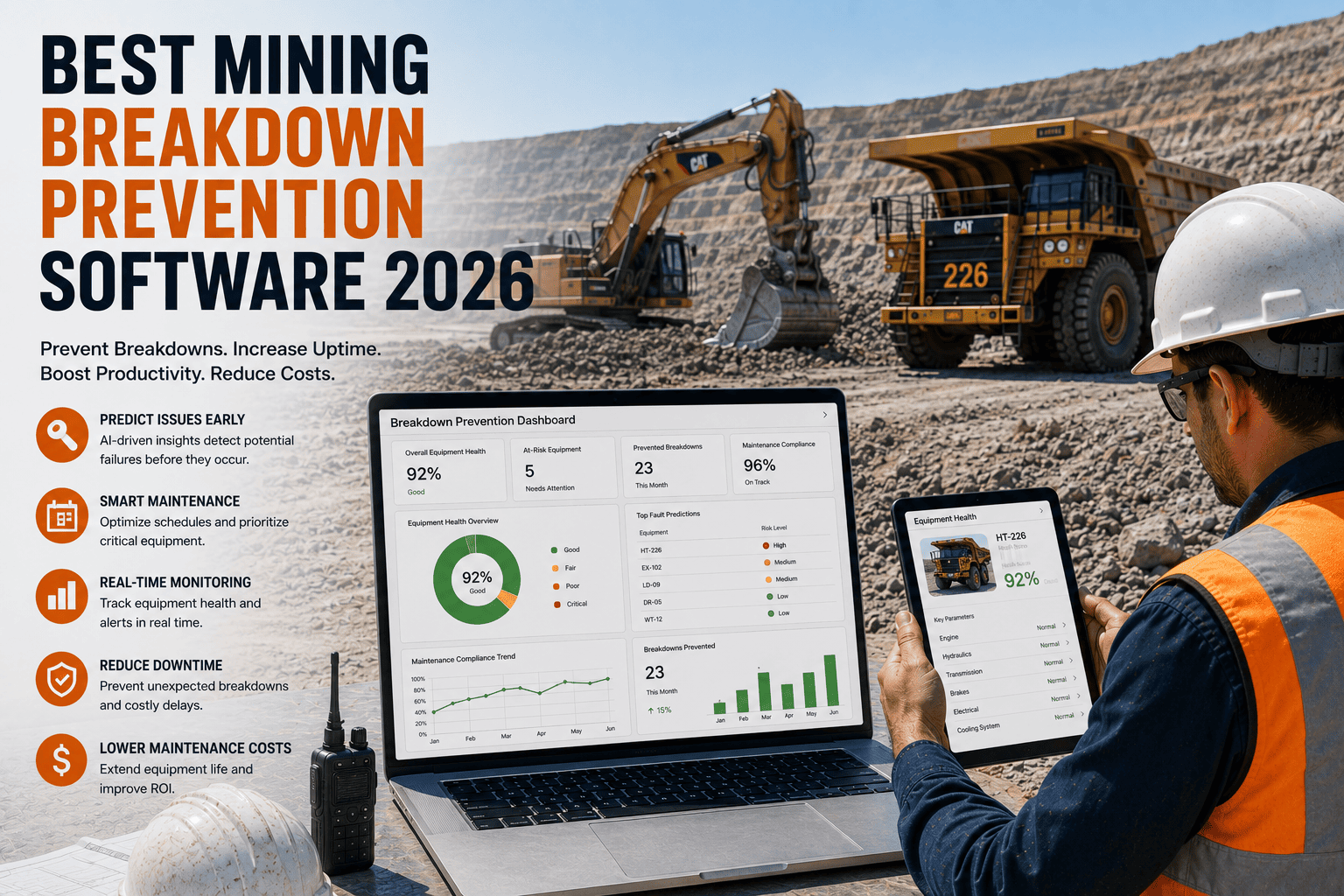
Every major equipment failure leaves a trail before it happens. A bearing runs slightly hotter than normal for two weeks. Oil samples start showing metal particles nobody flags in time. A vibration pattern shifts just enough to matter, but not enough to trip a fixed alarm threshold. The signals are almost always there. The question is whether anything on site is actually watching for them before the failure takes a haul truck out of production for days. Mining breakdown prevention software exists to close exactly that gap, turning scattered condition data into an early warning system instead of a post-mortem report.
The best mining breakdown prevention software combines condition monitoring, preventive maintenance compliance tracking, and predictive analytics to catch developing failures before they take equipment out of production. Unplanned downtime on a single haul truck commonly costs 5,000 to 10,000 dollars per hour, while mines using a layered prevention approach report 30 to 50 percent less unplanned downtime and 18 to 25 percent lower maintenance costs.
Why Breakdown Prevention Needs More Than One Layer
No single tactic prevents every failure. The mines with the fewest surprise breakdowns combine several layers of protection, each catching what the others might miss, rather than relying on one maintenance strategy to cover every failure mode.
Condition Data Reveals What a Calendar Can't
Vibration analysis, oil sampling, and thermal monitoring on critical components like bearings, gearboxes, and hydraulic systems reveal problems developing in real time, catching issues a fixed service schedule would miss entirely until the next scheduled inspection.
Cross-Referencing Signals Separates Real Warnings From Noise
When vibration, oil chemistry, and temperature all trend in the same direction on the same component, that agreement is what separates a genuine developing fault from a sensor hiccup. Software that cross-references these signals automatically catches patterns a technician reviewing one data source at a time would likely miss.
High-Value Components Deserve Priority Monitoring
Gearbox and differential failures on haul trucks are consistently among the most expensive to let happen, since a single unplanned failure on these components can cost tens of thousands of dollars in repairs alone before counting the downtime. Prioritizing monitoring on these systems delivers the fastest return. Teams that want to see this applied to their own fleet can book a demo and walk through it on real equipment data.
FleetRabbit fuses vibration, oil, thermal, and telemetry data into one early-warning system, flagging developing failures before they turn into a shop-floor emergency.
The Prevention Layers a Complete System Should Cover
Breakdown prevention works best as a stack, with each layer catching failure modes the others aren't built to see.
| Layer | What It Catches | Typical Lead Time | Best Suited For |
|---|---|---|---|
| Scheduled Preventive Maintenance | Wear items and known service intervals from OEM guidance | Fixed by calendar or engine hours | Predictable wear components like filters and fluids |
| Vibration and Thermal Monitoring | Bearing wear, misalignment, and overheating components | Days to a few weeks ahead of failure | Motors, crushers, conveyors, drivetrains |
| Oil and Fluid Analysis | Contamination, metal particles, and lubricant breakdown | Weeks ahead in hydraulic and powertrain systems | High-load excavators, haul trucks, gearboxes |
| AI-Based Predictive Analytics | Subtle deviations from a machine's normal operating signature | Up to 30 to 90 days ahead for major components | High-value assets where unplanned failure cost is greatest |
What to Look For in Breakdown Prevention Software
Plenty of platforms promise to prevent breakdowns. Fewer actually combine the data sources and workflows needed to deliver on it consistently.
Fusion of Every Signal Type in One Platform
Vibration, oil analysis, thermal, and telemetry data need to feed into a single system rather than living in separate tools that require manual comparison to spot a pattern.
Learning From Your Fleet's Own Failure History
A model trained only on generic industry thresholds produces far more false positives than one trained on your fleet's actual inspection records, work orders, and past failures, so accuracy should improve the longer the platform runs on your equipment.
Automatic Work Order Generation From Alerts
A flagged warning is only useful if it turns into action. The platform should generate a work order automatically when a developing fault crosses a meaningful threshold, rather than leaving that step to a manual follow-up.
Prioritization by Failure Cost, Not Just Alert Volume
With dozens of assets generating alerts, the software should surface the highest-cost risks first, such as gearbox or differential warnings, instead of burying them under lower-stakes notifications. Fleet teams evaluating this kind of prioritization can start a free trial and see how quickly it surfaces the alerts that matter most.
FleetRabbit cross-references every signal your fleet generates, learns from your own failure history, and turns confirmed warnings straight into work orders your team can act on.
Why Breakdown Prevention Delivers Fast, Measurable Returns
Breakdown prevention software tends to justify itself faster than most mining technology investments, because the math is straightforward. Preventing even a handful of major unplanned failures a year, each costing tens of thousands of dollars in repairs and downtime, typically covers the cost of the platform many times over. Mines applying a layered prevention approach commonly see 30 to 50 percent less unplanned downtime, which translates directly into more scheduled production hours instead of emergency shop time.
The return compounds over time as the system learns your fleet's specific failure patterns. Early alerts get more accurate, false positives drop, and maintenance teams spend less time chasing down noise and more time acting on warnings that matter. Combined with lower parts and labor costs from planned rather than emergency repairs, most operations see a clear return within the first year.
Frequently Asked Questions
FleetRabbit combines every condition signal your fleet generates into one early-warning system, so developing failures get caught and scheduled, not discovered on the shop floor. Start your free trial or book a demo to see it running against your own equipment.