Walk through most mine sites and the trucks get all the attention. Water trucks, graders, service vehicles, and light utility fleet sit in the background, running quietly while nobody tracks how many of those engine hours actually go toward work. That's exactly why idle time on support equipment is one of the largest hidden costs in mining. It doesn't show up as a dramatic breakdown or a missed production target. It shows up as a fuel bill that's higher than it should be and engines that wear out faster than their hour meters suggest, month after month, without anyone noticing until the budget review.
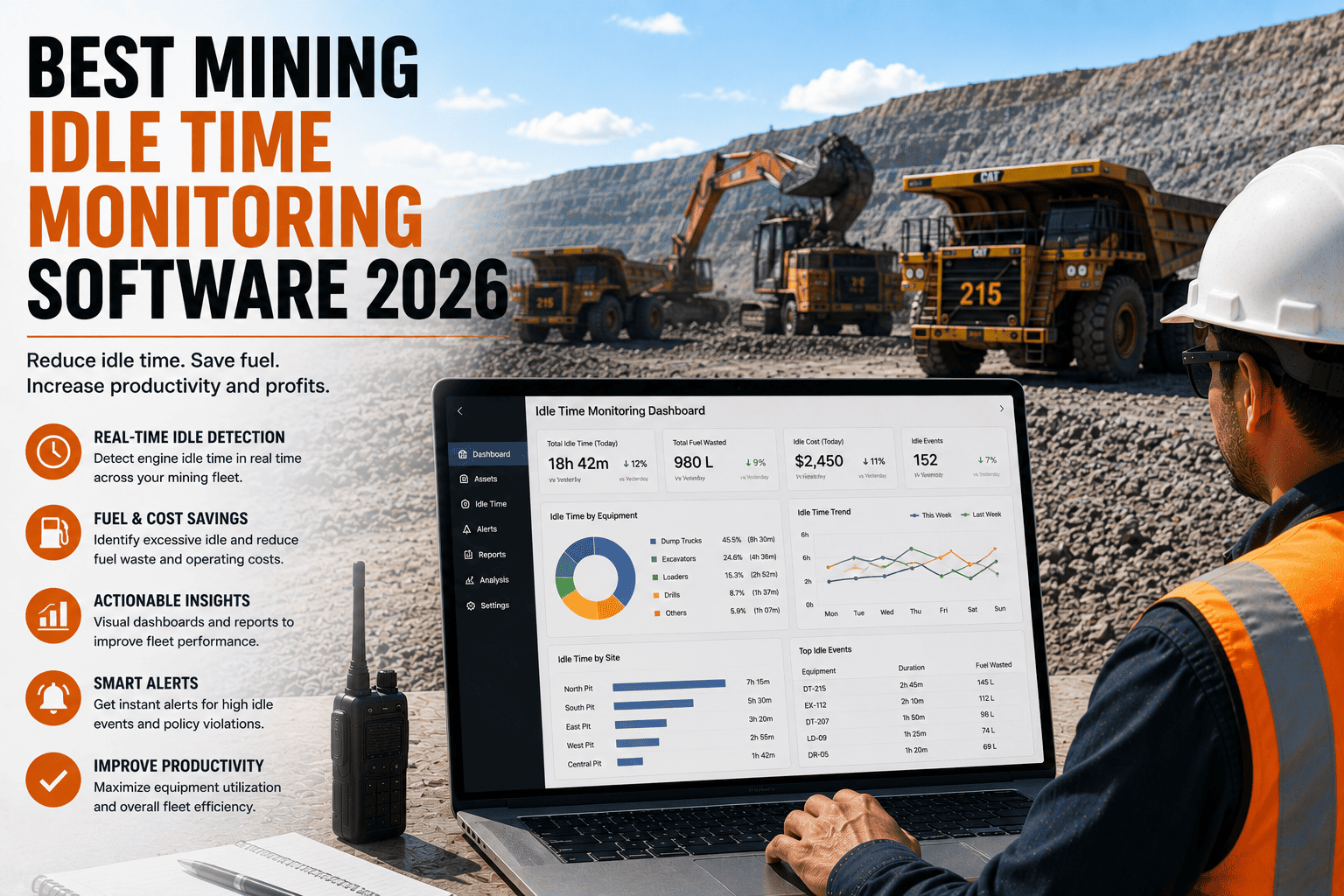
The best mining idle time monitoring software tracks engine-on, work-off hours across every asset, including support equipment like water trucks, graders, and service vehicles, then flags excessive idling in real time. Idle time on mobile mining equipment commonly runs 15 to 20 percent of total engine-on hours, and a single haul truck idling unnecessarily can cost 300 dollars or more per hour once fuel, wear, and lost production are factored in.
Why Idle Time on Support Equipment Stays Invisible
Idle time is easy to ignore precisely because nothing looks wrong. The engine is running, an operator may be in the seat, and the machine appears active on a schedule board. But engine-on time and productive time are two different numbers, and the gap between them is where fuel budgets quietly leak out of a mine's operating cost every single shift.
Support Vehicles Multiply the Problem Across a Larger Count
A mine site typically runs far more support vehicles than production haul trucks, including water trucks, graders, fuel and lube trucks, and light vehicles. Even a modest amount of unnecessary idling per unit adds up quickly once it's multiplied across a support fleet that size, and most sites have no consistent way to see that total.
Idle Time Looks Like Utilization Until Someone Checks
A vehicle parked with the engine running near a work zone can look identical to one that's actively supporting operations, unless the software distinguishes engine-on time from time spent doing real work. Without that distinction, idle hours get counted as utilization and the true cost stays hidden. Mine managers who want to see this gap measured on their own fleet can book a demo and look at the numbers directly.
FleetRabbit tracks idle time across every asset on site, from haul trucks down to water trucks and light vehicles, so nothing burns fuel unnoticed. See where the hidden hours are hiding today.
Where Idle Time Costs the Most Across the Fleet
Idle cost isn't identical across every asset type. Knowing where it concentrates helps a mine prioritize monitoring effort where it pays off fastest.
| Equipment Type | Common Idle Cause | Cost Impact | Monitoring Priority |
|---|---|---|---|
| Haul Trucks | Queuing at shovels, waiting at dump points, blast clearance delays | Can exceed 300 dollars per hour once fuel, wear, and lost production are counted | High, but already widely monitored on most sites |
| Water Trucks and Graders | Left running between road passes or during operator breaks | Lower per-hour cost but high cumulative impact across the support fleet | High and frequently underwatched |
| Service and Lube Trucks | Engine kept running during extended maintenance stops | Adds unnecessary hours toward the next service interval | Medium, worth automated alerting |
| Light Vehicles | Idling during meetings, shift handovers, or waiting periods | Individually small, but the largest unit count on most sites | Medium, best handled with fleet-wide policy rather than manual checks |
What to Look For in Idle Time Monitoring Software
Idle monitoring only creates value if it distinguishes real waste from legitimate engine-on time and turns that distinction into something a dispatcher can act on immediately.
Fleet-Wide Coverage, Not Just Production Equipment
The platform needs to track haul trucks, support vehicles, and light fleet under the same idle policy, since limiting monitoring to production equipment leaves a large share of total idle hours completely unmeasured.
Automated Thresholds Instead of Manual Log Review
Reviewing telematics logs by hand to spot excessive idling doesn't scale past a handful of units. The software should flag any asset exceeding a defined idle threshold automatically, the same shift it happens.
Separation of Necessary and Discretionary Idle Time
Some engine-on time is legitimate, such as auxiliary equipment running or safety-required idling in extreme temperatures. Good software flags these separately so idle scoring reflects real waste rather than penalizing necessary operation.
Engine-Hour Impact on Maintenance Scheduling
Because idle hours still count toward service intervals, the platform should connect idle data to maintenance scheduling so unnecessary idling doesn't quietly pull PM dates forward on the calendar.
Site-Wide Dashboards With Per-Asset Drill-Down
Fleet managers need a single view of total idle cost across the site, with the ability to drill into any specific vehicle or operator pattern driving that number up. Teams ready to see this level of visibility can start a free trial and connect it to their existing telematics feed.
FleetRabbit separates necessary engine-on time from real waste, flags excessive idling automatically, and ties idle hours straight into maintenance scheduling so nothing slips past unnoticed.
The Return on Monitoring Idle Time Across the Whole Fleet
Idle time reduction is one of the fastest-paying investments a mine can make, because the savings start the moment excessive idling is flagged and stopped, with no new hardware or long rollout required. On a fleet running dozens of support vehicles alongside its production equipment, even a modest reduction in average idle hours per unit adds up to a meaningful annual fuel saving once totaled across the site.
The secondary return comes from equipment life. Every idle hour still counts toward the engine-hour clock that drives maintenance scheduling and eventual replacement timing. Cutting unnecessary idling extends the productive life of every asset before it needs major service, which protects capital budgets in addition to the immediate fuel savings.
Frequently Asked Questions
FleetRabbit tracks idle hours across every vehicle on site, from haul trucks to water trucks and light fleet, and turns hidden waste into an alert your team can act on the same shift. Start your free trial or book a demo to see it running against your own fleet.