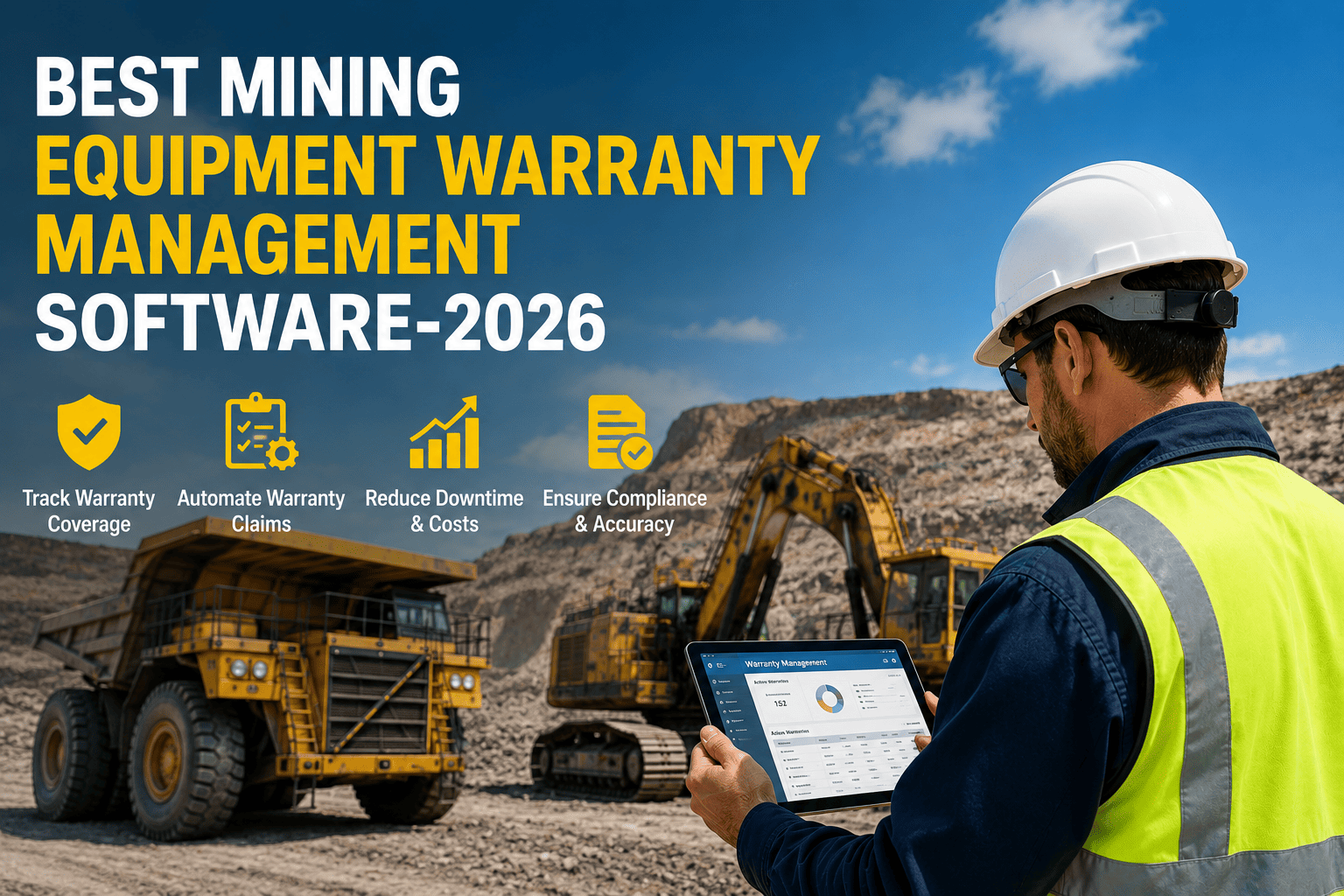
A single haul truck component failing three weeks after its warranty window closes because nobody tracked the hour-meter reading can cost a mine site 40,000 dollars or more in avoided-but-missed OEM coverage. Mining equipment warranty management is not paperwork. It is the difference between an OEM absorbing a repair bill and your operation absorbing it instead. Yet most sites still track coverage windows, hour-based entitlements, and claim deadlines across scattered spreadsheets, email threads, and paper service logs, and every gap in that system quietly becomes a cost your budget was never supposed to carry.
The best mining equipment warranty management software links every asset's OEM coverage terms, service history, and failure evidence in one system, so claims are filed complete and on time instead of denied over a missing inspection record. Industry data shows 10 to 15 percent of submitted warranty claims get flagged or rejected, and manual adjudication commonly takes 18 to 25 days when documentation is scattered across separate tools.
What Mining Equipment Warranty Management Software Actually Does
Mining equipment warranty management software is not a digital filing cabinet for warranty cards. It is a structured, data-driven system that ensures your operation receives every benefit already agreed to in the OEM contract, while protecting uptime and maintaining traceability for every asset, component, and part. At its core, the software centralizes coverage windows, claim procedures, entitlement rules, and documentation requirements into a single source of truth that both maintenance teams and warranty administrators can trust.
Coverage Tracking Across Multiple OEMs
Almost no mining fleet runs equipment from a single manufacturer. Haul trucks, excavators, drills, and support vehicles typically arrive from three or four different OEMs, each with its own coverage windows, hour-based entitlements, and documentation standards. A platform built for mining tracks each OEM's specific terms separately instead of forcing one generic warranty rule across every asset, so a 5,000-hour drivetrain warranty from one manufacturer never gets confused with a 12-month calendar warranty from another.
Evidence Capture Before Repair Begins
The most expensive mistake in warranty management is performing the repair first and checking coverage second. Photographs, fault codes, and diagnostic logs need to be captured immediately after a failure, before that evidence disappears into a repair that has already started. By the time someone realizes a component was actually under warranty, the work is already billed internally, and recovering that cost after the fact is far harder than confirming coverage before a wrench turns.
FleetRabbit links every asset's serial number to its OEM coverage terms, service history, and failure documentation, so claims go out complete on the first submission instead of getting stuck between a breakdown and a denial. You can sign up and load your fleet's warranty data in a single day.
Must-Have Features In Warranty Management Software
Not every asset management tool is built for the realities of a mine site. Remote locations, hour-based rather than calendar-based warranties, and multi-brand fleets all demand specific capabilities. The table below breaks down what to look for and why each feature matters once your equipment is actually in the field.
| Feature | Why It Matters On A Mine Site | What Good Looks Like |
|---|---|---|
| Hour-Meter And Cycle Tracking | Mining equipment warranties are usually tied to operating hours or cycles, not just calendar dates, so a component can lose coverage mid-year without anyone noticing | Automatic sync from telematics or manual meter logs against each component's entitlement threshold |
| Multi-OEM Rule Configuration | A single fleet often mixes several manufacturers, each with different coverage lengths, labour caps, and claim procedures | Separate warranty templates per OEM applied automatically at asset registration |
| Photo And Fault Code Capture | Claims without visual and diagnostic evidence are the easiest for an OEM to question or reject | Mobile capture at the point of failure, attached directly to the asset's service record |
| Deadline Alerts | Filing windows are strict, and a claim submitted late is often denied automatically regardless of validity | Automated reminders sent to the warranty administrator before every coverage or filing deadline |
| Maintenance History Linkage | OEMs frequently require proof the equipment was serviced according to manufacturer requirements before honouring a claim | Every inspection and repair tied permanently to the specific serial number, not a general fleet log |
| ERP And Telematics Integration | Warranty data that lives apart from operational systems creates duplicate entry and gaps at the exact moment a claim needs to be filed | Direct integration so claims, parts, and repair costs post automatically without manual re-entry |
Spreadsheets, Point Tools, Or A Unified Platform
Most mine sites start warranty tracking in a spreadsheet, move to a maintenance point tool as the fleet grows, and eventually hit a wall where neither approach can keep up with claim volume. Understanding where each approach breaks down helps you avoid repeating the same costly gap twice.
Spreadsheets And Manual Logs
Manual tracking works for a handful of assets but collapses once a site runs 20 or more machines across multiple OEMs. Coverage dates get overwritten, hour readings go stale, and nobody notices a filing deadline until the OEM's response arrives with a denial.
Standalone Maintenance Point Tools
Generic maintenance software tracks service schedules well but rarely models OEM-specific entitlement rules, labour rate caps, or region-specific warranty terms, so warranty tracking still ends up bolted on as an afterthought rather than built into the system.
A Unified Mining Asset Platform
Purpose-built platforms combine asset tracking, maintenance history, and OEM-specific warranty rules in one place, so a claim is generated directly from a repair record that already contains every piece of evidence the OEM requires.
FleetRabbit configures each OEM's coverage terms, labour caps, and filing rules separately, so your team never applies the wrong warranty rule to the wrong asset. Book a demo to see your own fleet's coverage data mapped against a live claim workflow.
How To Evaluate Vendors For Your Mine Site
Choosing warranty management software is a multi-year commitment, since switching platforms mid-fleet means re-mapping every OEM contract from scratch. A short evaluation checklist keeps the decision grounded in what your site actually needs rather than a generic feature list.
Confirm hour-based entitlement support
Ask the vendor directly whether the platform tracks warranty by operating hours and cycles, not just calendar dates. Mining equipment lives and dies by hour-meter readings, and a system built for retail or automotive warranty rarely handles this correctly out of the box.
Check documentation requirements per OEM
Every manufacturer has slightly different evidence requirements for a valid claim. A platform worth adopting lets you configure these per OEM rather than forcing a single documentation template across every brand in your fleet.
Test the mobile field experience
Failures happen at the pit, not at a desk. Confirm technicians can capture photos, fault codes, and signatures directly from a remote site with full cloud sync, since a system that only works from an office defeats the purpose.
Getting Your Fleet Onboarded
Most operations already have the data warranty management software needs. It just lives in scattered places. Loading an existing asset list, OEM coverage terms, and service history into a purpose-built platform is mostly an import exercise rather than a rebuild, and most mine sites get their core data loaded within a single day. From there, deadline alerts and entitlement rules start working immediately, and the first claim filed through the system is usually the first one that goes out complete on the first attempt.
Frequently Asked Questions
Key Takeaways
Mining equipment warranty management is a structural discipline, not a paperwork chore. Every hour-meter reading missed, every filing deadline that slips, and every repair started before coverage is confirmed converts an OEM-funded repair into a cost your own budget absorbs instead. The gap between sites that recover what they are owed and sites that quietly write off legitimate claims almost always comes down to whether coverage terms, service history, and failure evidence live in one connected system or across a dozen disconnected ones.
A purpose-built platform closes that gap by tying every OEM's specific rules to the exact asset they apply to, capturing evidence the moment a failure happens, and alerting your team before a filing window closes rather than after. The fleets that adopt this approach stop treating warranty recovery as luck and start treating it as a predictable, recoverable line item on their maintenance budget.
FleetRabbit connects every mining asset's OEM coverage, service history, and failure evidence in one platform, so claims go out complete and on time instead of getting denied over missing paperwork. Sign up free and load your fleet's warranty data today, or book a demo to see it mapped against your own OEM contracts.