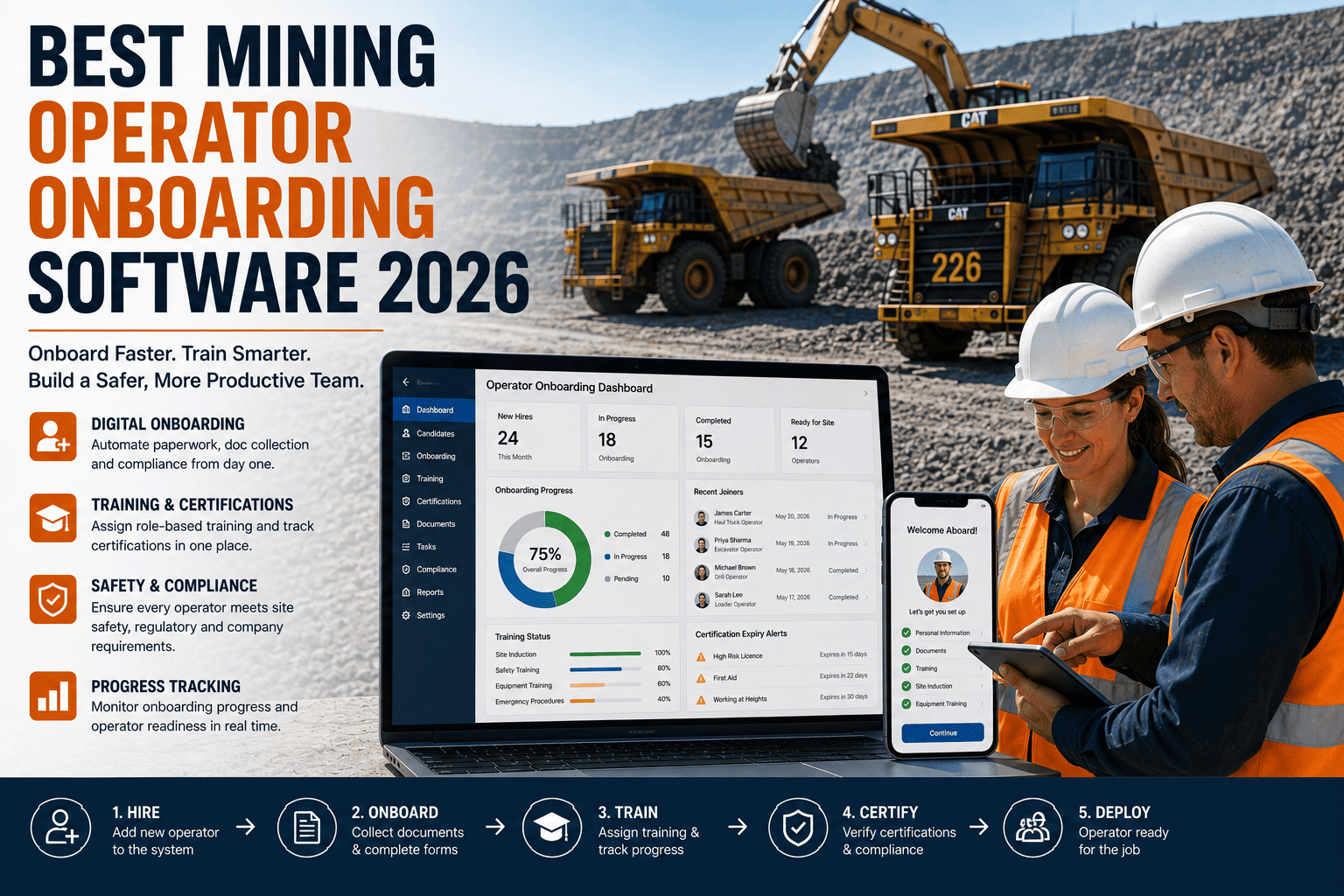
A new operator's first weeks on site are the most dangerous stretch of their entire career at that mine. Classroom training hasn't been tested against real production pressure yet, equipment feels unfamiliar, and terrain doesn't match anything covered in orientation. This is exactly the window where onboarding either sets someone up to work safely or quietly sets them up to become a statistic. Most mines still run onboarding through a mix of paper checklists, spreadsheets, and someone's memory of who's cleared to run what equipment. Mining operator onboarding software replaces that guesswork with a structured path from hire date to fully authorized, so no new operator ends up on equipment they haven't been cleared to run.
The best mining operator onboarding software manages certification verification, statutory new miner training, task-specific equipment authorization, and assignment tracking in one connected workflow. New operators face the highest injury risk in their first months on the job, and workers injured in their first year represent a disproportionate share of all workplace injuries, making a structured onboarding process one of the highest-leverage safety investments a mine can make.
The Onboarding Window That Determines Safety Outcomes
Getting a new operator from hire date to fully productive involves more steps than most sites formally track: identity and prior training verification, statutory new miner training, task-specific certification for the equipment they'll actually run, and a period of closer supervision once they start real shifts. Skipping or rushing any one of these steps doesn't usually cause an immediate problem. It quietly increases the odds of one happening later.
Statutory Training Sets the Floor, Not the Finish Line
New miner training requirements typically call for 24 hours of instruction for surface operations and 40 hours for underground, covering hazard recognition and emergency response. That training satisfies the regulatory minimum, but it happens before an operator has faced a single hour of real production pressure, which is exactly where the gap between training and practice tends to show up.
Refresher and Task-Specific Training Compounds the Safety Return
Ongoing refresher training has been shown to reduce incident rates by around 45 percent through reinforced knowledge and updated procedures. A structured onboarding process that carries this same discipline into task-specific and equipment certification pays off well beyond the first week on site. Mines that want to see this tracked automatically for every new hire can book a demo and walk through the workflow directly.
FleetRabbit tracks certification verification, statutory training, and equipment authorization in one workflow, so no new hire ends up on a machine they haven't been cleared to run.
The Onboarding Stages a Platform Should Manage
A structured onboarding workflow moves a new operator through a consistent sequence, with each stage verified before the next one opens up.
| Stage | What It Covers | Common Failure Point | What Software Fixes |
|---|---|---|---|
| Pre-Hire Verification | Confirming identity and any prior training or certification from previous sites | No searchable record to confirm claimed prior training quickly | Digital verification against a shared or importable training record |
| Statutory New Miner Training | Required surface or underground hours covering hazard recognition and emergency response | Completion tracked on paper, hard to confirm before an inspection | Digital records aligned to regulatory certificate formats |
| Task-Specific Certification | Training tailored to the specific equipment or role a new operator will handle | Certification never logged, or assigned equipment doesn't match training | Certification tied directly to equipment authorization |
| Equipment Assignment | Matching a cleared operator to the specific machine they're authorized to run | Assignment made based on availability rather than verified authorization | Assignment blocked automatically if certification is missing or expired |
| Early-Shift Monitoring | Closer observation and performance tracking during the first weeks on shift | Risk indicators go unnoticed once formal onboarding week ends | Performance and safety data tracked continuously past onboarding |
What to Look For in Operator Onboarding Software
Digitizing a checklist isn't the same as building a safe, fast path to full authorization. A handful of capabilities separate the platforms that genuinely reduce onboarding risk from ones that just move paperwork online.
Certification Tied Directly to Equipment Authorization
The system should prevent an operator from being scheduled onto a machine unless their task-specific certification for that exact equipment is verified and current, not just their general training status.
Fast Verification for Contractors and Transfers
Workers arriving from other sites or contractors need their prior training confirmed quickly, without waiting on a phone call or an email to a previous employer's HR department.
Mobile Access From the Pit and the Site Office
Supervisors need to verify a worker's authorization status from wherever they're standing, whether that's the site office or the loading area, not just from a desktop back at headquarters.
Automatic Alerts Before Certifications Lapse
The platform should flag expiring certifications well ahead of the deadline, since a lapsed credential that goes unnoticed for weeks creates both a safety gap and a compliance exposure.
Continuity Into Post-Onboarding Performance Tracking
Onboarding shouldn't end the moment a new hire is authorized. The software should carry that same operator's record into ongoing performance and safety tracking, since the first months on shift remain a higher-risk period even after formal onboarding wraps up. Teams that want to see this continuity in action can start a free trial and follow a new hire's record through the full workflow.
FleetRabbit links every operator's certification status directly to the equipment they're scheduled to run, so authorization gaps get caught before a shift starts, not after an incident.
Why the Return on Onboarding Software Is Easy to Justify
Structured onboarding pays back in two ways that matter to very different parts of the business. On the safety side, workers injured in their first year on the job represent a disproportionate share of all workplace injuries, and a mine that tightens its onboarding process directly targets the window where that risk concentrates. Fewer first-year incidents mean fewer investigations, fewer lost work days, and less exposure during regulatory inspections.
On the operations side, faster and more reliable verification means new operators reach full productivity sooner, since supervisors aren't left guessing whether someone is actually cleared for the equipment in front of them. That confidence lets scheduling move faster during crew shortages instead of stalling while someone tracks down a paper certificate.
Frequently Asked Questions
FleetRabbit turns operator onboarding into one connected workflow, from certification verification through equipment authorization, so every new hire starts production ready, documented, and correctly assigned. Start your free trial or book a demo to see it set up for your workforce.