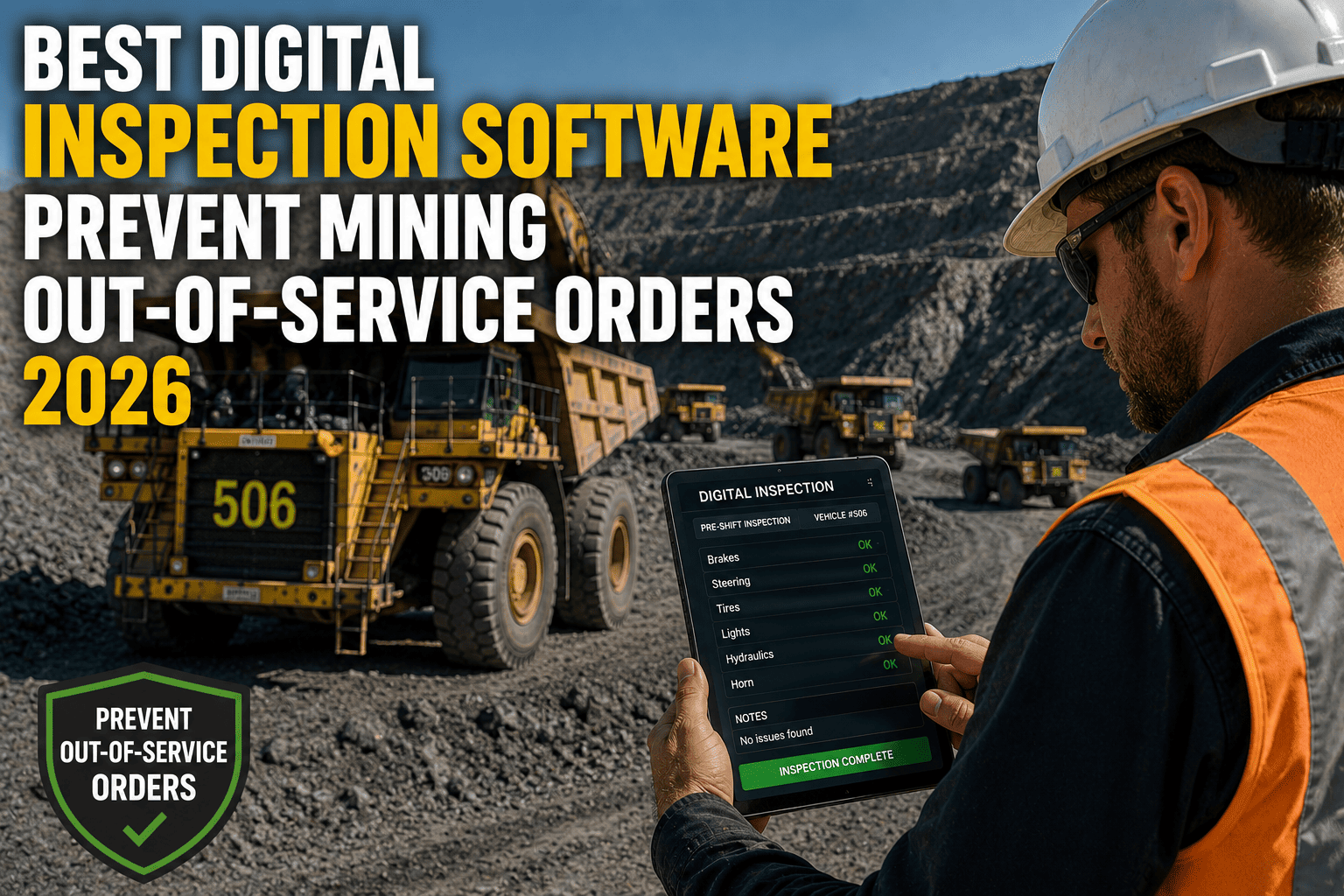
Every mining shift begins with a decision that carries legal weight: is this equipment safe to operate? Under Title 30 CFR, the answer must be documented before the first turn of a wheel. When that documentation lives on paper, the risk is enormous — forms vanish in pit dust, defects die on clipboards, and when MSHA arrives asking for 90 days of records, your compliance manager spends hours in a filing cabinet instead of seconds on a screen. Digital inspection software changes that equation entirely, turning a legal obligation into a competitive advantage. If your operation is still running paper checklists, every shift is a citation waiting to happen.
Failure to conduct pre-shift examinations is among the most frequently cited MSHA violations. An out-of-service order on a haul truck costs $15,000–$40,000 per day in lost production. Digital inspection software prevents these orders by ensuring every pre-shift check is completed, photo-verified, and audit-ready — before equipment leaves the pit.
Why Paper Inspections Are Killing Your Compliance
Mining operations run on tight margins and tighter schedules. A 100-ton haul truck sitting out-of-service because an inspector flagged a missed brake check isn't just a safety failure — it's a production catastrophe. The problem isn't that your operators skip inspections. The problem is that paper makes it impossible to prove they didn't. MSHA inspects surface mines twice a year and underground mines four times. Every pre-shift record, every defect report, every corrective action is subject to review. Sign up for FleetRabbit and give your team the digital backbone that paper can't provide.
What Makes Mining Inspection Software Different
Generic safety apps weren't built for haul trucks, open pit environments, or underground drives with zero connectivity. Mining inspection software must solve problems that no warehouse-focused CMMS was designed for. Before you evaluate any platform, understand the six capabilities that separate purpose-built mining tools from everything else. You can also book a demo to see how FleetRabbit handles all six in a live 30-minute session.
Offline-First Mobile Inspections
Operators in remote pit areas and underground drives must complete inspections without connectivity. Software that requires internet fails at the most critical moment. True offline capability means inspections sync automatically the instant signal returns — no data loss, no manual re-entry.
QR-Scan Equipment Auto-Load
Operators scan a QR code and the exact checklist for that asset loads automatically — haul truck, loader, excavator, dozer, or drill. No generic forms that miss mining-specific items. No manual selection errors. The right inspection, every shift, every time.
Photo-Verified Critical Items
MSHA inspectors check brakes, tires, ROPS, and fire suppression first. Digital inspections must require photographic evidence on these critical systems — GPS-tagged, timestamped, and impossible to bypass. A checkbox without a photo isn't compliance; it's liability.
Engine-Hour PM Scheduling
Mining equipment is maintained in engine hours, not calendar days. Software must pull live telematics data, calculate next-due dates automatically for every asset, and generate work orders before trucks go overdue. Manual tracking keeps PM compliance at 60–70%. Automated scheduling pushes it above 95%.
One-Click MSHA Audit Export
When MSHA arrives, you need 90 days of inspection records immediately. A compliance dashboard showing inspection completion by equipment, shift, and operator — exportable in one click — is the only acceptable answer. Retrieving paper files during an inspection is a red flag.
Defect-to-Work-Order Automation
A defect found during inspection must automatically block equipment dispatch and generate a maintenance work order — not sit on a clipboard until the next shift. The chain from defect discovery to repair completion to return-to-service must be digital, documented, and traceable.
MSHA Out-of-Service Orders: What Triggers Them and How to Prevent Them
An MSHA out-of-service order isn't just a fine — it's an immediate production stoppage with no timeline for resolution until the cited condition is corrected and verified. Understanding what triggers these orders is the first step to preventing them. The most commonly cited violations share one pattern: they were preventable with a consistent pre-shift inspection program.
| Violation Type | Trigger Condition | Citation Risk | Digital Prevention |
|---|---|---|---|
| Missed Pre-Shift Inspection | No documented inspection before equipment operation | High | Auto-timestamp and operator sign-off required before dispatch |
| Brake System Defects | Worn pads, air system faults, or parking brake failure | High | Mandatory photo capture with auto-block on failed brake items |
| ROPS / FOPS Damage | Cracked or missing rollover protection structures | High | Visual inspection with photo verification and defect flagging |
| Overdue Preventive Maintenance | Engine hours exceed PM interval without service record | Medium | Engine-hour tracking with automated work orders before due date |
| Missing Audit Records | Unable to produce 90-day inspection history | High | Cloud storage with one-click date-range export for any asset |
| Backup Alarm Failure | Alarm inaudible or non-functional on reverse | Medium | Checklist line item with pass/fail verification and defect routing |
FleetRabbit for Mining Operations
Digital pre-shift inspections, engine-hour PM scheduling, defect-to-work-order automation, and one-click MSHA audit exports — all in one platform that deploys in under a day. No IT team. No long-term contract. Setup from your first shift.
The Full Pre-Shift Inspection Checklist: What MSHA Actually Requires
Under 30 CFR Parts 56 and 57 (surface and underground metal/nonmetal) and Parts 75 and 77 (coal), every piece of self-propelled equipment must be inspected by the operator who will run it before each shift. The regulation is explicit: the inspection must be performed by a competent person, defects must be reported, and unsafe equipment must be tagged out of service until repaired. Here is what a complete, MSHA-aligned inspection covers for heavy mining equipment.
Brakes & Steering
- Service brake holding and response
- Parking brake function
- Brake lights operational
- Air system integrity
- Steering fluid level and leaks
ROPS / FOPS
- Structure intact, no cracks or deformation
- Mounting bolts tight and secure
- Certification tags legible
- Falling object guards in place
Fluids & Engine
- Engine oil level and visible leaks
- Coolant level and condition
- Hydraulic fluid level
- Fuel level and fuel system leaks
- Brake fluid level
Fire Suppression
- Extinguisher pressure and inspection tag
- Automatic suppression system armed
- Cylinder condition and mounting
- Discharge nozzle condition
Tyres & Tracks
- Tyre pressure and visible damage
- Tread depth and wear patterns
- Track tension and condition
- Wheel hardware torque indicators
Communications & Alarms
- Radio function and channel verification
- Backup alarm audibility at MSHA standard
- Horn function
- Engine warning alarm operation
A generic vehicle inspection form misses mining-specific items like ROPS, fire suppression system checks, and backup alarm MSHA distance standards. MSHA inspectors check these items first. Sign up for FleetRabbit to access MSHA-aligned inspection templates pre-built for haul trucks, excavators, loaders, dozers, and drills — ready to deploy from your first shift.
Surface vs. Underground Mining: Different Compliance Demands
MSHA treats surface and underground operations differently, and your inspection software must reflect those differences. Surface mines operating under Parts 56 and 57 face roughly twice-yearly MSHA inspections with every pre-shift record subject to review. Underground operations governed by Parts 75 and 77 for coal, and Part 57 for metal/nonmetal, face four inspections annually — and add ventilation testing, atmospheric monitoring, escapeway checks, and refuge chamber documentation to the standard equipment inspection requirement.
How FleetRabbit Prevents Out-of-Service Orders: The Full Workflow
FleetRabbit isn't a generic checklist app adapted for mining. It was built for the specific workflow that mining compliance demands — from the moment an operator approaches a haul truck at shift start to the moment an MSHA inspector asks for records. Book a 30-minute demo to see the full workflow live on an active mine site deployment.
Operator Scans QR Code at Equipment
The correct checklist for that specific asset auto-loads on the operator's phone. Haul truck, excavator, loader, or drill — each gets its own MSHA-aligned template with the right items in the right sequence.
Inspection Completed Offline or Online
Works completely offline in the pit or underground. Critical items require photos. Timestamped and GPS-tagged automatically. Submits when connectivity returns — no data loss, no gaps in the record.
Defects Trigger Automatic Action
A failed item instantly generates a maintenance work order, notifies the maintenance team, and blocks equipment dispatch. The machine is tagged out-of-service digitally until the repair is recorded and verified.
Compliance Dashboard Updates in Real Time
The mine manager sees inspection completion rate by shift, equipment, and operator as it happens. No missed inspections go unnoticed. No defect falls through the gap between the pit and the maintenance bay.
MSHA Arrives — Records Ready in Seconds
Filter by equipment, date range, or operator. Export 90 days of inspection records, training certifications, and incident reports with one click. What used to take hours in a filing cabinet now takes 30 seconds.
ROI of Digital Inspection Software in Mining
The financial case for digital inspection software in mining is straightforward. One prevented out-of-service order on a primary haul truck pays for an entire year of software subscription across a 50-asset fleet. But the real ROI extends across several areas that operations managers often undercount until they run the numbers.
Out-of-Service Orders
Per day in lost production when a primary haul truck is taken out of service by MSHA. One prevention per year covers annual software cost for most operations.
Emergency Repair Premium
Unplanned repairs cost four to five times more than scheduled maintenance for identical components. Digital PM scheduling eliminates the emergency premium.
Compliance Admin Time
Hours spent retrieving paper records during MSHA inspections, eliminated by one-click audit export. Compliance managers focus on operations, not filing cabinets.
PM Compliance Rate
Operations using manual tracking average 60–70% PM compliance. Automated engine-hour scheduling pushes this above 95% within the first month of deployment.
Start Your Free Trial Today
FleetRabbit is self-serve and requires no hardware, no IT team, and no enterprise contract. Add your equipment, configure inspection templates, and go live before the next shift change. $5 per asset per month. Start free with no credit card required.
Frequently Asked Questions
Key Takeaways
MSHA out-of-service orders are not random events — they are the predictable result of inspection programs that rely on paper, clipboards, and manual recordkeeping in environments where those systems consistently fail. Every missed pre-shift inspection, every defect that dies on a clipboard before reaching a mechanic, and every filing cabinet that can't produce 90 days of records during an audit is a citation waiting to happen. Digital inspection software doesn't just digitize a paper form. It closes the compliance chain from the moment an operator approaches equipment to the moment an MSHA inspector arrives on site.
The question for mine operators in 2026 isn't whether to go digital — it's how quickly you can deploy before your next scheduled MSHA inspection. With FleetRabbit deploying in under a day at $5 per asset per month, the barrier to compliance transformation is lower than it has ever been. Start your free trial or book a 30-minute demo to see exactly what changes on your site from the first shift.
Surface mines get inspected twice a year. Underground mines four times. Every pre-shift inspection record will be reviewed. Deploy FleetRabbit before that date and walk into every MSHA audit with complete confidence — records ready in 30 seconds, zero compliance gaps, full audit trail for every asset.