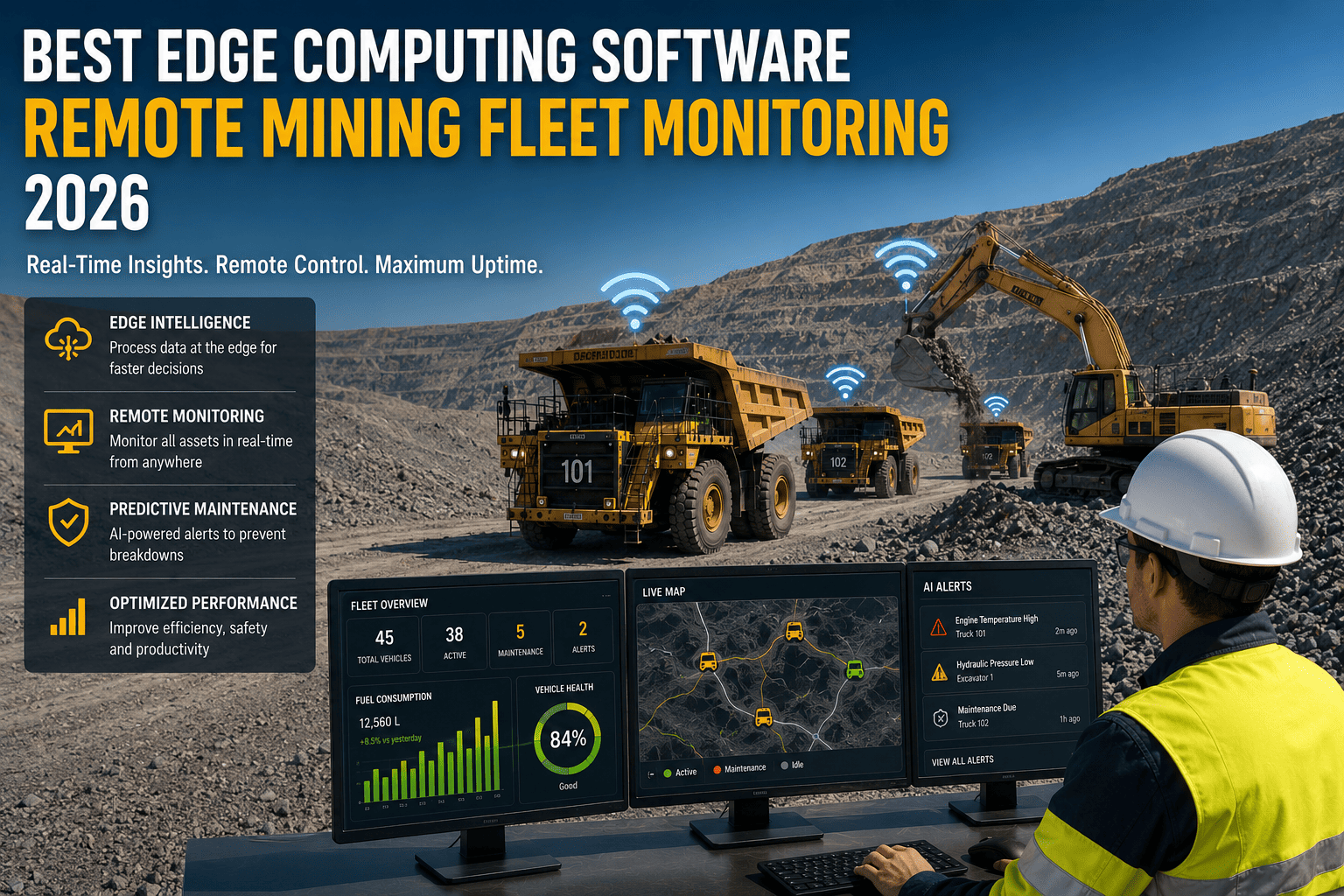
Mining operations often take place in remote areas where internet connectivity is unreliable or unavailable. Edge computing software processes fleet and equipment data directly on-site, enabling real-time monitoring, predictive maintenance, and faster operational decisions without relying on constant cloud access. In 2026, solutions like FleetRabbit help mining companies improve equipment uptime, synchronize data when connectivity is restored, and maintain continuous visibility across remote mining fleets.
Deep underground, on remote hillsides, in areas with zero connectivity — your mining fleet never stops. Your monitoring software shouldn't either. Edge computing makes that possible.
Remote mining operations are expanding into increasingly isolated terrain. Copper deposits in the Andes, lithium mines in the Atacama, iron ore sites across the Pilbara — these are not places with reliable 4G or fiber. Yet the pressure to maximize fleet uptime, reduce fuel waste, and stay compliant has never been greater. Edge computing software bridges the gap between the harsh reality of remote sites and the data-driven standards modern mining demands. FleetRabbit is built for exactly this environment.
What Is Edge Computing in Mining Fleet Monitoring?
Edge computing processes data locally — on the vehicle, at the site gateway, or in an on-premise server — rather than routing everything to a distant cloud. In mining fleet monitoring, this means your haul trucks, excavators, and service vehicles continue capturing and acting on critical data even when the satellite link drops or the LTE signal disappears into a canyon wall.
Traditional fleet management software assumes constant connectivity. When that assumption breaks in a remote mine, you're flying blind. Edge computing software flips the architecture: the intelligence lives at the edge, and the cloud becomes an optional sync destination rather than a single point of failure. You can book a demo to see how FleetRabbit handles offline operations with zero data loss.
The Three Layers of Edge Architecture for Mining Fleets
On-Vehicle Edge
Sensors and telematics hardware installed directly on each machine. Captures engine health, GPS coordinates, fuel burn, payload data, and driver behavior. Stores and processes locally when offline, syncs when connectivity returns.
Site Gateway Layer
A rugged on-premise computing node (often inside a site office or communications tower) that aggregates data from the entire local fleet. Runs analytics, generates alerts, and manages data synchronization schedules for the whole site.
Cloud Synchronization
When connectivity is available, data syncs bidirectionally to the cloud. Central operations teams get a unified view across all sites. Maintenance schedules, software updates, and compliance reports flow back to the edge.
Why Remote Mining Fleets Demand Edge-First Software
The challenges facing remote mining operations are unlike any other fleet environment. A delivery truck losing connectivity in a city is a minor inconvenience. A 250-tonne haul truck losing monitoring in a copper mine 200 km from the nearest town is an operational, safety, and financial crisis waiting to happen.
Zero Connectivity Zones
Underground mines, deep open pits, and remote high-altitude sites have no reliable internet. Cloud-dependent software simply stops working. Edge software keeps running, logging every metric, every minute.
Safety-Critical Decisions
Gas leaks, slope instability, brake failures — these demand immediate alerts. Waiting for data to travel to a cloud server and return adds dangerous latency. Edge processing triggers safety responses in milliseconds, locally.
Equipment Downtime Costs
A single haul truck out of service can cost $40,000–$80,000 per day in lost production. Predictive maintenance powered by edge AI catches failure signals before breakdown occurs, scheduling repairs during planned downtime.
Data Volume Overload
A single mining truck generates gigabytes of sensor data per shift. Sending all of it to the cloud via satellite is prohibitively expensive. Edge software filters, compresses, and intelligently routes only the data that matters.
Compliance Without Connectivity
Regulatory requirements for driver hours, equipment inspections, and emissions don't pause because your satellite link is down. Edge software maintains compliant records locally and syncs them when connectivity resumes.
Extreme Environmental Conditions
Dust, vibration, temperature extremes, and electromagnetic interference are daily realities in mining. Edge hardware and software must be designed for these conditions — not consumer-grade cloud connectors bolted onto fleet tools.
Key Features to Look for in Mining Fleet Edge Computing Software
Not all fleet management software marketed as "edge-ready" is built for the realities of remote mining. When evaluating platforms in 2026, these are the capabilities that separate genuine edge solutions from cloud software with an offline checkbox. Sign up with FleetRabbit to access all of these in one integrated platform.
| Feature | What It Does | Mining Impact |
|---|---|---|
| Offline-First Data Logging | Captures 100% of vehicle data locally with no connectivity required. Stores for days or weeks if needed. | No data gaps during underground operations or satellite outages |
| Edge AI Predictive Maintenance | Runs machine learning models on the vehicle or site gateway to detect anomalies in engine, transmission, and hydraulic data. | Predicts failures 3–14 days in advance, enabling planned repair scheduling |
| Intelligent Data Sync | Prioritizes which data to transmit first when bandwidth is limited. Critical alerts go first, raw telemetry batches later. | Reduces satellite bandwidth costs by 60–80% while maintaining operational visibility |
| Real-Time Site Dashboard | Local dashboard accessible via site LAN or mesh radio with full fleet visibility even without internet. | Site supervisors see the complete fleet picture regardless of external connectivity |
| Rugged Hardware Compatibility | Supports certified industrial-grade telematics units rated for mining environments (IP67+, wide temperature range). | Hardware survives the dust, vibration, and temperature swings of active mining sites |
| Multi-Site Central Console | When sites sync, operations centers get a unified view across all remote locations with historical and real-time data. | Corporate fleet managers and maintenance directors see everything from one screen |
How FleetRabbit Powers Remote Mining Fleet Monitoring
FleetRabbit was designed for fleets that operate where other software fails. Its edge-first architecture means your mining vehicles are fully monitored and managed whether they have a perfect 5G signal or no signal at all. The platform is purpose-built for the realities of industrial fleet management — not adapted from a ride-sharing app or a last-mile delivery tool.
Offline Fleet Tracking That Never Misses a Moment
FleetRabbit's on-vehicle module logs GPS position, speed, engine parameters, fuel consumption, and driver behavior continuously. When connectivity is absent — which in remote mining can mean hours or days — every data point is stored locally and queued for synchronization. When the link returns, data syncs automatically with full timestamp accuracy. Your fleet history is always complete. Book a demo to see offline logging in action.
Predictive Maintenance at the Edge
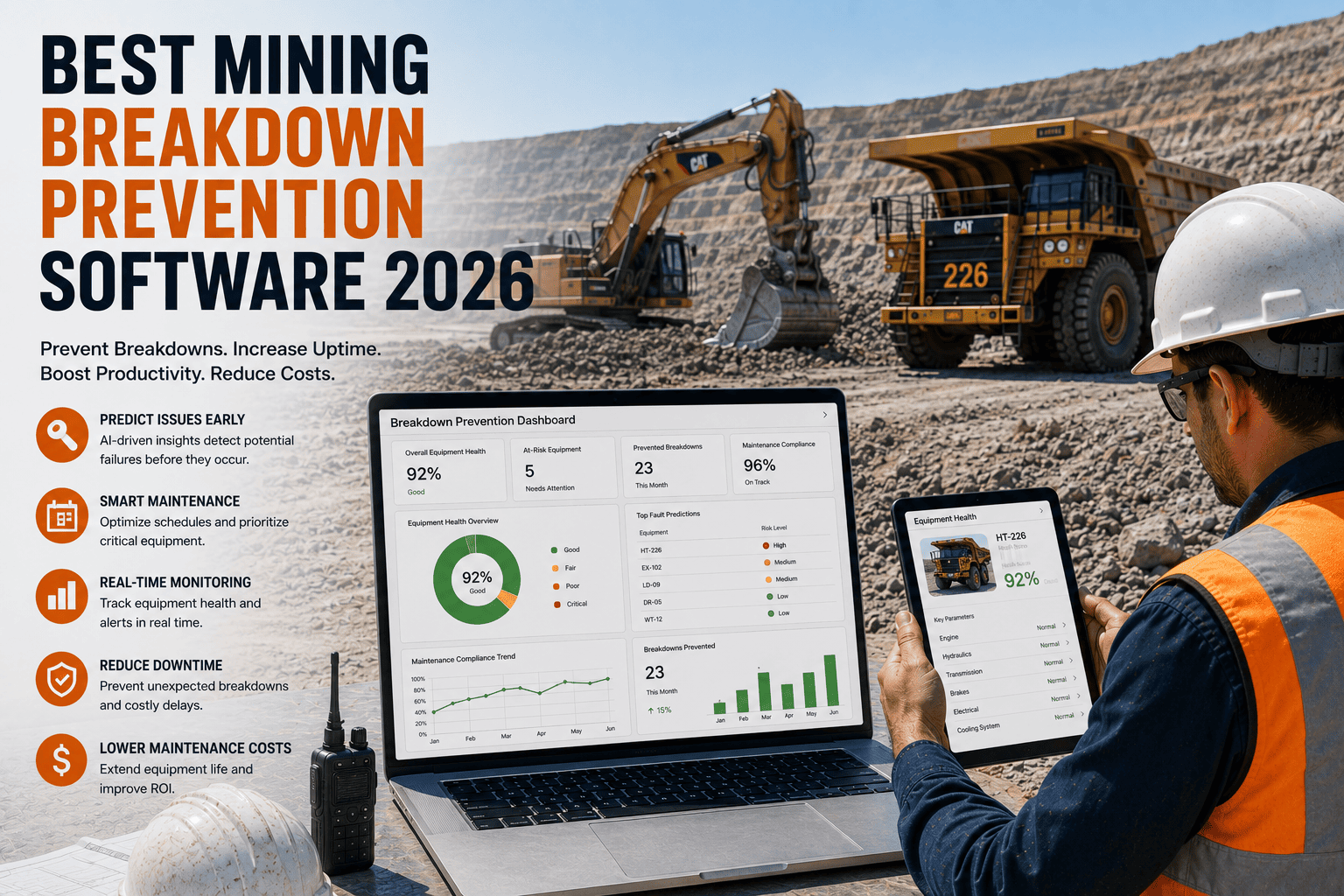
The most expensive thing in a remote mine is a surprise breakdown. FleetRabbit's predictive engine analyzes sensor streams in real time — engine temperature trends, vibration signatures, oil pressure anomalies — and generates maintenance alerts before components fail. Because this analysis runs at the edge, it doesn't wait for a cloud round-trip. A site mechanic gets notified on their tablet within seconds of an anomaly being detected, even underground.
Intelligent Synchronization for Low-Bandwidth Environments
Satellite bandwidth at remote mining sites is expensive and limited. FleetRabbit's sync engine is intelligent by design. Critical alerts and safety events transmit immediately via whatever bandwidth is available. Routine telemetry and historical logs batch-sync during scheduled windows — often overnight when bandwidth costs drop. Mining operations using FleetRabbit typically reduce satellite data consumption by 65–75% compared to legacy cloud-dependent fleet systems.
FleetRabbit's edge computing architecture keeps your remote mining fleet fully monitored, your predictive maintenance running, and your compliance records intact — even deep underground or hundreds of kilometers from the nearest cell tower. Start with 3 vehicles, no credit card required.
Real-World Applications: Edge Computing Across Mining Fleet Types
Edge computing software delivers different but equally critical value across the full spectrum of mining fleet equipment. Understanding how it applies to your specific equipment mix helps in evaluating which platform is the right fit for your operation.
Haul Trucks
The highest-value assets on any mine site. Edge monitoring tracks payload, cycle times, fuel burn, and tire pressure in real time. Predictive maintenance prevents catastrophic drivetrain failures that can cost $200K+ per incident.
Excavators & Shovels
Hydraulic system health, swing bearing wear, and bucket tooth monitoring via edge AI. Downtime for a rope shovel in a hard rock mine can stall the entire production chain — early warning is essential.
Dozers & Graders
Track tension, final drive temperature, and blade wear monitored continuously. Edge alerts let operators and site mechanics address issues during shift changes rather than during production.
Personnel Carriers
Driver behavior monitoring, fatigue detection alerts, and route compliance logging — all stored and processed locally. Safety-critical data for the most vulnerable people on the mine site.
Fuel & Service Trucks
Fuel dispensing records, service completion logs, and compliance documentation captured offline and synced to central records. Eliminates paper-based processes that create audit risks.
Auxiliary Equipment
Compressors, generators, pumps, and conveyors — often overlooked but equally capable of causing production stoppages. Edge sensors bring the same predictive intelligence to support equipment as to primary fleet.
What the Numbers Say: ROI of Edge Computing in Mining
The business case for investing in edge computing software for remote mining fleet monitoring is not theoretical. It is built on measurable outcomes that mining companies are documenting in 2025 and 2026. Sign up for FleetRabbit and begin capturing this value within weeks of deployment.
Edge predictive maintenance catches developing faults before they become failures, dramatically reducing the reactive repair cycles that dominate reactive maintenance budgets.
Each recovered week of haul truck availability translates to tens of thousands of dollars in additional production throughput, directly improving site output metrics.
Preventive maintenance enabled by edge software costs a fraction of emergency repairs. The same brake component costs 4–5x more to replace after failure than during a planned service window.
Comparing Edge Computing Approaches: What to Ask Any Vendor
When evaluating edge computing software for your mining fleet operation in 2026, the marketing language can obscure real capability differences. Use these questions to cut through the noise and identify which platforms are genuinely built for remote mining versus which are cloud-first tools with offline mode bolted on as an afterthought.
Five Questions That Reveal the Truth
How long can the system operate offline before data integrity is compromised?
Genuine edge software stores data indefinitely until sync is possible. Cloud-dependent systems typically fail or lose data after hours or days without connectivity. Any answer shorter than "as long as needed" is a warning sign.
Where does predictive maintenance analysis actually run?
If the answer is "in our cloud," the system cannot generate maintenance alerts during connectivity outages. True edge AI runs the analysis on the vehicle or site gateway, generating alerts regardless of connectivity status.
Can site supervisors access a real-time fleet dashboard without internet?
A site-local dashboard accessible via on-premise LAN or mesh radio is essential for operational teams on the ground. If supervisors need the internet to see their fleet, they're blind during outages.
How does the system handle data synchronization conflicts after a long offline period?
Sophisticated conflict resolution is essential when multiple data sources sync after extended offline periods. Ask for specifics about timestamp-based conflict resolution and data validation on sync.
What is the hardware certification level for on-vehicle and site gateway components?
Mining environments demand IP67 dust/water protection, wide operating temperature ranges, and vibration resistance ratings. Consumer-grade hardware will fail. Ask for the specific certifications, not general descriptions.
Implementation: Getting Started with Edge Mining Fleet Monitoring
Transitioning from reactive, connectivity-dependent fleet management to edge-powered monitoring is a structured process. For most mining operations, FleetRabbit can be operational on initial vehicles within 2–4 weeks. Here is a practical overview of what that process looks like.
Week 1–2: Baseline Audit and Hardware Selection
Assess your current fleet size, vehicle types, and connectivity profile across all mining sites. Identify which vehicles are highest-priority for monitoring based on criticality and breakdown history. Select compatible telematics hardware and edge gateway configurations for your site environment.
Week 2–3: Hardware Installation and System Configuration
Install on-vehicle telematics units on priority fleet. Deploy site gateway hardware in the site operations facility. Configure FleetRabbit's edge settings for your maintenance schedules, alert thresholds, and sync windows aligned with your satellite bandwidth availability.
Week 3–4: Team Training and Go-Live
Train site supervisors and maintenance teams on the local dashboard, alert workflows, and work order processes. Begin live operations with FleetRabbit active. Most teams see their first actionable predictive maintenance alerts within the first week of live operation.
Month 2–3: Optimization and Fleet Rollout
Review initial data patterns and refine alert thresholds based on your specific equipment condition baselines. Expand deployment to the full fleet. Connect corporate operations centers to the multi-site dashboard for unified fleet visibility.
FleetRabbit's implementation team has deployed edge monitoring on remote mining sites across three continents. We know the terrain, the connectivity challenges, and the operational pressures. Let us show you exactly what FleetRabbit looks like on your fleet. Book a personalized demo with a mining fleet specialist or start your free trial with three vehicles today.
Frequently Asked Questions
Every hour your mining fleet operates without edge monitoring is an hour of production risk you cannot see, predict, or prevent. FleetRabbit brings complete fleet intelligence to the most remote mining operations on the planet — no reliable connectivity required. Join the mining companies already running smarter operations with FleetRabbit.