Every piece of mining equipment runs on a clock that has nothing to do with the calendar on the wall. An excavator parked for two weeks ages zero hours. The same excavator running double shifts for ten days can rack up more wear than it would in a full month of light duty. Calendar-based maintenance treats both situations the same way, which is exactly why so many mines either replace healthy parts too early or run a worn one straight to failure. Engine hour-based maintenance software fixes this by scheduling every service around what a machine has actually done, not what date it happens to be.
Why Calendar Maintenance Fails Mining Equipment
A loader that sits idle during a slow week and a loader running flat out through a production push are not aging at the same rate, even if both are sitting on the same 30-day maintenance calendar. Time-based scheduling cannot tell the difference, so it either services the idle machine too soon, wasting good oil and good parts, or it lets the overworked machine run past the point where a manufacturer-rated component should have been inspected. Engine hours solve this because they track actual operating time, the same number an engine control module or hour meter has been counting since the day the machine left the factory.
What Happens When Intervals Are Missed
Manufacturer service tiers exist for a reason. Cat-class equipment, for example, typically follows a structured set of intervals at roughly 250, 500, 1,000, and 2,000 engine hours, with each tier building on the last. Skipping or delaying one of these intervals does not save money. It shifts a predictable 500 to 2,000 dollar scheduled service into an unpredictable repair that can run anywhere from 15,000 to well over 100,000 dollars once a component actually fails in the field.
How Engine Hour-Based Maintenance Actually Works
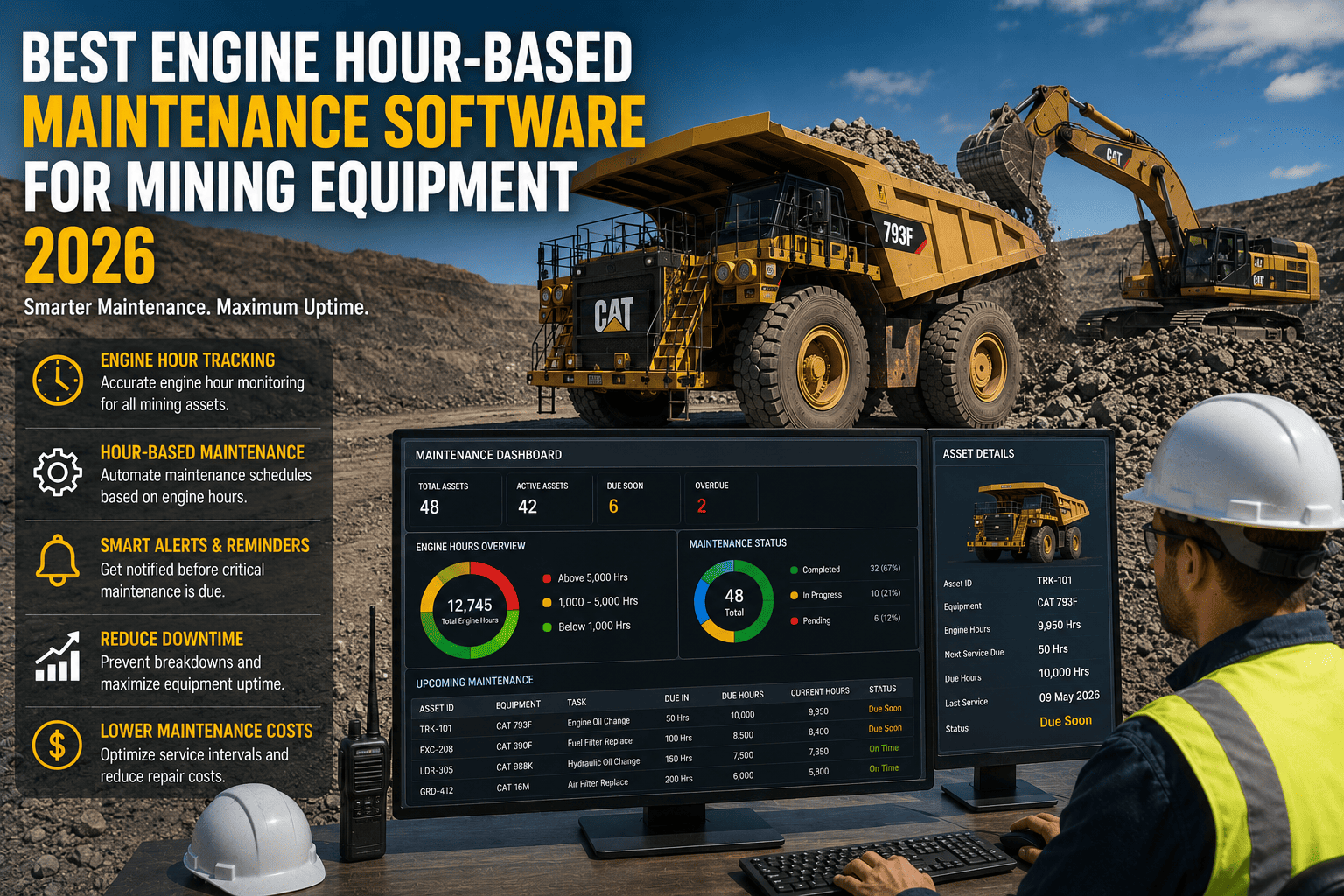
The mechanics are simpler than most fleet managers expect, which is part of why this approach has become the standard for haul trucks, loaders, excavators, and drills. Every asset has a current engine hour reading, pulled either from a telematics feed or entered manually by an operator at shift end. Each service task on that asset has a manufacturer-recommended interval, such as an oil change every 250 hours or a structural inspection every 1,000 hours. The software does the subtraction for you, calculating exactly how many hours remain before each task comes due, and turning that countdown into a work order the moment the threshold is crossed.
Pulling Hours From Telematics or Manual Entry
Modern haul trucks and excavators usually report engine hours automatically through onboard telematics, but older equipment or smaller support vehicles often rely on an operator logging hours from the dash meter at the end of a shift. Good software handles both paths without forcing every machine onto the same data source.
Mapping Hours to Manufacturer-Recommended Tiers
Each piece of equipment gets its own interval map based on its make, model, and engine configuration, because a drill rig and a haul truck do not wear the same way and should not share a maintenance schedule.
Generating Work Orders Before the Threshold Hits
Rather than waiting for an asset to cross its due hour and then scrambling, the strongest platforms send alerts at set lead times, commonly 90, 60, and 30 hours out, so parts and technicians are ready before the machine ever needs to come off the job.
| Interval | Typical Tasks | Risk of Skipping |
|---|---|---|
| 250 Hours | Oil and filter change, fluid checks, basic visual inspection | Accelerated engine wear, contamination buildup |
| 500 Hours | Hydraulic system check, air filter replacement, undercarriage inspection | Hydraulic component degradation, reduced filtration |
| 1,000 Hours | Structural inspection, deeper fluid analysis, wear-part measurement | Undetected structural fatigue, costly downstream failures |
| 2,000 Hours | Comprehensive overhaul-level service, major component evaluation | Catastrophic component failure, full rebuild instead of repair |
What to Demand From an Engine Hour Maintenance Platform
Plenty of generic maintenance tools claim to support engine hours, but mining sites need more than a basic counter. The platform has to handle harsh-condition adjustments, work offline in places with no signal, and turn a missed threshold into an actual work order instead of just a red number on a screen.
Condition-Adjusted Intervals
High-dust, high-heat, or rough-terrain sites need shortened intervals, sometimes 20 to 30 percent below standard manufacturer baselines, and the software should let you set that per asset.
Offline-First Mobile Access
Underground drives and remote open-pit zones rarely have reliable signal, so operators need to log hours and complete inspections without connectivity, syncing automatically once it returns.
Automatic Work Order Generation
An alert that nobody acts on is worthless. The platform should create the work order itself, with the right parts list and technician assignment attached the moment an interval is crossed.
Fleet-Wide Visibility by Asset
A planner overseeing forty machines across multiple pits needs one dashboard showing every asset's current hours and next-due service, not forty separate spreadsheets.
Most fleet managers find the clearest way to evaluate this is to put their own equipment list and intervals into a real system rather than read about it. You can sign up for a free trial and have your fleet's hour-based schedule running within a day.
How FleetRabbit Handles Engine Hour Scheduling
FleetRabbit was built around the way mining maintenance teams actually work, not around a generic asset list borrowed from another industry. Every haul truck, loader, excavator, and drill gets its current engine hours entered once, and the platform takes over from there.
Automatic Countdown to Every Service Milestone
Once an asset's hours and interval map are set, FleetRabbit calculates the exact hour at which every future service comes due and counts down automatically as new hour readings come in from telematics or manual entry.
Work Orders Without the Spreadsheet Chase
When a threshold is reached, FleetRabbit generates the work order automatically, complete with the tasks required at that tier, instead of relying on someone remembering to check a spreadsheet that was last updated two weeks ago.
Built for Sites With No Signal
Operators working underground or in remote pits can log hours, complete inspections, and close out work orders entirely offline, with everything syncing the moment connectivity returns.
Stop Guessing When the Next Service Is Due
FleetRabbit turns engine hours from every truck, loader, and drill into an automatic maintenance schedule, so the next work order is already waiting before the machine ever misses its window. Sign up for a free trial and load your fleet's intervals today, or book a demo to see it built around your specific equipment list on the call.
The Real Payback of Switching to Hour-Based Scheduling
The financial case for engine hour-based maintenance is rarely subtle once a mine actually runs the comparison. A single missed interval on a major component, the kind that turns a 500 dollar oil change into a multi-week repair, can cost more than the entire annual software investment on its own. Stack a handful of those avoided failures across a fleet of twenty or thirty machines and the savings move well past the cost of the platform.
Extending Asset Life, Not Just Avoiding Failures
Equipment maintained on the correct hour-based schedule consistently runs 40 to 60 percent longer before major components need replacement, which means fewer capital purchases and a longer useful life on every asset already on the books.
Frequently Asked Questions
Your Fleet Is Already Counting the Hours
The only question is whether your maintenance schedule is counting along with it. FleetRabbit turns every engine hour into an automatic, accurate maintenance plan across haul trucks, loaders, excavators, and drills, so nothing slips through on a missed calendar date again. Get started with a free trial or talk through your specific fleet and intervals with our team first.