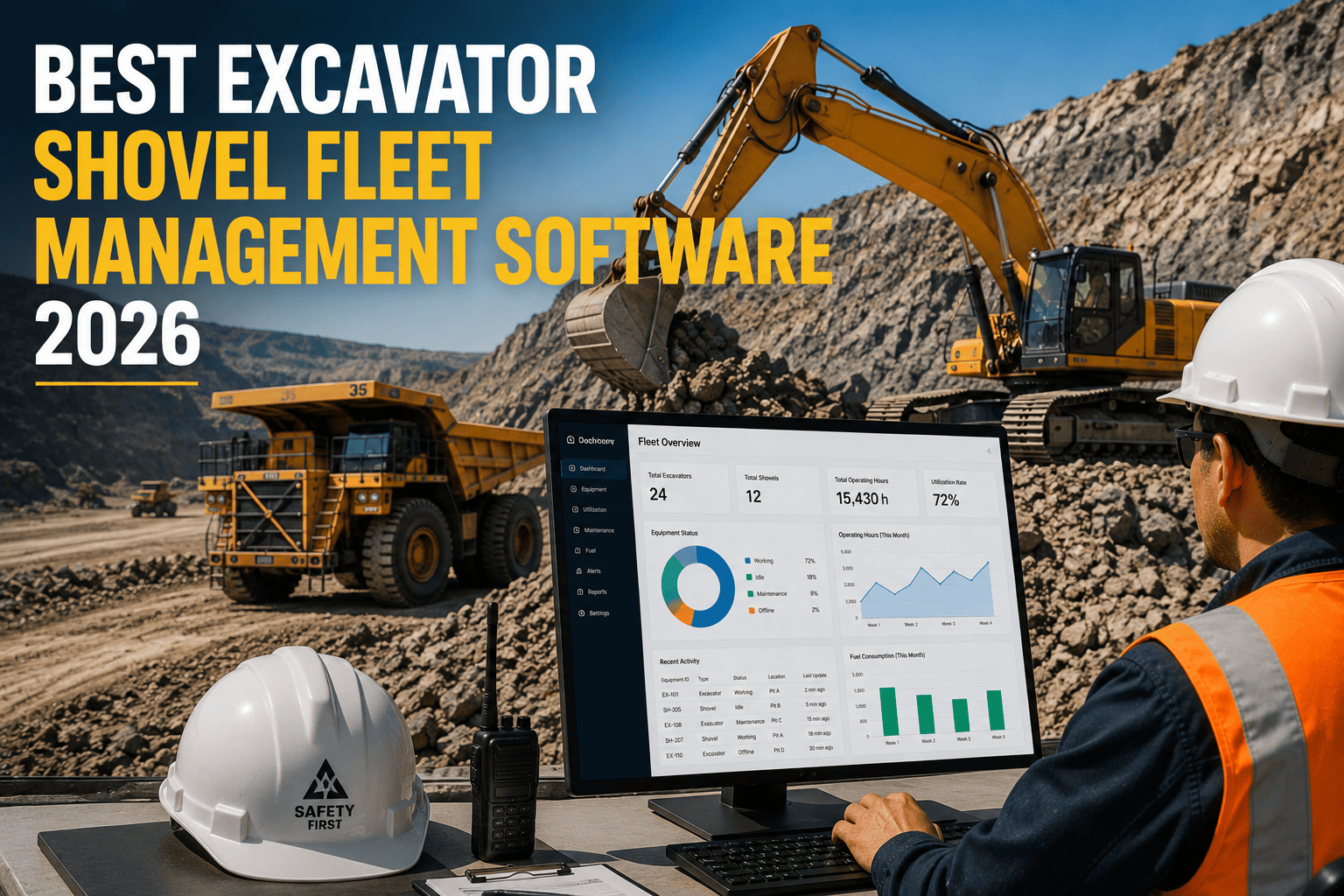
Best Excavator and Shovel Fleet Management Software in 2026

best-excavator-shovel-fleet-management-software-2026

An excavator or shovel is the most expensive piece of metal at most pit faces, and it is also the single biggest constraint on how much material the entire fleet can move. A haul truck only delivers what the loading unit puts in its tray. If the shovel is slow, swinging wide, or sitting idle waiting on trucks, every truck behind it inherits that delay. Yet most mines still measure loading unit performance with a stopwatch and a notepad, long after the shift that mattered is already over.

Quick Answer

Excavator and shovel fleet management software tracks bucket fill factor, pass count, swing cycle time, and loading-unit utilization in real time, then ties that data to preventive maintenance and truck-shovel matching. Mines using it typically push average fill factor toward 90 percent or higher and lift shovel utilization from the industry-average 72 to 78 percent toward the 90 to 92 percent world-class benchmark, without buying a single additional machine.

Why Loading Unit Performance Decides Your Whole Production Plan

Production planners size a fleet around a simple ratio: how many truck loads a shovel can fill per hour, multiplied by average payload per load. Everything downstream — truck count, haul road capacity, crusher feed rate — gets built on top of that number. When a shovel's real-world performance drifts from the plan, the whole production target drifts with it, and most mines do not find out until the monthly tonnage report comes in short.

The two numbers that matter most for a loading unit are pass match and fill factor. Pass match is how many bucket passes it takes to fill a truck — research consistently points to three or four even passes as the productivity sweet spot, since fewer passes at a lower fill factor and more passes at a higher one both waste cycle time. Fill factor is how full each bucket pass actually is compared to its rated capacity. A shovel running at an 80 percent fill factor in five passes is leaving payload on the ground every single cycle, and that gap compounds across hundreds of loads a shift. This is exactly the data excavator and shovel fleet management software is built to capture automatically instead of relying on an operator's estimate.

The Four Numbers Every Loading Unit Should Be Tracked Against

Mining research and OEM engineering data point to four metrics that consistently separate a well-managed loading fleet from one running on guesswork.

90%+
Target Bucket Fill Factor
World-class loading units consistently fill the bucket above 90 percent of rated capacity. Industry-average performance often sits closer to 80 to 85 percent, leaving payload behind on every pass.
3-4
Optimal Pass Count
Filling a truck in three to four even passes is the documented productivity sweet spot. Extra passes beyond that waste cycle time even when each pass looks efficient on its own.
90-92%
World-Class Shovel Availability
Top-performing mines hold shovel and excavator availability at 90 to 92 percent. Industry average runs 72 to 78 percent, a gap that represents significant recoverable tonnage.
400-600 Hrs
Average Mean Time Between Failures
Current industry-average MTBF for excavators and loaders. Predictive maintenance programs push that figure past 800 hours by catching wear before it becomes a breakdown.
Built For Loading Units, Not Adapted From Trucks
See Your Real Fill Factor And Pass Match Data

FleetRabbit tracks bucket fill factor, pass count, and swing cycle time automatically for every excavator and shovel on site. Sign up free and see your loading unit performance within a day.

90%+
Achievable Fill Factor
90-92%
World-Class Availability

What Excavator and Shovel Fleet Management Software Actually Tracks

A platform built specifically for loading units needs to go deeper than a GPS dot and an engine-hours counter. The differences between a 78 percent and a 92 percent availability rate, or between a four-pass and a six-pass load, live in data most mines have never systematically captured before.

Bucket Fill Factor and Payload Per Pass

Modern payload monitoring on the loading tool itself measures fill factor and specific gravity in real time, letting an operator see exactly how full each pass is rather than estimating by eye. This is the same data that helps a mine catch material density changes before a truck is overloaded or underloaded on the road.

Pass Count and Swing Cycle Time

Tracking how many passes it takes to fill each truck, and how long each swing-dig-dump-swing cycle runs, exposes whether a loading unit is matched correctly to the trucks it serves. A shovel consistently running six or seven passes against a truck it should fill in four is either undersized for that fleet or losing time somewhere in the swing cycle that needs investigating.

Truck-Shovel Match Factor

Match factor measures whether truck arrival rate is balanced against loading unit service rate. When trucks queue heavily at one shovel while another sits idle waiting for its next truck, the fleet is unbalanced, and software that tracks queue time per loading unit makes that imbalance visible in the same shift it happens, not in next month's report.

Engine-Hour Based Preventive Maintenance

Excavators and shovels rack up loading hours unevenly across a fleet depending on which face they are assigned to. Calendar-based maintenance schedules either over-service low-utilization units or under-service high-utilization ones. Pulling real engine hours from OEM telematics and triggering maintenance work orders automatically keeps every unit on the correct interval for how hard it is actually working.

Loading Unit Metric Industry Average World-Class Benchmark What Software Does About It
Bucket Fill Factor 80 to 85 percent 90 percent or higher Real-time payload monitoring per pass with operator feedback
Pass Count Per Load 5 to 6 passes 3 to 4 even passes Pass tracking flags mismatched truck-shovel pairing
Loading Unit Availability 72 to 78 percent 90 to 92 percent Predictive maintenance and engine-hour PM scheduling
Mean Time Between Failures 400 to 600 hours 800-plus hours Condition-based alerts catch wear before failure

Calculating What a Fill Factor Gap Is Actually Costing You

The math behind a fill factor improvement is straightforward once you have real data instead of operator estimates. Take a shovel loading a 200-ton truck in four passes at an 80 percent average fill factor. That truck is leaving roughly 40 tons of capacity unused on every single load. Across 20 loads in a shift, that is 800 tons of capacity sitting unused that day, for one shovel, on one shift. Closing even half that gap, without changing pass count or truck size, recovers meaningful tonnage with the same fleet already on site.

Availability works the same way at fleet scale. Moving a shovel from 75 percent availability toward the 90 percent world-class benchmark means roughly two additional productive hours out of every twelve-hour shift. Multiplied across a multi-shovel fleet running around the clock, that gap is the rough equivalent of adding an extra loading unit to the pit without the capital cost of buying one. Book a demo to see what that math looks like applied to your actual fleet size and shift pattern.

What To Look For When Comparing Loading Unit Software in 2026

Plenty of fleet platforms claim mining coverage, but only some are built around the specific behavior of excavators and shovels rather than adapted from haul truck tracking.

OEM Telematics Compatibility

Look for direct integration with Cat MineStar, Komatsu KOMTRAX, Volvo CareTrack, and similar OEM systems so engine hours, fault codes, and payload data sync automatically instead of requiring manual entry or duplicate hardware on the machine.

Per-Pass and Per-Cycle Granularity

Fleet-wide averages hide the detail that actually drives decisions. A platform should let you isolate fill factor and swing cycle time by individual machine, by shift, and even by operator, since operator technique alone can swing loading precision by a meaningful margin.

Maintenance Tied To Real Operating Hours

Excavators and shovels are some of the most expensive assets on a mine site, and unplanned downtime on a primary loading unit cascades through the entire truck queue behind it. Engine-hour based PM scheduling, not calendar-based, is the standard that prevents that cascade.

Fast Setup Without a Long Enterprise Rollout

A mid-size operation should not need months of integration work to get visibility into loading unit performance. Sign up for a platform that connects to what is already on your machines and surfaces a first performance report within a day.

From Loading Data To Recovered Tonnage
Stop Estimating Fill Factor By Eye

FleetRabbit connects to your existing OEM telematics and turns every pass, every swing cycle, and every maintenance hour into a live dashboard for your excavators and shovels. No new hardware. No long rollout.

24 Hrs
To First Performance Report
800+ Hrs
Achievable MTBF
Excavator Fleet Management Shovel Fleet Management Bucket Fill Factor Truck Shovel Match Factor Loading Unit Availability Mining Equipment Software

Frequently Asked Questions

QWhat is bucket fill factor and why does it matter
Bucket fill factor measures how full each bucket pass is compared to its rated capacity. A shovel running at 80 percent fill factor is leaving roughly a fifth of its potential payload unused on every pass, which compounds into significant lost tonnage across a full shift.
QHow many passes should it take to fill a haul truck
Research consistently points to three to four even passes as the productivity sweet spot for matching a loading unit to a truck. More passes waste cycle time even at a high fill factor, while fewer passes at a lower fill factor leave payload behind.
QWhat availability rate should an excavator or shovel achieve
World-class mining operations target 90 to 92 percent availability for shovels and excavators. The industry average sits at 72 to 78 percent, which represents a meaningful gap in recoverable production for most fleets.
QHow does truck-shovel match factor affect productivity
Match factor compares how fast trucks arrive against how fast the loading unit can service them. When the ratio is off, trucks either queue and waste cycle time, or the shovel sits idle waiting for its next truck. Tracking queue time per loading unit makes that imbalance visible in real time.
QDoes excavator and shovel software require new hardware
Not when it integrates properly with existing OEM telematics. Platforms connecting to Cat MineStar, Komatsu KOMTRAX, or Volvo CareTrack can pull engine hours and payload data directly. Sign up to check compatibility with your current fleet.
QHow quickly can a mine see results after implementation
Most sites get a usable fill factor and availability baseline within the first 24 hours of integration, with maintenance teams identifying their first actionable pattern within the first week. Book a demo to see a live walkthrough.

The Bottom Line on Excavator and Shovel Fleet Management

The loading unit sets the ceiling on what an entire haul fleet can produce, yet it is often the least instrumented machine on the pit. Fill factor, pass match, and availability are not abstract engineering terms — they are the levers that decide whether a mine hits its production target with the equipment already on site or falls short and starts pricing out another shovel. The operations closing that gap fastest are treating loading unit data as a live, daily signal rather than something reviewed once a quarter.

Find Out How Much Tonnage Your Loading Fleet Is Leaving Behind

FleetRabbit turns every pass, every swing cycle, and every maintenance hour on your excavators and shovels into live, actionable data. See your real fill factor, catch truck-shovel mismatches before they cost a shift, and get more tonnage out of the fleet you already have. No new hardware. No long rollout. No credit card required to start.


Bucket Fill Factor Pass Match Tracking Loading Unit Availability Predictive Maintenance OEM Telematics Integration

June 26, 2026 By John
All Posts

Best Excavator and Shovel Fleet Management Software in 2026

best-excavator-shovel-fleet-management-software-2026

An excavator or shovel is the most expensive piece of metal at most pit faces, and it is also the single biggest constraint on how much material the entire fleet can move. A haul truck only delivers what the loading unit puts in its tray. If the shovel is slow, swinging wide, or sitting idle waiting on trucks, every truck behind it inherits that delay. Yet most mines still measure loading unit performance with a stopwatch and a notepad, long after the shift that mattered is already over.

Quick Answer

Excavator and shovel fleet management software tracks bucket fill factor, pass count, swing cycle time, and loading-unit utilization in real time, then ties that data to preventive maintenance and truck-shovel matching. Mines using it typically push average fill factor toward 90 percent or higher and lift shovel utilization from the industry-average 72 to 78 percent toward the 90 to 92 percent world-class benchmark, without buying a single additional machine.

Why Loading Unit Performance Decides Your Whole Production Plan

Production planners size a fleet around a simple ratio: how many truck loads a shovel can fill per hour, multiplied by average payload per load. Everything downstream — truck count, haul road capacity, crusher feed rate — gets built on top of that number. When a shovel's real-world performance drifts from the plan, the whole production target drifts with it, and most mines do not find out until the monthly tonnage report comes in short.

The two numbers that matter most for a loading unit are pass match and fill factor. Pass match is how many bucket passes it takes to fill a truck — research consistently points to three or four even passes as the productivity sweet spot, since fewer passes at a lower fill factor and more passes at a higher one both waste cycle time. Fill factor is how full each bucket pass actually is compared to its rated capacity. A shovel running at an 80 percent fill factor in five passes is leaving payload on the ground every single cycle, and that gap compounds across hundreds of loads a shift. This is exactly the data excavator and shovel fleet management software is built to capture automatically instead of relying on an operator's estimate.

The Four Numbers Every Loading Unit Should Be Tracked Against

Mining research and OEM engineering data point to four metrics that consistently separate a well-managed loading fleet from one running on guesswork.

90%+
Target Bucket Fill Factor
World-class loading units consistently fill the bucket above 90 percent of rated capacity. Industry-average performance often sits closer to 80 to 85 percent, leaving payload behind on every pass.
3-4
Optimal Pass Count
Filling a truck in three to four even passes is the documented productivity sweet spot. Extra passes beyond that waste cycle time even when each pass looks efficient on its own.
90-92%
World-Class Shovel Availability
Top-performing mines hold shovel and excavator availability at 90 to 92 percent. Industry average runs 72 to 78 percent, a gap that represents significant recoverable tonnage.
400-600 Hrs
Average Mean Time Between Failures
Current industry-average MTBF for excavators and loaders. Predictive maintenance programs push that figure past 800 hours by catching wear before it becomes a breakdown.
Built For Loading Units, Not Adapted From Trucks
See Your Real Fill Factor And Pass Match Data

FleetRabbit tracks bucket fill factor, pass count, and swing cycle time automatically for every excavator and shovel on site. Sign up free and see your loading unit performance within a day.

90%+
Achievable Fill Factor
90-92%
World-Class Availability

What Excavator and Shovel Fleet Management Software Actually Tracks

A platform built specifically for loading units needs to go deeper than a GPS dot and an engine-hours counter. The differences between a 78 percent and a 92 percent availability rate, or between a four-pass and a six-pass load, live in data most mines have never systematically captured before.

Bucket Fill Factor and Payload Per Pass

Modern payload monitoring on the loading tool itself measures fill factor and specific gravity in real time, letting an operator see exactly how full each pass is rather than estimating by eye. This is the same data that helps a mine catch material density changes before a truck is overloaded or underloaded on the road.

Pass Count and Swing Cycle Time

Tracking how many passes it takes to fill each truck, and how long each swing-dig-dump-swing cycle runs, exposes whether a loading unit is matched correctly to the trucks it serves. A shovel consistently running six or seven passes against a truck it should fill in four is either undersized for that fleet or losing time somewhere in the swing cycle that needs investigating.

Truck-Shovel Match Factor

Match factor measures whether truck arrival rate is balanced against loading unit service rate. When trucks queue heavily at one shovel while another sits idle waiting for its next truck, the fleet is unbalanced, and software that tracks queue time per loading unit makes that imbalance visible in the same shift it happens, not in next month's report.

Engine-Hour Based Preventive Maintenance

Excavators and shovels rack up loading hours unevenly across a fleet depending on which face they are assigned to. Calendar-based maintenance schedules either over-service low-utilization units or under-service high-utilization ones. Pulling real engine hours from OEM telematics and triggering maintenance work orders automatically keeps every unit on the correct interval for how hard it is actually working.

Loading Unit Metric Industry Average World-Class Benchmark What Software Does About It
Bucket Fill Factor 80 to 85 percent 90 percent or higher Real-time payload monitoring per pass with operator feedback
Pass Count Per Load 5 to 6 passes 3 to 4 even passes Pass tracking flags mismatched truck-shovel pairing
Loading Unit Availability 72 to 78 percent 90 to 92 percent Predictive maintenance and engine-hour PM scheduling
Mean Time Between Failures 400 to 600 hours 800-plus hours Condition-based alerts catch wear before failure

Calculating What a Fill Factor Gap Is Actually Costing You

The math behind a fill factor improvement is straightforward once you have real data instead of operator estimates. Take a shovel loading a 200-ton truck in four passes at an 80 percent average fill factor. That truck is leaving roughly 40 tons of capacity unused on every single load. Across 20 loads in a shift, that is 800 tons of capacity sitting unused that day, for one shovel, on one shift. Closing even half that gap, without changing pass count or truck size, recovers meaningful tonnage with the same fleet already on site.

Availability works the same way at fleet scale. Moving a shovel from 75 percent availability toward the 90 percent world-class benchmark means roughly two additional productive hours out of every twelve-hour shift. Multiplied across a multi-shovel fleet running around the clock, that gap is the rough equivalent of adding an extra loading unit to the pit without the capital cost of buying one. Book a demo to see what that math looks like applied to your actual fleet size and shift pattern.

What To Look For When Comparing Loading Unit Software in 2026

Plenty of fleet platforms claim mining coverage, but only some are built around the specific behavior of excavators and shovels rather than adapted from haul truck tracking.

OEM Telematics Compatibility

Look for direct integration with Cat MineStar, Komatsu KOMTRAX, Volvo CareTrack, and similar OEM systems so engine hours, fault codes, and payload data sync automatically instead of requiring manual entry or duplicate hardware on the machine.

Per-Pass and Per-Cycle Granularity

Fleet-wide averages hide the detail that actually drives decisions. A platform should let you isolate fill factor and swing cycle time by individual machine, by shift, and even by operator, since operator technique alone can swing loading precision by a meaningful margin.

Maintenance Tied To Real Operating Hours

Excavators and shovels are some of the most expensive assets on a mine site, and unplanned downtime on a primary loading unit cascades through the entire truck queue behind it. Engine-hour based PM scheduling, not calendar-based, is the standard that prevents that cascade.

Fast Setup Without a Long Enterprise Rollout

A mid-size operation should not need months of integration work to get visibility into loading unit performance. Sign up for a platform that connects to what is already on your machines and surfaces a first performance report within a day.

From Loading Data To Recovered Tonnage
Stop Estimating Fill Factor By Eye

FleetRabbit connects to your existing OEM telematics and turns every pass, every swing cycle, and every maintenance hour into a live dashboard for your excavators and shovels. No new hardware. No long rollout.

24 Hrs
To First Performance Report
800+ Hrs
Achievable MTBF
Excavator Fleet Management Shovel Fleet Management Bucket Fill Factor Truck Shovel Match Factor Loading Unit Availability Mining Equipment Software

Frequently Asked Questions

QWhat is bucket fill factor and why does it matter
Bucket fill factor measures how full each bucket pass is compared to its rated capacity. A shovel running at 80 percent fill factor is leaving roughly a fifth of its potential payload unused on every pass, which compounds into significant lost tonnage across a full shift.
QHow many passes should it take to fill a haul truck
Research consistently points to three to four even passes as the productivity sweet spot for matching a loading unit to a truck. More passes waste cycle time even at a high fill factor, while fewer passes at a lower fill factor leave payload behind.
QWhat availability rate should an excavator or shovel achieve
World-class mining operations target 90 to 92 percent availability for shovels and excavators. The industry average sits at 72 to 78 percent, which represents a meaningful gap in recoverable production for most fleets.
QHow does truck-shovel match factor affect productivity
Match factor compares how fast trucks arrive against how fast the loading unit can service them. When the ratio is off, trucks either queue and waste cycle time, or the shovel sits idle waiting for its next truck. Tracking queue time per loading unit makes that imbalance visible in real time.
QDoes excavator and shovel software require new hardware
Not when it integrates properly with existing OEM telematics. Platforms connecting to Cat MineStar, Komatsu KOMTRAX, or Volvo CareTrack can pull engine hours and payload data directly. Sign up to check compatibility with your current fleet.
QHow quickly can a mine see results after implementation
Most sites get a usable fill factor and availability baseline within the first 24 hours of integration, with maintenance teams identifying their first actionable pattern within the first week. Book a demo to see a live walkthrough.

The Bottom Line on Excavator and Shovel Fleet Management

The loading unit sets the ceiling on what an entire haul fleet can produce, yet it is often the least instrumented machine on the pit. Fill factor, pass match, and availability are not abstract engineering terms — they are the levers that decide whether a mine hits its production target with the equipment already on site or falls short and starts pricing out another shovel. The operations closing that gap fastest are treating loading unit data as a live, daily signal rather than something reviewed once a quarter.

Find Out How Much Tonnage Your Loading Fleet Is Leaving Behind

FleetRabbit turns every pass, every swing cycle, and every maintenance hour on your excavators and shovels into live, actionable data. See your real fill factor, catch truck-shovel mismatches before they cost a shift, and get more tonnage out of the fleet you already have. No new hardware. No long rollout. No credit card required to start.

Bucket Fill Factor Pass Match Tracking Loading Unit Availability Predictive Maintenance OEM Telematics Integration

June 26, 2026 By John
All Posts

Share This Story, Choose Your Platform!

Latest Posts

Scroll