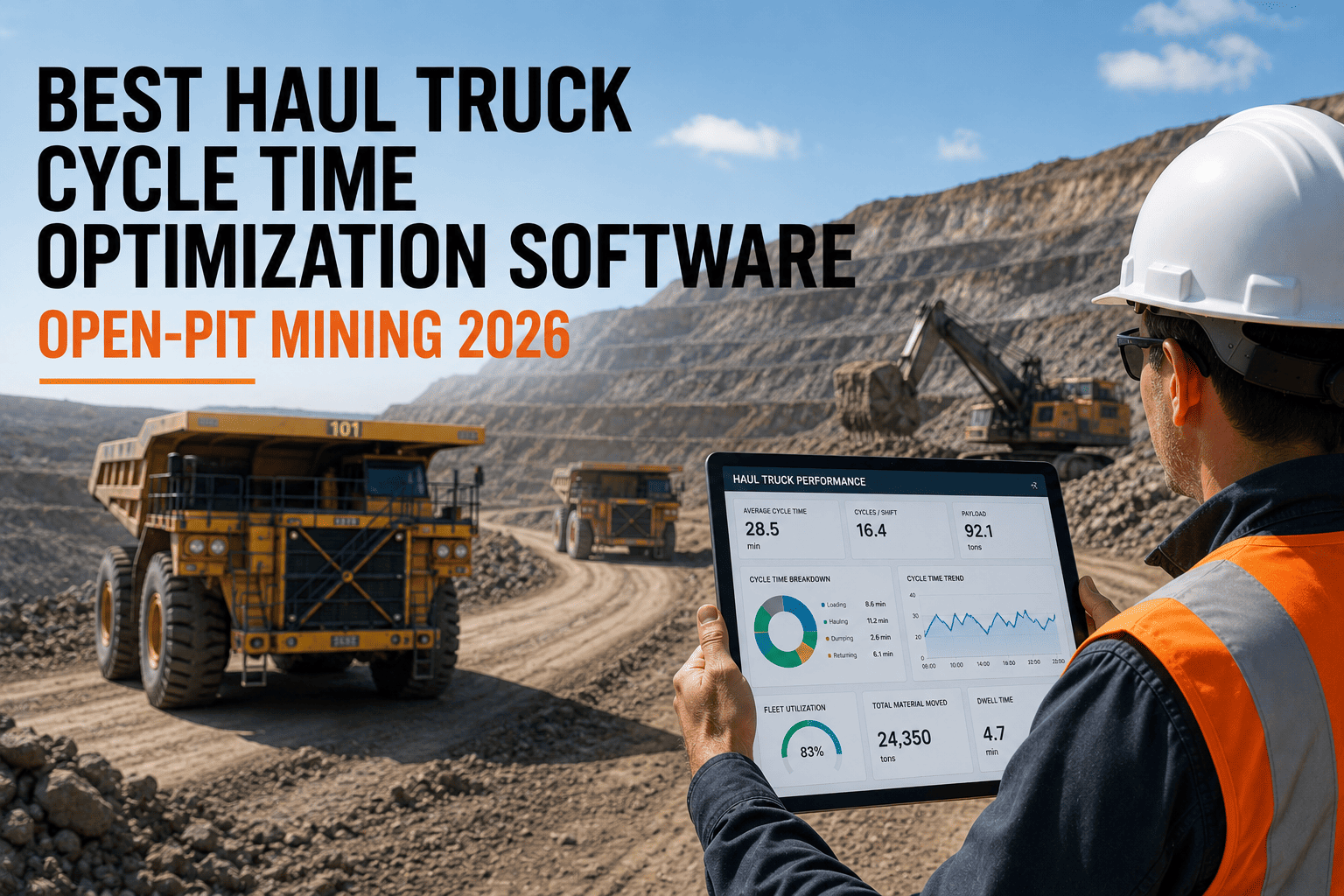
In an open-pit mine, every minute of a haul cycle has a price tag attached to it. A 793-class haul truck that should complete a load-haul-dump-return loop in 19 minutes but actually takes 23 minutes isn't just running 4 minutes slow. Multiply that gap across 30 trucks, three shifts, and 365 days, and you are looking at tens of thousands of tons of material that never got moved. Tons per hour is the number that determines whether a pit hits its production plan or falls behind it, and cycle time is the single biggest lever that controls that number.
Haul truck cycle time optimization software tracks every phase of the load-haul-dump-return loop in real time, flags where trucks are losing minutes to queueing, spotting, or route inefficiency, and uses dynamic dispatch to cut average cycle time by 8 to 15 percent. For a typical 25-truck pit, that improvement alone can add 1,500 to 3,000 extra tons moved per day without buying a single additional truck.
Why Cycle Time Is the Metric That Decides Your Production Plan
Cycle time is the total time a haul truck spends completing one full loop: spotting at the shovel, loading, hauling loaded, dumping, and returning empty to start again. It sounds like a simple stopwatch number, but it is built from dozens of smaller decisions made every shift — which truck goes to which shovel, how long it waits in queue, what speed it travels at on the haul road, and how long the dump takes at the crusher or waste dump. When any one of those pieces drifts even slightly, the whole loop stretches, and tons per hour drops accordingly.
What makes cycle time difficult to manage manually is that it is rarely one big problem. It is usually fifteen small ones stacked together: a queue at the shovel that runs four minutes longer than it should, a haul road segment where trucks crawl because of grade or surface condition, a dump point that backs up during shift change. None of these show up clearly on a paper dispatch board or a radio call. They only become visible when every phase of every cycle, for every truck, is being measured and compared automatically — which is exactly the gap that cycle time optimization software is built to close.
The Four Phases Where Minutes Disappear
Mining research breaks the haul cycle into four core segments, and each one has its own typical failure points. Understanding where time actually leaks is the first step before any software can fix it.
FleetRabbit tracks every phase of the load-haul-dump-return loop automatically and shows you exactly where minutes are leaking, truck by truck, shift by shift. Sign up free and see your first cycle time report within a day.
What Cycle Time Optimization Software Actually Does
The best haul truck cycle time optimization software for 2026 goes well beyond GPS dots on a map. It needs to capture machine state automatically, classify exactly which phase of the cycle a truck is in at any second, and surface that data in a way a dispatcher can act on within the same shift, not after a weekly report.
Real-Time Phase Detection
Context-aware algorithms detect whether a truck is queueing, spotting, loading, hauling, dumping, or traveling empty, without requiring a driver to press a button. This removes the guesswork and human error that comes with manual cycle logging, and it means every cycle, across every shift, gets recorded consistently.
Dynamic Dispatch
Instead of trucks running fixed routes between a single shovel and a single dump point, dynamic dispatch reassigns each truck to whichever load or dump point needs it most at that exact moment. This single capability is what allows mining operations to move significantly more tons per shift using the same number of trucks already on site.
Bottleneck and Queue Alerts
When a queue starts forming at a shovel or crusher, the system flags it immediately so dispatch can reroute trucks before the backup compounds. A four-minute delay caught early is a minor adjustment. The same delay left unmanaged for an hour becomes a fleet-wide slowdown.
Cycle Time Benchmarking By Truck, Shift, and Operator
Comparing cycle times across trucks, shifts, and operators reveals patterns that are invisible from a single shift report — which crew consistently runs faster cycles, which haul road segment is costing everyone time, and which truck is underperforming due to a mechanical issue rather than driver behavior.
| Cycle Phase | Typical Share of Cycle | Common Time Loss | How Software Fixes It |
|---|---|---|---|
| Spot & Load | 20 to 25 percent | Queueing at shovel, mismatched truck-to-shovel ratio | Real-time queue alerts and balanced truck assignment |
| Haul Loaded | 35 to 45 percent | Speed non-compliance, congestion, poor road segments | Route analytics and speed compliance tracking |
| Dump | 5 to 8 percent | Crusher or dump point queueing during peak hours | Dynamic rerouting to alternate dump points |
| Return Empty | 30 to 35 percent | Trucks returning to wrong shovel, idle travel | Dynamic dispatch to highest-need load point |
How To Calculate Your Pit's Cycle Time Opportunity
Before evaluating software, it helps to understand the size of the gap you are actually closing. Start with your current average cycle time per truck class, pulled from your existing dispatch system or telematics. Compare it against the theoretical cycle time for your haul distance, grade, and truck speed rating — most OEMs and mine planning tools publish this benchmark. The difference between your actual and theoretical cycle time is your recoverable minutes per cycle.
Multiply recoverable minutes by the number of cycles your fleet completes per shift, then by your average payload per cycle. For a 25-truck fleet running 12-hour shifts with an average payload of 220 tons and a recoverable gap of just 2 minutes per cycle, the math typically works out to 1,500 to 3,000 additional tons moved per day once that gap closes. Across a year, that is the production equivalent of adding two to three extra trucks to the fleet without any capital expenditure.
What To Look For When Comparing Cycle Time Software in 2026
Not every fleet platform marketed for mining actually tracks haul cycle phases with the granularity an open-pit operation needs. A few capabilities separate genuinely useful cycle time optimization software from a basic GPS tracker repurposed for mining.
OEM Telematics Integration
Your platform should pull engine hours, payload data, and machine state directly from Cat MineStar, Komatsu telematics, or Volvo CareTrack rather than relying on a separate hardware install. This keeps cycle time data accurate and avoids duplicate sensor conflicts on the truck.
Shift-Level and Operator-Level Reporting
Cycle time data is only useful if it can be broken down by shift, by operator, and by truck. Aggregate fleet averages hide exactly the patterns that matter — like one crew consistently outperforming another on identical routes.
Dump and Crusher Queue Visibility
Many platforms track the haul road well but miss what happens at the dump point. Since dump queueing is one of the most common hidden time sinks, look for software that treats the crusher or waste dump as a monitored node, not a blind spot.
Fast, Lightweight Deployment
A mid-size open-pit operation does not need a six-month enterprise rollout to start seeing cycle time data. Book a demo with a platform that integrates with what you already have on the trucks and can surface a first cycle time report within days, not quarters.
FleetRabbit connects to your existing OEM telematics, classifies every phase of the haul cycle automatically, and gives dispatch the alerts they need to keep trucks moving instead of queueing. No new hardware. No long rollout.
Frequently Asked Questions
The Bottom Line on Cycle Time Optimization
Cycle time is not a maintenance metric or a nice-to-have dashboard number. It is the variable that sits directly between your fleet's theoretical capacity and what actually gets moved each shift. Every minute recovered from queueing, route inefficiency, or poor dispatch decisions compounds across hundreds of cycles a day and thousands across a year. The mines closing that gap fastest in 2026 are the ones treating cycle time data as a live operational signal rather than a number reviewed once a month.
FleetRabbit turns every haul truck's load-haul-dump-return loop into live, actionable data. See your real cycle time breakdown, catch queue bottlenecks before they cascade, and start moving more tons with the trucks you already have. No new hardware. No long rollout. No credit card required to start.