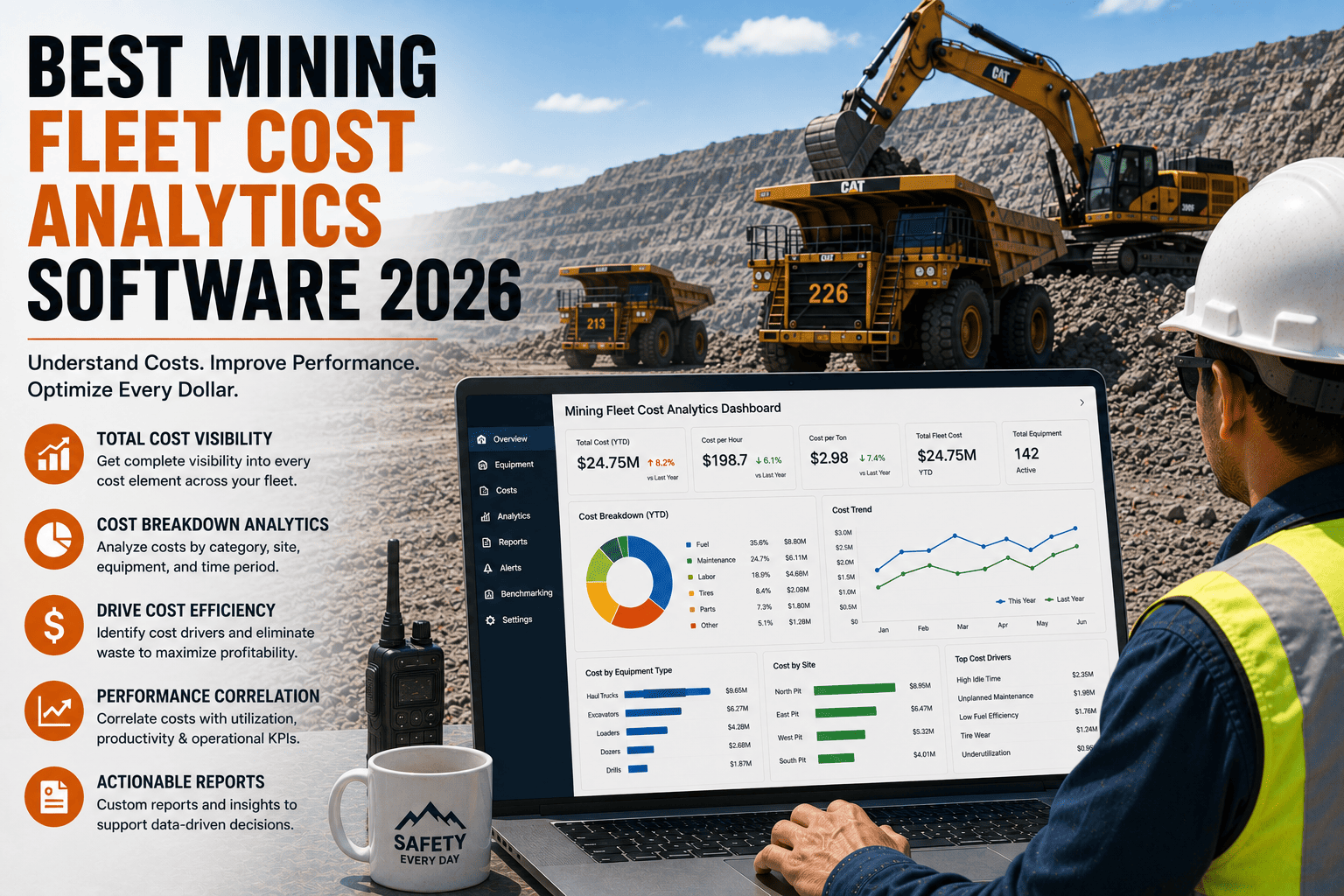
In open-pit mining, haul trucks are both the backbone of production and the single largest operating cost on site. Truck haulage accounts for 50 to 60 percent of total open-pit operating costs — and fuel alone eats up 22 percent of that figure. Every minute a haul truck sits idle in a queue, waits for dispatch, runs an inefficient cycle, or carries an underloaded bucket is money leaving the operation with nothing to show for it. If your operation is still relying on radio-based dispatch, paper payload logs, and manual cycle time tracking, you are almost certainly leaving 10 to 20 percent of your production capacity on the table every single shift. Sign up for FleetRabbit AI today and see exactly where your haul fleet is losing time and money — your first insight comes within hours of setup.
This guide covers what haul truck management software actually delivers for open-pit operations, the six core capabilities that separate high-performing software from basic GPS tools, how to evaluate dispatch and payload monitoring systems for your specific fleet size, and how FleetRabbit AI delivers complete haul truck visibility — from dispatch to maintenance — in one platform built for mining operations of every scale. Book a free demo to see it live on your own operation data.
FleetRabbit AI connects your haul trucks into one live dashboard showing cycle times, payload data, idle time, dispatch status, fuel consumption, and maintenance scheduling — all updated in real time. Setup takes less than a day. No IT team. No enterprise contract. Start your 14-day free trial and get your first cycle time insight within hours of going live.
Why Haul Truck Management Software Is the Highest-ROI Investment in Open-Pit Mining in 2026
Open-pit mining operations are measured in tons moved per shift. Every decision that affects cycle time, payload utilization, or truck availability directly impacts how many tons cross the scales by end of shift. The problem is that most operations are making those decisions blind — dispatchers work from radio calls and experience, maintenance teams react to breakdowns instead of preventing them, and production managers review yesterday's numbers in a spreadsheet this morning.
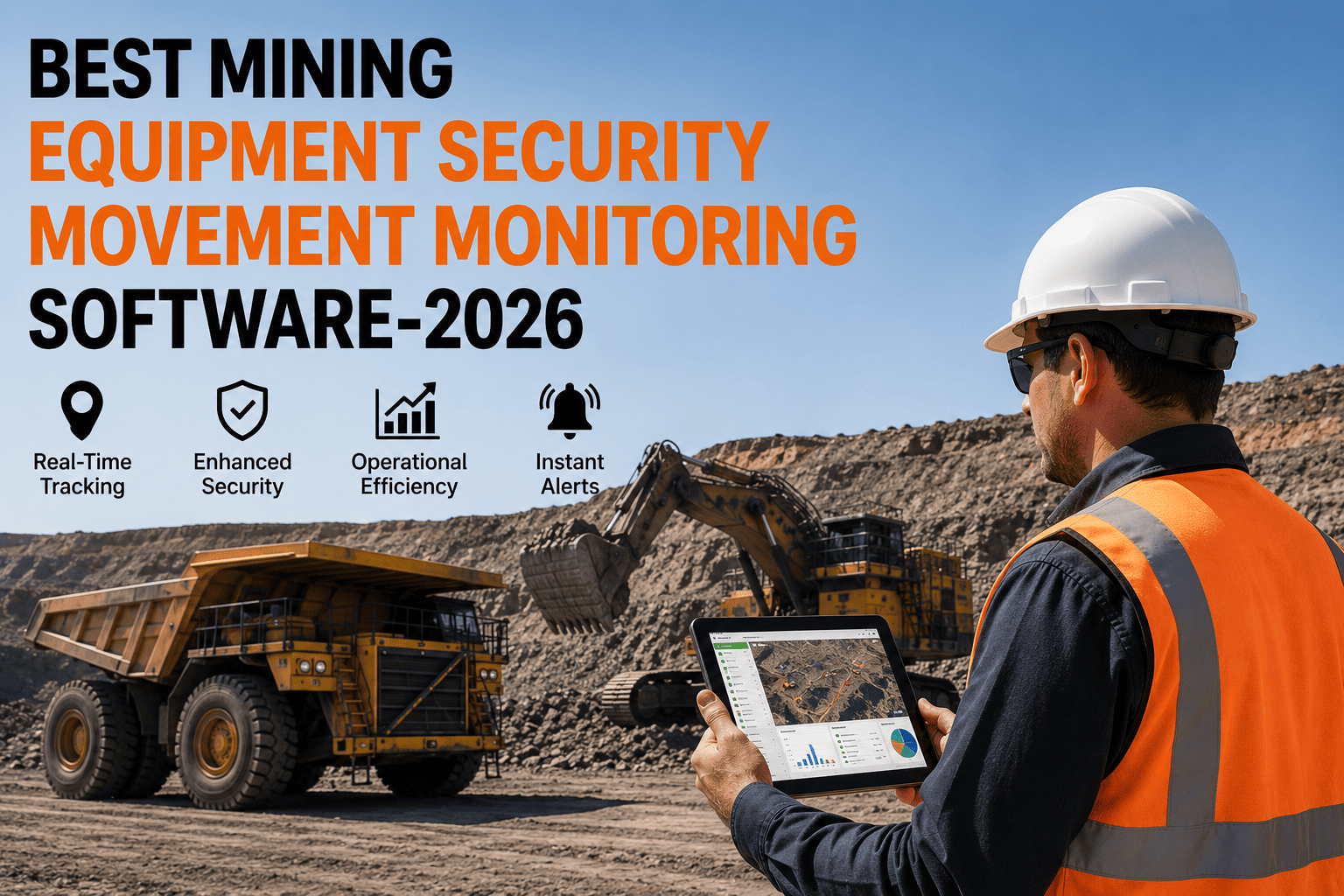
Purpose-built haul truck management software changes this by giving every decision-maker real-time visibility into what is actually happening across the fleet at this moment. Dispatchers see which trucks are loaded and en route, which are queued and waiting, and which are available for reassignment. Maintenance teams see which trucks are approaching PM intervals before they miss them. Production managers see cycle time trends developing across shifts and can identify underperformance while there is still time to act. If your operation has not made this move yet, you can start a free trial right now and have your first dashboard live before end of day.
The numbers justify the investment immediately. A 10 percent reduction in truck idle time on a 20-truck open-pit operation running three shifts translates to roughly 4,800 hours of recovered productive time per year. At even modest production rates, that is a material increase in tons moved without adding a single truck to the fleet. Book a demo to see what that looks like on your specific operation.
Haul truck haulage is the dominant cost in open-pit mining. Every efficiency gain in dispatch, payload, or cycle time directly reduces the largest line item on the P&L. Software-driven optimization is the highest-leverage tool available to mine managers.
Fuel consumption is driven by load weight, haulage distance, lift height, road grade, and queuing time. Real-time monitoring of all five factors lets operations cut fuel waste without reducing production — typically 8 to 13 percent in the first quarter.
Research shows that optimizing haul road management and dispatch assignments can reduce truck cycle times by up to 15 percent. On a 20-truck fleet, that is equivalent to adding 3 trucks of productive capacity without the capital spend.
When cycle time optimization combines with payload monitoring and intelligent dispatch, per-truck productivity improves by up to 17 percent. The same fleet moves significantly more tons per shift — which is the entire goal of haul truck management.
The 5 Biggest Haul Truck Problems Open-Pit Mines Solve With Software
Before evaluating any platform, it is essential to identify exactly where your haul fleet is losing performance — because the right software solves all five issues simultaneously, not just one at a time. You can also book a 30-minute demo with FleetRabbit to map these problems against your own operation and get a custom ROI estimate before committing to anything.
What happens: Haul trucks arrive at loading or dumping areas at the same time, creating queues. Trucks sit idle burning fuel while waiting for a shovel, crusher, or dump point. Without real-time dispatch optimization, dispatchers cannot prevent these queues from forming — they can only react to them after the fact.
The cost: Excessive queuing is a direct multiplier on fuel costs. Trucks burning diesel while stationary contribute to the 22 percent fuel cost figure without moving a single ton. One documented case saw idle time drop from 210 hours per month to 38 hours after implementing automated dispatch — an 82 percent reduction in wasted idle time.
The fix: Real-time dispatch software that monitors shovel status, crusher availability, and truck locations simultaneously — automatically rerouting trucks before they arrive at a blocked destination. Sign up and see how FleetRabbit handles this for operations just like yours.
What happens: Without real-time payload monitoring, shovel operators and truck drivers have no way to confirm each load is optimized. Underloading reduces tons moved per cycle and requires more cycles to hit production targets. Overloading accelerates tire wear, damages truck suspension, and creates safety risks — all of which increase maintenance costs dramatically.
The cost: A 10 percent average underload on a 100-ton truck means 10 tons of wasted truck capacity per cycle. Across 500 cycles per day on a medium operation, that is 5,000 tons of potential production lost daily to inefficient loading.
The fix: Integrated payload monitoring that shows each truck's load weight in real time, alerts operators when loads are outside the optimal range, and tracks payload performance by shovel and operator over time — identifying coaching opportunities before they become production patterns.
What happens: Actual truck cycle times are rarely what the production plan assumes. Haul road conditions, traffic conflicts, operator behavior, loading efficiency, and dump point congestion all cause variance. Without cycle time data by truck, route, and shift, managers cannot identify which specific factor is causing production shortfalls.
The cost: Research on actual open-pit cycle times shows that loading time alone can run 33 percent higher than optimal — 3.98 minutes actual versus 2.98 minutes target for excavator loading. Multiply that variance across hundreds of cycles per day and the production shortfall becomes structural, not situational.
The fix: Automated cycle time tracking that captures load, haul, dump, and return times for every cycle on every truck — surfacing variance by route, shift, and operator so managers can identify and fix the specific bottleneck rather than guessing.
What happens: Maintenance schedules are set by calendar rather than actual engine hours and usage patterns. High-utilization trucks running three shifts hit their service intervals twice as fast as the calendar predicts. Missed PMs lead to hydraulic failures, tire blowouts, and engine breakdowns that halt production for hours or days.
The cost: Emergency breakdown repair on a haul truck costs 3 to 9 times more than the preventive maintenance that would have prevented it. A single major hydraulic or transmission failure on a large haul truck can cost $50,000 to $200,000 in parts and labor — plus lost production during the repair.
The fix: Engine-hour based PM scheduling that auto-triggers maintenance work orders based on actual telematics data — ensuring every truck gets serviced at the right interval regardless of how many calendar days have passed. Start your free trial to set up automated PM scheduling for your fleet today.
What happens: Dispatch data, fuel logs, maintenance records, and production counts live in separate systems — or on paper. Shift supervisors cannot see the full picture at a glance. Post-shift production reviews require manual data compilation that takes hours. By the time root-cause analysis is complete, the next shift is already underway with the same problems.
The cost: Decision delay in mining is a production cost. Every hour a shift supervisor spends compiling data is an hour not spent coaching operators, optimizing dispatch, or preventing the next breakdown. Operations running on separate systems consistently underperform operations with unified dashboards.
The fix: A single platform that connects dispatch, GPS, fuel monitoring, payload data, maintenance records, and inspection history — with a shift-level dashboard that shows production status in real time, not in yesterday's report. Book a demo to see the FleetRabbit unified dashboard live.
Per-operation annual loss estimate: For a 20-truck open-pit operation running three shifts, the combined cost of excessive idle time, payload inefficiency, cycle time variance, reactive maintenance, and decision delay routinely exceeds $400,000 per year. These are not theoretical losses — they are the documented gap between average open-pit performance and top-quartile performance in published mining benchmarks.
The software cost comparison: FleetRabbit AI costs $5 per asset per month. For 20 haul trucks, that is $1,200 per year — less than 0.3 percent of the annual losses it prevents. The ROI calculation is not close. Sign up free and run your own numbers in the first two weeks.
What changes from day one: GPS tracking goes live immediately. Digital pre-shift inspections replace paper checklists. Engine hours sync to PM schedules. Cycle time data starts accumulating. Within two weeks, you have enough data to identify your top three performance improvement opportunities and prioritize the highest-ROI fix first.
The 6 Essential Capabilities of Best-in-Class Haul Truck Management Software
Not every fleet management platform handles the specific demands of open-pit haul truck operations. Commercial trucking tools, generic CMMS platforms, and basic GPS trackers all fall short in ways that matter on an active mine site. Here are the six capabilities that define purpose-built haul truck management software — and what to verify in any evaluation. If you want to see all six in action before making any decision, book a 30-minute demo with FleetRabbit and we will walk through your specific operation.
Every haul truck, loader, excavator, and ancillary vehicle must be visible on a live map showing location, status, speed, and assigned route. Dispatchers need to see the full picture — which trucks are loaded and en route, which are queuing, which are returning empty, and which are in maintenance. Without this visibility, dispatch optimization is impossible. Look for platforms that update location data every 15 to 30 seconds, show historical route playback for performance analysis, and allow dispatchers to reassign trucks from the same dashboard without switching to a radio or separate system.
Cycle time — the round-trip time including loading, hauling, dumping, and return — is the master metric of haul truck productivity. The software must capture each phase of the cycle automatically using GPS geofencing around loading areas, dump points, and maintenance bays. Manual cycle time recording by operators is inaccurate and inconsistent. Automated tracking allows comparison of actual versus planned cycle times by truck, route, shift, and operator — giving supervisors the diagnostic data needed to identify and fix performance variance. A 10 percent cycle time improvement is equivalent to adding 2 trucks to a 20-truck fleet without any capital spend.
Payload monitoring tracks the weight of each load carried by each truck on each cycle. This data connects to fuel efficiency (heavier loads on longer routes burn more fuel per ton), equipment wear (overloading accelerates suspension and tire degradation), and production performance (underloading reduces tons per cycle and increases the total cycles needed to hit shift targets). The platform should surface average payload by shovel and truck, flag out-of-range loads in real time, and track payload trends over shifts and weeks to identify systematic loading efficiency problems by excavator operator, bucket size, or material type.
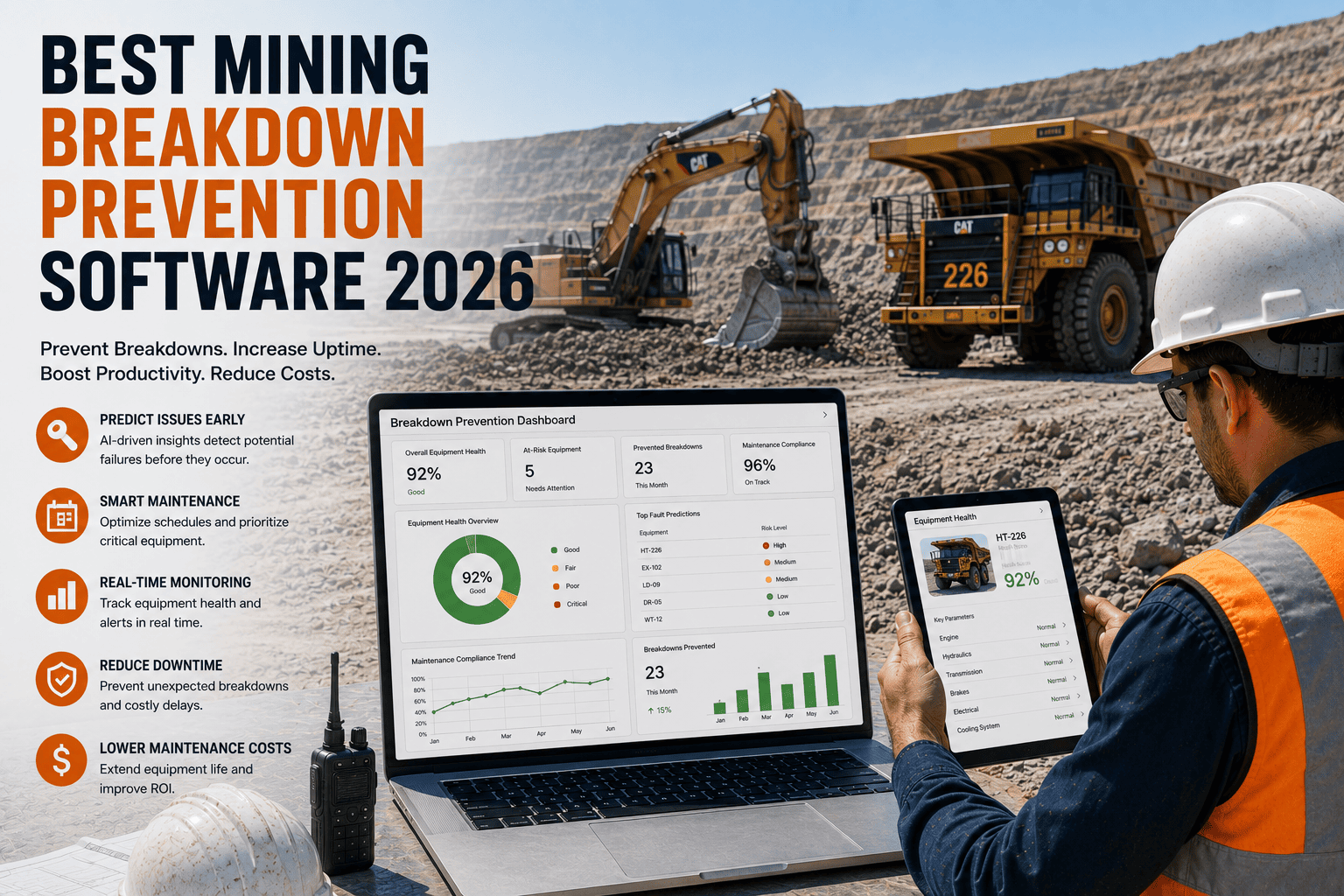
Haul truck maintenance intervals are defined in engine hours, not calendar days. A truck running three shifts per day accumulates 18 to 21 engine hours daily and will hit a 250-hour oil change interval in under two weeks — regardless of what the calendar says. The software must sync with telematics or GPS to track real engine hours per truck, automatically generate PM work orders at the correct intervals, and alert maintenance supervisors before trucks become overdue. PM compliance rates of 95 percent or higher are achievable with automated scheduling — compared to the 60 to 70 percent compliance typical of calendar-based systems managed manually.
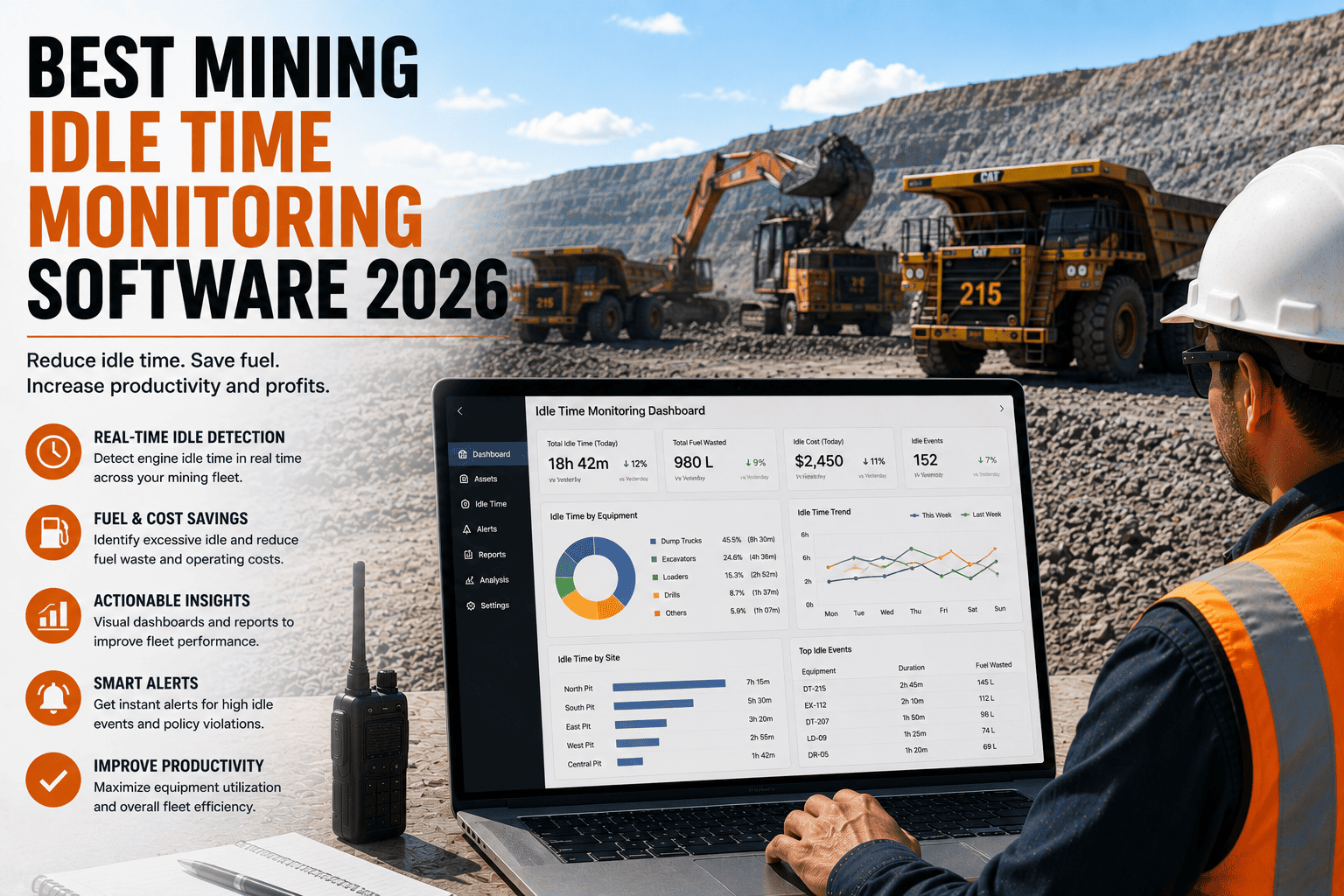
Fuel is the 22 percent cost that haul truck management software has the most immediate ability to reduce. The platform should track fuel consumption per truck, per shift, and per cycle — and correlate fuel data with cycle time, payload, route grade, and road condition data to identify the specific drivers of high fuel costs. Idle time tracking is equally important: trucks queuing at crushers or loading areas burn fuel at 8 to 12 liters per hour without contributing to production. Real-time idle alerts allow dispatchers to redirect trucks before idle accumulates into a significant fuel cost.
Pre-shift truck inspections are not optional — they are a regulatory requirement and an early-warning system for developing mechanical problems. The software must provide mobile inspection checklists that operators complete before every shift, with photo verification for critical items, mandatory completion enforcement, and automatic sync of inspection records to a central compliance dashboard. In operations with underground access or remote pit locations, offline-first functionality is essential — operators must be able to complete inspections without internet connectivity and have data sync automatically when signal returns. Sign up for FleetRabbit to access MSHA-aligned haul truck inspection templates pre-built and ready to deploy from your first shift.
Open-pit operations that deploy haul truck management software covering all six capabilities consistently outperform operations running on radio-based dispatch and paper records. Cycle times improve 10 to 15 percent. Per-truck productivity increases 15 to 17 percent. Fuel consumption drops 8 to 13 percent. PM compliance reaches 95 percent and above. Emergency repair costs fall 25 to 30 percent. The combined effect is a fleet that produces more tons per shift, costs less per ton to operate, and experiences significantly fewer unplanned production stoppages — all without adding trucks, hiring additional operators, or expanding the mine footprint. Book a demo to see what this looks like for your specific operation size and fleet composition.
Haul Truck Management Software Comparison — 2026
Choosing software for your haul fleet means evaluating tools built for very different kinds of operations. Enterprise mining dispatch platforms like Komatsu DISPATCH and Modular Mining are designed for 100-plus truck operations with dedicated IT infrastructure and six-figure implementation budgets. Generic fleet management tools designed for commercial trucking lack the mining-specific features needed for open-pit operations. Purpose-built platforms like FleetRabbit AI are designed specifically for small-to-mid-size open-pit operations that need real mining capability at a price and complexity level that matches their actual scale. You can sign up and compare FleetRabbit against your current system in a free 14-day trial with no commitment required.
| Capability | FleetRabbit AI | Enterprise Dispatch Platforms | Generic Fleet Tools | Paper and Radio |
|---|---|---|---|---|
| Real-time GPS fleet tracking | Included, live map | Yes, enterprise hardware | Basic GPS only | None |
| Automated cycle time tracking | Geofence-based, automatic | Yes, complex setup | Manual entry only | None |
| Payload monitoring | Telematics-integrated | Hardware-dependent | Not available | None |
| Engine-hour PM scheduling | Auto-sync, real-time alerts | Yes, maintenance module | Calendar-based only | None |
| Fuel and idle time monitoring | Real-time dashboard | Full module, extra cost | Fuel card integration only | None |
| Offline mobile inspections | Full offline, auto-sync | Partial offline mode | Online required | Paper only |
| MSHA compliance documentation | Built-in, one-click reports | Configurable add-on | Not available | Manual binders |
| Implementation time | Same day, self-serve | 3 to 9 months | 2 to 6 weeks | None (no system) |
| Pricing per month | $5 per asset | $5,000 to $25,000+ | $500 to $2,000 | Free (until breakdown) |
| Built for open-pit mining | Purpose-built | Yes, enterprise only | Adapted, not purpose-built | No |
FleetRabbit AI gives open-pit operations real-time haul truck visibility, automated cycle time tracking, engine-hour based maintenance scheduling, fuel monitoring, and MSHA-ready inspection records — all in one platform at $5 per asset per month. Setup takes less than a day. No IT team. No long-term contract. Start your 14-day free trial or book a 30-minute demo to see it live on your operation.
How to Deploy Haul Truck Management Software Without Disrupting Operations
The most common reason open-pit mine managers delay adopting fleet management software is the fear of operational disruption during implementation. FleetRabbit AI eliminates that concern entirely with a same-day deployment approach designed specifically for active mine sites that cannot afford downtime. Sign up here and follow these five steps to be fully live before your next shift change.
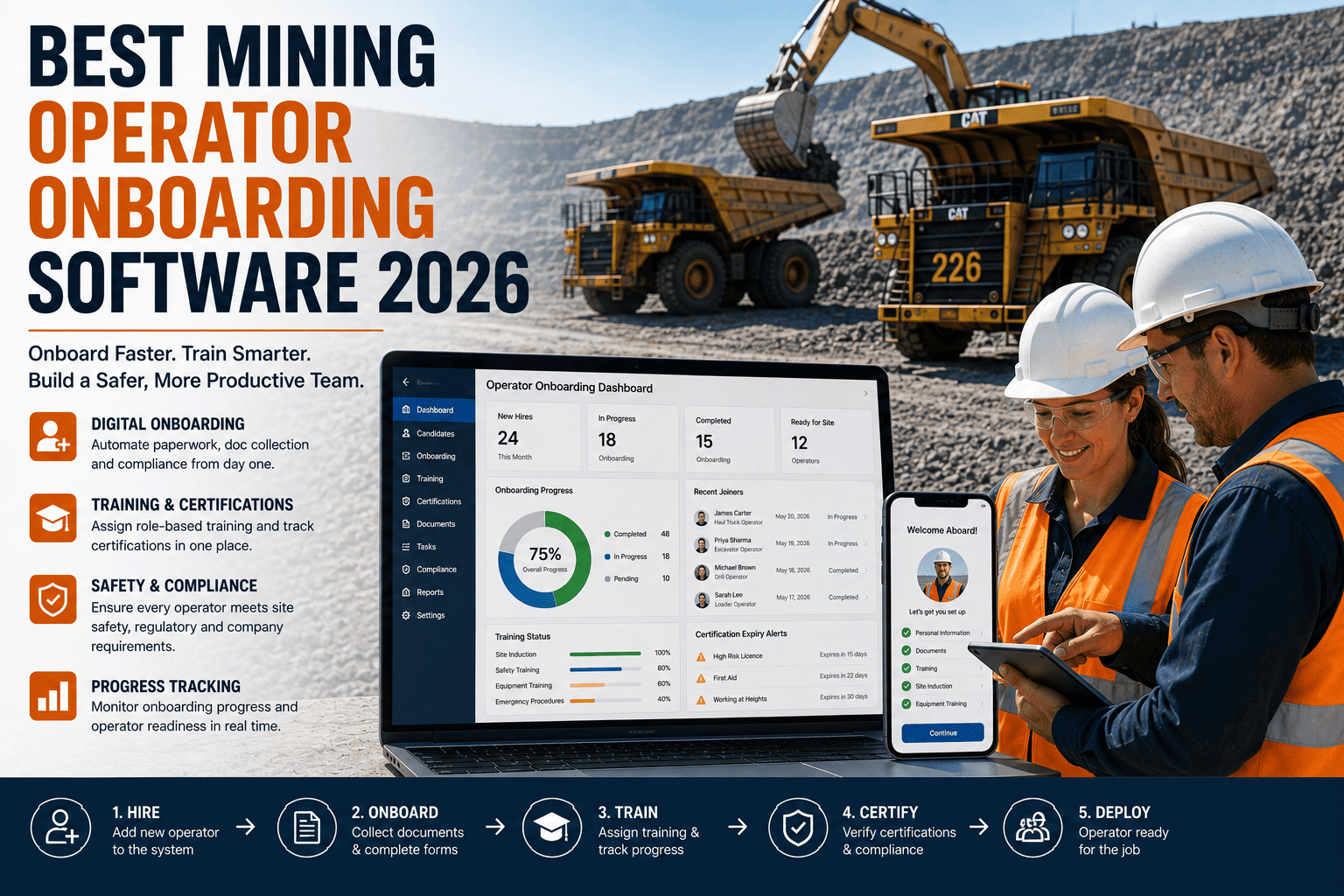
Enter each haul truck, loader, excavator, and ancillary vehicle with its asset ID, current engine hours, and assigned operator. Import from a CSV file or add manually — most 20-truck operations complete this in under 25 minutes. If your operation already uses telematics hardware from any major provider, connect it now and engine hours will sync automatically going forward. If not, the mobile app provides the core GPS and inspection functionality you need from day one without any hardware changes.
Draw geofence boundaries around your key production areas — shovel loading points, crusher dump points, waste dumps, maintenance bays, and fuel stations. These geofences become the anchors for automated cycle time tracking. The moment a truck enters a loading area, the load phase timer starts. The moment it leaves, the haul phase begins. No operator input required. Cycle time data accumulates automatically from the first truck movement after geofences are set.
Operators receive mobile access to FleetRabbit inspection checklists via a simple link — no app store download needed. Select the haul truck pre-shift inspection template from the MSHA-aligned template library or customize it to match your existing checklist format. Set mandatory photo verification for critical items like tire condition, brake check, and fluid levels. Operators complete the first digital inspection before the next shift starts. MSHA compliance records begin building automatically from that first submission.
Enter manufacturer-recommended service intervals in engine hours for each haul truck model in your fleet. FleetRabbit calculates each truck's next due date based on current engine hours and average daily usage. Work orders generate automatically before the due date and appear in the maintenance queue for your technicians. Managers receive alerts when trucks approach their service intervals — not after they have passed them. This single change typically moves PM compliance from 60 to 70 percent on calendar-based systems to 90 to 95 percent within the first month.
After the first full shift with FleetRabbit running, the dashboard automatically generates a shift performance summary showing total cycles per truck, average cycle time by route, idle time by truck, payload averages where telematics data is available, and inspection completion rates. This is your baseline — the starting point from which every improvement will be measured. Most shift supervisors report identifying at least one significant performance issue in the first shift report that was invisible before because there was no data to surface it. Book a demo to walk through what your first shift report will look like based on your fleet size and operation type.
Frequently Asked Questions About Haul Truck Management Software
Open-pit haul truck haulage is 50 to 60 percent of your total operating cost. Fuel is 22 percent of that cost alone. Cycle time variance, idle queuing, payload inefficiency, reactive maintenance, and invisible production data are costing your operation hundreds of thousands of dollars per year in preventable losses. FleetRabbit AI solves all five with a single platform that deploys in under a day, requires no IT team, and costs $5 per asset per month. Real-time GPS tracking, automated cycle time monitoring, engine-hour based PM scheduling, fuel and idle time dashboards, and MSHA-ready inspection records — all connected in one place from your first shift. Start your free 14-day trial and get your first haul fleet performance insight within hours. Or book a 30-minute demo and we will build a custom ROI estimate for your specific operation before you commit to anything.