Brakes on a 200-ton haul truck don't fail the way a car's brakes do. There's no long, gradual squeal warning the operator for weeks. A retarder that's been running hot on every descent, a pad that's worn past its last safe margin, or a hydraulic line that's been seeping slowly can hold together for shift after shift right up until the one grade where it doesn't. When that happens on a loaded haul road, the cost isn't measured in a repair invoice. It's measured in an MSHA investigation, a shutdown, and in the worst cases, a life. Brake inspection management software exists to close that gap between what a paper checklist claims happened and what actually got checked, shift after shift.
Mining brake inspection management software digitizes pre-shift and periodic brake checks, requires photo verification on pads, lines, and retarders, and automatically routes any flagged defect to maintenance before the truck leaves the yard. A brake defect caught mid-shift can trigger 20,000 to 60,000 dollars in emergency repair and investigation costs, and MSHA brake citations under 30 CFR 56.14101 range from 7,000 to 70,000 dollars per violation. FleetRabbit turns brake inspections into a tracked, audit-ready record that catches wear before it becomes a failure.
Why Brake Inspections Get Treated Differently Than Other Checks
Every item on a pre-shift walk-around matters, but brakes sit in a category of their own for one simple reason: a failed light or a worn wiper blade slows down a shift, while a failed brake system on a loaded haul truck can end it permanently. MSHA regulations recognize that difference explicitly. Brake system checks are called out under 30 CFR §56.14101 for surface mines, requiring functional service brakes, secondary brakes, and parking brakes before equipment operates. Inspectors ask about brakes first when they arrive on site, and for good reason — brake-related incidents are consistently among the most severe category of mining equipment accidents.
The Problem With Paper Brake Checks
A paper checklist can record "brakes OK" in the same five seconds it takes to record "mirrors clean." There's no way to prove, after the fact, that a pad thickness was actually measured or that a retarder temperature was actually checked rather than assumed. When an incident happens and MSHA requests 90 days of brake inspection records, a stack of identical checkmarks with no photos and no measurements doesn't hold up as evidence of a real inspection — it looks like exactly what it often is.
What Brake Inspection Management Software Does
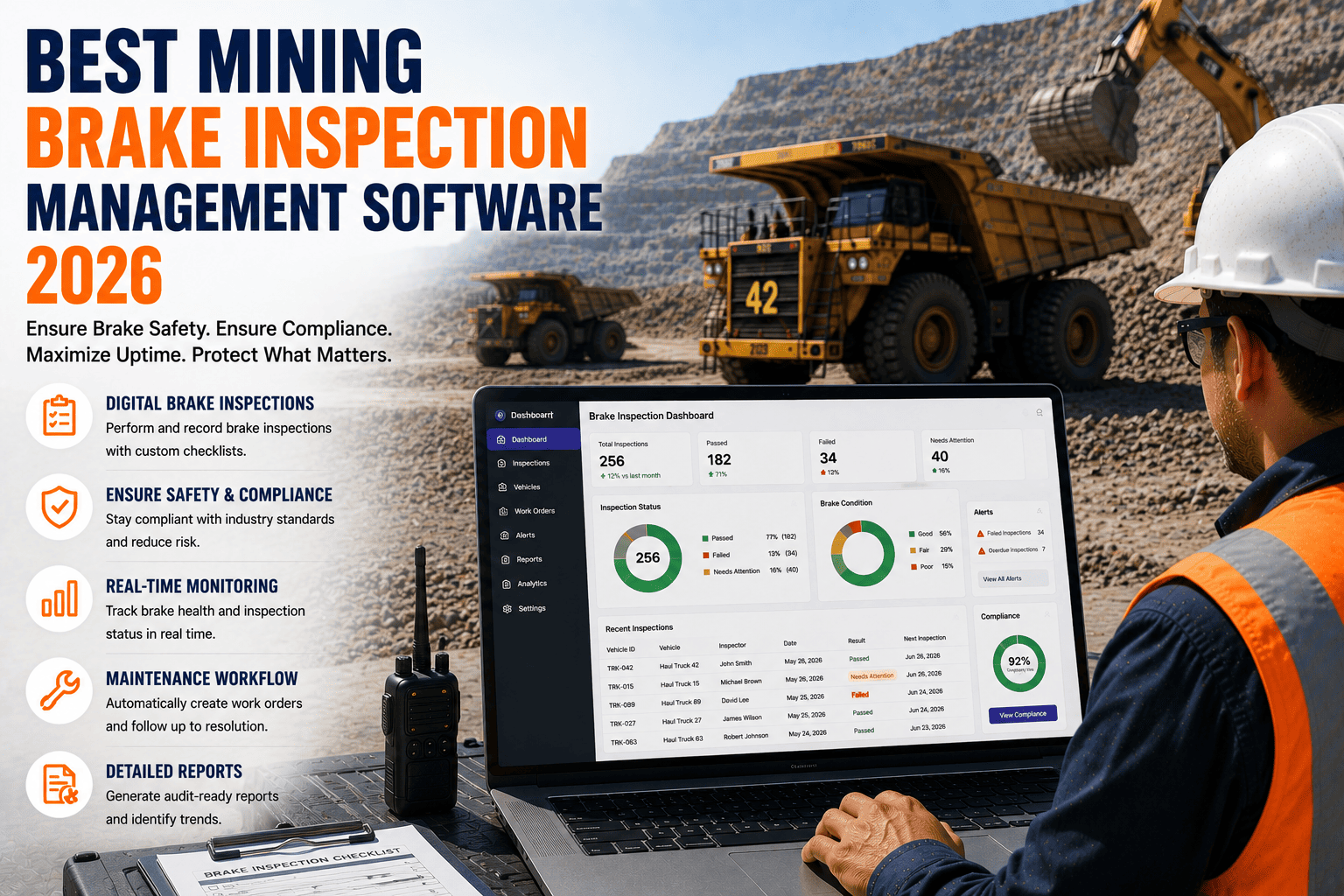
A purpose-built brake inspection platform replaces the paper form with a structured digital checklist specific to each truck's brake configuration — service brakes, secondary or emergency brakes, parking brakes, and retarder systems where equipped. The operator or inspector works through the checklist on a phone or tablet, and critical items require a photo before the step can be marked complete, so there's a visual record tied to the exact date, time, and GPS location of the check.
Photo-Verified Pad and Line Checks
Instead of a checkbox, the software requires a timestamped photo of brake pad thickness, line condition, and any visible fluid seepage. That photo becomes part of the permanent inspection record, giving maintenance teams a visual trend to compare against previous inspections rather than relying on the operator's memory of "looked fine last week."
Automatic Defect Routing
When an inspector flags a brake defect — reduced pad thickness, a soft pedal, an overheating retarder — the software routes that defect directly to the maintenance queue in real time, rather than waiting for a paper form to reach the shop at shift change. The truck can be tagged out automatically until the defect is cleared, closing the gap where a known issue gets "run for one more shift" because nobody flagged it loudly enough.
Engine-Hour Based Brake Service Scheduling
Because brake wear in mining tracks engine hours and grade severity far more closely than calendar days, the best platforms calculate next-due brake service automatically from live telematics data instead of a fixed monthly schedule, so a truck running steep, loaded descents all week gets flagged for inspection sooner than one running flatter routes.
FleetRabbit routes every flagged brake defect straight to your maintenance team and keeps a complete, audit-ready record for every truck. Start your free trial and see how fast brake compliance improves.
Brake Failure Cost: Caught Early vs. Caught Late
The financial gap between a brake defect caught during a scheduled inspection and one discovered mid-shift is one of the clearest ROI arguments in mining maintenance. The table below breaks down where that gap comes from.
| Scenario | Typical Cost | Downtime | Regulatory Risk |
|---|---|---|---|
| Caught in Scheduled Inspection | 400 to 1,500 dollars for planned pad or line replacement | A few hours during a planned maintenance window | Minimal — documented as routine preventive service |
| Caught Mid-Shift | 20,000 to 60,000 dollars in emergency repair, towing, and investigation time | Full shift or more, plus incident review time | High — near-miss reporting and possible MSHA inquiry |
| Missed Entirely (Citation Issued) | 7,000 to 70,000 dollars in fines per violation, plus repair costs | Equipment tagged out until corrected | Severe — citation on permanent MSHA record |
Building a Brake Inspection Program That Actually Holds Up
A strong brake inspection program isn't just about having software — it's about how consistently that software gets used and how quickly it turns a flagged issue into a completed repair. Mines that get the most out of brake inspection platforms tend to follow the same pattern: mandatory photo evidence on every critical brake component, automatic tag-out on any flagged defect, and a maintenance dashboard that shows every truck's current brake status at a glance instead of buried in individual paper forms.
Making Records Audit-Ready by Default
When an MSHA inspector requests brake inspection history, the difference between producing it in minutes versus hours often decides how the rest of the visit goes. Digital records that are automatically timestamped, GPS-tagged, and stored centrally mean a supervisor can pull 90 days of brake checks for any truck instantly, with photo evidence attached to every entry.
Coaching Operators, Not Just Catching Defects
The most useful brake inspection data isn't just the defect log — it's the pattern behind it. If one operator consistently reports brake temperature issues on the same route while others don't, that's a coaching opportunity on retarder use and descent technique, not just a maintenance ticket. Software that surfaces these patterns turns inspection data into a training tool as much as a compliance one.
What to Look for Before You Choose a Platform
Not every digital inspection tool is built with mining brake systems in mind. A generic checklist app built for logistics or construction will miss mining-specific brake configurations like retarder systems, secondary brake requirements, and grade-specific service intervals. Before choosing a platform, confirm it supports photo-mandatory brake checks, automatic defect routing to maintenance, engine-hour based service scheduling, and instant exportable records for MSHA review.
Integration With the Rest of Your Maintenance Program
Brake inspection data is most valuable when it's connected to the rest of a truck's maintenance history rather than sitting in its own silo. A platform like FleetRabbit ties every brake defect and every completed repair to that specific truck's full record, so a pattern of repeated brake issues on one unit gets flagged for deeper investigation instead of being treated as a series of unrelated repairs.
The Bottom Line on Brake Inspection Software
Brakes are the one system on a haul truck where "probably fine" isn't an acceptable standard, and paper checklists were never built to prove otherwise. Digital brake inspection software closes that gap by making every check photo-verified, every defect immediately visible to maintenance, and every record instantly ready if MSHA asks for it. The mines that get this right aren't the ones with the newest trucks — they're the ones where a worn pad gets caught on a Tuesday morning inspection instead of on a Thursday afternoon descent.
If your brake inspections are still living on paper or scattered across radio calls and memory, the risk isn't hypothetical. It's sitting on your haul road right now, waiting for the one shift where nobody catches it in time.
A missed brake defect doesn't stay small — it turns into an emergency repair, a grounded truck, or worse. FleetRabbit gives your team photo-verified brake inspections, automatic defect routing, and audit-ready records in one platform built for mining. Start your free trial or book a 30-minute demo to see it on your fleet.