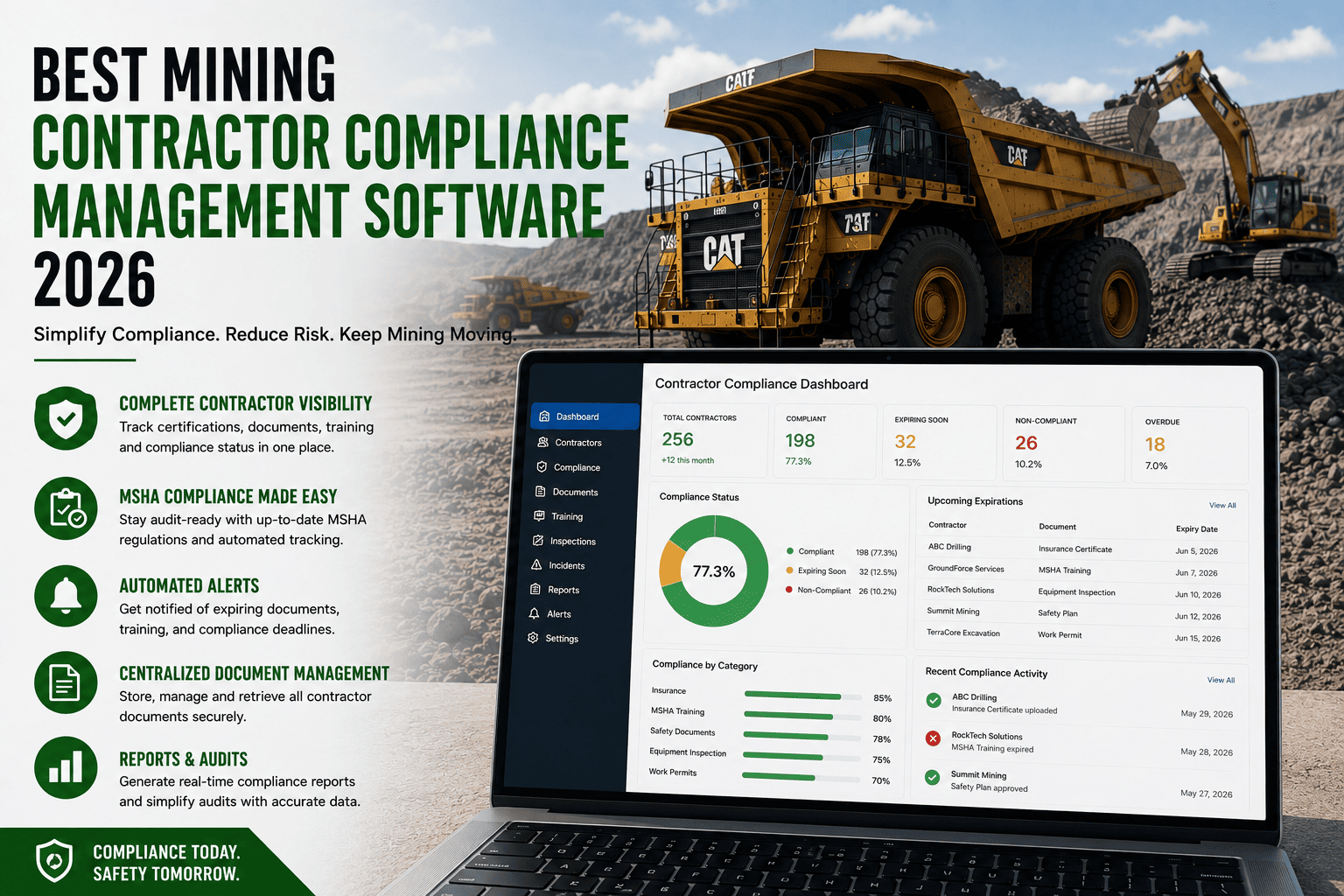
A mine operator does not get to shrug off responsibility just because the worker on the equipment belongs to a contractor, not the payroll. MSHA holds the operator accountable for the safety and training of every contractor working on site, which means an expired certification, a missed induction, or an unverified insurance certificate is not the contractor's problem alone. It is yours, the moment an inspector or an incident asks the question. Mining contractor compliance management software exists to make sure that question always has a clean answer, no matter how many contractor crews are rotating through your gates in a given month.
Mining contractor compliance management software centralizes contractor prequalification, MSHA Part 46 and Part 48 training verification, equipment inspection, insurance documentation, and ongoing performance monitoring in one system. Manual, spreadsheet-based tracking is where the gaps quietly form: certifications expire without anyone noticing, access records go incomplete, and documentation takes days to compile when it's actually needed. Centralizing contractor data cuts that retrieval time to minutes and closes the certification-expiry gaps that put both compliance and site safety at risk.
Why Contractor Compliance Is Its Own Category of Risk
Mining sites routinely run drilling contractors, equipment maintenance crews, environmental monitoring services, and specialty trades side by side with the core workforce, and each of those crews arrives with a different set of certifications, insurance terms, and training histories. MSHA's Part 46 and Part 48 standards require documented, task-specific training for every contractor miner, and those training records need to be on site and available for inspection at any time. When that data lives in separate binders and inboxes for each vendor, a single missed renewal can put an entire crew on site without valid certification, and nobody finds out until it is already a problem.
Industry data on centralized safety management shows the scale of the gap: only a small fraction of EHS functions have consolidated their processes into a single system, meaning most organizations, mining included, are still piecing contractor compliance together from disconnected sources. That fragmentation is exactly where certification expiries slip through, where access records go incomplete, and where documentation takes far longer than it should to compile when an inspector or an incident review calls for it.
Prequalification
Verify licenses, MSHA IDs, insurance, and safety history before a contractor is approved for site work.
Onboarding
Confirm site-specific induction, hazard awareness, and Part 46/48 training before mobilization.
Active Monitoring
Track certification expiries, equipment condition, and safety performance while the contractor is on site.
Close-Out
Document performance review, deactivate site access, and retain records for future prequalification.
What Falls Through the Cracks Without a Centralized System
Expired Certifications Nobody Catches in Time
Contractor certifications, medical clearances, and insurance policies all carry expiration dates that do not align with your internal review cycle, and a crew can easily still be on site weeks after one of those documents has lapsed if nothing is actively flagging it. Automated expiry alerts close that gap by notifying the right person well before a lapse happens, not after.
Equipment That Was Never Pre-Inspected
Contractor-owned equipment needs to be pre-inspected and approved before it ever mobilizes to site, the same way internal fleet assets are, but this step is frequently skipped or poorly documented when it depends on a paper form passed between departments.
Safety Performance That Isn't Tracked Separately
Contractor incident rates, near-misses, and violations need to be tracked apart from internal workforce statistics so that a contractor's actual safety record is visible for future engagement decisions, rather than getting blended into a single site-wide number that hides underperforming vendors.
Incomplete Records at Close-Out
When a contract ends without a documented performance review, access deactivation, and proper record retention, the mine loses the historical data it needs to make an informed decision the next time that same contractor bids for work.
FleetRabbit centralizes contractor certifications, equipment approvals, and safety performance in one dashboard, with automated alerts before anything expires. Sign up for free to bring your contractor records into one place, or book a demo to see how expiry alerts and access control work together.
Manual Tracking vs. Contractor Compliance Software
| Compliance Task | Manual, Spreadsheet-Based Process | Centralized Compliance Software |
|---|---|---|
| Certification Expiry Tracking | Relies on someone remembering to check dates | Automated alerts before expiration |
| Equipment Pre-Approval | Paper forms passed between departments | Digital sign-off tied to the equipment record |
| Safety Performance Visibility | Blended with internal workforce statistics | Tracked and reported separately by contractor |
| Record Retrieval for Audits | Days, across multiple vendor files | Minutes, searchable by contractor or site |
| Close-Out Documentation | Inconsistent, easy to skip under time pressure | Standardized workflow required before contract closes |
Building a Contractor Compliance Program That Holds Up
Standardize Prequalification Requirements
Every contractor should clear the same baseline before mobilization, including verified MSHA IDs under 30 CFR 45.1, current insurance, and a reviewed safety record, rather than an informal check that varies by who is doing the hiring.
Centralize Training and Certification Records
Part 46 and Part 48 training records need to be stored where they are instantly retrievable, not scattered across each contractor's own paperwork, since MSHA can request them on site at any time under 30 CFR 46.9.
Monitor Continuously, Not Just at Onboarding
Compliance is not a one-time gate. Ongoing supervision, task-specific training verification for high-risk work, and ongoing safety statistic tracking need to continue for the full duration a contractor is active on site.
Formalize Close-Out and Record Retention
A documented performance review at the end of every contract builds the historical data that makes your next prequalification decision faster and better informed, and it protects you if a contractor's work is ever questioned after the fact.
Certification gaps and missing records are what turn a routine contractor review into a compliance problem. FleetRabbit keeps every contractor's certifications, equipment approvals, and safety record current and instantly accessible. Sign up for free and centralize your contractor compliance today, or book a demo to walk through it with our team.