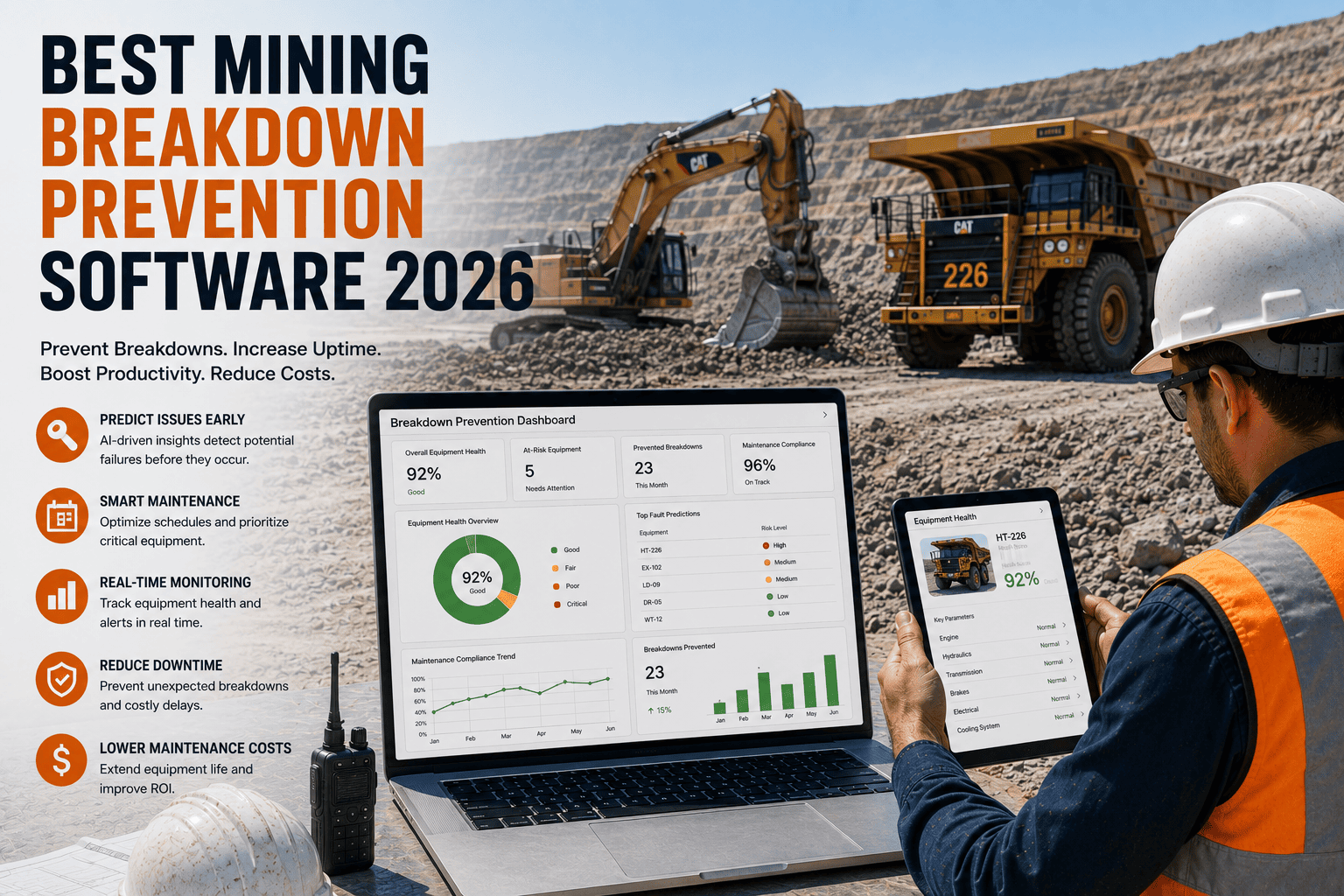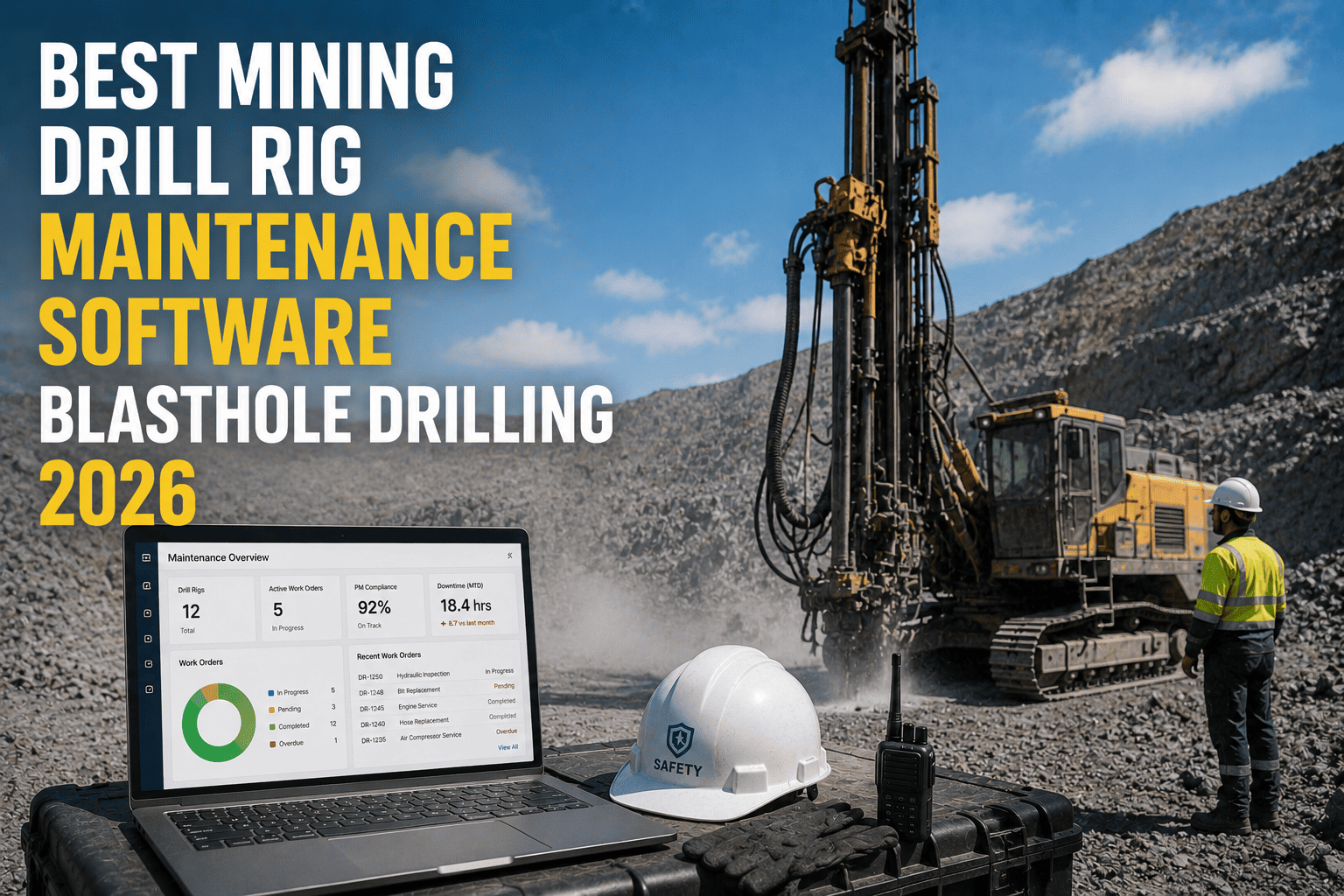
A blasthole drill rig going down mid-campaign doesn't just delay a repair ticket — it stops your entire blast schedule, idles your crews, and cascades delays through every downstream mining process. Drill rigs are the first domino in the mining production chain. When they fall unexpectedly, everything falls with them. Yet in 2026, the majority of mining operations still manage drill rig maintenance through spreadsheets, paper cards, and memory — tools that were never designed to protect assets worth $1 million to $5 million operating in 24-hour, high-abrasion environments.
Mining drill rig maintenance software schedules preventive maintenance by engine hours, tracks component wear in real time, manages digital inspections, and alerts maintenance teams before failures happen. Unplanned drill rig downtime costs an average of $180,000 per incident across the industry. FleetRabbit's purpose-built platform reduces unplanned breakdowns by 40–50%, keeps blasthole campaigns on schedule, and pays back within months. Start your free trial or book a live demo today.
Why Drill Rig Maintenance Is the Highest-Stakes Job on Any Mine Site
Drilling is the first process in the mining production cycle — and the most consequential. Every blast, every excavation, every truck load of ore traced back to a drill hole executed on schedule. When your Epiroc SmartROC, Atlas Copco Pit Viper, or Sandvik DR411 goes down unexpectedly during a blasthole campaign, you don't just lose the rig. You lose the blast. You lose the dig. You lose the entire downstream sequence that was built around that production window.
Research confirms the scale of the problem. Mining operations that book a demo with FleetRabbit are often shocked to discover just how much of their unplanned downtime originates with drilling equipment. Studies show drilling rigs account for more than 15% of all unplanned mobile equipment downtime on underground mine sites — a disproportionate share given the number of rigs relative to total fleet size. On surface operations running blasthole programs, the impact is even larger because a single drill rig typically services the blast requirements for an entire bench or pit section.
The Core Challenge: Why Generic Maintenance Tools Fail Drill Rigs
Most fleet management and CMMS platforms on the market were designed for road vehicles or general industrial equipment. They track mileage, manage work orders, and handle basic PM schedules. But blasthole and surface drill rigs operate on fundamentally different parameters — and the gap between what generic tools offer and what drill rig maintenance actually requires is where breakdowns hide.
What Makes Drill Rig Maintenance Uniquely Demanding
High-Vibration Component Wear
Blasthole drilling generates constant percussive stress on drill strings, rotary heads, feed systems, and compressor components. Wear accumulates faster than calendar-based schedules anticipate — making engine-hour and cycle-count triggers essential, not optional.
Dust and Abrasion Environments
Surface blast drilling operates in high-dust environments that accelerate wear on air filtration systems, hydraulic seals, and engine components. Without regular condition-based inspection triggers, dust infiltration silently degrades systems until failure.
Remote Site Operations
Drill rigs often operate kilometers from the maintenance workshop on pit benches or remote blast zones. When a rig goes down, getting a technician, parts, and equipment to the location adds hours to every repair — hours that multiply rapidly into production losses.
OEM Complexity and Part Lead Times
Major drill rig OEMs — Epiroc, Sandvik, Atlas Copco, Komatsu Mining — produce highly engineered machines with specialized parts. Emergency sourcing for a compressor module or rotary head component can mean days of lead time, compounding the downtime cost of every unplanned breakdown.
Multi-Shift Production Pressure
Blasthole programs run 24 hours across multiple shifts. Every shift change is an opportunity for defects to go unreported, maintenance findings to go undocumented, and developing faults to be handed off without context — until something fails catastrophically.
Regulatory Inspection Requirements
Drill rigs in mining operations carry strict regulatory inspection obligations tied to operating condition, operator certification, and equipment class. Paper-based inspection records create audit risk and often result in missed inspection windows that trigger compliance findings.
What Drill Rig Maintenance Software Must Do in 2026
If you're evaluating platforms — or considering signing up to FleetRabbit — these are the non-negotiable capabilities that separate purpose-built mining maintenance software from general-purpose tools that happen to have a "mining" checkbox on their feature list.
Engine-Hour and Meter-Based PM Scheduling
Drill rigs accumulate wear in hours and drill meters — not kilometers. Your software must trigger PM intervals based on engine hours for mechanical systems and meters drilled for drill string and bit wear. A blasthole rig running 20 hours per day needs PM reminders calibrated to actual usage, not calendar weeks.
Digital Pre-Shift Drill Rig Inspections
Mobile inspection checklists that operators complete before every shift — covering drill string condition, rotary head lubrication, compressor pressures, hydraulic fluid levels, crawler track tension, and cab safety equipment. Defects flagged during inspection escalate to work orders automatically, creating an unbroken chain from discovery to repair.
Component-Level Wear Tracking
Track individual component lifespans — drill bits by meters, compressor elements by hours, rotary heads by cycles. When a component approaches its replacement threshold, the system alerts you in advance so parts can be ordered and labor scheduled during a planned window rather than an emergency shutdown on a pit bench.
Telematics and Fault Code Integration
Modern drill rigs from Epiroc, Sandvik, and Atlas Copco output continuous diagnostic data — fault codes, operating temperatures, pressure readings, and performance metrics. Purpose-built maintenance software ingests this telematics feed and converts raw fault codes into plain-language alerts with recommended actions, letting maintenance teams act before a warning becomes a breakdown.
Work Order Management with Parts Tracking
Digital work orders that capture labor hours, parts consumed, technician notes, and photo documentation for every repair. Recurring repairs on the same component trigger pattern recognition — giving managers the data to justify upgraded parts, revised PM intervals, or OEM consultation before a pattern becomes a chronic failure mode.
Drill Rig Availability and KPI Reporting
Shift-level and weekly reports showing mechanical availability, mean time between failures, planned vs unplanned maintenance ratio, and cost per operating hour. These are the KPIs that mine production managers, maintenance superintendents, and site GMs actually use to evaluate drill rig fleet performance — and the numbers that justify maintenance investment decisions.
FleetRabbit Keeps Your Blasthole Program on Schedule
Engine-hour PM scheduling, digital pre-shift inspections, component wear tracking, and real-time fault alerts — all in one platform built for mining environments. Reduce unplanned drill rig downtime by 40–50% and stop letting breakdowns derail your blast schedule. Start free with 3 rigs or book a demo to see it live.
The Real Numbers: What Drill Rig Downtime Costs Your Operation
Before evaluating software, understand the baseline cost of doing nothing. The numbers below reflect documented losses from mining operations running reactive drill rig maintenance programs — and the recoverable opportunity available through structured preventive maintenance.
Cost Comparison: Reactive vs Preventive Drill Rig Maintenance
A single major drill rig breakdown in a blasthole campaign — compressor failure, rotary head seizure, hydraulic system rupture — routinely costs $50,000 to $180,000 when you account for repair, downtime, crew idle time, blast schedule recovery, and cascading production delays. The same issue caught during a planned inspection costs $800 to $4,000 to fix. The difference is whether your maintenance program finds the problem or the problem finds you. Book a demo with FleetRabbit and we'll calculate your specific breakeven point.
How FleetRabbit Works for Mining Drill Rig Fleets
FleetRabbit is designed to handle heavy equipment in demanding mining environments — including the specific requirements of blasthole and surface drill rig maintenance programs. Here's how the platform addresses each stage of the drill rig maintenance workflow, from pre-shift inspection to long-term reliability analysis. Start your free trial with up to 3 drill rigs — no credit card required.
The FleetRabbit Drill Rig Maintenance Workflow
Pre-Shift Inspection (Operator, Mobile)
Operator opens the FleetRabbit mobile app before shift start. Completes a configurable drill rig inspection checklist — drill string, compressor, hydraulics, crawler tracks, cab safety. Photos attached to any flagged item. Completed inspection logged with timestamp and operator signature.
Automatic Defect Escalation (System)
Any defect flagged during inspection automatically generates a work order with priority level, photo evidence, and assigned technician. Maintenance supervisor receives immediate notification. No defect slips through the handoff between shifts.
PM Alert Triggers (Engine Hours / Meters)
As the rig accumulates operating hours and drill meters, FleetRabbit tracks progress against PM thresholds. Alerts fire at 80% of the interval — giving maintenance teams advance notice to schedule labor, order parts, and coordinate with production to plan the downtime window.
Telematics Fault Monitoring (Continuous)
FleetRabbit integrates with OEM telematics feeds from major drill rig manufacturers, reading fault codes, temperature readings, and performance anomalies in real time. Abnormal patterns trigger alerts to maintenance teams — often days before a failure would occur.
Work Order Completion and Documentation
Technicians complete repairs, log labor hours, record parts used, and add notes on findings — all on mobile. Digital records create a permanent, searchable repair history for every rig in the fleet. No paperwork, no data gaps, no compliance risk.
Performance Reporting and Analysis (Ongoing)
Maintenance superintendents review weekly KPI dashboards — mechanical availability, MTBF, planned vs unplanned ratio, cost per hour. Trends surface early. Investment decisions are data-driven. And the site GM gets a single-page reliability report without asking for it.
Selecting the Right Software for Your Drill Rig Fleet
The market includes a range of tools marketed for "mining maintenance" — but most are either too generic for drill rig-specific workflows or too narrowly focused on geological drilling data management rather than equipment maintenance. Use this evaluation framework to separate purpose-built solutions from repurposed alternatives. Then book a FleetRabbit demo to see how we compare on every criterion.
Hour-Based Scheduling
PM intervals by engine hours AND meters drilled. If the software only supports calendar or mileage intervals, it can't properly maintain drill rigs.
Offline Mobile Inspections
Drill rigs operate in remote pit locations with poor connectivity. Inspection apps must work fully offline and sync when coverage returns.
OEM Fault Code Integration
Native integration with Epiroc, Sandvik, Atlas Copco telematics. Fault codes should display plain-language descriptions, not raw hex strings.
Component-Level Wear Tracking
Track individual drill bits, compressor elements, and rotary heads by usage — not just the rig as a whole. Component-level data drives the most valuable maintenance decisions.
KPI Dashboards and Reporting
Mechanical availability, MTBF, planned vs unplanned ratio, and cost per hour — automatically calculated and reportable by rig, crew, or site.
Multi-Rig Multi-Site Management
Single dashboard showing maintenance status across all rigs on all sites. Essential for operations running blasthole campaigns at multiple pits or benches simultaneously.
Benchmarks: What Good Drill Rig Maintenance Performance Looks Like
Use these industry benchmarks to assess where your drill rig fleet stands — and how much recoverable performance you're leaving behind. Fleets managed with FleetRabbit consistently move from the reactive column toward best-in-class within 90 days of implementation.
Frequently Asked Questions
Key Takeaways
Blasthole drill rigs sit at the critical path of mining production — and their maintenance is among the most technically demanding work in any mining operation. Generic fleet tools and paper-based systems cannot provide the engine-hour scheduling, component-level wear tracking, offline mobile inspections, and real-time fault alerting that drill rig maintenance requires. The cost of this gap is measurable and large: $180,000 per unplanned incident, 15% or more of total mobile equipment downtime, and blast schedules disrupted 8–15 times per rig per year for operations running reactive programs.
The solution is equally measurable. Mining operations implementing purpose-built preventive maintenance software achieve 40–50% downtime reduction, $2.3M average annual savings per operation, and 25% longer equipment life from assets already on their books. The software doesn't replace your maintenance team — it gives them the intelligence to work ahead of failures instead of behind them. In a production environment where every drill shift directly determines every downstream output, getting maintenance right on your drill rigs isn't optional. It's the highest-leverage decision your maintenance team can make.
Stop Running Your Drill Rig Fleet on Luck and Spreadsheets
Every unplanned breakdown on a blasthole rig is a preventable event — and a $50,000 to $180,000 lesson you don't need to pay again. FleetRabbit gives mining maintenance teams engine-hour PM scheduling, digital pre-shift inspections, real-time fault alerts, and the KPI reporting to prove the value. Start free with 3 rigs, or book a 30-minute demo to see how it maps to your operation.