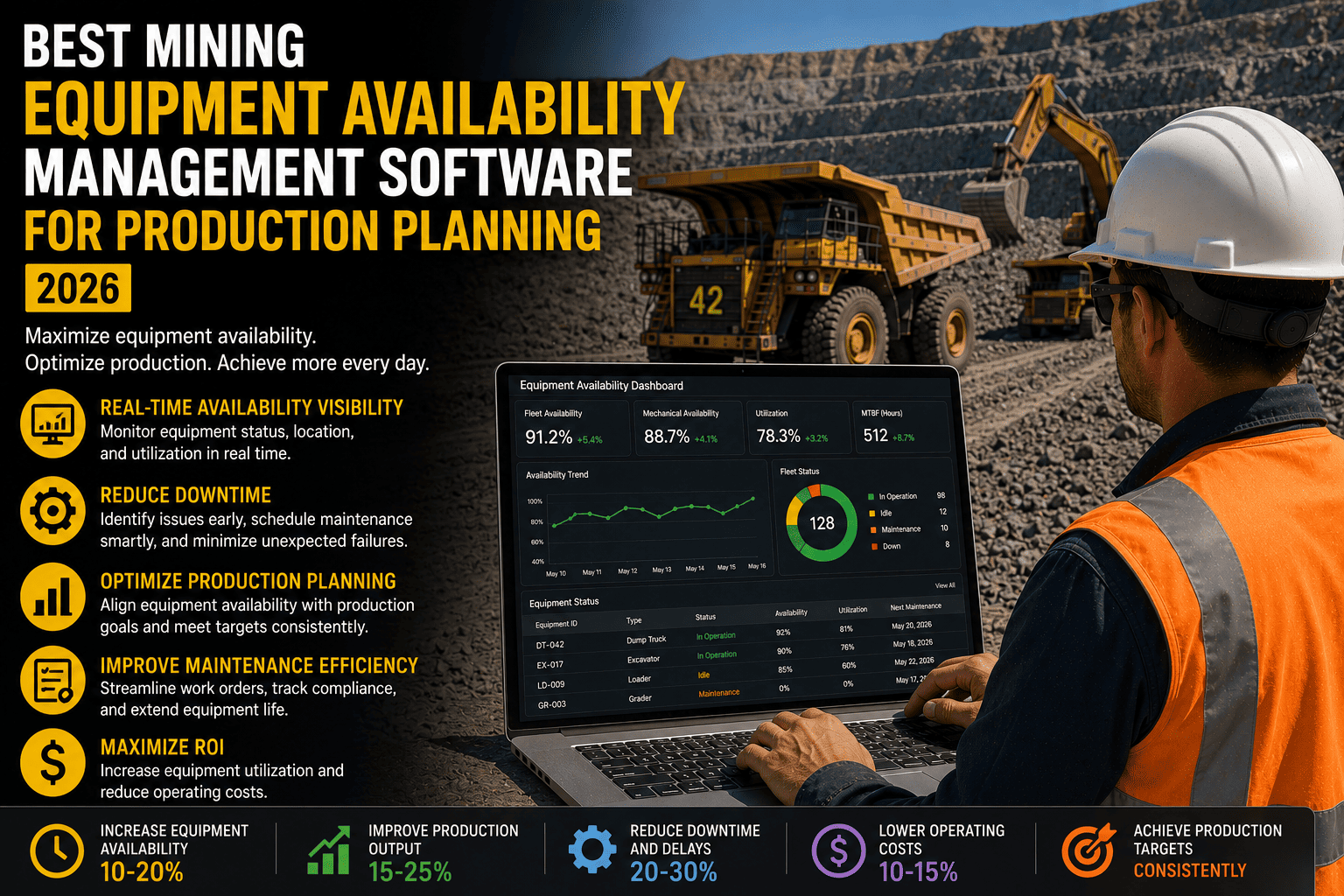
A production plan is only as good as the assumption behind it, and the assumption every mine plan quietly relies on is that the equipment will be there when the schedule says it will. When a haul truck, shovel, or drill is not available at the moment production needs it, the plan does not bend gracefully, it breaks, and the shift supervisor is left rebalancing routes and reshuffling crews on the fly. Equipment availability management software exists to close that gap, turning maintenance data into a number production planners can actually build a schedule around instead of a surprise they find out about at shift start.
Mining equipment availability management software tracks Mean Time Between Failures (MTBF), Mean Time To Repair (MTTR), and real-time asset status so production planners know exactly how many machines they can count on for every shift. A 10 percentage point availability gain on a 20-truck fleet can recover roughly $50,000 a day in additional throughput. You can sign up for FleetRabbit to see your fleet's live availability number today.
Why Availability Is the Missing Link in Production Planning
Most production schedules are built on an assumed fleet size, ten trucks, three shovels, two drills, without ever asking how many of those units will genuinely be available when the shift starts. Maintenance teams track uptime for their own purposes, production teams build schedules for theirs, and the two numbers rarely talk to each other until a plan falls apart mid-shift.
Mechanical Availability Is Not the Same as Planning Availability
A machine can be mechanically capable of running and still not be available for the shift because of delayed inspections, parts staging, or a scheduling conflict with another job. Separating mechanical availability from physical or operational availability is the difference between a maintenance team getting blamed for a production gap they did not cause and a planner actually seeing the real constraint.
The MTBF and MTTR Relationship Planners Rarely See
Availability is mathematically tied to two numbers: how often equipment fails and how fast it gets repaired. Availability equals MTBF divided by the sum of MTBF and MTTR, which means a fleet can improve its availability either by failing less often or by getting back online faster after it does. Most planning conversations only ever look at the finished availability percentage and never ask which of those two levers is actually the one worth pulling.
The Core Metrics Every Availability Dashboard Should Show
A useful availability platform does not just report one number. It breaks availability down into the components production planners and maintenance leads each need to act on.
| Metric | Formula | Why Production Planners Should Watch It |
|---|---|---|
| MTBF | Total operating hours ÷ number of failures | Predicts how many machines will still be running by shift's end |
| MTTR | Total repair time ÷ number of repairs | Tells planners how long a down machine stays out of the schedule |
| Mechanical Availability | MTBF ÷ (MTBF + MTTR) | The theoretical ceiling on how much fleet capacity exists to plan around |
| Physical Availability | Scheduled hours minus all delays ÷ scheduled hours | The realistic capacity planners should actually build the schedule on |
| PM Compliance | Completed PMs on time ÷ scheduled PMs | Low compliance today predicts falling availability next quarter |
FleetRabbit tracks MTBF, MTTR, and real-time availability by asset class, feeding a live number production planners can build tomorrow's schedule around instead of finding out at shift start.
Reactive Planning vs Availability-Driven Planning
The difference between a mine constantly firefighting its schedule and one that hits its production targets consistently usually comes down to when the availability data reaches the planner, before the shift or after it has already gone wrong.
- Schedule assumes full fleet is available every shift
- Breakdowns discovered when the machine fails to show up
- Supervisors rebalance routes manually, mid-shift, by radio
- Maintenance and production data live in separate systems
- Availability is reviewed monthly, long after the damage is done
- Schedule is built on real-time available fleet count
- Degrading assets flagged days before they fail
- Dispatch adjusts routes proactively before the shift begins
- Maintenance and production share one live data source
- Availability is tracked continuously, by asset and by shift
What Changes Once Planners Get Real-Time Availability Data
Once a planner can see which specific machines are trending toward failure days in advance, the schedule stops being a static document and becomes something that adjusts before the problem hits the floor. Routes get rebalanced, backup equipment gets pre-positioned, and the shift starts with a realistic number instead of an optimistic one.
Connecting Availability Data to Fleet-Sizing Decisions
Once availability is tracked by asset over months rather than as a single fleet-wide average, it becomes obvious which units are chronically dragging the number down and whether the fix is more maintenance attention or outright replacement.
Why PM Compliance Is a Leading Indicator, Not a Lagging One
A drop in scheduled maintenance compliance today shows up as falling MTBF two or three months later. Tracking PM compliance in real time gives maintenance leaders a warning long before the availability number itself starts to slide.
If you want to see your own fleet's MTBF, MTTR, and availability trend mapped against these benchmarks, you can book a demo and walk through it with our team using your actual equipment data.
FleetRabbit connects MTBF, MTTR, and PM compliance directly to a live availability dashboard, so production planning finally runs on real numbers instead of an assumed fleet count.
Frequently Asked Questions
Production planning built on an assumed fleet size is planning built on hope, and hope is not a reliability strategy. The mines that consistently hit their targets are the ones that turned MTBF, MTTR, and PM compliance into a live availability number planners actually use, not a maintenance report that arrives after the schedule has already broken. If you want to see what that live number looks like against your own fleet, you can start a free trial or book a 30-minute demo with our team.
FleetRabbit turns MTBF, MTTR, and PM compliance into one live availability dashboard, so your production plan is built on real fleet capacity instead of an assumption that breaks by lunch.