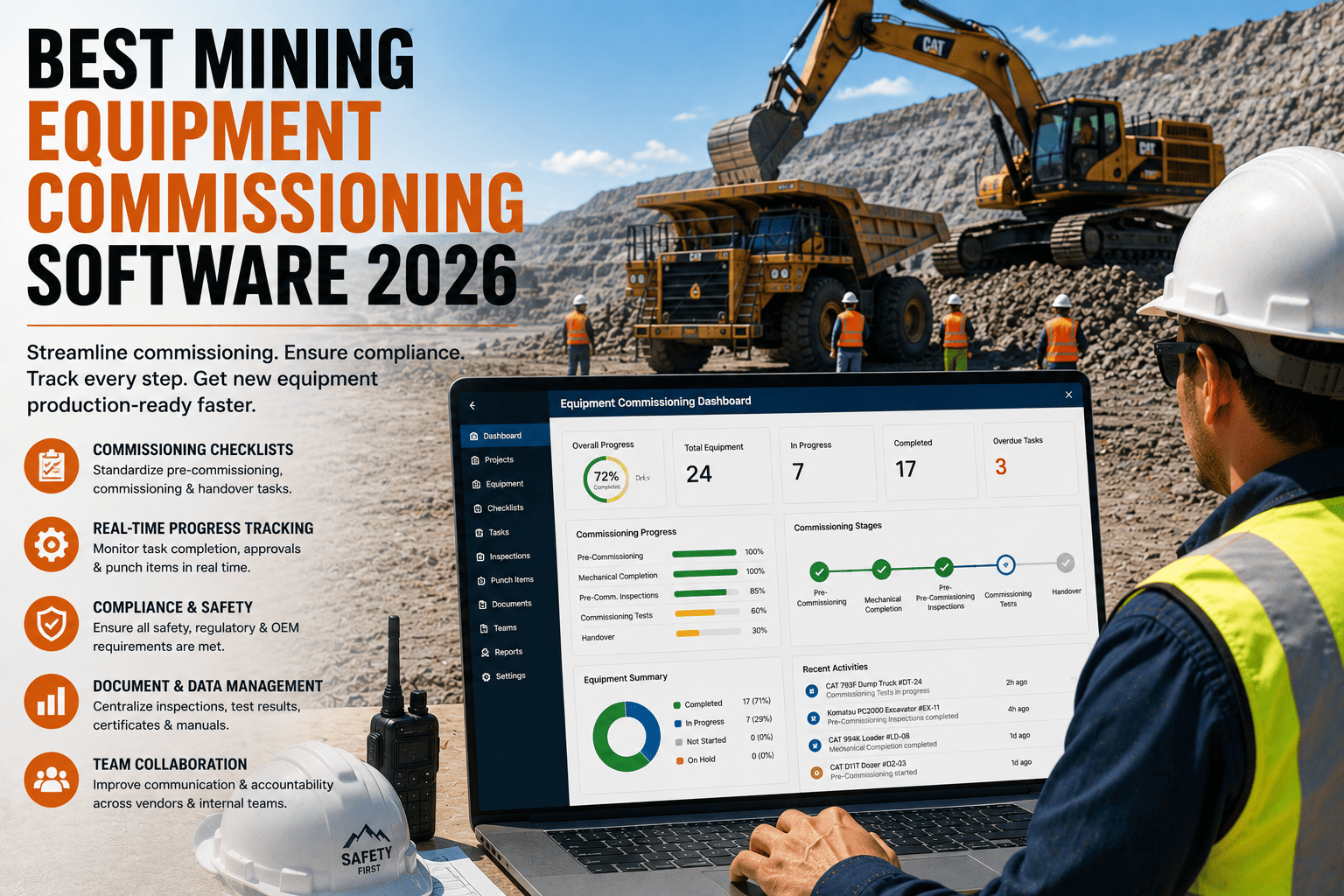
A new haul truck or excavator rolling onto site should be a productivity win from day one. Too often it isn't. Utilities aren't verified, baseline inspections get skipped, preventive maintenance schedules never get entered, and the asset quietly starts its life with gaps that show up as breakdowns months later. Most of that damage traces back to one place: a commissioning process still run on spreadsheets, paper checklists, and email chains instead of a connected system. Mining equipment commissioning software closes that gap by turning onboarding into a structured, trackable workflow from delivery to full production.
The best mining equipment commissioning software manages site readiness checks, factory and site acceptance testing, baseline performance capture, and preventive maintenance setup in one connected workflow. Industry data shows most unplanned downtime in an asset's first year traces back to a commissioning gap, while capital projects with weak operational readiness commonly run 30 to 50 percent over budget.
The Chain Reaction of a Weak Commissioning Process
Commissioning is treated as a formality on too many sites, a box to check between delivery and putting an asset into production. When it's rushed, the consequences don't appear immediately. They build quietly over the following months until they land as a breakdown, a missed maintenance interval, or an asset that never quite hits its expected output.
Untracked Site Readiness Creates Warranty Risk
Utilities, space, and documentation gaps discovered after an asset arrives on site cause costly delays and can void OEM warranty terms entirely. Verifying readiness before delivery, rather than scrambling afterward, protects both schedule and warranty coverage.
Skipped Baselines Erase Your Comparison Point
Without a recorded baseline for performance and condition at startup, there's no reliable way to tell later whether a machine is degrading normally or developing a real problem. That baseline has to be captured during commissioning or it's gone for good.
Missing PM Schedules Turn Into Reactive Maintenance
An asset that enters production without its preventive maintenance schedule configured effectively runs on borrowed time. The first real maintenance event becomes reactive instead of planned, often at a much higher cost. Teams that want a clearer look at how this plays out on their own fleet can book a demo to see the workflow in practice.
FleetRabbit turns commissioning into a connected checklist, so nothing gets skipped between delivery and full production. Site readiness, acceptance testing, and PM setup all live in one place your team can track and verify.
The Five Stages a Commissioning Platform Should Manage
Structured commissioning follows a consistent pattern regardless of equipment type, moving an asset from pre-delivery checks through to a fully configured maintenance profile.
| Stage | What It Covers | Common Failure Point | What Software Fixes |
|---|---|---|---|
| Site Readiness | Utilities, space, access, and documentation verification before delivery | Gaps discovered only after the asset arrives | Digital pre-delivery checklist with sign-off tracking |
| Factory Acceptance | Verifying the equipment meets specification before it ships | Paper-based FAT records that never make it into the maintenance system | Records captured digitally and linked to the asset profile automatically |
| Site Acceptance | Functional testing once installed and connected on site | Skipped functional tests under schedule pressure | Mandatory test sequencing before an asset can move to production status |
| Baseline Capture | Recording starting performance, condition, and OEE figures | No baseline reference for future condition comparisons | Baseline readings stored permanently against the asset record |
| PM Schedule Setup | Configuring maintenance intervals aligned to OEM and site conditions | Schedules never entered or left generic instead of asset-specific | PM intervals generated automatically from commissioning data |
What to Look For in Commissioning Software
Not every asset management tool handles commissioning well. Several capabilities separate platforms that genuinely reduce ramp-up delay from ones that simply digitize a checklist.
Guided, Sequenced Workflows
The system should enforce the order of commissioning steps so an asset can't be marked production-ready until site readiness, acceptance testing, and PM setup are actually complete.
Direct Link to the Asset Record
Commissioning data, including FAT and SAT results and baseline figures, needs to feed straight into the asset's permanent record rather than sitting in a separate document that gets lost after handover.
Vendor and Field Team Collaboration
OEM vendors are part of the commissioning process, not outside observers. A platform that lets vendors log test results and training completion directly keeps everyone working from the same record.
Mobile Access for Field Verification
Technicians commissioning equipment out in the pit need to complete checklists and capture readings from a phone or tablet, since most of this work happens away from a desk.
Automatic PM Schedule Generation
Once baseline and specification data is captured, the platform should build the preventive maintenance schedule from it automatically instead of requiring a separate manual setup step. Fleet teams evaluating this can start a free trial to see how quickly a new asset moves from delivery to a fully configured maintenance profile.
FleetRabbit connects site readiness, acceptance testing, and PM configuration into a single trackable workflow, so nothing gets skipped and every new asset starts production with a full record already in place.
Why the Return on Commissioning Software Is Easy to Justify
Commissioning software rarely competes for budget the way other mining technology does, because the cost of getting it wrong is already well documented across the industry. Capital projects with weak operational readiness commonly overrun their budgets by 30 to 50 percent, and much of that overrun traces directly to gaps discovered late instead of caught during commissioning. Avoiding even a fraction of that overrun on a single major asset purchase covers the cost of a commissioning platform many times over.
The return continues well past day one. Assets that enter service with a complete baseline and a properly configured PM schedule are far less likely to suffer the kind of first-year unplanned downtime that traces back to a commissioning gap. That translates into fewer surprise repairs, more predictable maintenance budgets, and equipment that reaches more of the working life the OEM designed it for.
Frequently Asked Questions
FleetRabbit turns commissioning from a scattered paper process into one connected workflow, so every new asset arrives at production ready, documented, and already on a maintenance schedule. Start your free trial or book a demo to see it set up for your fleet.