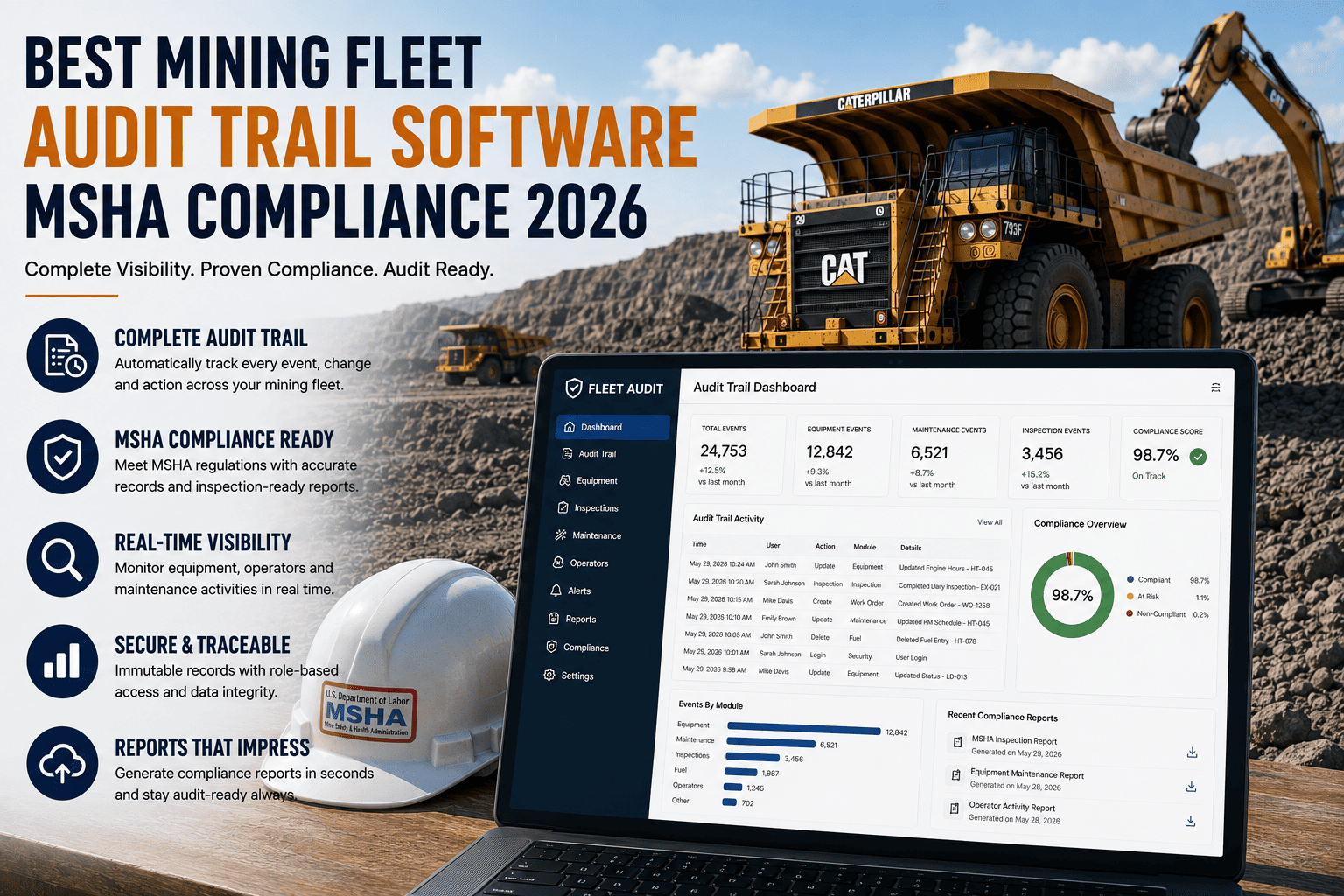
An MSHA inspector does not call ahead. Federal law requires every surface mine to be inspected at least twice a year and every underground mine at least four times a year, and the inspector can walk onto your site without warning and ask to see records going back months. If your equipment inspection logs, maintenance history, and pre-operational checks are scattered across paper binders, whiteboards, and someone's memory, that moment turns into a scramble instead of a formality. Mining fleet audit trail software exists to make sure the records are already there, timestamped, complete, and ready to hand over the second they are requested.
Mining fleet audit trail software automatically logs equipment inspections, maintenance events, operator checks, and defect corrections with timestamps, so every record MSHA might ask for is instantly retrievable. Civil penalties for cited violations currently range from 112 dollars up to 70,000 dollars per violation, with flagrant violations reaching 242,000 dollars, and a documented pattern of significant and substantial violations can trigger a formal Pattern of Violations status. Digital audit trails reduce inspection prep time from days to minutes and close the recordkeeping gaps that turn a minor citation into a costly one.
Why Paper Records Put Mines at Risk
MSHA inspectors are legally entitled to enter any mine without a warrant and without advance notice, which means recordkeeping cannot be something you clean up before an expected visit. Every citation issued carries a civil penalty calculated from six statutory factors, including the operator's history of previous violations and negligence, so a pattern of missing or inconsistent equipment records does not just risk one fine. It raises the negligence and history factors on every future citation as well.
The Real Financial Exposure
Under the current penalty structure, non-flagrant violations range from 112 dollars for minor, promptly corrected issues up to 70,000 dollars, while violations classified as flagrant can reach 242,000 dollars. Unwarrantable failure violations, which include situations where a known hazard or overdue defect was not corrected, carry statutory minimums of 2,000 to 4,000 dollars on top of the base penalty. A mine that accumulates 50 or more significant and substantial violations in 12 months, or issues them at a rate of eight or more per 100 inspection hours, can be placed on Pattern of Violations status, triggering intensified enforcement across the entire operation.
What an Audit Trail Actually Needs to Capture
Pre-Operational Equipment Checks
Every haul truck, loader, and drill rig needs a documented pre-shift inspection recording what the operator checked, what was found, and who signed off. When these checks live on paper, they are easy to skip, easy to lose, and impossible to prove happened consistently over time when an inspector asks for six months of history.
Defect Identification and Correction Timelines
Finding a defect is only half the record. MSHA wants to see when it was found, what corrective action was taken, and how long it took to fix, because an unwarrantable delay in correcting a known hazard is exactly the kind of finding that escalates a citation into a higher-penalty violation. A software-based trail timestamps the defect the moment it is logged and again the moment it is closed, removing any ambiguity about response time.
Scheduled Maintenance History
Preventive maintenance records need to tie back to the specific asset, the specific date, and the specific technician, in a format that can be pulled up instantly rather than cross-referenced across separate maintenance software, fuel logs, and paper work orders.
Training and Certification Records
Operators running specific equipment need documented, current training, and an inspector can ask to see it alongside the equipment record itself. Keeping training data disconnected from the fleet record is one of the most common gaps that turns a routine inspection into a longer, more adversarial one.
FleetRabbit timestamps every inspection, defect, correction, and maintenance event automatically, so your compliance history is always one click away. Sign up for free to start building a complete audit trail today, or book a demo to see how it holds up against a real inspection walkthrough.
Paper Logs vs. Digital Audit Trail Software
| Recordkeeping Factor | Paper & Spreadsheet Logs | Audit Trail Software |
|---|---|---|
| Time to Retrieve Records | Hours to days, across binders and files | Seconds to minutes, searchable by asset |
| Timestamp Accuracy | Manually written, easy to backdate or omit | Automatically logged at the moment of entry |
| Defect-to-Correction Tracking | Often disconnected from the original finding | Linked automatically from finding to close-out |
| Consistency Across Shifts | Depends on individual operator habits | Standardized checklist enforced every shift |
| Inspection-Day Readiness | Scramble to compile requested history | Full history available on demand |
How Digital Records Reduce Your Compliance Risk
They Remove the Guesswork From Inspection Day
When an inspector asks for the last six months of pre-operational checks on a specific haul truck, a searchable digital record answers that question in seconds instead of triggering a scramble through paper files that may or may not be complete. That speed and completeness itself signals a well-run compliance program, which factors into how an inspector approaches the rest of the visit.
They Shorten the Gap Between Defect and Correction
Because a digital system flags open defects automatically instead of relying on someone remembering to follow up, corrective action happens faster, which directly reduces exposure to unwarrantable failure findings and the elevated penalties that come with them.
They Build a Defensible History Over Time
A consistent, timestamped record across every piece of equipment builds a documented compliance history that works in your favor if a citation is ever contested, and it is the exact kind of evidence that keeps a mine off Pattern of Violations status in the first place.
They Connect Compliance to Maintenance
Audit trail data is most useful when it lives next to maintenance scheduling and equipment health data rather than in a separate compliance-only tool, because a defect that is both logged and scheduled for repair in the same system is far less likely to slip through the cracks.
Getting a Fleet Audit-Ready
Digitize Existing Records
Move current paper logs and spreadsheets into a centralized system so historical records are searchable alongside new entries going forward.
Standardize Pre-Shift Checklists
Build a consistent digital checklist for every equipment type so every operator captures the same information the same way, every shift.
Automate Defect Escalation
Configure automatic alerts for open defects that pass a set time threshold, so corrective action happens before it becomes a compliance issue.
Run a Mock Inspection
Test how quickly your team can pull a full history for a random piece of equipment, the same way an inspector would request it on-site.
An MSHA inspector can walk onto your site today with no warning and ask for months of equipment history. FleetRabbit keeps every inspection, defect, and maintenance record timestamped and ready to pull up instantly. Sign up for free and start your audit trail today, or book a demo to walk through it with our team.