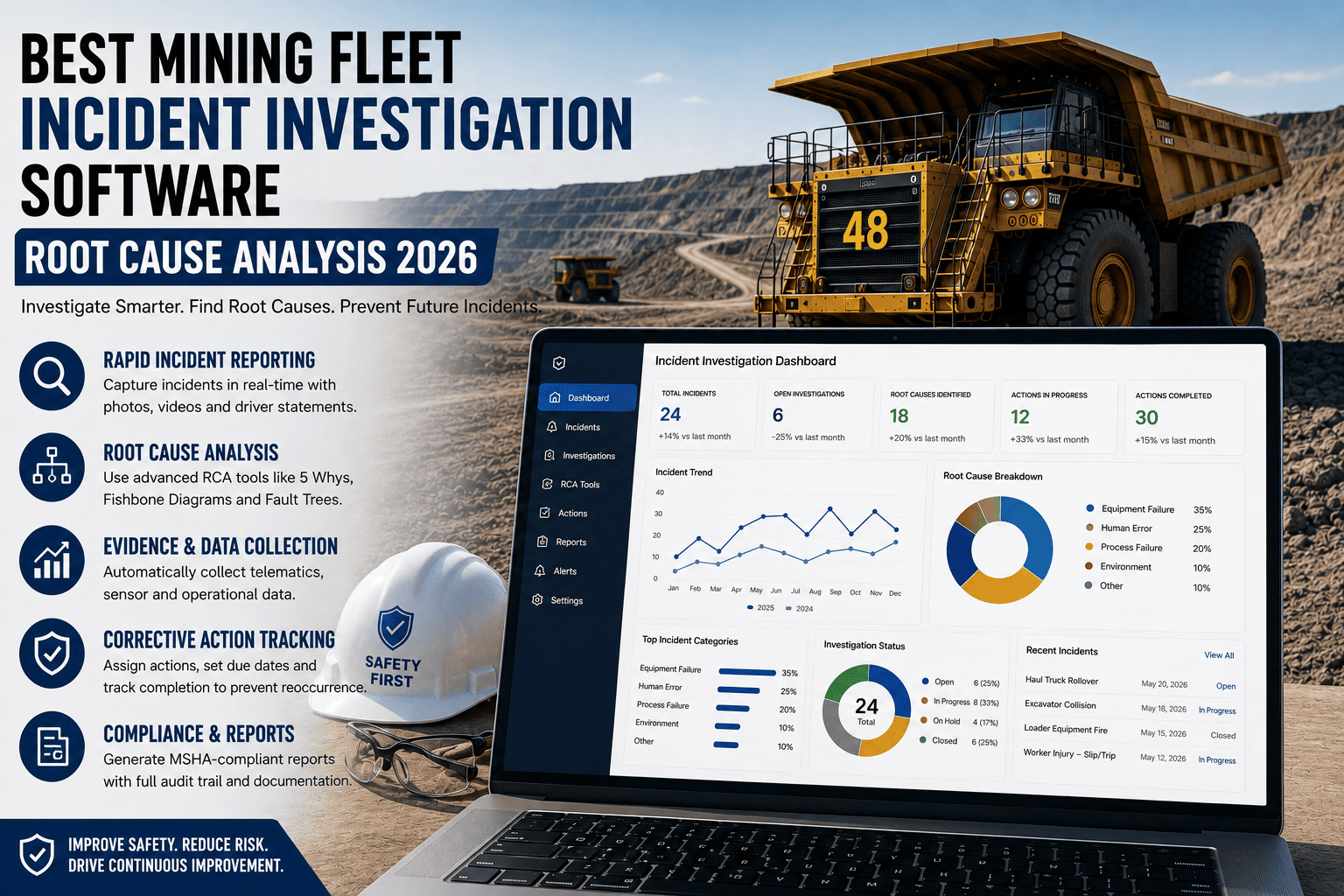
When a haul truck rolls back into another vehicle, or a loader's drivetrain fails for the third time this year, the real damage is rarely limited to the equipment. It is the shift shutdown, the MSHA notification clock already running, and a safety team trying to reconstruct what happened from a handwritten statement, a maintenance log in a different system, and a supervisor's memory of the shift. Mining fleet incident investigation software exists to close that gap, and choosing the right one in 2026 depends on whether it actually finds root causes or just files paperwork faster.
The best mining fleet incident investigation platforms in 2026 combine structured, MSHA Form 7000-1 aligned incident capture with true root cause analysis tools, corrective action tracking, and equipment telemetry so investigators are working from timestamped facts instead of memory. They connect near-miss reports, inspection defects, and maintenance history into one searchable record, which is what turns a single investigation into a pattern your fleet can actually prevent from repeating.
The Real Cost of an Unstructured Investigation
Mining safety investment is often framed as a cost line item, but the more accurate frame is risk exposure. A single serious incident triggers an investigation shutdown, regulatory review, insurance premium adjustments, and legal costs that can run into the millions before the equipment is even repaired. In the first half of 2025 alone, MSHA issued more than 43,000 citations, many requiring corrective action plans and follow-up verification within tight federal deadlines. Powered haulage incidents remain the single most common cause of mining fatalities, and MSHA data from early 2025 showed miner deaths had more than tripled year over year in just the first two months.
What makes this worse operationally is how much time gets lost to disorganized documentation rather than actual prevention work. Safety teams frequently spend the majority of their week shuffling data between spreadsheets, handwritten witness statements, and government portals instead of fixing the conditions that caused the incident in the first place. One missing file or one data discrepancy during a follow-up inspection is treated as a violation in its own right, regardless of whether the underlying safety issue was ever addressed.
FleetRabbit gives your safety team Form 7000-1 aligned incident capture, root cause workflows, and automatic corrective action tracking in one platform. Start your free trial today, or book a 30-minute demo to see it against your current process.
What Root Cause Analysis Actually Requires
Most mining operations have attempted root cause analysis at some point, and many have found it frustrating. The reason is usually one of two predictable failure modes, and good software is built specifically to prevent both of them.
Stopping at the physical cause
"The bearing failed due to lubrication starvation" sounds like an answer, but it is only the surface. Why was lubrication starved? Was the wrong lubricant specified for the operating conditions? Was the preventive maintenance interval too long for the actual duty cycle? A structured investigation on a recurring drivetrain failure frequently uncovers that contaminated hydraulic fluid was traced back to inadequate filter change intervals combined with operator loading practices causing repeated overload events, and that nobody had updated the maintenance schedule when the fleet shifted to higher-payload operation.
Turning investigation into blame-finding
When root cause analysis is used to identify who made a mistake rather than what systemic condition made the mistake likely, the process becomes adversarial fast. People stop reporting near-misses because they do not want to be the next name in an investigation file. Software that frames investigation around conditions and process gaps, not individual blame, keeps the near-miss pipeline open, which is exactly the data that prevents the next serious incident.
Core Features to Look For in Mining Incident Investigation Software
Generic EHS or safety platforms built for offices and warehouses routinely miss what mining investigations actually require. The comparison below covers what separates purpose-built mining investigation tools from adapted general-purpose software.
| Capability | Why It Matters for Mining |
|---|---|
| Form 7000-1 aligned capture | Structured intake matches MSHA's own reporting categories instead of forcing a manual rewrite before submission |
| Guided root cause workflow | Prompts investigators past the first physical cause instead of letting the analysis stop at the obvious answer |
| Near-miss intake | Captures hazards before they escalate, building the pattern data that predicts the next serious incident |
| Equipment telemetry linkage | Ties objective, timestamped, spatially referenced sensor data to the investigation instead of relying on recollection |
| Maintenance system integration | Connects a logged defect or failure directly to prior work orders and PM schedules for the same asset |
| Corrective action tracking | Assigns, dates, and closes out fixes so an identified hazard cannot quietly disappear after the report is filed |
| Multi-site dashboard | Surfaces patterns across zones, shifts, and locations that a single-site view would never reveal |
How the Best Platforms Turn Data Into Prevention
Collecting incident data has never been the hard part for mining operations. Turning it into something that actually stops the next incident is where most systems fall short.
Connect telemetry to the investigation, not just the vehicle
Objective, timestamped, and spatially referenced sensor data gives an investigator facts instead of assumptions about speed, load, location, and equipment status in the moments before an incident. This removes the guesswork that used to depend entirely on witness memory.
Auto-generate work orders from defects
When a defect logged during a pre-shift inspection automatically creates a maintenance work order, the gap between finding a hazard and fixing it shrinks from days to hours, and the record proves it happened.
Tie training records to who was operating what
Certification expiry alerts linked directly to equipment assignments confirm whether the operator involved in an incident was actually cleared to run that machine, a detail investigators and regulators both look for immediately.
Give safety managers one view across every site
Multi-site mining operations need a consolidated safety view without manually reconciling separate system instances. A single dashboard covering every asset, every site, and every shift is what makes trend analysis by zone or shift possible instead of theoretical.
FleetRabbit connects inspection defects, maintenance history, training records, and incident data into a single safety view. Sign up for a free trial or book a demo to see how quickly your team could produce an audit-ready record.
Building an Investigation Workflow That Actually Closes the Loop
Software alone does not prevent repeat incidents. The workflow built around it determines whether an investigation produces a real fix or just a filed report.
Capture the incident the moment it happens
Mobile, offline-capable capture means a shift supervisor can start documenting an incident on-site immediately, with photos and location data attached, rather than reconstructing details hours later from memory.
Ask why at least five times before closing the file
A root cause investigation is not finished at the first explanation. Each answer should prompt another why until the analysis reaches a systemic condition, a maintenance interval, a training gap, a specification choice, that can actually be corrected.
Track the corrective action until it is verified closed
An investigation that ends with a recommendation but no verified completion date is functionally unfinished. The best platforms keep the corrective action open and visible on the dashboard until someone confirms it was actually done.
Every incident that gets a shallow investigation is one more chance for the same failure to repeat. FleetRabbit gives your safety team a structured, MSHA-aligned investigation workflow that finds real root causes and tracks every corrective action to completion.