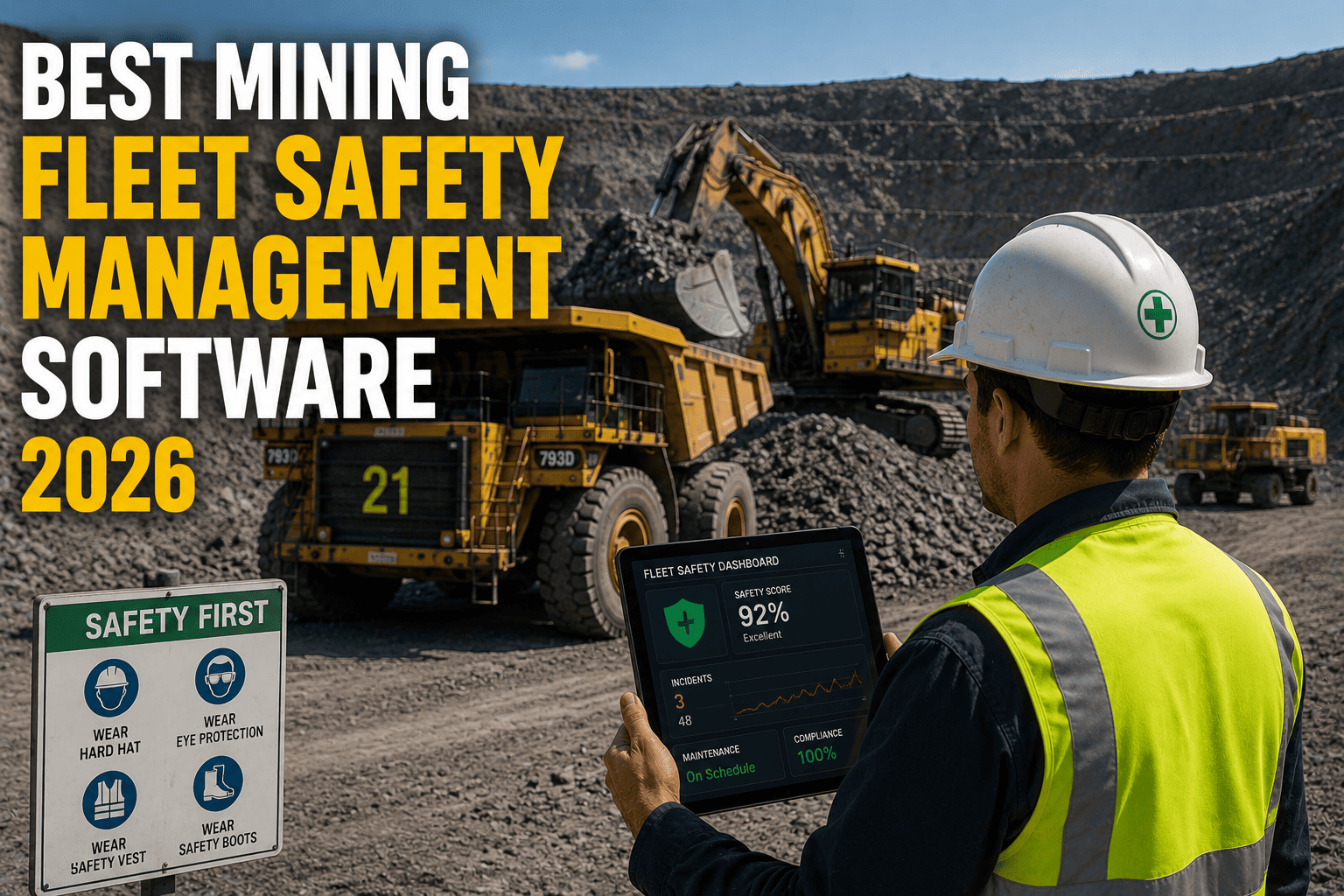
Powered haulage accidents remain the single most common cause of mining fatalities — and in early 2025, MSHA reported that miner deaths had more than tripled year-over-year in the first two months alone. Yet the overwhelming majority of these incidents share a common thread: they were preventable. The right fleet safety management software turns the data your operation already generates — equipment telemetry, driver behaviour, inspection records, near-miss reports — into a proactive safety system that catches risk before it becomes an incident.
Mining fleet safety management is not a single feature or a compliance checkbox. It is the integration of incident reporting, driver coaching, real-time risk monitoring, equipment inspection workflows, and safety analytics into one connected platform that gives safety managers the visibility they need to act before harm occurs. If you want to see what that looks like in a live mining operation, start a free trial or book a demo with FleetRabbit today.
Why Mining Fleet Safety Demands a Dedicated Platform
Most fleet management tools entering the mining market were built for commercial trucking or construction logistics. They were adapted for mines as an afterthought — and it shows. A mine site is not a paved highway network. Equipment operates on unstructured haul roads, in underground drives with no mobile signal, on ramps with gradient loads that stress braking systems far beyond what a delivery truck ever encounters. The inspection requirements are governed by MSHA under Title 30 CFR, not DOT. The consequence of a missed safety signal is not a late delivery — it is a rollover, a runaway vehicle, or a collision between a 180-tonne haul truck and a service ute.
Mining fleet safety management software must be built for these conditions from the ground up. That means offline-capable mobile apps for underground and remote surface operations, MSHA-aligned inspection templates rather than generic checklists, driver behaviour analytics calibrated for severe-duty operating cycles, and incident management workflows that match the regulatory documentation requirements of a 30 CFR compliance environment. Generic platforms fail mining safety programmes on multiple dimensions simultaneously. Purpose-built ones do not.
The Five Pillars of Mining Fleet Safety Management
Effective safety management in mining is not a single capability — it is five interconnected systems working together. A weakness in any one pillar creates vulnerability across the whole safety programme.
Pre-Shift Inspection
Digital, offline-capable checklists that verify equipment is safe before every shift starts. Photo-verified for critical items. Every defect auto-routed to the maintenance queue.
Real-Time Risk Monitoring
Live GPS tracking, geofence zone monitoring, speed violation alerts, and equipment health signals — giving supervisors an instant picture of every active risk on site.
Driver Behaviour Coaching
Operator scorecards measuring speeding, harsh braking, seatbelt compliance, and zone adherence. Data-driven coaching that corrects behaviour before it causes an incident.
Incident and Near-Miss Reporting
Structured digital incident capture aligned to MSHA Form 7000-1 requirements. Near-miss tracking that documents hazards before they escalate to recordable events.
Safety Analytics and Compliance
Fleet-wide safety dashboards, trend analysis by zone and shift, audit-ready compliance exports, and insurance-grade documentation — all in one place, always current.
The Financial Case: What Poor Safety Management Actually Costs
Safety investment decisions in mining are frequently framed as a cost. The more accurate frame is risk exposure — and the numbers make that clear. Unplanned equipment downtime in mining costs between $5,000 and $20,000 per hour for a large haul truck. When a primary shovel fails, cascading losses across the truck queue can reach $180,000 per hour at large operations. A single serious incident triggers investigation shutdowns, regulatory review, insurance premium adjustments, and legal costs that can run into millions. A 75-vehicle fleet avoiding just one serious incident per year through better safety management recovers multiples of any software investment.
Driver Behaviour: The Root Cause Safety Leaders Cannot Ignore
Seventy percent of mining haul truck accidents are caused by human behaviour — not mechanical failure, not road conditions, not visibility. Speed on ramps, inadequate stopping distances, seatbelt non-compliance, fatigue late in extended shifts, and failure to observe zone speed limits are the actions that translate into rollovers and collisions. The most effective mining fleet safety platforms address driver behaviour directly, systematically, and at scale — not through disciplinary reactions after incidents but through structured, data-driven coaching programmes that correct unsafe patterns before they cause harm.
What Driver Behaviour Analytics Tracks in Mining
Zone Speed Compliance
Percentage of time within posted speed limits across every geofenced zone — crusher approaches, ramps, intersections, and pedestrian areas.
Harsh Braking Events
Deceleration events exceeding safe thresholds — the single strongest predictor of crash involvement across all telematics studies.
Shift Duration and Fatigue
Hours on shift overlaid against speed variance and braking patterns — flagging end-of-shift fatigue behaviour before it creates a dangerous situation.
Idle Time Monitoring
Excessive engine idle tracked per operator and per asset — reducing fuel waste and identifying operators who are resting in the cab rather than completing assignments.
Pre-Shift Completion Rate
Percentage of required inspections completed on time, by operator — identifying individuals who skip or rush inspections as a leading safety indicator.
Operator Safety Score
A weighted composite score combining all behaviour metrics into a single operator safety rating — the starting point for every coaching conversation and performance review.
Fleets with active driver scorecard programmes report 28% fewer preventable accidents and 19% lower insurance premiums within 18 months. Book a demo to see FleetRabbit's operator scorecard in action.
Incident and Near-Miss Management: Closing the Loop
One of the most expensive gaps in mining safety management is the space between a near-miss and a response. Near-miss events are the clearest signal that a safety risk exists on site — but in operations without structured digital reporting, near-misses either go unreported or get logged in a paper register that nobody reviews systematically. Best-in-class mining fleet safety software turns near-miss reporting into a live intelligence feed: every reported hazard triggers a structured corrective action workflow, is assigned to a responsible owner, and is tracked to closure with timestamps.
Incident management aligned to MSHA Form 7000-1 requirements ensures that when a recordable event does occur, the documentation is captured immediately, completely, and in the format regulators require. Sign up for FleetRabbit to access built-in incident templates aligned to MSHA reporting requirements, or book a demo to walk through the incident management workflow with your safety team.
Event Captured
Near-miss or incident reported on mobile app, with location, time, photos, and witness details captured at the scene.
Classified and Assigned
Incident is classified by type and severity. A corrective action is assigned to the responsible owner with a due date.
Action Tracked to Closure
Corrective actions are tracked in real time. Overdue items escalate automatically to the safety manager dashboard.
Audit-Ready Export
Complete incident records — MSHA Form 7000-1 aligned — are exportable by date range in minutes for any regulatory review.
Stop Managing Safety Reactively
FleetRabbit connects pre-shift inspections, real-time risk monitoring, driver behaviour analytics, and incident management into one platform built for mining. Your safety team gets the visibility to act before incidents happen — not after. Start your free trial today with no credit card required.
What to Look For When Evaluating Safety Software
The evaluation process for mining fleet safety management software should be grounded in your operation's specific risk profile — not a generic feature comparison. Surface open-pit operations have different priority needs than underground mines, and a 20-truck contract mining operation has different budget and implementation constraints than a 200-truck owner-operated site. That said, certain capabilities are non-negotiable regardless of scale or type.
Offline Operation Is Not Optional
Any safety software that requires internet connectivity to complete inspections, report incidents, or log near-misses will fail in underground and remote surface environments. This is a binary requirement: the app either works offline or it does not. Ask to see offline mode demonstrated in a live demo before signing anything.
Purpose-Built Mining Templates
Generic vehicle inspection checklists miss ROPS, FOPS, fire suppression, backup alarm compliance, and other MSHA-specific items. Incident report templates must align to MSHA Form 7000-1, not generic EHS reporting forms. The best platforms ship with mining-ready templates that work from day one without customisation effort from your team.
Integration With Your Existing Systems
Safety data in isolation has limited value. The best platforms integrate with your maintenance management system — so a defect logged during a pre-shift inspection auto-generates a work order — and with your HR or training management system, so certification expiry alerts tie directly to who is cleared to operate which equipment.
Scalability Across Sites
Multi-site mining operations need a platform that delivers a consolidated safety view across all locations without requiring separate system instances or manual data consolidation. A single dashboard covering every asset, every site, every shift is the standard in 2026. If a platform cannot deliver that, it is not the right choice for an operation planning to grow.
| Evaluation Criterion | Why It Matters | FleetRabbit |
|---|---|---|
| Offline Mobile Inspections | Underground and remote sites have no reliable signal. Offline-first is mandatory. | Full offline capability with auto-sync |
| MSHA Inspection Templates | Generic checklists miss mining-specific ROPS, FOPS, and fire suppression items. | Pre-built MSHA Part 56/57 templates included |
| Driver Behaviour Analytics | 70% of incidents are caused by human behaviour — you cannot manage what you do not measure. | Operator scorecards with coaching workflows |
| Incident and Near-Miss Tracking | Structured near-miss reporting prevents escalation to recordable events. | MSHA Form 7000-1 aligned reporting built in |
| Real-Time Safety Dashboard | Live visibility across all assets and operators — not yesterday's data. | Live fleet map with safety status overlays |
| Audit-Ready Export | MSHA inspections are unannounced. 90-day records must be producible in minutes. | One-click export by date range and asset |
| Predictive Maintenance | Equipment failure is a safety event — not just a maintenance cost. | Hour-based PM scheduling with defect alerts |
| Multi-Site Dashboard | Safety visibility must span all locations without manual consolidation. | Unified cross-site safety and compliance view |
Frequently Asked Questions
Conclusion: Safety Management Is a Competitive Advantage
Mining operations that invest in comprehensive fleet safety management do not just reduce their injury rates. They reduce their operating costs — through lower insurance premiums, fewer emergency maintenance events, less regulatory friction, and better equipment availability. They attract and retain better operators, because workers choose operations where safety is taken seriously. And they demonstrate to investors, regulators, and customers the kind of ESG accountability that is increasingly expected of responsible mining operations in 2026.
The best mining fleet safety management software in 2026 is not the most expensive enterprise platform with the longest feature list. It is the platform that your operators will actually use on every shift, in every operating environment, with every piece of equipment — and that turns the safety data it collects into visible, actionable improvements in how your fleet operates. FleetRabbit is built to be that platform.
Your Fleet's Safest Shift Starts Here
Every shift without a connected safety management platform is a shift where a preventable incident can occur undetected. FleetRabbit gives your safety team real-time visibility, structured incident capture, data-driven driver coaching, and MSHA-ready compliance documentation — from day one, with no IT infrastructure and no long-term contract.