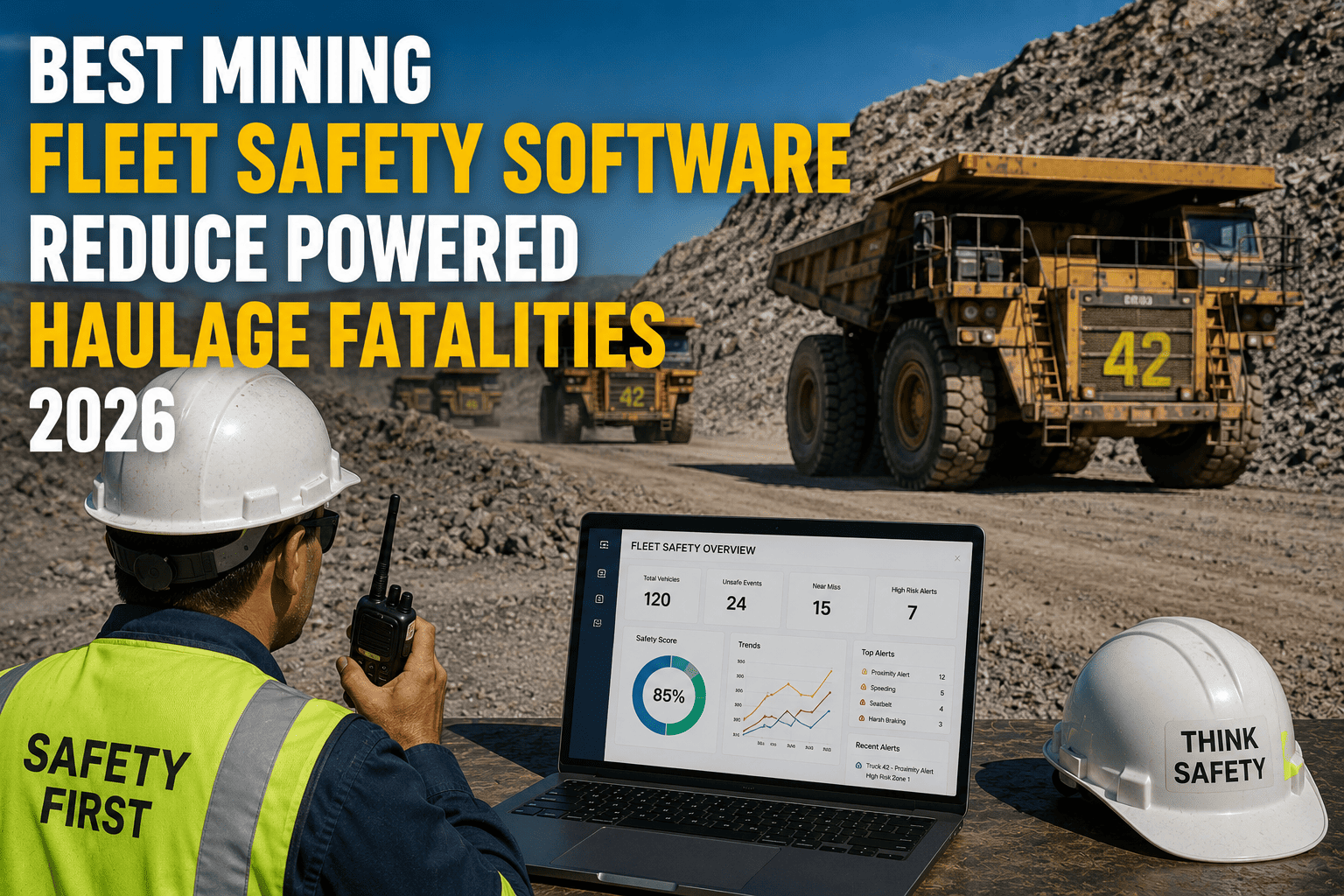
Powered haulage remains the single deadliest hazard in mining. In 2025, 13 of 33 US mining fatalities were classified as powered haulage incidents — the highest count since 2006. Behind every one of those numbers is a preventable event: a missed blind spot, an absent traffic management plan, a fatigue-impaired operator, or an unchecked vehicle defect. The mining industry cannot afford to keep reacting after the fact. The right mining fleet safety software changes that equation entirely — shifting operations from reactive incident response to proactive, data-driven hazard prevention. This guide breaks down what to look for, what the data says, and why fleet managers across surface and underground mines are turning to purpose-built platforms like FleetRabbit to protect their people and stay MSHA compliant in 2026.
Why Powered Haulage Kills — And What Software Actually Fixes
MSHA fatality investigation reports tell the same story year after year: operations without written traffic management plans, operators not wearing seatbelts, and blind-spot mitigation that exists on paper but not in practice. Haul trucks carrying 200+ ton payloads create blind spots large enough to conceal a pickup truck entirely. When software closes these gaps — real-time proximity alerts, pre-shift digital inspections, speed monitoring on haul roads, and automated MSHA documentation — fatality risk drops measurably. Mining fleet safety software is not a checkbox exercise. It is the operational infrastructure that keeps people alive.
Blind Spot Collisions
200-ton haul trucks eliminate visibility around the entire vehicle. Proximity detection software triggers real-time alerts before a pedestrian or light vehicle enters the danger zone.
Operator Fatigue
Long haul shifts impair reaction time faster than intoxication. AI fatigue monitoring software detects micro-sleep indicators and forces rest breaks before an incident occurs.
Absent Inspection Records
Verbal pre-shift walkarounds are unverifiable and unenforceable. Digital inspection workflows enforce completion of every checklist item with timestamps, photos, and driver sign-off.
Uncontrolled Speeds
Haul road speed limits exist on signs but rarely in data. GPS-based speed monitoring logs every violation in real time, enabling coaching before a rollover or intersection strike occurs.
MSHA Non-Compliance
Since July 2024, MSHA requires written safety programs for surface mobile equipment. Software auto-generates audit-ready compliance documentation — eliminating the 12–18 hours per week spent on manual assembly.
No Traffic Management
MSHA fatality reports repeatedly cite absent traffic management plans. Fleet software creates digital geofences, enforces separation zones, and documents every traffic rule in place.
Core Features of Best-in-Class Mining Fleet Safety Software
Not all fleet platforms are built for the specific demands of mining environments. The best mining fleet safety software in 2026 combines real-time hardware integration with intelligent analytics purpose-built for high-consequence operations. Sign up with FleetRabbit to explore how each of these capabilities works in practice for your mine site.
Real-Time Vehicle Health Monitoring
Engine temperature anomalies, brake pressure drops, and transmission irregularities are detectable days before they cause a failure on the haul road. Mining fleet safety software ingests CAN bus sensor data across 40+ parameters, running continuous anomaly detection so maintenance teams receive alerts before equipment becomes a safety liability mid-shift.
Digital Pre-Shift Vehicle Inspections
Paper-based pre-shift checks are the weakest link in mining safety programs. Digital inspection workflows on mobile devices enforce item-by-item completion with photo evidence, defect escalation routing, and automated supervisor notification. Every inspection is timestamped, signed, and stored as an audit-ready MSHA compliance record automatically.
AI-Powered Fatigue and Behavior Monitoring
Machine learning models correlate driver behavior patterns — erratic steering, inconsistent following distance, micro-corrections — with historical incident data to flag elevated-risk operators before accidents occur. Fatigue monitoring systems in 2026 achieve 85–92% accuracy in predicting individual collision risk, enabling proactive intervention rather than post-incident investigation.
Geofencing and Proximity Detection
Virtual safety zones enforce separation between heavy equipment and pedestrian access routes, blast zones, and restricted areas. When a vehicle approaches a defined boundary, the system triggers cab alerts and logs the event. Advanced systems provide 360-degree awareness, warning operators of approaching personnel or vehicles before they enter the danger zone.
Speed Monitoring and Haul Road Compliance
GPS-based speed tracking records every vehicle against defined haul road speed limits in real time. Violations trigger immediate in-cab alerts and are logged for supervisory review. Aggregate speed data reveals which routes, shifts, or operators carry the highest risk — enabling targeted coaching and infrastructure changes before a rollover event occurs.
Automated MSHA Compliance Documentation
30 CFR Part 56 Subpart T now mandates written safety programs for all surface mobile equipment, including annual updates and documented miner input. Fleet safety software generates tamper-evident compliance records continuously — inspection histories, incident reports, training completion logs, and vehicle maintenance data — eliminating the 12–18 weekly hours previously spent on manual audit preparation.
FleetRabbit Mining Safety Platform
Real-time vehicle monitoring, digital inspections, AI behavior analytics, and automated MSHA compliance — all in one platform built for the complexity of mining fleets. Reduce powered haulage incidents from day one. Start your free trial with no credit card required.
The Real Cost of Powered Haulage Incidents
The financial argument for mining fleet safety software is as compelling as the human one. A single powered haulage fatality triggers MSHA investigations, operational shutdowns, legal liability, and reputational damage that can run into the millions. Equipment damage from vehicle collisions averages $200,000–$800,000 per incident. Production halts during investigations cost surface mines $50,000–$150,000 per day. And insurance premiums following a fleet-related fatality can increase 15–25% across the entire policy. The ROI of safety software pays back within months — not years.
| Incident Type | Direct Cost | Downtime Impact | Regulatory Risk | Prevention Method |
|---|---|---|---|---|
| Vehicle-to-Person Strike | $500K–$2M+ legal/comp | Site shutdown 3–14 days | MSHA investigation, citations | Proximity detection + geofencing |
| Haul Truck Rollover | $200K–$800K equipment damage | Route closed 1–5 days | 30 CFR Part 56 violations | Speed monitoring + fatigue detection |
| Brake Failure on Grade | $50K–$400K repair + payload loss | Inspection halt, 2–7 days | Mechanical failure citation | Digital pre-shift inspections |
| Pedestrian Zone Breach | $25K–$100K per MSHA citation | Segment shutdown, 1–3 days | Pattern-of-violations risk | Geofencing + real-time alerts |
| Audit Documentation Failure | $10K–$75K in penalties | Enhanced enforcement program | Repeat inspection targeting | Automated compliance records |
How FleetRabbit Addresses Every Powered Haulage Risk Factor
MSHA's own guidance identifies the same repeating root causes across powered haulage fatalities: no traffic management plan, blind spots, speed violations, fatigue, and inadequate pre-shift inspections. FleetRabbit's mining safety platform is engineered to close each of these gaps systematically. You can book a live demo to see exactly how these features map to your mine site's specific risk profile.
No Written Traffic Management Plan
Digital geofencing enforces traffic separation zones in real time. Automated zone logs satisfy MSHA's requirement for a documented, auditable traffic management program under 30 CFR Part 56 Subpart T.
Blind Spot Vehicle Interaction
GPS proximity monitoring tracks every vehicle and worker in real time. Cab alerts activate when a pedestrian or light vehicle enters the defined hazard radius around heavy equipment — before any physical contact.
Operator Fatigue and Impairment
AI behavior analytics monitor driving patterns throughout every shift. Anomalies consistent with fatigue — steering micro-corrections, speed inconsistency, extended idle periods — trigger supervisory alerts before impairment becomes a crash risk.
Inadequate Pre-Shift Inspection
Mobile digital inspection workflows prevent equipment from being dispatched until every checklist item is completed and signed. Brake defects, hydraulic leaks, and tire anomalies are flagged before the vehicle leaves the yard — not discovered on a downhill haul road grade.
Haul Road Speed Violations
GPS-linked speed zone mapping enforces posted limits with real-time cab alerts and automatic violation logging. Aggregate speed reports reveal systemic risk patterns — enabling supervisory action and infrastructure improvements based on data, not assumptions.
MSHA Compliance in 2026: What Your Software Must Cover
Since the July 2024 final rule under 30 CFR Part 56 Subpart T, every surface mine operator must maintain a written safety program for mobile equipment covering hazard identification, documented miner input, technology evaluation, and annual updates. Manual compliance management is no longer sustainable at scale — and the consequences of gaps extend well beyond citations. The best mining fleet safety software automates the documentation trail entirely, so your team focuses on safety rather than paperwork. Start a free trial to see FleetRabbit's compliance module in action.
Written Safety Program
Auto-generated documentation covering hazard identification, technology evaluation, and miner input — updated and version-controlled automatically.
Pre-Shift Inspection Records
Every inspection logged with timestamp, GPS location, driver ID, defect notes, and photographic evidence — audit-ready without any manual assembly.
Training Completion Logs
Part 46 and Part 48 training records tracked per operator, with certification expiry alerts so no one operates equipment outside their qualified scope.
Incident and Near-Miss Reports
Every incident logged automatically with GPS coordinates, vehicle telemetry, operator ID, and timeline — eliminating the 15-minute MSHA reporting gap risk and providing defensible documentation.
Annual Safety Program Reviews
Automated alerts remind responsible persons of annual review deadlines with pre-populated update reports based on the prior year's incident and inspection data.
Geofence and Zone Compliance
Every geofence breach logged with vehicle ID, coordinates, time, and operator — creating the documented evidence trail MSHA expects for traffic management plan enforcement.
What to Evaluate When Choosing Mining Fleet Safety Software
The mining software market in 2026 ranges from OEM-specific systems tied to Caterpillar or Komatsu equipment to OEM-agnostic platforms that work across mixed fleets. Here is what to evaluate before committing — and where FleetRabbit consistently outperforms single-OEM alternatives. Ready to compare firsthand? Book a live demo with our mining safety specialists.
OEM-Agnostic Compatibility
Your mine likely operates Caterpillar, Komatsu, Hitachi, and service vehicles simultaneously. Your safety software must monitor all of them — not just the OEM it was designed for. Look for open API architecture and hardware-agnostic sensor integration.
Offline Functionality in Remote Operations
Remote mine sites have intermittent cellular coverage. Safety data — inspection records, proximity alerts, speed logs — cannot wait for connectivity. Platform architecture must support offline data capture with automatic sync on reconnection.
Real-Time Alert Latency
A proximity alert that arrives 30 seconds late is worthless on a haul road. Evaluate actual alert latency under operating conditions — not the vendor's lab benchmark. Sub-3-second alert delivery is the 2026 standard for collision avoidance systems.
MSHA-Specific Compliance Mapping
Generic fleet software generates generic reports. Mining safety software should map its outputs specifically to 30 CFR Part 56 requirements — with report templates your HSE team can submit directly without reformatting or manual additions.
Predictive vs. Reactive Analytics
Reporting what happened is table stakes. Best-in-class platforms use historical telemetry and behavior data to forecast which vehicles and operators are at elevated risk — enabling intervention before incidents occur rather than after.
Implementation Speed and Training Burden
Mine operations cannot absorb weeks of system deployment disruption. Evaluate realistic time-to-value: how quickly can inspections go digital, monitoring go live, and compliance records begin generating? The best platforms reach operational baseline within 2–4 weeks.
Mining Safety Software ROI: The Numbers
Fleet managers frequently ask whether the investment justifies itself. The data from mining operations implementing comprehensive safety platforms shows the answer clearly — and the payback period is typically 6 to 9 months, not years.
Frequently Asked Questions
FleetRabbit gives mining fleet managers real-time visibility, AI-driven risk prediction, digital inspections, and automated MSHA compliance — all in one platform built for the demands of modern mining operations. 13 powered haulage fatalities in 2025. Make 2026 different for your operation.