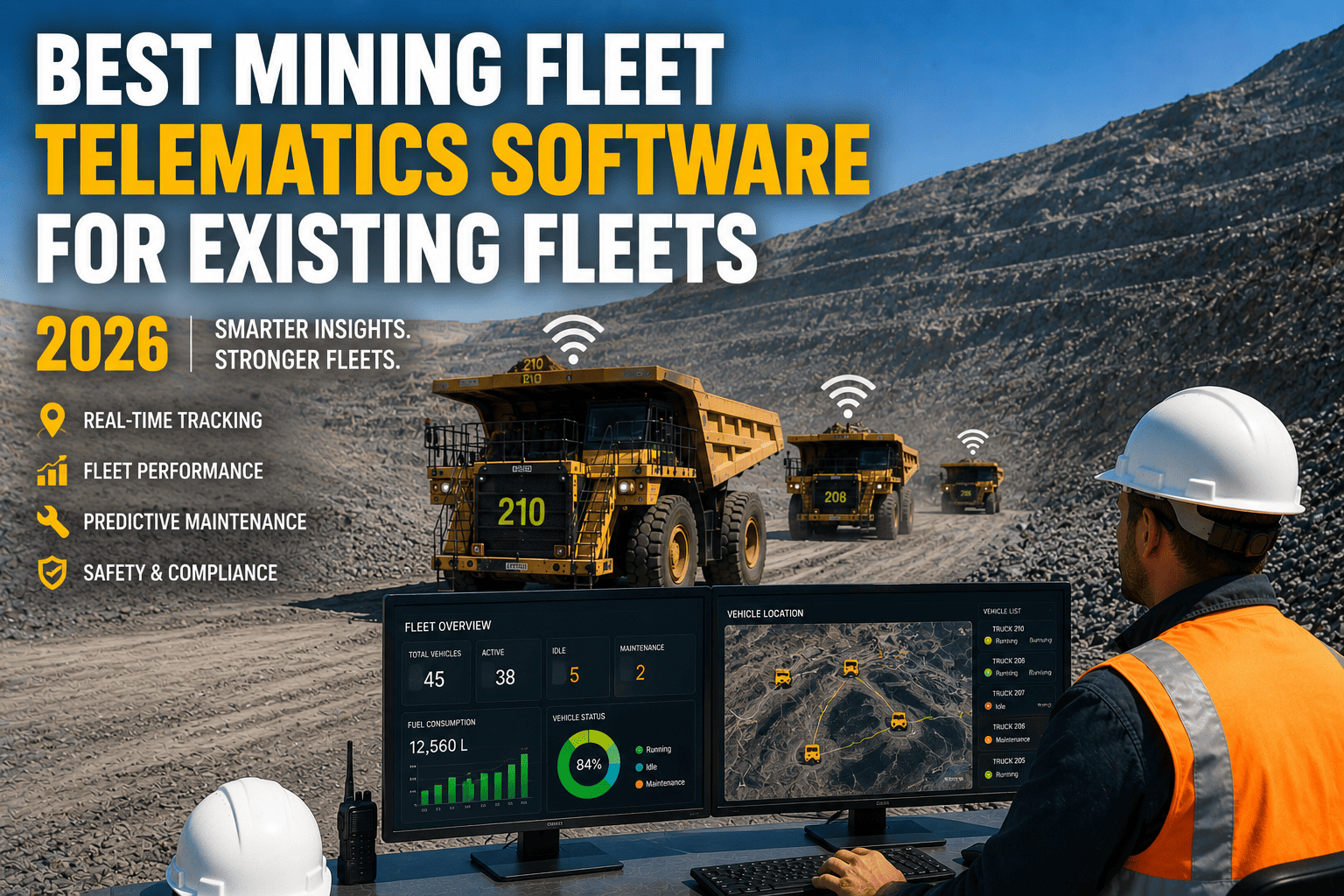
You already own the fleet. Haul trucks, loaders, excavators, drill rigs, service vehicles — capital assets worth millions sitting across your site right now. The question in 2026 isn't whether to buy new equipment. It's whether the equipment you already have is working as hard as it possibly can. Most mining fleets are leaving serious money on the table: 30–40% idle time on tracked machines, unplanned breakdowns costing $1,200 per hour in lost production, and safety blind spots that only become visible after an incident. Mining fleet telematics software changes all of that — retrofitting real-time intelligence onto your existing fleet without replacing a single machine. Book a FleetRabbit demo to see how your existing fleet can start generating actionable data before your next shift.
A typical 15-truck mining operation loses $127,000 per year to preventable downtime, fuel waste, missed inspections, and emergency repair premiums — losses that telematics software identifies and eliminates. The median fleet recovers its full telematics investment in just 4.2 months.
What Is Mining Fleet Telematics Software
Mining fleet telematics software connects your existing equipment — regardless of brand, age, or OEM — to a unified platform that delivers real-time GPS location, engine diagnostics, fuel consumption tracking, driver behavior scoring, maintenance alerts, and compliance documentation. Unlike consumer GPS trackers or generic fleet apps repurposed from logistics, purpose-built mining telematics handles offline underground environments, rugged terrain, CAN-bus diagnostic data from heavy equipment, and hour-based maintenance scheduling that mine operations actually use.
In 2026, telematics has evolved far beyond tracking where a truck is. Modern platforms analyze 45+ sensor parameters from CAN-bus data — exhaust temperature, pressure readings, rotational speed, engine load, hydraulic pressure — and run AI models that flag developing failures days or weeks before a breakdown occurs. That's the difference between a $40,000 scheduled repair and a $400,000 emergency engine rebuild. Sign up for FleetRabbit to start connecting your existing fleet today.
The 5 Problems Telematics Solves for Existing Mining Fleets
Most mining operations managing existing fleets without telematics are dealing with the same five problems — and absorbing the same preventable costs. Here's what telematics software eliminates directly.
The Problem: Dispatch by Radio
Without real-time GPS, locating a specific haul truck or loader means waiting on radio responses, walking the site, or guessing based on shift assignments. Operators delay assignments, equipment sits idle, and managers cannot make real-time utilization decisions. Mining operations lose an average of 40 minutes per shift just locating and coordinating equipment without live visibility.
The Fix: Live Asset Map
Every haul truck, loader, excavator, and service vehicle appears on a live map — with real-time position, speed, and status. Dispatch makes assignments in seconds. Geofence alerts fire instantly when equipment enters blast zones or restricted areas. No radio, no walking, no guessing.
The Problem: Invisible Idle Time
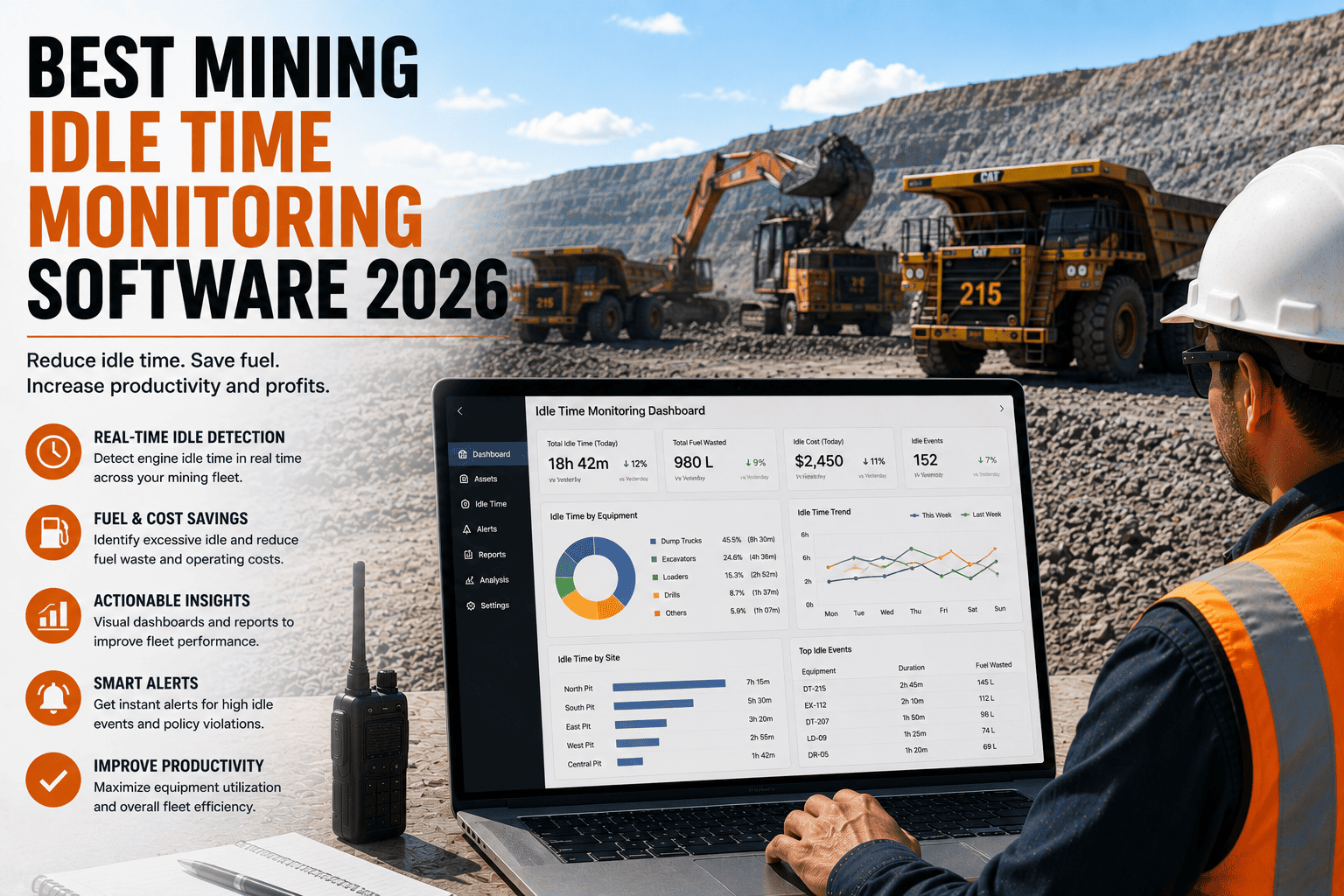
Komatsu data shows 38% average idle time across 75,000 North American machines. Without telematics, that waste is invisible — no one knows which truck is idling for two hours behind the crusher. Idle fuel burn at mining equipment scale costs $80–120 per machine per day, adding up to hundreds of thousands annually across a typical fleet.
The Fix: Idle Alerts & Fuel Analytics
Telematics platforms alert operators and dispatchers after 10 minutes of idle, track fuel consumption per machine and operator, and generate weekly waste reports. Fleets consistently achieve 15–25% fuel cost reduction within the first 90 days of telematics deployment — often covering the full software cost through fuel savings alone.
The Problem: Reactive Maintenance
71% of mining fleets still rely on preventive maintenance as their primary strategy — servicing by calendar, not by actual equipment condition. Breakdowns happen mid-shift on the most critical machines. Average unplanned downtime costs $448–760 per hour across labor, project delay, and rental replacement. A single major engine failure runs $400,000 to rebuild.
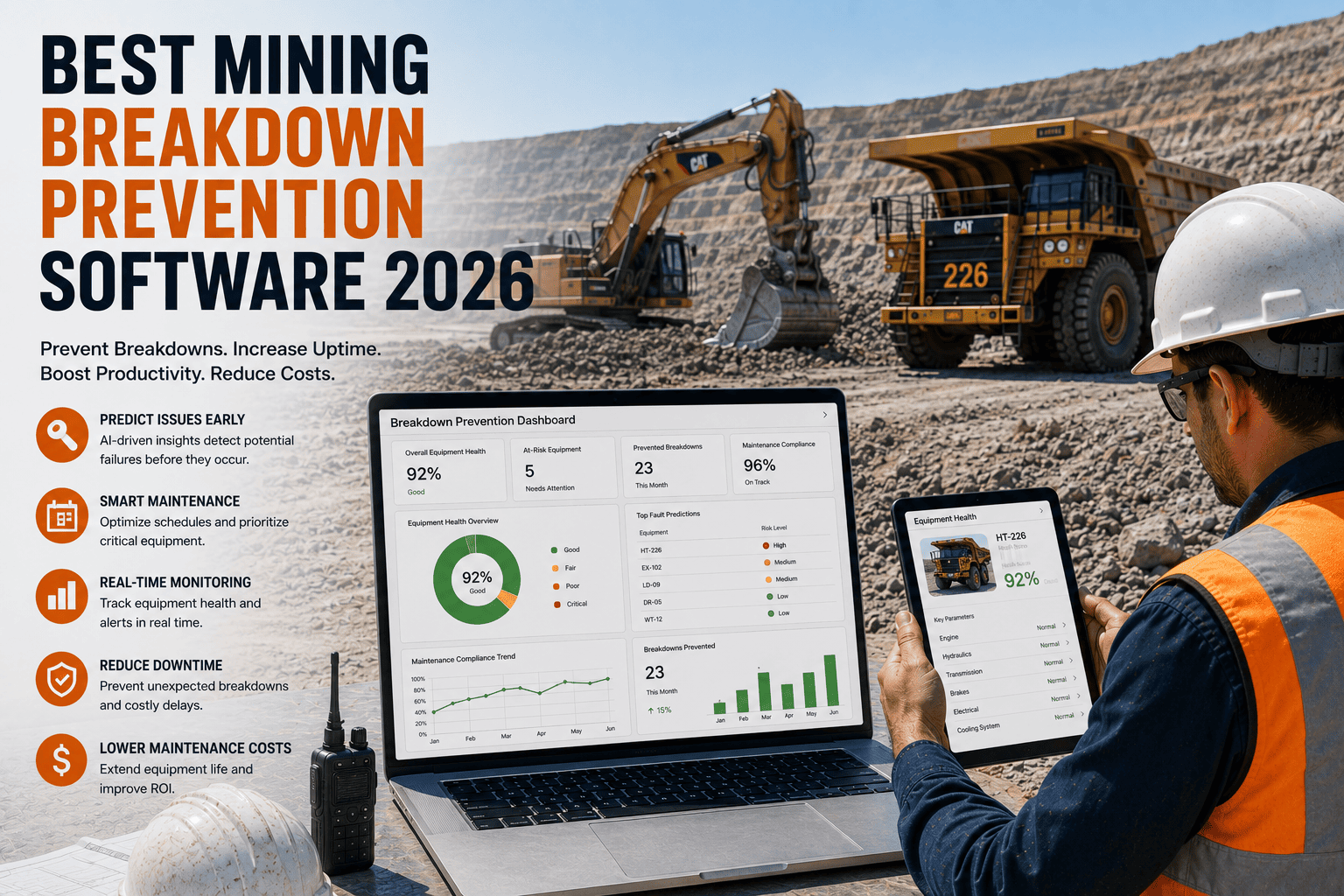
The Fix: AI Predictive Alerts
Telematics platforms monitoring 45+ CAN-bus parameters detect anomalies — unusual exhaust temperature oscillations, hydraulic pressure drops, transmission vibration spikes — days or weeks before failure. A predictive alert converts a $400,000 emergency rebuild into a $40,000 planned repair scheduled during low-demand downtime.
The Problem: Behavior Blind Spots
30–40% of mining fatalities involve vehicle interactions. Without behavior monitoring, harsh braking, speeding in restricted zones, and fatigue-pattern driving go undetected until a near-miss or incident report surfaces. Manual observation is impractical across a multi-shift operation covering hundreds of acres of remote terrain.
The Fix: RAG Scoring & In-Cab Alerts
Driver behavior scoring (Red-Amber-Green) tracks harsh braking, excessive speed, aggressive cornering, and excessive idling per operator per shift. In-cab audible alerts give real-time feedback before behaviors become incidents. Safety coaching is targeted to specific operators and events — not blanket policy announcements.
The Problem: Four Systems, No Single Picture
GPS data lives in one tool. Maintenance records live in a spreadsheet. Fuel receipts are in an email inbox. Compliance docs are in a filing cabinet. Getting a complete picture of one vehicle requires checking four places and still misses half the story. Capital replacement decisions get made on gut feel, and underperforming assets stay in the fleet too long.
The Fix: Single Unified Dashboard
A unified platform connects GPS telematics, OEM machine data (CAT, Komatsu, Volvo, JCB), maintenance records, inspection history, parts inventory, and compliance documentation — with drill-down from the summary dashboard to the individual asset level. One login, complete picture, every machine.
Retrofit vs Replace: Why Telematics Wins for Existing Fleets
The most common mistake mining operations make when evaluating fleet visibility is assuming they need new equipment to get new data. That assumption costs millions in unnecessary capital expenditure. Modern telematics platforms retrofit onto existing equipment in three ways — and the right approach depends on your fleet's age and current OEM integration.
API Integration — No New Hardware
Over 90% of mining equipment manufactured since 2015 ships with factory-installed telematics broadcasting CAN-bus engine and diagnostic data. Platforms like FleetRabbit integrate directly with Cat MineStar, Komatsu KOMTRAX, Volvo CareTrack, JCB LiveLink, Epiroc, and Sandvik via standard API — pulling existing diagnostic streams without a single new hardware installation. Setup takes hours, not weeks.
OBD-II Adapters — Plug and Play
For equipment with OBD-II diagnostic ports, plug-in cellular adapters deliver GPS location, engine diagnostics, fuel consumption, and fault code monitoring with no wiring required. Installation takes under 10 minutes per machine. These devices work across brands — haul trucks, loaders, service vehicles, and ancillary equipment — giving uniform visibility regardless of OEM.
Retrofit IoT Sensors — ~$100 Per Unit
Older equipment without OBD-II ports or factory telematics can be equipped with wireless IoT sensors that attach externally and monitor engine temperature, vibration, and operating hours. At approximately $100 per unit, retrofit sensors deliver 80% of the predictive maintenance value of factory telematics — making even aging legacy equipment a productive data source without scrapping and replacing it.
Connect Your Mining Fleet to Live Intelligence in Under a Day
FleetRabbit integrates with Cat MineStar, Komatsu KOMTRAX, Volvo CareTrack, JCB LiveLink, and all major OEM telematics via API — no new hardware on connected equipment. For older assets, retrofit IoT sensors activate in minutes. One dashboard for every machine on site.
Core Features of Mining Fleet Telematics Software
Not every telematics platform is built for the realities of mine sites. Remote connectivity gaps, offline underground environments, hour-based maintenance scheduling, and MSHA compliance requirements are not afterthoughts in purpose-built mining telematics — they are the foundation. Here's what to look for in every platform you evaluate.
Real-Time GPS Tracking With Offline Capability
Underground levels and deep pits lose cellular signal by design. Purpose-built mining telematics captures location, speed, and engine status locally on the device — with zero connectivity dependence — and syncs data automatically when signal returns. Generic GPS apps that require live signal become useless the moment equipment goes underground or into a deep pit. Offline-first architecture is not optional for mine sites; it is essential.
Predictive Maintenance Via CAN-Bus Diagnostics
CAN-bus integration reads 45+ engine and equipment parameters directly from the machine's own diagnostic systems — exhaust temperature, hydraulic pressure, transmission data, engine load, fuel consumption, and fault codes. AI models running on this data identify anomalies that predict failures 5–45 days before they occur. A real documented case: time-series anomaly detection identified a faulty valve causing unusual exhaust temperature oscillation several days before catastrophic engine failure — saving $400,000 in rebuild costs through a single planned maintenance intervention.
Driver Behavior Monitoring & Safety Scoring
Every driver on every shift receives a behavior score based on harsh braking, speeding in geofenced zones, aggressive cornering, excessive idle time, and hours-of-service patterns. Scores are color-coded RAG (Red-Amber-Green) for immediate management visibility. In-cab audible alerts correct behavior in real time before it becomes a safety incident. AI-combined driver coaching and predictive maintenance together reduce mining accidents by 35% — addressing the 30–40% of fatalities that originate from vehicle interaction failures.
MSHA-Compliant Digital Inspections
Pre-shift inspection checklists configured for each equipment type — haul trucks, excavators, loaders, drill rigs — with offline mobile capability for remote pit locations. Every completed inspection creates a timestamped, photo-documented digital record. Defects found during inspection automatically generate work orders and flag equipment for grounding. MSHA audit preparation that once required days of manual document assembly takes under 15 minutes with complete digital records available on demand.
Fleet Utilization & Cost-Per-Hour Analytics
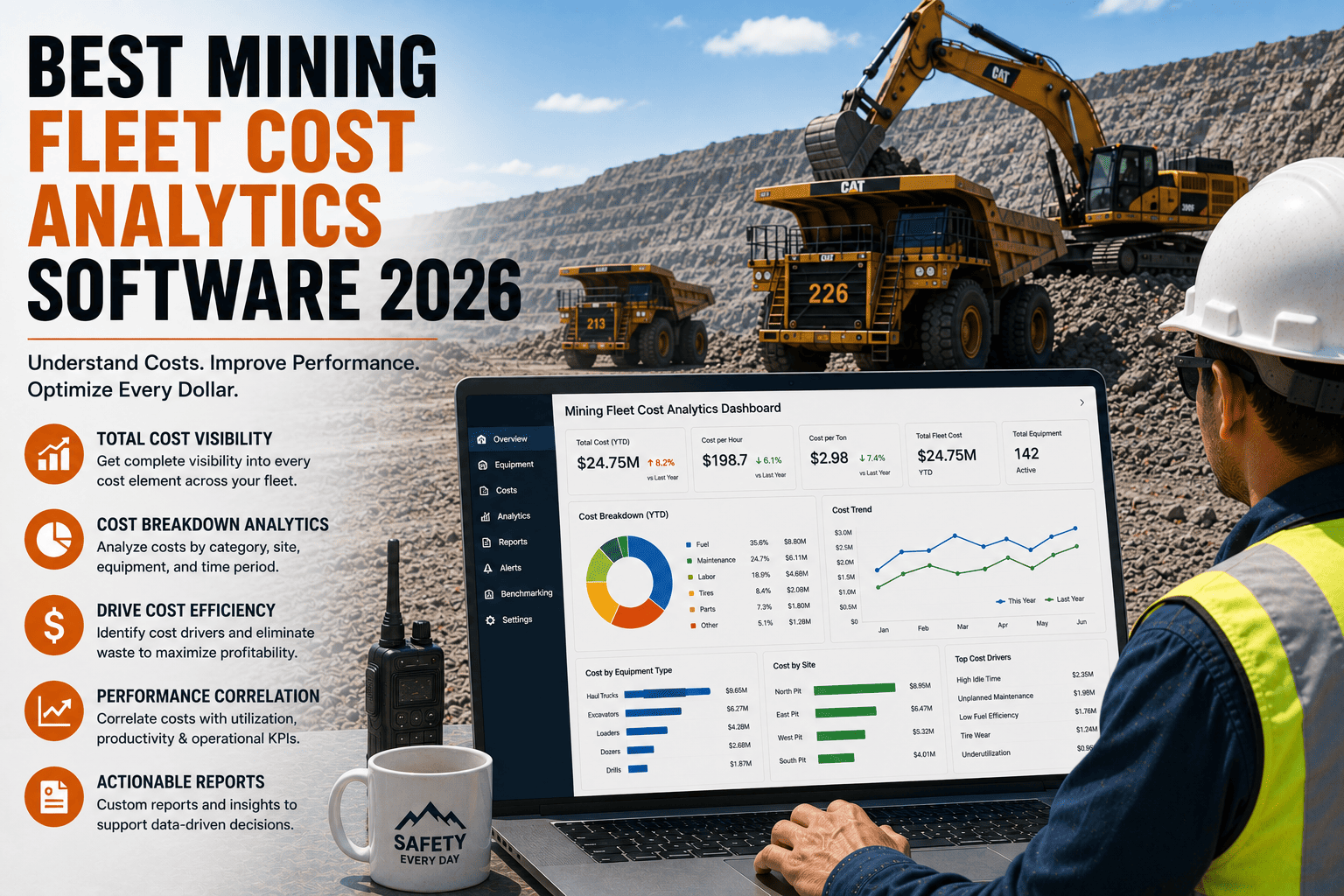
Equipment utilization analytics reveal exactly which assets are productive versus which are quietly costing money while parked. A copper mine study using OEE framework found shovels operating at just 25% OEE and dump trucks at 38% — losses that were invisible without systematic utilization measurement. Cost-per-operating-hour analytics identify underperforming machines before they distort capital replacement decisions. Operating costs drop by up to 28% when utilization data drives dispatch and fleet right-sizing decisions.
What Telematics Actually Costs — and What It Returns
The business case for mining fleet telematics is one of the clearest ROI calculations in fleet technology. Here's how the numbers break down for a typical 20-truck mining operation, using real-world data from documented deployments — not vendor projections. Sign up for FleetRabbit to model your specific fleet ROI.
How to Get Your Existing Fleet Connected — Step by Step
One of the most common reasons mining operations delay telematics adoption is fear of a complex implementation that disrupts active operations. FleetRabbit is designed to eliminate that barrier entirely. Here's exactly what getting connected looks like — from sign-up to live fleet dashboard. Book a demo to walk through this process for your specific fleet configuration.
Register Your Fleet Assets
List every haul truck, loader, excavator, drill rig, and service vehicle. Import from a CSV or add manually. Assign each asset its current engine hours and maintenance history. For a 15-truck operation, this step typically takes under 20 minutes.
Connect Existing Telematics
If any equipment has OEM telematics (Cat MineStar, Komatsu KOMTRAX, Volvo CareTrack), connect the provider via API — location and engine data starts flowing immediately. No new hardware, no site visits, no waiting for installation teams.
Configure Inspection Checklists
Choose from MSHA-aligned inspection templates for each equipment type or customize your own. Set up which team members receive alerts for defects found. Mobile app installed on operator devices — offline capability active from day one.
Set Geofences & Alert Rules
Mark blast zones, restricted areas, haul roads, and crusher stations directly on the site map. Assign which zones trigger alerts and who receives them — supervisor, dispatcher, or safety lead. Idle time thresholds configured per asset type.
Go Live — First Insights Within Hours
Every tracked asset appears on the live map. Dispatchers see real positions instead of waiting on radio responses. Predictive maintenance AI begins analyzing sensor data. Most sites identify 2–4 previously invisible equipment issues within the first two weeks of active monitoring.
Frequently Asked Questions
Start Connecting Your Existing Mining Fleet Today
The equipment you already own is your most valuable operational asset — and right now, most of it is generating far less insight than it could. Mining fleet telematics software retrofits intelligence onto your existing fleet without replacing a single machine. Real-time GPS, CAN-bus predictive maintenance, driver safety scoring, MSHA-compliant digital inspections, and utilization analytics — all live and accessible from a single dashboard within hours of setup.
The median mining fleet recovers its telematics investment in 4.2 months. A comprehensive program achieves 200–500% first-year ROI. Every month without telematics is preventable fuel waste, invisible idle time, breakdown risk, and compliance exposure that your operation doesn't need to carry. Sign up for FleetRabbit free or book a 30-minute demo — and see your existing fleet's live data before your next shift starts.
See Your Existing Fleet Live on One Dashboard Today
FleetRabbit connects to your existing mining equipment in under a day. Cat, Komatsu, Volvo, Epiroc, Sandvik, legacy machines — all visible on one live map with predictive maintenance alerts, driver safety scores, MSHA-ready digital inspections, and fuel analytics running from day one.