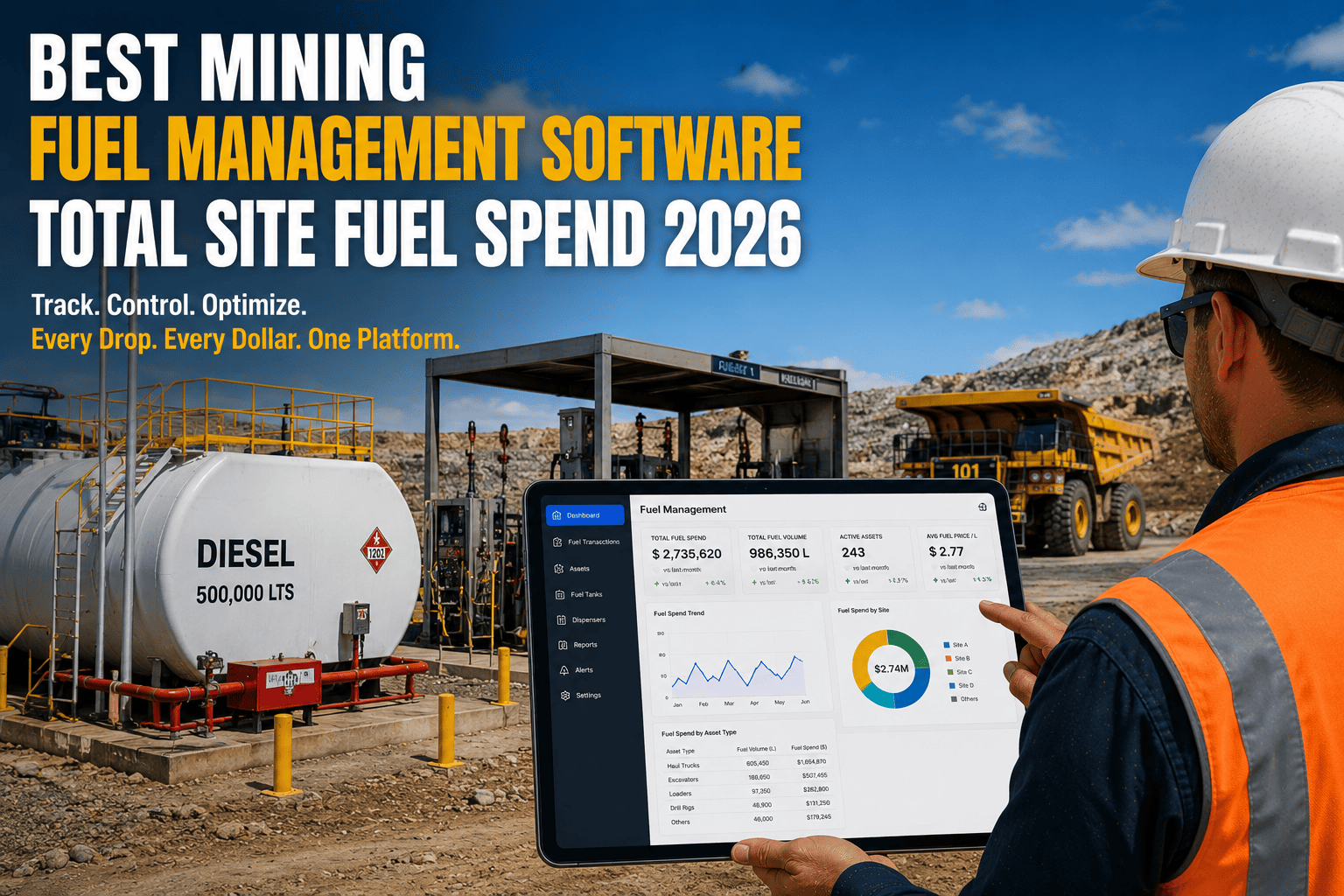
Fuel is the single largest controllable cost on a mining site, and it is also the easiest cost to lose without noticing. Bulk tanks get dipped by hand, bowsers get logged on paper, and haul trucks, excavators, and generators burn diesel around the clock across a site that might stretch for kilometers. Mining and construction equipment now accounts for roughly 22 percent of the global fuel management system market, covering more than 1.8 million heavy machines worldwide, because operators in this sector lose an outsized share of fuel to theft, over-dispensing, and unrecorded burn. The right mining fuel management software closes that visibility gap and turns fuel from a guessing game into a controlled, auditable line item.
The best mining fuel management software combines bulk tank sensors, dispenser meters, and equipment telematics into one platform that tracks every liter from delivery to burn. Mining operations typically lose 8 to 12 percent of fuel spend to theft and unrecorded dispensing, and sites that deploy dedicated fuel monitoring cut that loss by up to 30 percent while improving equipment uptime.
Why Mining Sites Bleed Fuel Budget Without Realizing It
A mid-sized mine can run hundreds of pieces of mobile equipment across an area with limited connectivity, multiple fuel islands, and shift changes that make manual reconciliation almost impossible. Every gap in that chain, a bowser that isn't logged, a night shift top-up that isn't authorized, a tank level that drifts from what the delivery ticket says, becomes an invisible cost. Sign up for a free FleetRabbit trial and you can see exactly where those gaps sit on your own site within days.
What Mining Fuel Management Software Actually Needs to Do
Generic fleet fuel cards and consumer telematics apps were not built for a mine site. Harsh terrain, remote depots, and mixed equipment fleets, from haul trucks to stationary generators, need a platform purpose-built for bulk fuel, not just fuel cards. Below is what separates a system that genuinely protects your fuel budget from one that just produces reports nobody reads.
Bulk Tank and Bowser Monitoring
Continuous level sensing on storage tanks and mobile bowsers replaces manual dipping, catching leaks, evaporation losses, and unauthorized draw-downs the moment they happen rather than at month-end reconciliation.
Dispenser-to-Equipment Matching
Every fill-up should be tied automatically to a specific machine, operator, and shift using RFID or telematics integration, so a fuel record that doesn't match an active asset gets flagged instantly instead of buried in a spreadsheet.
Exception-Based Theft Alerts
Rather than forcing a fuel supervisor to scroll through thousands of transactions, the software should automatically surface after-hours fills, impossible fill volumes, and consumption spikes that don't match machine hours worked.
Consumption-to-Work Benchmarking
The strongest platforms compare fuel burned against actual tonnes hauled, hours run, or cycles completed, so a machine that suddenly burns more fuel per tonne moved gets caught before it becomes a maintenance failure or a hidden loss.
| Capability | What It Solves | Impact on Site |
|---|---|---|
| Real-Time Tank Levels | Manual dipping errors and delayed leak detection | Catches losses within hours instead of at month-end audit |
| Automated Fill Records | Paper logs and unmatched fuel transactions | Every liter tied to an asset, operator, and timestamp |
| Theft and Anomaly Alerts | Siphoning, ghost fills, and card misuse | Recovers 8 to 12 percent of fuel spend typically lost to diversion |
| Equipment Fuel Efficiency Tracking | Engines burning more fuel per tonne without visible cause | Flags mechanical issues early, before costly breakdowns |
| Compliance Reporting | Manual paperwork for emissions and fuel tax audits | Automated, audit-ready records reduce administrative hours |
FleetRabbit connects bulk tanks, bowsers, and mobile equipment into a single dashboard so your team can catch theft and waste before it eats into margin. Start a free trial and get your first fuel loss report within a week.
Calculating the ROI for Your Site
The math behind mining fuel management software is straightforward once you know your baseline. Take your annual diesel spend, apply a conservative 8 percent loss estimate, and compare that number against the cost of monitoring hardware and software licensing.
Example: A Mid-Sized Open-Pit Site
A site spending 3 million dollars annually on diesel across haul trucks, excavators, and support equipment loses an estimated 240,000 to 360,000 dollars a year to theft, over-dispensing, and unrecorded burn at the industry-typical 8 to 12 percent rate. Cutting that loss by even half through automated monitoring recovers well over 100,000 dollars annually, often within the first quarter of deployment.
Where the Savings Come From
Recovered fuel spend is only part of the return. Sites also see fewer unplanned equipment failures because fuel and engine data flag developing mechanical problems early, lower administrative hours spent reconciling paper logs, and stronger audit readiness for emissions and fuel tax reporting.
Mining vs. General Fleet Fuel Software: Why the Difference Matters
Standard fleet fuel cards work well for on-road vehicles fueling at commercial stations, but they fall short on a mine site where fuel is delivered in bulk, stored on-site, and dispensed through private bowsers to equipment that may never touch a public road. A platform designed for mining needs to handle bulk inventory reconciliation, offline data capture for low-connectivity zones, and integration with heavy equipment telematics, not just card-swipe transactions.
Signs Your Current System Isn't Built for Mining
If your team is still reconciling tank dips against delivery tickets by hand, if bowser fills aren't automatically tied to specific machines, or if theft is only discovered during a scheduled audit weeks after it happened, your current process is costing you more than the software would.
Every site is different. Book a 30-minute demo and we'll walk through your current fuel workflow, show what FleetRabbit would catch on your site, and map out a rollout plan for tanks, bowsers, and equipment.
Bringing Fuel Under Control
Fuel does not have to be the cost line your site simply accepts as unpredictable. With bulk tank sensors, automated dispenser tracking, and equipment-level consumption analysis working together, mining operations turn one of their largest expenses into one of their most tightly controlled. The sites that make this shift first capture the recovered margin; the ones that wait keep absorbing losses they can't see.
Ready to find out what your site is actually losing? Sign up for a free FleetRabbit trial or book a demo and get a clear picture of your fuel spend within days.
FleetRabbit gives mining operations real-time visibility across bulk tanks, bowsers, and every piece of equipment on site. Catch theft, cut waste, and protect margin with a platform built for the way mines actually run fuel.