A 300-ton haul truck that rolls out of the pit 8% overloaded doesn't look any different from one running on target. There's no warning light, no siren, nothing the operator can feel in the seat. But that single overloaded pass cracks the chassis a little faster, burns through a tire a few thousand hours early, and quietly erases the fuel savings the mine thought it was banking. Multiply that across a fleet running three shifts a day, and payload drift becomes one of the most expensive problems in mining that almost nobody can see coming without the right software.
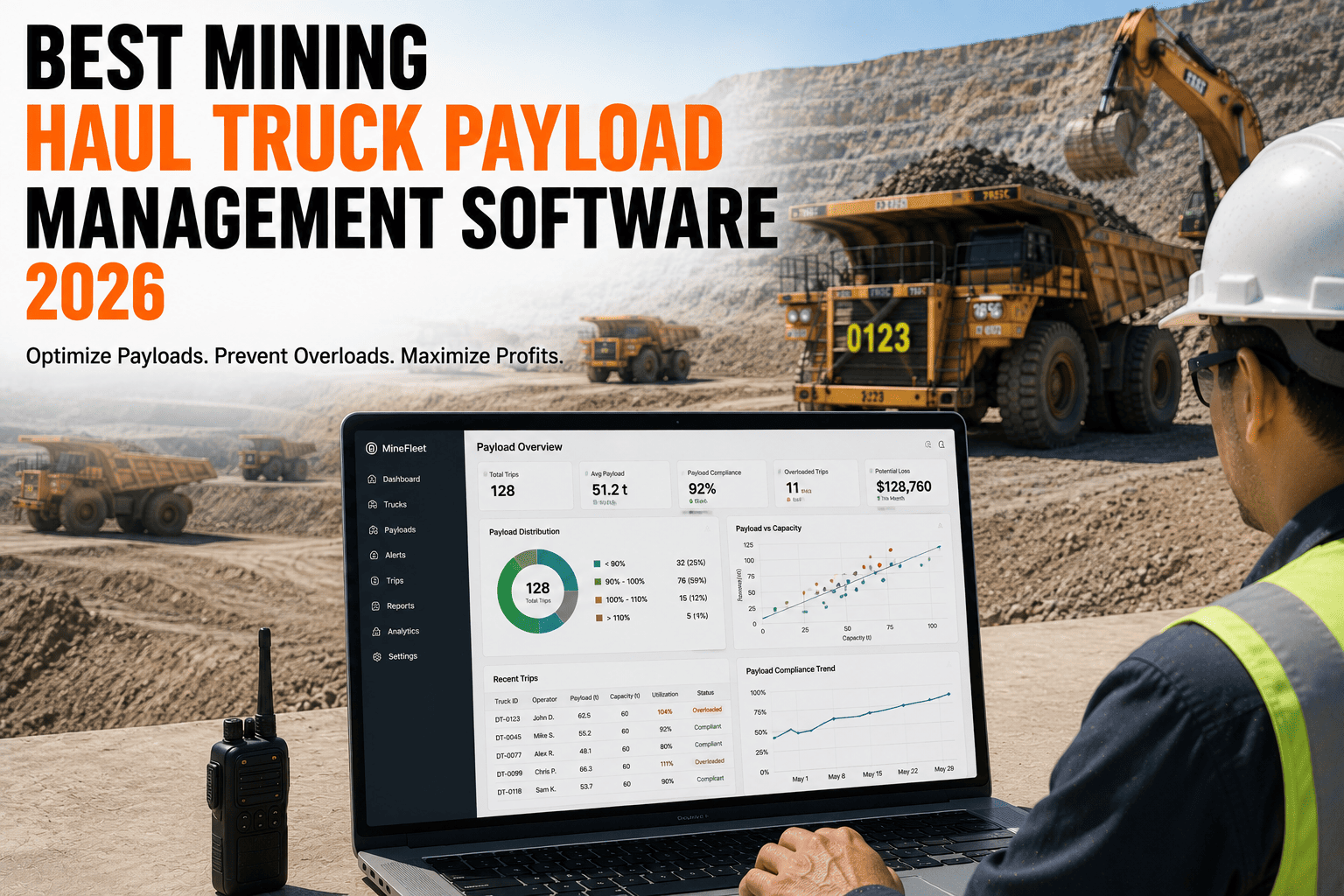
Mining haul truck payload management software uses onboard load cells, suspension sensors, and telematics to weigh every load in real time, flag over- and under-loading before the truck leaves the bench, and report tons-to-target on the operator's screen. Mines running payload software cut chassis, tire, and suspension failures by 20 to 35 percent, and recover 5 to 12 percent in haulage efficiency by eliminating wasted passes. FleetRabbit brings this monitoring into one connected dashboard alongside the rest of your mining fleet.
Why Payload Drift Is So Expensive to Ignore
Payload management sits at the center of everything a haul fleet does, because every ton hauled outside the target range costs money in a different place. An overloaded truck strains its frame, its suspension, and its tires with every cycle, and that stress doesn't show up as a single breakdown — it shows up as a chassis crack eighteen months early, a tire replaced at 60% of its rated life, and a retarder that runs hotter than it should. An underloaded truck is just as costly in a quieter way: it needs an extra pass to move the same tonnage, which means extra fuel, extra cycle time, and an extra driver-hour spent hauling dirt that a properly loaded truck would have moved in one trip.
The Two-Sided Cost of Getting Payload Wrong
Mine sites tend to focus on overloading because it feels riskier, but underloading drains a fleet just as steadily. A truck rated for 240 tons that consistently hauls 210 tons needs roughly 14% more trips to move the same material over a shift. Multiply that inefficiency across dozens of trucks and thousands of cycles a month, and a mine can lose the equivalent of two or three trucks' worth of productivity without a single mechanical failure. Payload management software closes both gaps by showing the operator and the dispatcher exactly where each load sits against target, in real time, before the truck leaves the loading unit.
What Payload Management Software Actually Does
At its core, a payload management system measures weight through strain gauges, load cells, or suspension pressure sensors mounted on the truck, then compares that live reading against a configured target range. The operator sees a simple readout — tons carried against tons targeted — directly on the in-cab display, so the decision to add or hold off on one more bucket happens before the truck ever leaves the bench. On the dispatch side, the same data streams into a fleet dashboard, letting supervisors see which trucks are running hot on overload events, which loading units are consistently over- or under-filling buckets, and which shifts show the worst payload compliance.
Real-Time Load Alerts
The software flags overload events as they happen, often triggering an automatic speed restriction so an overloaded truck can't run at full haul speed until it's within range. This single feature protects tires, brakes, and suspension components from the compounding stress of high-speed travel under excess load.
Carry-Back and Spillage Tracking
Material that sticks to the tray after dumping — carry-back — quietly inflates the next load's actual weight beyond what the operator sees on paper. Good payload software tracks carry-back trends per truck so maintenance teams know which trays need liner attention before it skews production numbers.
Tons-to-Target Reporting for Loading Units
Because payload compliance is really a loading-unit problem as much as a truck problem, the best platforms report which shovel or loader operators are consistently over- or under-filling buckets, so coaching goes to the source of the drift instead of just the symptom.
FleetRabbit connects payload data, tire wear, and maintenance history in one dashboard, so overload events get caught before they become cracked frames or blown tires. Start your free trial and see your fleet's payload compliance today.
Comparing the Top Payload Management Approaches in 2026
Mines evaluating payload software in 2026 are generally choosing between OEM-integrated systems built into the truck itself, standalone aftermarket monitoring kits, and connected fleet platforms that fold payload data into broader maintenance and dispatch tools. Each approach has a different fit depending on fleet size and how mixed the equipment brands are on site.
| Approach | Best Fit | Strength | Limitation |
|---|---|---|---|
| OEM-Integrated Systems | Single-brand fleets running new trucks | Factory-calibrated accuracy, tight suspension integration | Locked to one manufacturer, limited cross-fleet reporting |
| Aftermarket Load Sensors | Mixed or older fleets | Works across truck brands and ages | Needs separate dashboard unless integrated with fleet software |
| Connected Fleet Platforms | Mines wanting one system for payload, maintenance, and dispatch | Combines payload, tire, and downtime data in one view | Requires initial data integration across existing sensors |
Calculating the Return on Payload Software
The math behind payload management software is straightforward once a mine tracks it. Start with the cost of a single premature tire replacement, typically 20,000 to 60,000 dollars for large haul truck tires, and a single chassis or suspension repair triggered by fatigue, often 40,000 to 120,000 dollars depending on the truck class. If payload software prevents even four or five of these incidents a year across a mid-size fleet, the software pays for itself well before accounting for the fuel and cycle-time savings from eliminating underloaded passes.
Fuel and Cycle-Time Savings
Every unnecessary pass caused by underloading burns diesel and consumes cycle time that could have gone toward moving actual tonnage. Mines that tighten payload compliance typically see 5 to 12 percent improvement in tons moved per fuel unit, because fewer trucks are making wasted trips to compensate for underfilled loads.
Extended Component Life
Consistent, targeted loading extends the service life of frames, suspension cylinders, and drivetrain components. Mines with strong payload compliance programs report component life extensions of 15 to 25 percent compared to sites with high overload event rates, directly deferring capital replacement costs.
Implementing Payload Management Without Disrupting Operations
Rolling out payload software doesn't require shutting down a pit. Most mines start with a baseline audit, pulling 60 to 90 days of existing weigh data or scale tickets to establish current overload and underload rates by truck and by loading unit. From there, sensor installation or activation on existing hardware typically takes one to two weeks per truck class, followed by operator and loader training on reading the in-cab tons-to-target display. Within the first month, most sites see payload compliance improve simply because operators and loading unit crews can finally see the number they're being measured against.
Getting Loading Units and Haul Operators Aligned
Payload compliance breaks down fastest when loaders and haul operators aren't looking at the same target. Sharing live tons-to-target data with both sides of the loading cycle — not just the truck operator — closes that gap and turns payload management into a shared metric instead of a one-sided one.
What to Look for in a Payload Management Platform
Not every payload system reports the same depth of data, and the differences matter once a mine tries to act on the numbers. A platform worth adopting should provide truck-level overload and underload event logs, loading-unit-level accuracy trends, automatic speed restriction on overload events, carry-back tracking, and integration with existing maintenance schedules so repeated overload trucks get flagged for inspection automatically rather than waiting for a breakdown.
Data That Connects to Maintenance
Payload data is most valuable when it doesn't sit in isolation. A platform that links overload frequency per truck to that truck's tire and suspension maintenance history lets a maintenance team predict which units need earlier inspection, instead of discovering the wear after a failure. This is where connected fleet software like FleetRabbit outperforms standalone payload sensors — the overload event doesn't just get logged, it gets tied directly to the maintenance record of that specific truck.
The Bottom Line on Payload Management
Payload drift is one of the few mining fleet problems that's almost entirely preventable once it's visible. The trucks aren't failing because they're poorly built — they're failing early because they're being asked to carry the wrong weight, cycle after cycle, without anyone at the loading unit or in the cab having a clear number to aim for. Software fixes that by putting the target in front of the people making the loading decision, in real time, every single cycle.
Mines that put payload software in place tend to see the benefit compound: fewer overload-driven repairs, fewer wasted underloaded passes, and a maintenance team that finally knows which trucks need attention before they break down on the haul road. If your fleet is still relying on scale tickets and operator judgment alone, the gap between where you are and where a connected payload system could take you is worth measuring.
Every overloaded cycle costs your fleet in tires, frames, and downtime you can't see coming until it's too late. FleetRabbit brings real-time payload monitoring together with maintenance and dispatch data in one platform built for mining fleets. Start your free trial or book a 30-minute demo to see your fleet's payload compliance in action.