Nothing burns money in an open pit faster than a line of loaded haul trucks sitting still. Every truck idling behind another at the shovel or the crusher is tonnage that never gets moved, fuel that never turns into production, and an operator wage spent on waiting instead of hauling. Mining fleets have accepted queuing as a cost of doing business for decades, but the trucks and shovels themselves are rarely the real constraint. The constraint is coordination, and that is exactly what queue management software is built to fix.
Haul truck queue management software uses real-time GPS, telematics, and dispatch logic to predict shovel and crusher congestion before it happens, then reroutes or re-times trucks to avoid it. Mines using dynamic dispatch and queue prediction typically cut queue time by 10 to 30 percent and recover truck idle hours that would otherwise sit unused every shift.
Why Haul Trucks Spend So Much Time Waiting
Queuing is not random bad luck. It is a predictable outcome of matching a fixed number of shovels to a variable stream of trucks, and it shows up at every loading and dumping point in the pit. Independent studies of real mining fleets have found shovels operating at an average effectiveness of just 25 percent and haul trucks around 38 percent, with low utilization rather than mechanical failure identified as the dominant constraint. That gap between what equipment could produce and what it actually produces is almost entirely a scheduling and queuing problem, not an equipment problem.
Truck Bunching
When several trucks are dispatched to the same shovel around the same time, they arrive in a cluster instead of a steady stream, forcing later arrivals to wait even though the shovel has idle gaps elsewhere in the shift.
Static Truck Allocation
Fixed truck-to-shovel assignments made at shift start cannot react when a shovel moves faster or slower than planned, so trucks queue at the busy shovel while another sits underserved.
Crusher and Dump Backlogs
Dump points and crushers have their own service rate, and when several loaded trucks converge at once, the queue simply shifts from the shovel to the tip without warning.
What Queue Management Software Actually Does
Modern queue management platforms replace radio-based, reactive dispatching with a live model of the pit. Instead of discovering a queue after trucks are already backed up, the system predicts it minutes ahead and adjusts truck routing before the line forms.
Live Position and Cycle Tracking
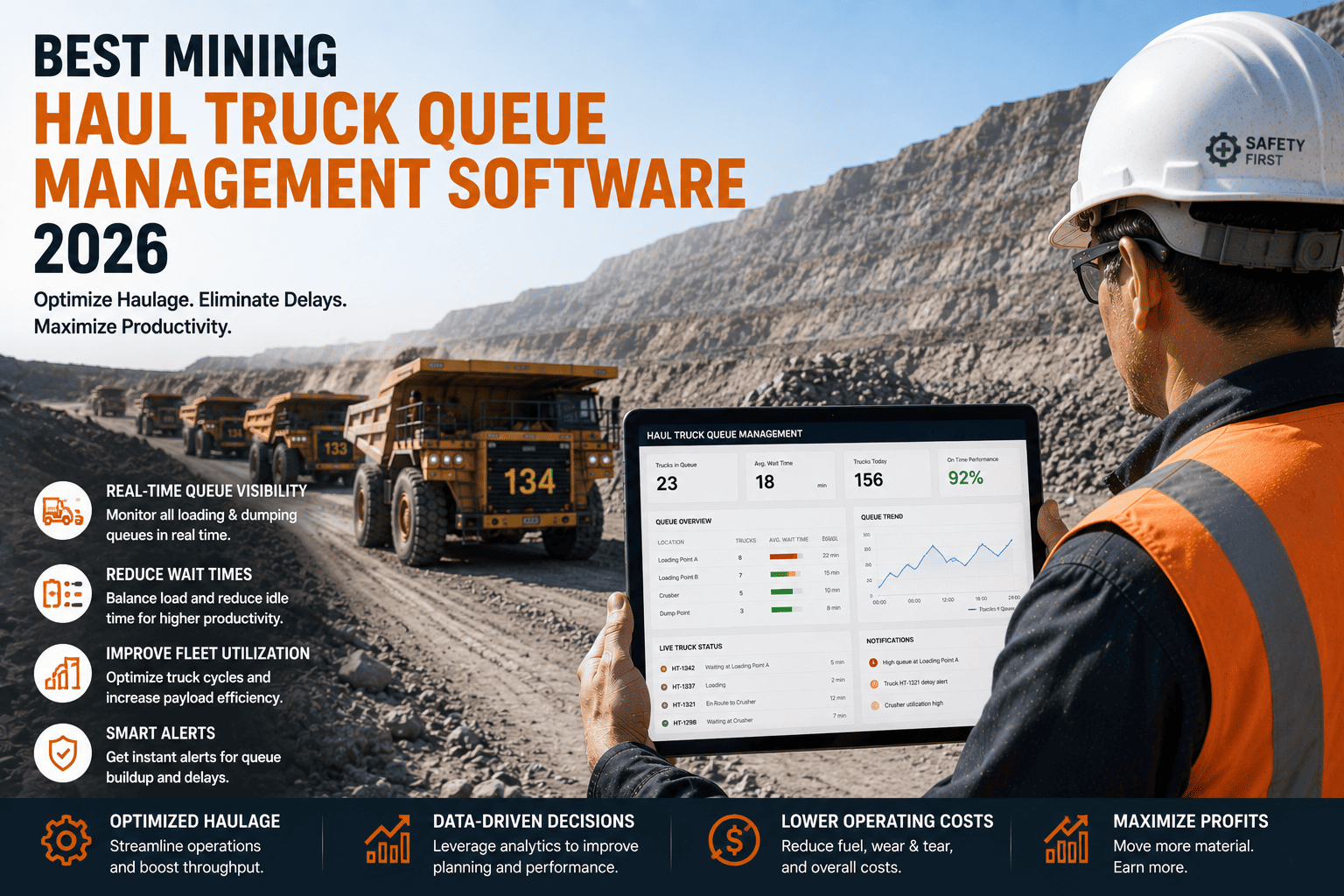
GPS and telematics feed every truck's location, speed, and load state into one dispatch view, so planners see exactly where congestion is building in real time.
Predictive Queue Modeling
The system compares current shovel and crusher service rates against inbound truck volume to forecast wait times before a queue physically forms.
Dynamic Re-Dispatch
Trucks approaching a predicted bottleneck are automatically redirected to a shovel or dump point with shorter wait times, spreading load evenly across the fleet.
Shift-Level Reporting
Every queue event, its cause, and its duration is logged automatically, giving planners the data to fix recurring bottlenecks instead of reacting to the same one every shift.
FleetRabbit tracks every haul cycle in real time and flags shovel or crusher congestion before it slows your fleet down. Sign up free and see your first queue report within a shift, or book a live demo to walk through your pit layout with our team.
Manual Dispatch vs Software-Driven Queue Management
The difference between radio-based dispatch and a predictive queue system shows up clearly once you compare how each one handles the same shift.
| Factor | Manual Radio Dispatch | Queue Management Software |
|---|---|---|
| Queue Detection | Noticed after trucks are already backed up | Predicted minutes before the queue forms |
| Truck Reassignment | Based on dispatcher memory and radio calls | Automated, based on live shovel and crusher rates |
| Shovel Utilization | Uneven, with idle gaps at slower shovels | Balanced across all active loading units |
| Shift Reporting | Manual notes, limited historical detail | Automatic queue logs by location and cause |
| Response To Change | Reactive, after congestion is already visible | Proactive, rerouting trucks before delay occurs |
What Queue Reduction Looks Like in the Field
The gains from better dispatch are not theoretical. A Komatsu-led implementation at an operating mine found that truck idle times dropped from 210 hours per month to 38 hours per month after the site improved its dispatch coordination between the crusher and central dispatch. Separately, a predictive queue-forecasting tool applied across dumping areas in South American iron ore operations delivered a 10 percent reduction in queue time on each dumping area where it was deployed. Neither result came from buying new trucks or shovels. Both came from giving dispatch better visibility into where and when congestion was about to happen.
Turning Queue Hours Into Tons
Every hour of queue time removed from a haul truck's shift is an hour that truck can spend loading, hauling, or dumping instead of sitting still. Across a 25 to 40 truck fleet, even a modest queue reduction compounds fast, because the saved minutes repeat on every single cycle, every single shift, for every truck on the pit.
A Simple Way to Estimate Your Own Queue Cost
Take your average queue wait per truck per cycle, multiply it by the number of cycles a truck completes in a shift, then multiply that by your fleet size. The resulting hours are production capacity your mine already owns and is simply not using. Most sites are surprised by how large that number is once it is written down.
Frequently Asked Questions
Queue time is capacity your mine already paid for. FleetRabbit turns live truck and shovel data into automatic re-dispatch decisions that keep your fleet moving instead of waiting. Create your free account to start tracking queue time today, or book a 30-minute demo to see it mapped to your own pit.