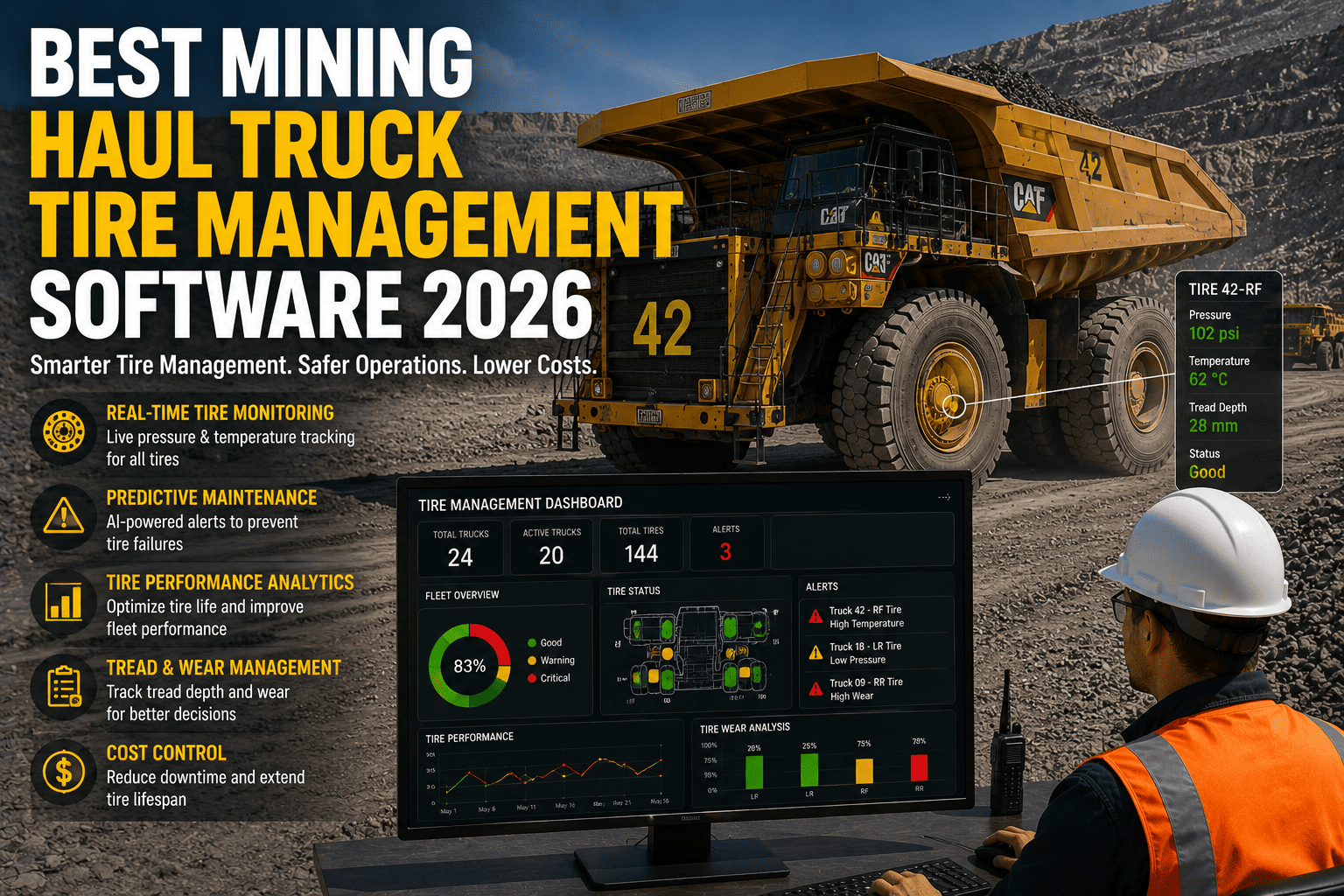
A single mining haul truck rides on six tires, and each one can cost anywhere from 5,000 to over 40,000 dollars. That means one truck can be carrying 150,000 to 250,000 dollars in rubber alone, every single shift, across rock, heat, and grade. Most of that value disappears quietly through overloading, underinflation, and heat damage that nobody notices until a tire is already scrap. Mining tire management software exists to stop that silent bleed, and choosing the right platform in 2026 can be the difference between replacing tires every seven months or stretching that to twelve.
Why Mining Tire Costs Spiral Out of Control
Haul truck tires do not fail randomly. They fail predictably, from the same handful of causes, repeated across thousands of haul cycles. Overloading pushes a tire past its rated tons-kilometers-per-hour, generating internal heat that breaks down the rubber compound from the inside. Underinflation does the same thing through a different path, flexing the sidewall more than it was built for on every single rotation. Rough haul roads add cuts, impacts, and uneven wear that shortens life even when pressure and load are perfect. None of these problems are visible from the cab. A driver cannot feel a tire running ten degrees hotter than it should, and by the time a tire visibly bulges or separates, the damage has been building for weeks.
The Real Numbers Behind Tire Failure
Industry data on OTR mining tires consistently points to the same pattern: tires rated for nine to twelve months of service are instead being replaced at seven to nine months, and the gap is almost always traceable to load, pressure, or heat that went unmonitored. On a fleet running twenty haul trucks, even a two-month reduction in average tire life across a full tire set translates into hundreds of thousands of dollars in accelerated replacement spend every year, on top of the lost production hours when a truck sits idle for a tire change.
What Actually Drives Premature Tire Failure
- Overloading past TKPH rating — heat builds inside the casing faster than it can dissipate
- Underinflation — every drop in pressure increases sidewall flex and internal temperature
- Haul road conditions — rutted, ungraded roads add cuts, impacts, and uneven tread wear
- Mismatched tire-to-site specification — wrong compound or TKPH rating for the actual pit conditions
- No real-time visibility — problems are caught after failure instead of days before it
What Mining Tire Management Software Actually Does
The best platforms in this category do three things well: they monitor every tire in real time, they predict failure before it happens, and they give fleet and maintenance teams one place to act on that information. Strip away the marketing language and the value comes down to catching a problem when it is a 200 dollar pressure adjustment instead of a 30,000 dollar tire replacement and a half-day of downtime.
Real-Time Monitoring
Sensors mounted inside or on each tire continuously track pressure and temperature, sending that data to a dashboard where dispatchers and maintenance teams can see every tire on every truck at once. When a tire starts running hot or losing pressure, the system flags it immediately instead of waiting for a scheduled inspection.
TKPH and Duty Cycle Planning
Because tire load capacity is rated against tons-kilometers-per-hour, software that models haul routes against tire TKPH limits helps planners assign the right truck and tire combination to the right route, rather than discovering the mismatch after a tire has already overheated repeatedly.
Predictive Maintenance and Lifecycle Tracking
Good platforms track every tire from installation to retirement, building a history that reveals which positions wear fastest, which compounds last longest on your specific terrain, and when a tire is statistically close to failure based on its accumulated stress, not just its calendar age.
| Capability | What It Solves | Why It Matters |
|---|---|---|
| Pressure & Temp Sensors | Catches underinflation before heat damage starts | Pressure loss is the single biggest preventable cause of failure |
| TKPH Route Modeling | Matches truck and tire to the right haul cycle | Prevents chronic overload on tough or steep routes |
| Lifecycle Tracking | Knows the full history of every tire by serial number | Reveals which positions, brands, and routes wear fastest |
| Predictive Alerts | Flags tires trending toward failure days in advance | Turns an emergency tire change into a scheduled one |
What to Look for Before You Choose a Platform
Not every tire management tool is built for the scale of a mining operation. A platform designed for highway fleets will not understand TKPH ratings, haul road severity, or the duty cycle of a 300-ton ultra-class truck. Before committing, fleet managers should weigh a short list of priorities against what each vendor actually delivers.
Sensor Compatibility
Works across tire brands and sizes instead of locking you into one manufacturer's hardware.
Integration With Existing Fleet Systems
Connects with your GPS, payload monitoring, and maintenance management tools instead of becoming another disconnected dashboard.
Offline and Remote-Site Reliability
Most mine sites have unreliable connectivity, so the system needs to log and sync data without constant signal.
Actionable Alerts, Not Just Data
A wall of numbers is not useful. The platform should tell a dispatcher exactly which truck to pull and why.
Once those boxes are checked, the decision usually comes down to how quickly a platform can be deployed and how well it fits the operational rhythm of your specific site. This is where signing up for a free trial tends to answer more questions in a week than another month of vendor comparisons ever could.
How FleetRabbit Approaches Tire Management
FleetRabbit was built around the idea that maintenance teams should not have to choose between visibility and simplicity. Instead of forcing fleet managers to stitch together separate tools for pressure monitoring, lifecycle tracking, and maintenance scheduling, the platform pulls all three into one view tied to the actual vehicle and route data already running through your operation.
Continuous Health Visibility
Every tire's pressure and temperature trend is visible at a glance, with alerts triggered the moment a reading drifts outside safe range, long before that drift becomes a failure on the haul road.
Maintenance That Plans Itself
Instead of reacting to flat tires and emergency callouts, teams using FleetRabbit shift toward scheduled tire changes during planned downtime windows, cutting the premium labor and rush-parts costs that come with unplanned repairs.
One Record Per Tire, From Install to Retirement
Every tire gets a full history: when it was mounted, which truck and position it served, how its pressure and temperature behaved over its life, and when it came off. That record turns guesswork about which tire brand or compound performs best on your terrain into a documented answer.
Stop Losing Tires to Problems You Can't See
FleetRabbit gives your maintenance team real-time pressure and temperature visibility across every haul truck tire on site, so problems get caught at the pressure-adjustment stage instead of the replacement stage. Sign up for a free trial and connect your first vehicles today, or book a demo to walk through your site's specific haul conditions with our team.
Calculating the Return on a Tire Management Platform
The math on tire monitoring software is unusually direct compared to other fleet technology investments, because the cost of the asset being protected is so high. If a 30,000 dollar tire that would have failed at month seven instead lasts through month eleven because pressure and load issues were caught early, that single save can cover the platform's cost for an entire truck for the year. Multiply that across a twenty-truck fleet running six tires each, and the potential savings move from a nice-to-have into a core part of the maintenance budget.
Where the Savings Actually Come From
Extended tire life is the headline number, but it is not the only one. Fewer emergency tire changes mean less unplanned downtime and less overtime labor for the maintenance crew. Better-matched tire-to-route assignments reduce the rate of repeat failures on the same haul segments. And a documented lifecycle record gives procurement teams real data when negotiating tire contracts or comparing brands, instead of relying on anecdotes from the shop floor.
Frequently Asked Questions
Your Tires Are Already Telling You Something
The only question is whether anyone is listening before the next failure. FleetRabbit turns pressure and temperature data into early warnings your maintenance team can act on, protecting hundreds of thousands of dollars in tire investment across your fleet. Get started with a free trial or talk through your site's haul conditions with our team first.