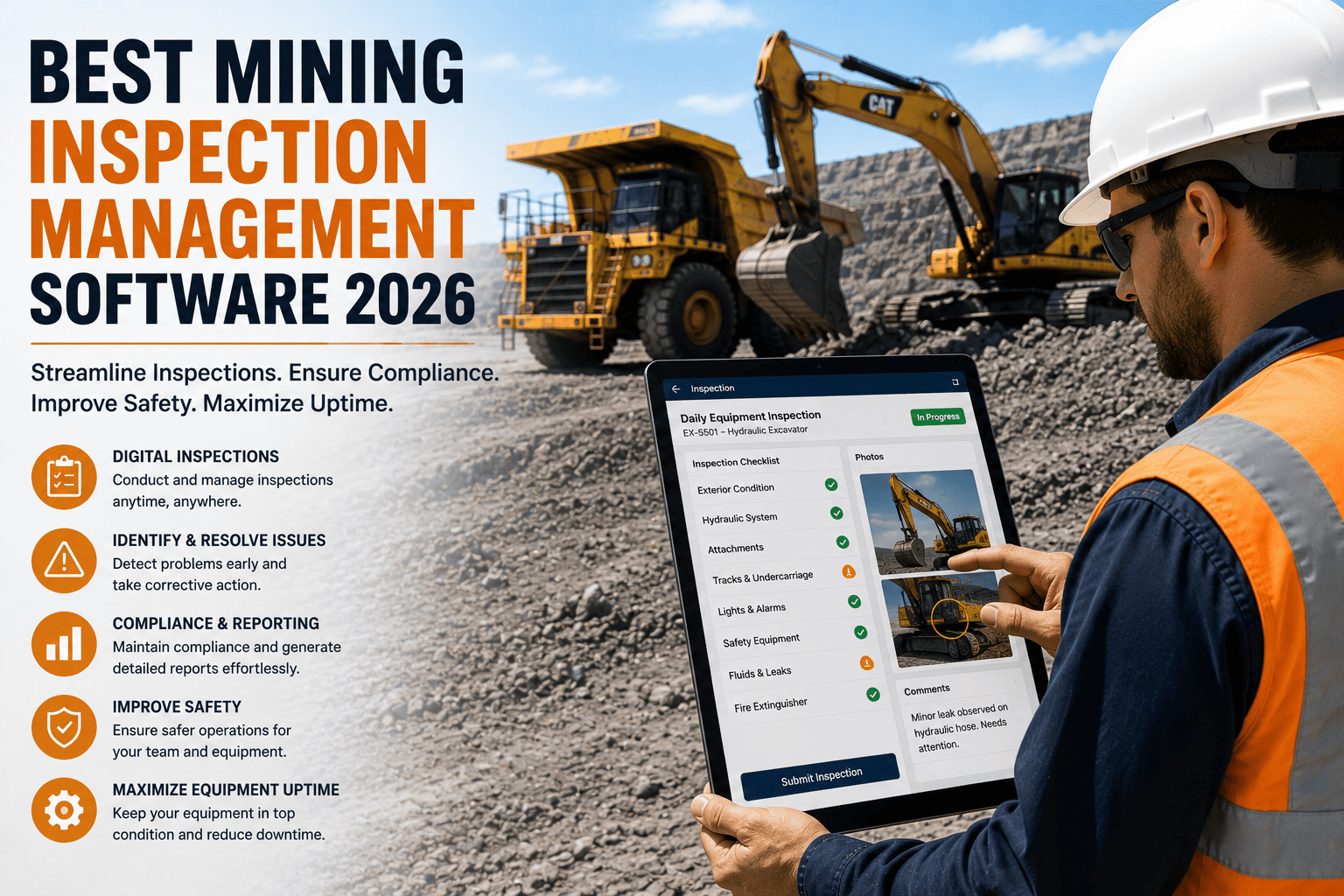
Best Mining Inspection Management Software in 2026

best-mining-inspection-management-software-2026

A missed pre-shift inspection on a haul truck rarely stays a small problem. A cracked frame goes unnoticed at 5 a.m., a hydraulic line fails by noon, and by the time MSHA asks for the record, there isn't one. Mining inspection management software exists to close that gap — turning pre-shift checklists into a system that catches defects before they become downtime, and builds the audit trail automatically while it does it. This guide covers what the best mining inspection management software actually needs to do, and how FleetRabbit delivers it for surface and underground fleets alike. You can start a free trial to explore it yourself, or book a demo to walk through it with our team.

Mining Inspection Reality Check

Operations running paper-based pre-shift inspections average just 60 to 70 percent completion rates, and a single serious MSHA citation carries an average penalty of 70000 dollars or more. Digital inspection platforms that build compliance records automatically push audit pass rates close to 100 percent, and FleetRabbit delivers this starting at 5 dollars per asset per month — roughly 1200 dollars a year for a 20-truck operation.

Compliance Risk

Pre-Shift Inspections Are Not Optional

MSHA requires pre-shift inspections under 30 CFR §56.14100 for surface mines and §57.14100 underground, every single shift. A paper trail with gaps is exactly what an inspector flags first, and it's the single fastest route to a citation.
Response Delay

Defects Sit Until the Shift Ends

A defect written on paper usually reaches maintenance hours later, if it reaches them at all. That delay is how a cracked bucket pin or a failing brake line turns into an unplanned repair instead of a scheduled one.
Prevention

Digital Routing Closes the Gap

When a defect is logged digitally, it reaches maintenance instantly and the asset can be held from dispatch automatically. Operations using this workflow report audit pass rates near 100 percent and far fewer surprise repairs.

Understanding the True Risk of Paper-Based Mining Inspections

Paper inspection sheets fail in predictable ways. They get filled out from memory back in the cab, they get left in a truck that goes straight to the wash bay, and they rarely make it to the maintenance office the same day a defect is spotted. None of that shows up as a single dramatic failure — it shows up as a slow erosion of completion rates, until an operation is averaging 60 to 70 percent inspection completion without anyone noticing until an inspector asks for 90 days of records.

The financial exposure is not hypothetical. A single serious MSHA citation averages 70000 dollars or more, and unmanaged fleet operations at small mines and quarries lose an estimated 127000 dollars a year to missed maintenance and compliance gaps combined. A missed preventive maintenance interval alone can turn into a 40000 dollar emergency repair that halts production for two days. Mining inspection management software is built to remove the point of failure — the moment a checklist depends on someone remembering to file it.

Built For Surface And Underground Fleets

Inspection Records That Build Themselves

FleetRabbit routes every defect straight to your maintenance team, blocks unsafe equipment from dispatch automatically, and produces MSHA-ready records in minutes. Start a free trial and see it running on your fleet today.

~100%
Digital Audit Pass Rate
$5/mo
Per Asset, Per Month

Components of a Complete Mining Inspection Management Platform

A generic safety-checklist app built for construction or logistics will miss the items MSHA inspectors check first — ROPS and FOPS structural integrity, fire suppression status, backup alarm compliance, and mining-specific lighting requirements. A purpose-built mining inspection platform needs to cover the following capabilities, and the difference against a paper process is stark.

Capability Paper Process FleetRabbit Why It Matters
Offline mobile inspections Not possible without signal Fully offline, auto-sync Underground drifts and remote pits rarely have connectivity
Equipment-specific checklists One generic form for everything Templates per asset type Haul trucks, excavators, and drills each need different checks
Defect routing to maintenance End of shift, if at all Instant, automatic A defect caught early is a scheduled repair, not an emergency
Unsafe equipment dispatch hold Manual, easy to miss Automatic block Removes the chance a known defect goes back on the haul road
MSHA-ready record export Hours searching filing cabinets One-click, any date range Inspectors expect records in minutes, not by the end of the day
Compliance dashboard No day-to-day visibility Live by asset and shift Gaps get caught long before an inspector ever arrives

How Inspection Requirements Change Across Mine Types

Surface mines, underground operations, and contractor-heavy sites don't share the same inspection burden. Underground fleets need software that assumes zero connectivity as the default, not the exception. Surface operations spread across large benches need inspection records tied to GPS-tagged assets so a completed checklist can be verified against the equipment's actual location. Sites running mixed contractor and direct-employee crews need the same inspection rigor applied to every operator regardless of who they work for, since MSHA holds the mine operator responsible either way.

Small Mines and Quarries Carry the Same Exposure

Smaller operations often assume MSHA scrutiny scales with fleet size. It doesn't. A five-truck quarry faces the same 70000 dollar citation exposure as a fifty-truck operation, which is why inspection management software priced and built for small fleets — not bundled into enterprise software neither the budget nor the team will use — matters as much here as anywhere.

Calculating Your Compliance Risk Exposure

Estimating exposure starts with your current completion rate. An operation logging inspections on paper at a typical 60 to 70 percent completion rate is effectively running 30 to 40 percent of shifts with no documented pre-shift check at all. Multiply that gap by your shift count, and by the average 70000 dollar cost of a single serious citation, and the exposure becomes concrete rather than abstract. Add the operational side: a missed defect that becomes an unplanned repair averages tens of thousands of dollars and days of lost production, on top of any compliance penalty.

Setup In Under A Day, No IT Team Required

Turn Every Shift Into a Documented One

FleetRabbit connects haul trucks, excavators, loaders, drills, and support vehicles into one real-time inspection and compliance view. Book a 30-minute demo and see how it maps to your specific mine type and fleet.

<1 Day
Typical Setup Time
$1,200/yr
20-Truck Operation

Preventive Inspection as a Compliance and Maintenance Strategy

Treating pre-shift inspection as a preventive maintenance tool, not just a compliance box to check, is what separates the best mining inspection management software from a digital form builder. When a defect routes to maintenance the moment it's logged, it gets scheduled during planned downtime instead of discovered mid-shift. Repair turnaround times drop by as much as 40 percent when inspection data feeds directly into parts and maintenance planning, because the team isn't reacting — it's already working the list.

The Dashboard Is Where the Habit Sticks

A compliance dashboard showing inspection completion by equipment and shift, open defect status, and certification records gives supervisors daily visibility, not just visibility on the day an inspector shows up. That daily habit is what pushes completion rates from 60 to 70 percent toward 100 percent.

Benchmarking Inspection Performance

Inspection completion rate is the single most useful metric for a compliance manager to track weekly, broken down by equipment and shift. Operations still on paper typically sit at 60 to 70 percent. Digital platforms with automated reminders and escalation routinely push that to near 100 percent within the first few months. Time-to-resolution on logged defects is the second key metric — the gap between a defect being found and a work order being closed. Shrinking that gap is what prevents a known issue from becoming a breakdown.

Records retrieval time is worth tracking too, even though it only gets tested when an inspector arrives. Manual retrieval from filing cabinets can take hours across departments and sites. A one-click export that produces a complete, formatted MSHA compliance report in minutes is the benchmark a modern platform should be judged against.

ROI of Digital Inspection Management

The return on a digital inspection platform is straightforward to model. At 5 dollars per asset per month, a 20-truck operation spends roughly 1200 dollars a year. Avoiding a single serious MSHA citation, which averages 70000 dollars or more, pays for that investment nearly 60 times over. Add the operational side — fewer emergency repairs, faster defect resolution, and repair turnaround times improved by up to 40 percent — and the payback period is typically measured in weeks, not years.

Implementation Timeline

Most operations move from paper to a fully running digital inspection program in under a day. Equipment-specific checklist templates are configured first, then operators are added and trained on the mobile app, and the compliance dashboard goes live immediately. There's no IT rollout required and no long-term contract to commit to before seeing completion rates move.

QWhat is mining inspection management software?
It's a digital platform that replaces paper pre-shift checklists with mobile inspections, automated reminders, instant defect routing to maintenance, and one-click MSHA-ready compliance reporting.
QDoes FleetRabbit work underground with no internet signal?
Yes. FleetRabbit's mobile app is offline-first — inspections, near-miss reports, and work order completions all run fully without connectivity and sync automatically once the device returns to signal.
QHow does this reduce our MSHA citation risk?
Every completed inspection builds a compliance record automatically. When MSHA requests 90 days of records, you export them in minutes instead of scrambling through filing cabinets. Book a demo to see the export in action.
QWhat does FleetRabbit cost?
FleetRabbit is priced at 5 dollars per asset per month with no setup fees and no long-term contract. A 20-truck operation runs on it for roughly 1200 dollars a year.
QHow long does implementation take?
Most operations are running digital inspections within a day, with no IT team required. Start a free trial to see your own setup timeline.
QCan it stop unsafe equipment from being dispatched?
Yes. Equipment flagged with an open safety defect can be held from dispatch automatically until the issue is cleared and the work order is closed.
QDoes it work for small mines and quarries, not just large operations?
Yes. Small operations face the same citation exposure as large ones, and FleetRabbit is priced and built for fleets of any size rather than bundled into enterprise-only software.

Key Takeaways on Mining Inspection Management Software

Pre-shift inspections are non-negotiable under MSHA, but the way most operations document them — on paper, filled out from memory, filed hours later — is what turns a routine requirement into real compliance exposure. Completion rates stall at 60 to 70 percent, defects sit unresolved, and a single citation can cost 70000 dollars or more against a platform that costs 5 dollars per asset per month.

The gap between those two numbers is the opportunity. Digital inspection management software with offline mobile checklists, instant defect routing, automatic dispatch holds, and one-click MSHA exports turns pre-shift inspection from a paperwork burden into a genuine preventive maintenance and compliance tool — one that builds its own audit trail while it works.

Stop Losing Shifts to Incomplete Paper Inspections

Every shift without a documented inspection is a shift with compliance exposure you can't afford. FleetRabbit turns pre-shift checklists into audit-ready records automatically, routes defects to maintenance instantly, and blocks unsafe equipment from dispatch. Start your free trial today, or book a 30-minute demo to see it mapped to your fleet.


Digital Pre-Shift Inspections MSHA-Ready Compliance Offline Mobile Checklists Automated Defect Routing Dispatch Hold Protection

July 17, 2026 By John
All Posts

Best Mining Inspection Management Software in 2026

best-mining-inspection-management-software-2026

A pre-shift inspection is supposed to be the last line of defense before a defective truck rolls onto a haul road. On paper, it often isn't. A checklist gets filled out fast to keep the shift moving, a cracked hose or worn brake line gets a checkmark instead of a flag, and the clipboard disappears into a filing cabinet where nobody looks at it again until an MSHA inspector asks for ninety days of records. Mining inspection management software replaces that clipboard with a mobile system that catches defects before they become downtime and builds the audit trail automatically while it does it.

Quick Answer

The best mining inspection management software runs pre-shift checklists on a mobile app that works offline, routes flagged defects straight to maintenance, and blocks unsafe equipment from dispatch automatically. Operations running paper inspections average just 60 to 70 percent completion rates, while digital platforms commonly push that close to 100 percent. Sign up for a free trial or book a demo to see your inspection program go digital before your next shift.

Paper Checklists Versus Digital Inspections

The difference between paper and digital inspections is not just convenience. It changes whether a defect actually gets fixed or quietly disappears.

Paper
Completion You Cannot Verify
A clipboard checkmark proves nothing about whether the item was actually checked. Paper-based inspections average just 60 to 70 percent real completion rates, and there is no way to prove otherwise later.
Digital
Verified, Time-Stamped Completion
Every item requires a real response, photo evidence on critical components, and a timestamp, pushing genuine completion rates close to 100 percent across the fleet.
Paper
Defects That Die On A Clipboard
A flagged issue written on paper still has to be manually carried to a supervisor and then to maintenance, and every handoff is a chance for it to be forgotten.
Digital
Defects That Route Instantly
A flagged defect creates a work order automatically and notifies maintenance the moment it is logged, cutting the gap between discovery and repair to minutes.

What Happens To A Defect After It Is Found

The real value of inspection software shows up after the checklist is done. Here is the path a flagged issue actually takes on a well-run digital inspection program.

Spotted During The Walk-Around

An operator flags a worn brake line or a cracked hose during the pre-shift check, attaching a photo directly from the mobile app instead of a written note that may or may not be legible later.

Routed To Maintenance Automatically

The flag creates a work order the instant it is submitted, landing directly in the maintenance queue instead of waiting for a supervisor to physically carry the paperwork over.

Equipment Blocked From Dispatch When Needed

For safety-critical defects, the platform can automatically flag the asset as out of service, preventing dispatch from sending it out before the repair is confirmed complete.

Logged For The Audit Trail

Every step, from the original flag to the completed repair, stays attached to that asset's record, so producing ninety days of documentation for an inspector takes minutes instead of a search through a filing cabinet.

Stop Losing Defects To A Clipboard
Route Every Flagged Issue Straight To Maintenance

FleetRabbit turns every pre-shift inspection into a verified, time-stamped record, and routes flagged defects to your maintenance team the moment they are found. Most sites are fully set up in under a day.

~100%
Verified Completion Rate
40%
Faster Repair Turnaround

Core Features Every Mining Inspection Platform Needs

A generic safety checklist app built for construction or logistics will miss the specific items MSHA inspectors look for first. Compare any platform against these capabilities before committing.

Feature Why It Matters
Offline-First Checklists Inspections must complete underground and in remote pits with zero signal, syncing automatically once connectivity returns
Mining-Specific Templates Covers ROPS and FOPS structural integrity, fire suppression status, and backup alarm compliance, not generic vehicle items
Photo-Verified Responses Requires photo evidence on critical components like tires, brakes, and hydraulic systems instead of a bare checkbox
Automatic Defect Routing Flagged issues create a work order instantly and notify maintenance without manual handoff
Audit-Ready Reporting Produces complete inspection history on demand instead of requiring a manual records search

Passing An MSHA Audit Without The Scramble

Surface mines are typically inspected twice a year and underground mines four times, and failure to conduct proper pre-shift examinations remains one of the most frequently cited violations. A single serious citation averages 70000 dollars or more, which puts a real number behind the cost of an inspection program that cannot produce clean records on demand.

What A Compliance Dashboard Should Show Instantly

When an inspector arrives, a compliance manager should be able to pull up completion rates by equipment and shift, open corrective actions, and full defect history without leaving the screen. That single view is what separates a five-minute audit prep from a day spent in a filing cabinet.

Benchmarks Worth Tracking

Inspection completion rate is the clearest signal of program health. Paper-based programs typically run 60 to 70 percent, while digital programs commonly reach close to 100 percent verified completion. Time from defect flagged to work order created should be measured in minutes, not shift changes. Repair turnaround time on flagged defects often improves by up to 40 percent once routing becomes automatic instead of manual.

Be Ready Before The Inspector Arrives
Turn Your Next MSHA Visit Into A Five-Minute Task

FleetRabbit builds your audit trail automatically with every inspection, so completion rates, defect history, and corrective actions are always ready to show. No filing cabinet required.

60-70%
Typical Paper Completion
$70K+
Average Serious Citation

Frequently Asked Questions

QWhat is mining inspection management software
It is a mobile platform that replaces paper pre-shift checklists, verifies each inspection item with timestamps and photo evidence, and automatically routes flagged defects to maintenance while building an audit-ready record.
QDoes it work underground or in areas with no signal
Yes, when built for mining conditions. Checklists load and complete fully offline, storing responses locally on the device and syncing automatically once connectivity returns.
QHow does this help with MSHA compliance specifically
It documents every pre-shift examination as required under 30 CFR, and produces complete completion rates, defect history, and corrective action records instantly when an inspector requests them.
QWhat happens when an operator flags a safety-critical defect
The flag creates a maintenance work order immediately, and the platform can automatically mark the asset out of service so dispatch cannot send it out before the repair is confirmed.
QHow long does it take to move from paper to digital inspections
Most operations configure equipment-specific templates, add operators, and go fully live within a single day, often during one shift change window.
QIs digital inspection software worth it for a small fleet
Yes. Even a small fleet carries real MSHA citation exposure, and the cost of a single serious violation typically outweighs years of software investment many times over. Book a demo to see the setup for your specific fleet size.

Key Takeaways

Mining inspection management software earns its place by closing the gap between what a pre-shift checklist is supposed to catch and what a clipboard actually catches. Paper-based programs average just 60 to 70 percent real completion, and every flagged defect has to survive a manual handoff before it reaches maintenance. Digital platforms push completion close to 100 percent, route defects automatically, and turn ninety days of audit records into a five-minute pull instead of a filing cabinet search.

If your inspection program still runs on paper, it is worth seeing how quickly that changes. Sign up for a free trial to digitize your first checklist today, or book a short demo and walk through your fleet's inspection and compliance needs with the FleetRabbit team.

Catch Defects Before They Cost You A Shift

FleetRabbit replaces paper pre-shift checklists with a mobile system that works offline, routes flagged defects instantly, and builds your MSHA audit trail automatically. Go from clipboard to dashboard before your next shift starts.

Digital Pre-Shift Inspections Automatic Defect Routing Offline Mobile App MSHA Audit Trail Compliance Dashboard

July 27, 2026 By John
All Posts

Share This Story, Choose Your Platform!

Latest Posts

Scroll