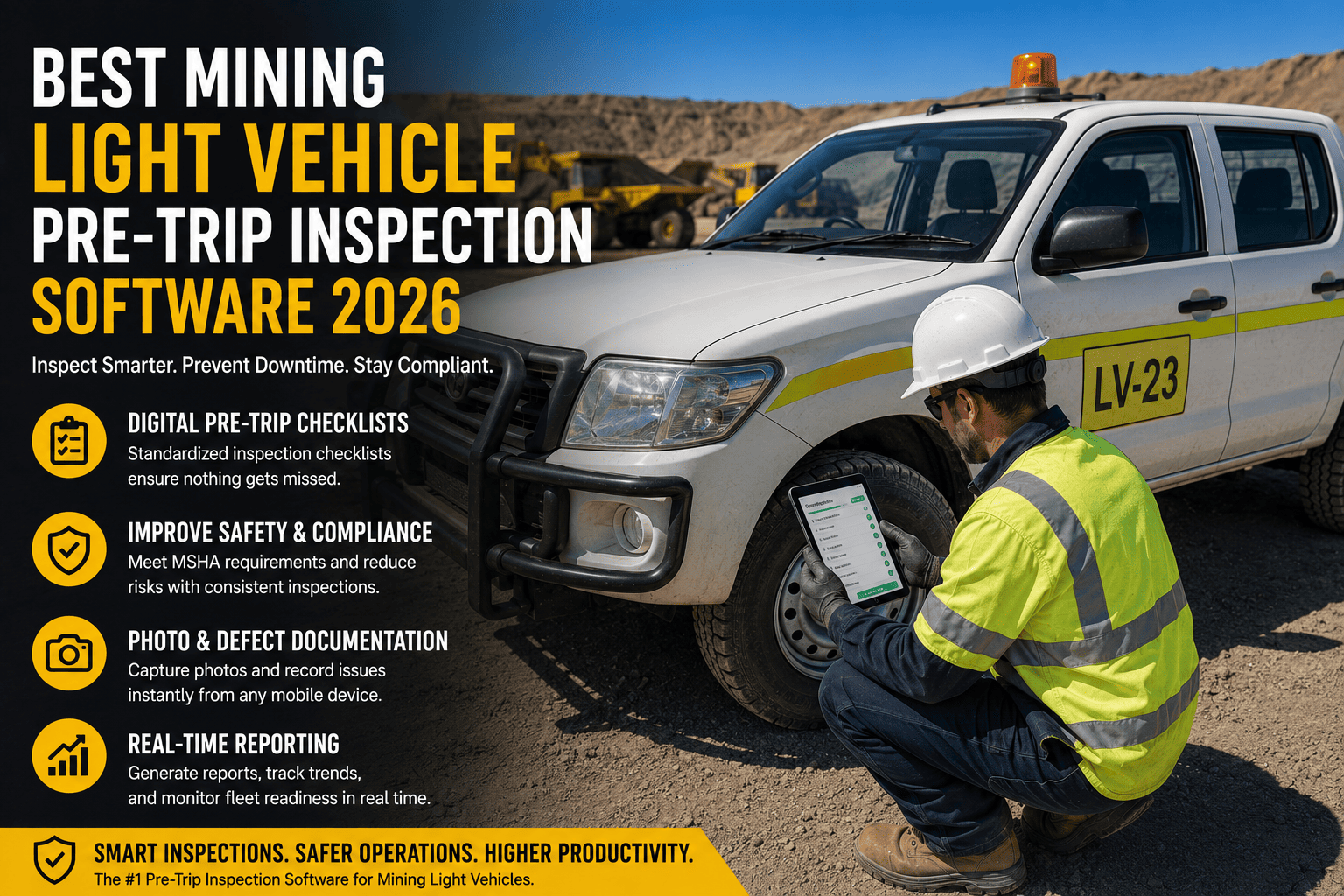
Best Mining Light Vehicle Pre-Trip Inspection Software in 2026

best-mining-light-vehicle-pre-trip-inspection-software-2026

A supervisor's pickup pulls onto a haul road to check a stockpile, and the reverse alarm that should have warned a 200-tonne haul truck operator never sounds. On a mine site, the light vehicle is not the biggest machine on the road, it is the most vulnerable one. Yet light vehicle pre-trip checks are often the first thing to get rushed or skipped entirely, because a pickup truck feels routine compared to the haul trucks and excavators everyone assumes carry all the risk.

Quick Answer

Mining light vehicle pre-trip inspection software replaces paper checklists with a mobile app built specifically for pickups and SUVs operating around haul roads, pits, and underground drives, covering items generic vehicle checklists miss, like reverse alarms, amber beacons, recovery kits, and tray latches. The best platforms work fully offline, block dispatch automatically when a critical item fails, and produce audit-ready records in seconds. FleetRabbit brings light vehicle inspections into the same platform as your heavy equipment fleet, so nothing falls through the cracks.

Site Risk
Light Vehicles Share Roads With Giants
A pickup sharing a haul road with a multi-hundred-tonne truck has almost no margin for a failed brake, a dead reverse alarm, or a beacon that will not turn on.
Speed
A Five-Minute Check, Not a Chore
A mobile checklist built for a pickup, not repurposed from a haul truck form, takes minutes to complete and gets done every single time a vehicle leaves the yard.
Auto Block
Unsafe Vehicles Never Reach the Road
A failed critical item, like a dead reverse alarm, automatically blocks that vehicle from dispatch instead of relying on someone remembering to say something.

Why Light Vehicles Need Their Own Inspection Standard

Light vehicles on a mine site are almost always pickup trucks or SUVs used to move people, tools, and small cargo between the pit, the workshop, and the office. They look like ordinary road vehicles, which is exactly the trap. A generic vehicle checklist built for a highway fleet checks tires, lights, and fluids and calls it done. It has no idea a mine site pickup also needs a functioning amber beacon, a recovery kit, a tray latch, and a reverse alarm loud enough to be heard over a running haul truck engine at distance.

What a Real Light Vehicle Pre-Trip Checklist Covers

A checklist built specifically for mining light vehicles goes well beyond a standard roadworthiness check. Brakes and the handbrake need to hold on the steepest grade the vehicle will encounter that shift, not just stop on flat ground. The windscreen has to be inspected for the dirt and cracking that rough haul roads cause daily. The steering wheel gets tested before every trip because loss of control at speed near open pit edges is not a minor incident. The tray latch has to be secure so tools and equipment do not become a hazard on the road behind the vehicle.

Safety Equipment Items Generic Forms Miss

The recovery kit, including a wheel jack, jumper leads, and tire repair tools, needs to be present and complete before any trip begins, since a breakdown on a remote haul road with no recovery gear can strand a driver for hours. The two-way radio must be tested and set to the correct site channel, since mine sites are large enough that a vehicle can be well out of sight of the nearest person. Fluid levels, battery condition, and cable integrity round out the mechanical side, catching the kind of electrical fault that strands a vehicle in the worst possible location.

Stop Using a Highway Checklist On A Mine Site
Light Vehicle Inspections Built For Pits and Haul Roads

FleetRabbit includes pre-built light vehicle templates covering reverse alarms, beacons, recovery kits, and tray latches, not just tires and lights. Operators complete the check in minutes, right from their phone, before they ever leave the yard.

5 min
Average Inspection Time
2-5
Shifts To Full Digital Adoption

Core Features to Look For in Light Vehicle Inspection Software

Not every inspection app is built to handle the specific realities of a mine site. Compare any platform against the capabilities that actually matter once a pickup leaves the yard.

Feature What It Does Why It Matters for Light Vehicles
Mining-Specific Templates Pre-built checklists covering beacons, reverse alarms, recovery kits, and tray latches Catches the exact items a generic road vehicle checklist skips entirely
Offline Mobile Access Completes and stores inspections without a live connection Keeps checks consistent in remote pits and underground areas with no signal
Photo-Verified Defects Requires a photo on critical items before the inspection can be marked complete Turns a checkbox into evidence that holds up during an audit or investigation
Automatic Dispatch Block Locks a vehicle out of dispatch the moment a critical item fails Removes reliance on a driver remembering to report or a supervisor catching it manually
Defect to Work Order Routing Sends flagged issues straight to the maintenance team with severity and photos attached Prevents a defect from sitting unresolved until the next shift finds it the hard way
One-Click Audit Export Pulls complete inspection history for any vehicle, date range, or operator instantly Turns a records request into seconds instead of hours searching a filing cabinet

Offline Capability Is Not Optional on a Mine Site

Open pits and underground drives regularly sit outside reliable cellular coverage, which means an inspection app that requires a live connection will fail at exactly the moment it matters most, the start of a shift in a remote area. A properly built platform lets the operator complete the full checklist offline, then syncs the record automatically the moment the vehicle comes back into range, with zero data loss along the way.

QR-Based Vehicle Identification Speeds Everything Up

Rather than manually selecting a vehicle from a long fleet list, operators scan a QR code on the pickup and the correct light vehicle template loads automatically, cutting inspection time down further and removing the chance of someone accidentally completing the wrong checklist for the wrong vehicle.

Turning Light Vehicle Records Into Audit-Ready Compliance

Light vehicles are still subject to the same scrutiny as any other equipment on a regulated mine site. When an inspector or an internal safety audit asks for records, retrieving a paper form from a glovebox or a filing cabinet is a red flag in itself. Digital pre-trip records tied to each vehicle, each operator, and each shift give you an answer in seconds rather than an afternoon of searching, and they show a pattern of consistent compliance rather than a single form pulled together for the occasion.

Every Pickup, Every Shift, Fully Documented
One Platform For Light Vehicles and Heavy Equipment

FleetRabbit keeps light vehicle inspections in the same system as your haul trucks and loaders, so your entire fleet's compliance record lives in one place, searchable and exportable in a click.

100%
Digital Adoption Within Days
Seconds
To Export Any Audit Record
Light Vehicle Inspection Mining Pre-Trip Checklist Mine Site Safety Digital Vehicle Inspection Pickup Truck Compliance Offline Inspection App

Frequently Asked Questions

QWhat counts as a light vehicle on a mine site
Light vehicles are typically pickup trucks and SUVs used to transport people, tools, and cargo around a mine site, separate from heavy production equipment like haul trucks, loaders, and drills.
QWhy can't we just use a generic vehicle inspection form
A generic road vehicle checklist misses mine-specific safety items like reverse alarms rated to distance standards, amber beacons, recovery kits, and tray latches, all of which matter far more on a haul road than on a public street.
QDoes light vehicle inspection software work without internet access
Reliable platforms allow the full checklist to be completed offline, storing the record locally on the device and syncing it automatically once the vehicle returns to an area with signal.
QWhat happens if an operator finds a defect during inspection
The defect is logged with a photo and severity level, automatically routed to the maintenance team as a work order, and if the item is safety-critical the vehicle is blocked from dispatch until it is resolved.
QHow long does a digital light vehicle inspection take
Most operators complete a mobile light vehicle pre-trip check in about five minutes once the correct template loads, considerably faster than filling out a paper form by hand.
QHow do I get started with FleetRabbit
You can load your light vehicle fleet and start running digital pre-trip inspections within your first shift. Start a free trial to explore the platform, or book a demo to see the light vehicle templates in action.
Mining Fleet Software Pre-Trip Inspection App Fleet Compliance Software Mine Vehicle Safety Digital Checklist Software Audit Ready Records

Bringing It All Together

Light vehicles rarely get the attention that haul trucks and excavators do, but they share the same roads, the same blind spots, and the same consequences when something is missed. A pre-trip inspection app built specifically for mine site pickups, not repurposed from a highway checklist, catches the items that actually matter, blocks unsafe vehicles before they reach the road, and gives you a clean audit trail without a single filing cabinet. That is a small daily habit that quietly prevents the worst kind of incident on site.

Get Every Light Vehicle Inspection-Ready

FleetRabbit brings mining-specific light vehicle checklists, offline mobile access, and automatic dispatch blocking into one platform alongside your heavy equipment fleet. Start protecting your drivers and your compliance record today, no credit card required.


Light Vehicle Templates Offline Inspections Auto Dispatch Block Photo-Verified Checks Audit-Ready Records

July 3, 2026 By John
All Posts

Best Mining Light Vehicle Pre-Trip Inspection Software in 2026

best-mining-light-vehicle-pre-trip-inspection-software-2026

Every mine site obsesses over haul truck uptime, and rightfully so. But walk any pit and you'll notice the vehicles moving constantly between them: pickups carrying supervisors, light trucks hauling parts, personnel carriers shuttling crews between the office and the bench. These light vehicles carry people, not just payload, and they're just as legally required to be inspected before every shift as the 400-ton trucks getting all the attention. Choosing the right software to run that inspection isn't a nice-to-have. It's the difference between a defect getting caught in the yard and a defect getting discovered on a haul road.

Quick Answer

The best mining light vehicle pre-trip inspection software offers offline-capable mobile checklists tailored to pickups and light trucks, mandatory photo evidence on safety-critical items, automatic defect routing to maintenance, and one-click audit exports for MSHA. Failure to conduct pre-shift examinations remains among the most frequently cited MSHA violations, with penalties ranging from $7,000 to $70,000 per violation. Sign up for FleetRabbit to put light vehicle inspections on the same digital footing as your production fleet.

Why Light Vehicles Need Their Own Inspection Standard

Under Title 30 CFR, MSHA requires every piece of self-propelled mobile equipment to be examined by its operator before each shift, with no carve-out for a pickup just because it's smaller than a haul truck. The mistake most operations make is running light vehicles through a generic vehicle checklist built for on-highway trucks, which misses the mining-specific items an MSHA inspector checks first.

What a Generic Checklist Misses

Mining strobe lights and high-visibility flags, backup alarm volume calibrated to MSHA distance standards, and radio or communication equipment required for haul road travel all get skipped by an off-the-shelf on-highway inspection form.

What a Mining-Specific Checklist Covers

Seat belts and latch mechanisms, mirrors and visibility, tire condition, brake function, lighting including strobes and flags, backup alarms, and horn function — all checked against the standard the inspector is actually trained to look for.

The Cost of Getting This Wrong

Citations for missed or inadequate pre-shift examinations run $7,000 to $70,000 per violation, and repeat findings within 24 months contribute to Pattern of Violations screening, which triggers heightened enforcement across the entire site. A light vehicle citation carries the exact same financial exposure as one written against a production machine.

Stop Running Light Vehicles On Generic Forms

Get Mining-Specific Checklists for Every Pickup and Light Truck

FleetRabbit auto-loads the correct light vehicle template the moment an operator scans the equipment, so no shift ever runs on the wrong checklist.

What to Look For: The Evaluation Checklist

Not every inspection app built for on-highway fleets translates cleanly to a mine site. Before choosing a platform, run it against the criteria below.

01

Works Fully Offline

Remote pits and haul roads regularly sit outside cell coverage. The inspection must complete entirely on-device and sync automatically once signal returns, with no data loss in between.

02

Mining-Specific Templates

Pre-built checklists for light vehicles that include strobes, flags, backup alarms, and communication equipment, not a repurposed on-highway DVIR form.

03

Photo Evidence on Critical Items

A checkbox without a photo isn't compliance, it's liability. Brakes, lights, and seat belts should require photographic proof, GPS-tagged and timestamped.

04

Automatic Defect Routing

A flagged defect should generate a maintenance work order instantly, not sit on a form until someone happens to read it days later.

05

One-Click Audit Export

When MSHA requests 90 days of records, the software should produce them in seconds, in an MSHA-accepted format, not require hours in a filing cabinet.

06

Fleet-Wide Completion Dashboard

A live view of which light vehicles have been inspected this shift, which have open defects, and which are tagged out, visible without a single phone call.

Comparing the Old Way to the Digital Way

The comparison below reflects what actually plays out on a shift-by-shift basis at sites still running paper light vehicle inspections versus those that have digitized.

What Happens Paper Checklist Digital Inspection Software
Finding 90 days of records for MSHA Hours searching filing cabinets Seconds, exported in an audit-ready format
A defect flagged by the night shift Sits on a clipboard until someone reads it Routes instantly to maintenance as a work order
Proving a brake or seatbelt check happened A checkmark with no evidence behind it Timestamped, GPS-tagged photo evidence
Knowing which vehicles are inspected today Phone calls around the site Live completion dashboard by shift and vehicle

Rolling Out Software Without the IT Headache

The most common hesitation mine managers raise is assuming a new platform means weeks of IT involvement and hardware procurement. For a typical light vehicle fleet, that assumption doesn't hold up: entering vehicles with asset IDs, adding operators with role and certification details, and going live can be done in under an hour, often via a simple CSV import with no dedicated IT team required.

$7K–$70K
Penalty range per missed pre-shift violation
95%+
PM compliance achievable with automated scheduling
40%+
Safety incident reduction at digitally integrated sites
Seconds
Time to produce 90 days of audit-ready records

Why FleetRabbit Fits the Light Vehicle Workflow

FleetRabbit was built around the exact chain a mining pre-trip inspection needs: an operator scans the vehicle, the correct light vehicle template loads automatically, critical items require photo evidence, a flagged defect creates a work order in real time, and every record exports to an MSHA-ready audit in one click. It works fully offline in remote pits and syncs the moment connectivity returns, so no shift ever goes undocumented because of a dead signal. Start a free trial and load your first light vehicle template in minutes, or book a demo to see how it maps onto your site's specific fleet and shift pattern.

Frequently Asked Questions

QAre light vehicles at mine sites really required to be pre-shift inspected?
Yes. Under Title 30 CFR, MSHA requires every piece of self-propelled mobile equipment to be examined by its operator before each shift, and light vehicles like pickups and personnel carriers are not exempt simply because they're smaller than production equipment.
QWhat does a generic vehicle checklist typically miss for mining light vehicles?
Mining-specific items like strobe lights, high-visibility flags, backup alarms calibrated to MSHA distance standards, and required communication equipment are usually absent from an off-the-shelf on-highway inspection form, which is exactly what an MSHA inspector checks first.
QDoes mining inspection software work without cell signal in remote pits?
The best platforms are offline-first, meaning the full inspection completes on the device with no internet connection needed. Data, photos, and signatures are stored locally and sync automatically once the device returns to signal, which is essential for most mine site conditions.
QWhat's the penalty for skipping a light vehicle pre-shift inspection?
MSHA citations for missed or inadequate pre-shift examinations range from $7,000 to $70,000 per violation, and repeat violations within a 24-month period can trigger Pattern of Violations screening with heightened enforcement across the site.
QHow long does it take to roll out inspection software for a light vehicle fleet?
For most operations, entering vehicle asset IDs, adding operators, and going live takes under an hour, often via a simple CSV import, with no dedicated IT team or hardware procurement required.
QHow does FleetRabbit handle light vehicle inspections specifically?
FleetRabbit auto-loads a mining-specific light vehicle checklist when the operator scans the vehicle, requires photo evidence on safety-critical items, routes defects to maintenance instantly, and exports MSHA-ready audit records in one click. Book a demo to see it configured for your fleet.
Give Every Light Vehicle An Audit-Ready Record

See Your Light Vehicle Fleet's Inspection Status In One Dashboard

Offline-capable checklists, photo evidence, and instant defect routing — built for the vehicles that carry your people.


July 4, 2026 By John
All Posts

Share This Story, Choose Your Platform!

Latest Posts

Scroll