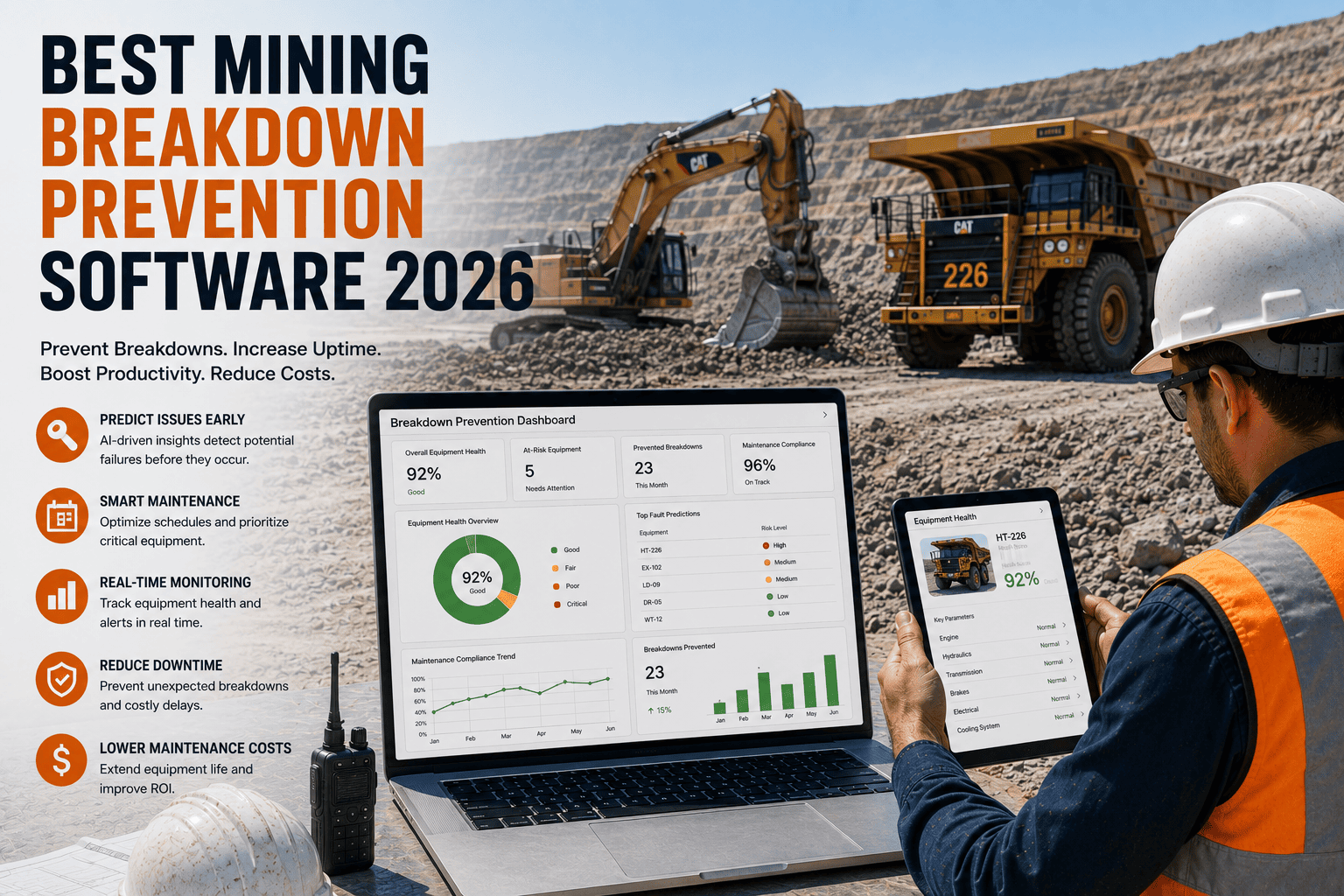
Most mine sites do not have a maintenance problem so much as a planning problem. The wrenches turn, the parts get ordered, the work gets done, but it happens on a whiteboard schedule that has no idea what production is doing that week. A haul truck gets pulled for service right as it is needed for a critical blast sequence, or a PM slips because nobody flagged the conflict until the technician showed up to a truck already dispatched. Mining maintenance planning software fixes this by scheduling repairs against the same production plan your dispatchers are working from, not a separate calendar that nobody cross-checks.
The best mining maintenance planning software schedules preventive work around live production plans, tracks PM compliance automatically, and turns condition data into work orders before a component fails. Sites moving from whiteboard scheduling to planning software typically raise PM compliance from 60 to 70 percent up to 90 percent or higher within a few months. Sign up for a free trial or book a demo to see it against your own maintenance calendar.
The Real Cost Of Planning Maintenance In Isolation
When maintenance schedules are built without visibility into production plans, the two departments end up fighting for the same equipment at the same time. A manual, calendar-based approach typically achieves only 60 to 70 percent PM compliance on active mine sites, meaning close to a third of scheduled services slip, get skipped, or turn into emergency repairs later. Emergency repairs then cost 3 to 9 times more than the planned maintenance that would have prevented them, and a single major failure on a haul truck or excavator can run 50000 to 200000 dollars in parts and lost production.
Where The Conflict Actually Happens
Maintenance planners work from OEM intervals and paper logs. Production planners work from tonnage targets and shift schedules. Without a shared system, a truck flagged for service on Tuesday gets dispatched Tuesday anyway, because nobody checked the maintenance calendar before building the day's routes.
Why This Gets Worse At Scale
A single-pit operation might absorb a few scheduling conflicts a week. A multi-site fleet running dozens of assets across several pits compounds that into dozens of missed windows, each one quietly increasing the odds of an unplanned failure later.
Four Stages Of Mining Maintenance Planning Maturity
Every mine site sits somewhere on a spectrum between fully reactive and fully optimized maintenance planning. Knowing which stage you are in shows exactly what to fix first.
FleetRabbit connects your maintenance calendar to live production schedules, so a truck flagged for service never gets dispatched by accident again. Most sites are running planned maintenance windows within their first week.
Core Capabilities To Compare Before You Choose
Not every CMMS built for general industry survives contact with a mine site's production pressure. These are the capabilities that separate a purpose-built mining maintenance planning platform from a repurposed generic tool.
| Capability | Problem It Solves | Impact On Your Site |
|---|---|---|
| Production-Aligned Scheduling | Maintenance and dispatch working from separate calendars | Eliminates conflicts between planned service and active haul routes |
| Automated PM Compliance Tracking | Services quietly slipping past their due date | Raises compliance from the 60 to 70 percent manual average toward 90 percent or higher |
| Condition-Triggered Work Orders | Sensor and inspection data sitting unused in a dashboard | Turns early warning signs into a scheduled repair instead of a forgotten alert |
| Parts And Labor Forecasting | Emergency parts sourcing and overtime labor for unplanned repairs | Lets planners order parts and schedule technicians ahead of the actual repair |
| Cross-Site Visibility | Maintenance data isolated at each individual pit or location | Gives leadership one view of compliance and reliability across every site |
Manual Scheduling Versus Software-Driven Planning
The gap between a whiteboard and a planning platform is not just convenience. It changes how often maintenance actually happens on time.
The Manual Approach
A planner checks OEM intervals against a spreadsheet, cross-references it with a printed production schedule that is already a day old, and hopes nothing changed overnight. Conflicts surface only when a technician or dispatcher notices something is wrong in the moment.
The Software-Driven Approach
Maintenance windows sit inside the same live schedule production is using. When a production plan shifts, the system flags any maintenance conflict immediately, and planners can move the service window before it becomes a missed PM or a dispatch mistake.
Benchmarks That Show Your Planning Is Working
PM compliance rate is the clearest signal. Sites relying on manual scheduling typically sit at 60 to 70 percent, while sites running planning software commonly reach 90 percent or higher. The ratio of planned to unplanned repairs should trend toward 80 to 90 percent planned; any site running closer to 50 to 70 percent unplanned is a strong candidate for a planning overhaul. Mean time between failures is the lagging indicator that confirms it is working, typically improving 40 to 60 percent within a year of consistent planned maintenance.
FleetRabbit gives planners a single view of PM status, condition alerts, and production schedules, so every service window gets picked at the right time. See your current PM compliance rate in your first session.
Frequently Asked Questions
Key Takeaways
Mining maintenance planning software earns its place by closing the gap between what maintenance intends to do and what production actually lets happen. Sites stuck in reactive or purely scheduled stages lose PM compliance to conflicts nobody catches until it is too late, while sites that plan maintenance directly against production schedules routinely push compliance from 60 to 70 percent up toward 90 percent or higher. That single shift cuts emergency repair costs, improves mean time between failures, and gives leadership one honest view of reliability across every site.
If your maintenance calendar and your production schedule still live in two different systems, it is worth seeing what happens when they share one. Sign up for a free trial to get your fleet's PM schedule live, or book a short demo and walk through your current planning gaps with the FleetRabbit team.
FleetRabbit aligns preventive maintenance with your live production schedule, tracks PM compliance automatically, and turns condition data into work orders before a breakdown happens. See your planning maturity stage and a path to the next one.