A single haul truck sitting idle on a mine site is not a maintenance problem. It is a production crisis measured in tonnes, not minutes. Mining operations lose an average of 180,000 dollars per unplanned equipment failure, and across the industry that adds up to roughly 10 billion dollars a year in preventable downtime. Most of that loss traces back to one root cause: maintenance schedules built on whiteboards, spreadsheets, and radio calls instead of real engine-hour data. The good news is that mining maintenance schedule management software fixes this exact problem, and choosing the right platform in 2026 can be the difference between a fleet that runs and a fleet that reacts.
The best mining maintenance schedule management software automates preventive maintenance based on engine hours, odometer, or meter readings instead of the calendar, generates work orders automatically, and gives supervisors a live compliance dashboard. Mines using manual scheduling typically complete only 60 to 70 percent of PM services on time. Mines using automated scheduling software push that compliance rate above 95 percent, cutting unplanned downtime by 30 to 50 percent.
Why Manual Mining Maintenance Scheduling Keeps Failing You
Mining maintenance teams have been fighting the same battle for decades. A supervisor tracks service intervals on a spreadsheet or a paper log, a technician forgets to radio in the actual hour meter reading, and a preventive service window quietly passes by unnoticed. Multiply that across a fleet of haul trucks, excavators, drills, crushers, and conveyors, and it becomes almost impossible to know which asset is actually due for service on any given day. Research shows calendar-based, manually tracked maintenance schedules typically achieve only 60 to 70 percent PM compliance on active mine sites, meaning 30 to 40 percent of scheduled services are missed, delayed, or completed late.
The Whiteboard and Radio Call Problem
Paper trails and whiteboard schedules are prone to human error, lost records, and zero historical searchability. When a hydraulic system fails on a 200-tonne haul truck, the resulting repair can run anywhere from 50,000 to 200,000 dollars in parts and lost production, and in many cases the failure trail leads back to a missed inspection that was never flagged because nobody was tracking it in real time.
The Compliance Gap Nobody Is Watching
Every missed PM interval accelerates wear on the next component in line. A skipped filter change becomes a fuel system failure. A missed brake inspection becomes a brake failure at the worst possible moment. This is why mining maintenance programs now account for up to 45 percent of total operating expenditure at major operations, and why closing the compliance gap is the single highest-leverage move a maintenance manager can make this year. You can sign up for FleetRabbit and see your entire fleet's PM compliance on one screen before your next shift starts.
FleetRabbit schedules every preventive service automatically based on real engine hours and meter readings, generates work orders before a component fails, and puts your entire fleet's compliance status on one live dashboard.
What the Best Mining Maintenance Schedule Management Software Includes
Not every maintenance tool is built for the realities of a mine site. Dust, remote locations, multi-shift operations, and heavy equipment with wildly different service intervals demand a platform designed specifically around engine hours and meter data, not a generic calendar app repurposed for fleets. Before you commit to any platform, make sure it covers the core capabilities below.
| Capability | What It Solves | Impact on Your Fleet |
|---|---|---|
| Engine-Hour Based Scheduling | Calendar dates don't reflect actual equipment usage or wear | Services trigger from real usage, not guesswork |
| Automated Work Order Generation | Manually creating work orders delays repairs and loses records | Work orders appear automatically before failure risk rises |
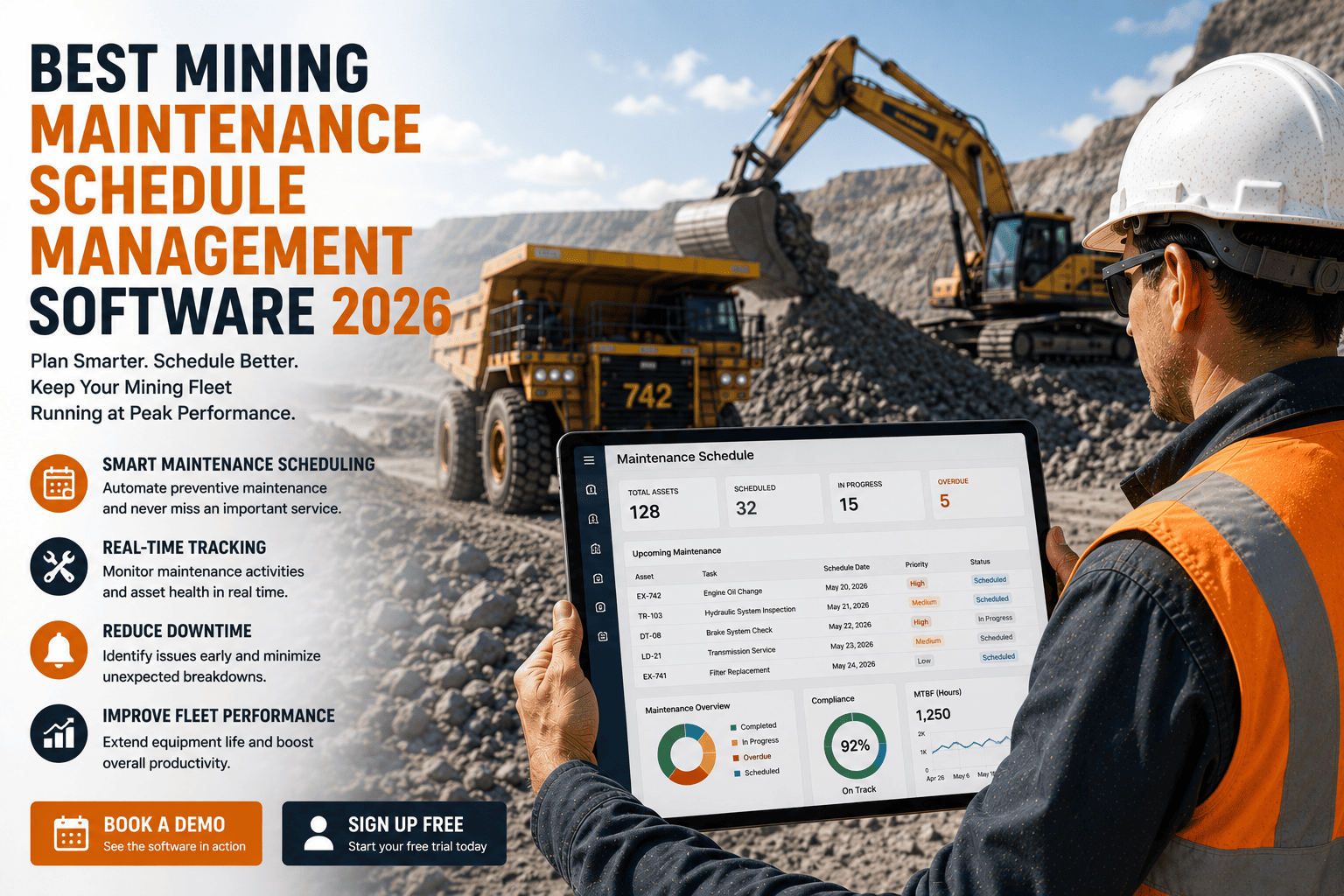
| Live Compliance Dashboard | Supervisors can't see which assets are overdue in real time | One screen shows every overdue and upcoming service |
| Parts and Inventory Sync | Remote mine sites face long lead times for spare parts | Parts are ordered ahead of the scheduled service date |
| Mobile Technician Access | Field crews lose time chasing paper logs and radio updates | Technicians view, complete, and document jobs from any device |
Engine-Hour and Meter-Based Scheduling
The single biggest upgrade a mine site can make is moving off calendar-based PM and onto usage-based scheduling. A haul truck running 600 hours a month wears differently than one running 300 hours, yet a paper calendar treats them identically. Engine-hour based scheduling with automated work order generation pushes PM compliance above 95 percent, turning maintenance from a reactive cost center into a predictable, controllable operating expense.
Automated Work Order Generation
Once a schedule is built around real usage data, the software should generate the work order itself, assign it to the right technician, and flag the parts needed, all without a supervisor manually creating a ticket.
Real-Time Compliance Dashboards
A dashboard that shows every asset's status at a glance turns a fleet manager's morning meeting from a guessing game into a five-minute review. Overdue services stand out immediately instead of hiding in a filing cabinet.
Predictive, Preventive, or Reactive: Choosing the Right Approach
Most mine sites run a blend of all three maintenance strategies, but understanding where each one leaks money helps explain why software-driven scheduling pays for itself so quickly.
| Maintenance Type | Approach | Typical Cost Impact |
|---|---|---|
| Reactive | Run equipment until it fails, repair after breakdown | 4 to 5 times more expensive than planned work |
| Preventive | Service on a fixed calendar or hour interval | Reduces unplanned downtime by 30 to 45 percent |
| Predictive | Condition-based scheduling using real equipment data | Reduces unplanned downtime by 30 to 50 percent, cuts maintenance cost by up to 25 percent |
Predictive and preventive strategies both depend on one thing: a scheduling system that actually knows what state every asset is in. Without software tying usage data to your work order queue, even the best-designed maintenance strategy collapses back into guesswork. If your team is ready to move off spreadsheets, you can book a free demo with FleetRabbit and walk through your current fleet setup live.
FleetRabbit connects engine-hour data, work orders, and parts inventory into one platform built for mining fleets, so your team schedules the next service instead of reacting to the last failure.
Benchmarking Your Fleet Against Industry Standards
Before choosing a platform, it helps to know where your fleet currently stands. Track these three numbers over the next 30 days and compare them against the benchmarks below.
PM Compliance Rate
This measures the percentage of scheduled services completed on time. Manual scheduling typically lands between 60 and 70 percent. Automated, engine-hour based scheduling routinely pushes this above 95 percent.
Mean Time Between Failures
Fleets that shift to condition-based, data-driven scheduling report Mean Time Between Failure improvements of 40 to 60 percent, meaning far fewer surprise breakdowns across the same number of operating hours.
Cost Per Operating Hour
When emergency repairs drop and planned maintenance rises as a share of total work, cost per operating hour falls. Since maintenance can represent up to 45 percent of total operating expenditure at large mining operations, even a modest improvement here compounds into significant annual savings.
Mining maintenance is not becoming easier, but managing it can be. The gap between a 65 percent compliance rate and a 95 percent compliance rate is not a staffing problem, it is a visibility problem, and visibility is exactly what the right software delivers. Whether you run five haul trucks or fifty, the fastest way to know where you stand is to see your own fleet on the dashboard.
FleetRabbit automates PM scheduling, work orders, and compliance tracking for mining fleets of every size. See your entire fleet's maintenance status before your next shift starts, with no credit card required to begin.