Best Mining Operator Shift Handover Software in 2026

best-mining-operator-shift-handover-software-2026

Somewhere around 2 a.m., an outgoing operator mentions to whoever's nearby that a haul truck felt a little rough on the last descent — nothing urgent, just something to keep an eye on. No one writes it down. The next operator climbs in six hours later, has no idea the comment was ever made, and runs the truck exactly as always. That single dropped sentence is how most equipment problems in mining actually escalate — not because nobody noticed something, but because what someone noticed never made it to the person who needed to know.

Quick Answer

Mining operator shift handover software replaces verbal handoffs and paper logbooks with a digital record of equipment condition, open defects, and pending work orders that transfers automatically between crews. Shift transitions account for less than 5 percent of total operating time but are linked to over 40 percent of industrial incidents, because information that isn't logged simply doesn't transfer. Crews also perform 20 to 40 percent worse during the final hour of an outgoing shift and the first hour of an incoming one, making that window the highest-risk part of any mining operation. FleetRabbit turns shift handover into a structured digital record tied directly to each asset's maintenance history.

Why Shift Handover Is the Riskiest Five Percent of a Mine's Day

A mine site doesn't stop between shifts. Trucks keep running, equipment keeps cycling, and the only thing that actually changes is who's watching it. That transition window is small on paper — a few minutes of overlap, maybe a radio call — but it carries an outsized share of risk because it's the one moment where operational knowledge has to move from one person's head into another's without losing anything along the way. Industrial research consistently shows this transition period accounts for a disproportionate share of incidents relative to how little time it actually occupies.

The Sentence That Never Gets Logged

The pattern behind most handover failures is almost always the same. Something gets noticed — a vibration, a warning light, a slower brake response — and it gets mentioned verbally, or scribbled in a margin, or just held in memory until the shift ends and the observer goes home. The incoming operator starts the next shift with none of that context, running equipment exactly as if the previous crew had noticed nothing at all.

Timing Risk
Under 5% of Time, Outsized Risk
Shift handover periods make up a small fraction of total operating hours but are linked to a disproportionate share of equipment and safety incidents across 24/7 industrial operations.
Performance Dip
The Transition Slump
Crew performance typically runs 20 to 40 percent lower during the final hour of an outgoing shift and the first hour of the next, exactly when handover accuracy matters most.
Escalation Cost
Minor Note Becomes Major Failure
An abnormal reading mentioned verbally but never logged is one of the most common paths from a minor developing issue to a costly unplanned equipment failure.

What Digital Shift Handover Software Actually Changes

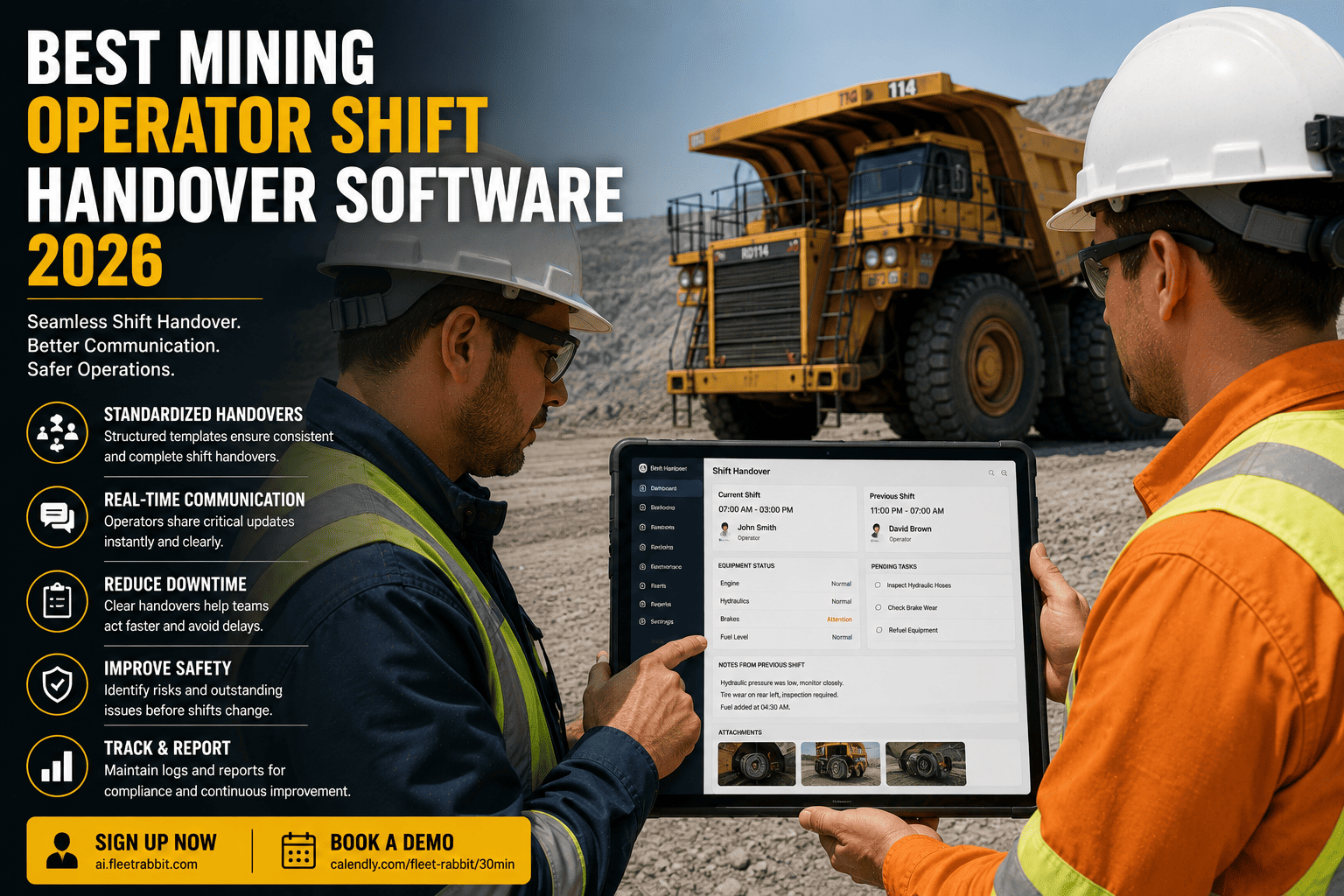
A structured handover platform doesn't just move the same paper logbook onto a screen — it changes when and how information gets captured in the first place, so the record reflects what actually happened during the shift instead of what someone remembers at the very end of it.

Real-Time Logging Instead of End-of-Shift Recall

Instead of reconstructing the shift from memory in the last ten minutes, operators log equipment status changes, defects, and exceptions as they happen. A truck that ran hot on one descent gets recorded the moment it's noticed, not hours later when the detail has faded or been forgotten entirely.

Equipment Status Boards That Carry Forward Automatically

The incoming crew starts their shift looking at a live status board showing every asset's current condition, every open defect, and every pending work order — carried forward automatically from the previous shift instead of depending on someone remembering to mention it at the handoff.

Structured Fields for Safety-Critical Items

Items that genuinely can't be communicated verbally and considered transferred — an active lockout, a grounded machine, a defect awaiting parts — get a structured field requiring a named receiving person and a digital acknowledgment, closing exactly the gap where a verbal mention gets lost in a busy handoff.

Auto-Generated Shift Summaries

Rather than expecting an outgoing operator to remember and prioritize everything from a twelve-hour shift, software can surface the handful of items that actually matter most — abnormal readings, unresolved defects, recurring patterns — so the incoming crew sees the priorities first instead of scrolling through a full shift log.

Nothing Falls Through the Cracks at Shift Change
Digital Handover Built for Mining Fleets

FleetRabbit captures equipment condition and open defects in real time and carries them forward automatically to the next crew. Start your free trial and see how much clearer shift change becomes.

40%+
Of Incidents Tied to Shift Handover
20-40%
Performance Dip During Transition

Verbal Handoff vs. Paper Logbook vs. Digital Handover Software

Most mines evolve through the same three stages of handover practice, and each stage closes a real gap while leaving another one open.

Method How Information Transfers Main Risk Auditability
Verbal or Radio Handoff Spoken during a brief overlap or radio call Details forgotten, misheard, or never mentioned at all None — no record exists after the conversation ends
Paper Logbook Written notes left for the next crew to read Illegible entries, incomplete notes, easy to skim past Low — scattered across physical books, hard to search
Digital Handover Software Logged in real time, carried forward automatically to the next crew Requires consistent operator adoption to be fully effective High — searchable, timestamped, tied to each asset's record

Building a Handover Process That Actually Holds Up

The mines that get shift handover right treat it as a continuous process built throughout the shift, not a rushed summary assembled in the final few minutes before the next crew arrives. That distinction matters because performance and attention are already dipping at exactly the moment a rushed handover would need them most.

Capturing Events From the Channels Teams Already Use

Operators communicate through radio, text, and phone calls whether or not a formal system exists to capture it. The strongest handover platforms pull from those existing channels rather than forcing an entirely new communication habit, so the informal comment that used to get lost becomes part of the permanent record instead.

Connecting Handover Data to Maintenance History

A handover note about unusual equipment behavior is far more useful when it's tied directly to that asset's maintenance record. A platform like FleetRabbit links every logged observation to the specific truck or loader it concerns, so a pattern across multiple shifts — the same vibration mentioned three times in a week — becomes visible as a trend instead of three separate, forgotten comments.

What to Look for in a Shift Handover Platform

Not every digital logbook is built for the pace and structure of a working mine. A platform worth adopting should support real-time logging rather than end-of-shift entry, a live equipment status board visible to incoming crews immediately, structured acknowledgment fields for safety-critical items, and direct integration with maintenance work orders so a logged defect doesn't just sit in a report nobody acts on.

Why Automatic Carry-Forward Matters Most

The single biggest failure point in most handover systems, digital or paper, is an open issue that quietly disappears between shifts because nobody manually re-entered it. Software that carries open defects and pending items forward automatically until they're formally closed removes the one step most likely to be skipped during a rushed transition.

QWhat is mining operator shift handover software?
It's a digital platform that captures equipment condition, defects, and pending work orders in real time throughout a shift, then automatically presents that information to the incoming crew instead of relying on verbal handoffs or paper notes.
QWhy is shift handover such a high-risk period in mining?
Shift transitions account for less than 5 percent of total operating time but are linked to over 40 percent of industrial incidents, largely because information that isn't formally logged doesn't reliably transfer between crews.
QHow does poor handover actually lead to equipment failures?
An abnormal reading or minor issue noticed by one crew but never logged means the next crew operates the equipment without that context, allowing a developing problem to continue unaddressed until it becomes a larger failure.
QDoes shift handover software replace radio communication?
No, it works alongside it. The strongest platforms capture events from the channels operators already use, including radio and text, and turn those into a permanent, searchable record rather than replacing how crews communicate.
QHow quickly can a mine roll out digital shift handover software?
Most sites can begin logging shift handovers digitally within days, since operators use the same phone or tablet already in place for other inspections. Book a demo to see a rollout plan for your fleet.
QCan handover data connect to equipment maintenance records?
Yes, connected platforms tie every logged observation to the specific asset it concerns, making it easy to spot a pattern across multiple shifts instead of treating each note as an isolated comment.

The Bottom Line on Shift Handover Software

Most mining equipment problems don't start as mysteries. They start as something one operator noticed and mentioned, that somehow never reached the person who needed to hear it. Shift handover software doesn't add new information to a mine's operation — it just makes sure the information that already exists actually survives the transition between crews, at the exact moment attention and performance are naturally at their lowest.

If your site's handover process still depends on a radio call and whatever the outgoing operator remembers to mention, that gap is where the next avoidable equipment issue is most likely hiding. You can start a free trial to see how a structured handover record changes what your incoming crews actually know.

Stop Losing Critical Information at Shift Change

A comment that never gets logged is a problem that never gets fixed until it becomes a breakdown. FleetRabbit captures equipment condition and defects in real time and carries them forward automatically, so every crew starts their shift fully informed. Start your free trial or book a 30-minute demo to see it on your fleet.

Digital Shift Handover Operator Accountability Equipment Status Tracking Mining Workforce Software

July 19, 2026 By John
All Posts

Best Mining Operator Shift Handover Software in 2026

best-mining-operator-shift-handover-software-2026

Somewhere around 2 a.m., an outgoing operator mentions to whoever's nearby that a haul truck felt a little rough on the last descent — nothing urgent, just something to keep an eye on. No one writes it down. The next operator climbs in six hours later, has no idea the comment was ever made, and runs the truck exactly as always. That single dropped sentence is how most equipment problems in mining actually escalate — not because nobody noticed something, but because what someone noticed never made it to the person who needed to know.

Quick Answer

Mining operator shift handover software replaces verbal handoffs and paper logbooks with a digital record of equipment condition, open defects, and pending work orders that transfers automatically between crews. Shift transitions account for less than 5 percent of total operating time but are linked to over 40 percent of industrial incidents, because information that isn't logged simply doesn't transfer. Crews also perform 20 to 40 percent worse during the final hour of an outgoing shift and the first hour of an incoming one, making that window the highest-risk part of any mining operation. FleetRabbit turns shift handover into a structured digital record tied directly to each asset's maintenance history.

Why Shift Handover Is the Riskiest Five Percent of a Mine's Day

A mine site doesn't stop between shifts. Trucks keep running, equipment keeps cycling, and the only thing that actually changes is who's watching it. That transition window is small on paper — a few minutes of overlap, maybe a radio call — but it carries an outsized share of risk because it's the one moment where operational knowledge has to move from one person's head into another's without losing anything along the way. Industrial research consistently shows this transition period accounts for a disproportionate share of incidents relative to how little time it actually occupies.

The Sentence That Never Gets Logged

The pattern behind most handover failures is almost always the same. Something gets noticed — a vibration, a warning light, a slower brake response — and it gets mentioned verbally, or scribbled in a margin, or just held in memory until the shift ends and the observer goes home. The incoming operator starts the next shift with none of that context, running equipment exactly as if the previous crew had noticed nothing at all.

Timing Risk
Under 5% of Time, Outsized Risk
Shift handover periods make up a small fraction of total operating hours but are linked to a disproportionate share of equipment and safety incidents across 24/7 industrial operations.
Performance Dip
The Transition Slump
Crew performance typically runs 20 to 40 percent lower during the final hour of an outgoing shift and the first hour of the next, exactly when handover accuracy matters most.
Escalation Cost
Minor Note Becomes Major Failure
An abnormal reading mentioned verbally but never logged is one of the most common paths from a minor developing issue to a costly unplanned equipment failure.

What Digital Shift Handover Software Actually Changes

A structured handover platform doesn't just move the same paper logbook onto a screen — it changes when and how information gets captured in the first place, so the record reflects what actually happened during the shift instead of what someone remembers at the very end of it.

Real-Time Logging Instead of End-of-Shift Recall

Instead of reconstructing the shift from memory in the last ten minutes, operators log equipment status changes, defects, and exceptions as they happen. A truck that ran hot on one descent gets recorded the moment it's noticed, not hours later when the detail has faded or been forgotten entirely.

Equipment Status Boards That Carry Forward Automatically

The incoming crew starts their shift looking at a live status board showing every asset's current condition, every open defect, and every pending work order — carried forward automatically from the previous shift instead of depending on someone remembering to mention it at the handoff.

Structured Fields for Safety-Critical Items

Items that genuinely can't be communicated verbally and considered transferred — an active lockout, a grounded machine, a defect awaiting parts — get a structured field requiring a named receiving person and a digital acknowledgment, closing exactly the gap where a verbal mention gets lost in a busy handoff.

Auto-Generated Shift Summaries

Rather than expecting an outgoing operator to remember and prioritize everything from a twelve-hour shift, software can surface the handful of items that actually matter most — abnormal readings, unresolved defects, recurring patterns — so the incoming crew sees the priorities first instead of scrolling through a full shift log.

Nothing Falls Through the Cracks at Shift Change
Digital Handover Built for Mining Fleets

FleetRabbit captures equipment condition and open defects in real time and carries them forward automatically to the next crew. Start your free trial and see how much clearer shift change becomes.

40%+
Of Incidents Tied to Shift Handover
20-40%
Performance Dip During Transition

Verbal Handoff vs. Paper Logbook vs. Digital Handover Software

Most mines evolve through the same three stages of handover practice, and each stage closes a real gap while leaving another one open.

Method How Information Transfers Main Risk Auditability
Verbal or Radio Handoff Spoken during a brief overlap or radio call Details forgotten, misheard, or never mentioned at all None — no record exists after the conversation ends
Paper Logbook Written notes left for the next crew to read Illegible entries, incomplete notes, easy to skim past Low — scattered across physical books, hard to search
Digital Handover Software Logged in real time, carried forward automatically to the next crew Requires consistent operator adoption to be fully effective High — searchable, timestamped, tied to each asset's record

Building a Handover Process That Actually Holds Up

The mines that get shift handover right treat it as a continuous process built throughout the shift, not a rushed summary assembled in the final few minutes before the next crew arrives. That distinction matters because performance and attention are already dipping at exactly the moment a rushed handover would need them most.

Capturing Events From the Channels Teams Already Use

Operators communicate through radio, text, and phone calls whether or not a formal system exists to capture it. The strongest handover platforms pull from those existing channels rather than forcing an entirely new communication habit, so the informal comment that used to get lost becomes part of the permanent record instead.

Connecting Handover Data to Maintenance History

A handover note about unusual equipment behavior is far more useful when it's tied directly to that asset's maintenance record. A platform like FleetRabbit links every logged observation to the specific truck or loader it concerns, so a pattern across multiple shifts — the same vibration mentioned three times in a week — becomes visible as a trend instead of three separate, forgotten comments.

What to Look for in a Shift Handover Platform

Not every digital logbook is built for the pace and structure of a working mine. A platform worth adopting should support real-time logging rather than end-of-shift entry, a live equipment status board visible to incoming crews immediately, structured acknowledgment fields for safety-critical items, and direct integration with maintenance work orders so a logged defect doesn't just sit in a report nobody acts on.

Why Automatic Carry-Forward Matters Most

The single biggest failure point in most handover systems, digital or paper, is an open issue that quietly disappears between shifts because nobody manually re-entered it. Software that carries open defects and pending items forward automatically until they're formally closed removes the one step most likely to be skipped during a rushed transition.

QWhat is mining operator shift handover software?
It's a digital platform that captures equipment condition, defects, and pending work orders in real time throughout a shift, then automatically presents that information to the incoming crew instead of relying on verbal handoffs or paper notes.
QWhy is shift handover such a high-risk period in mining?
Shift transitions account for less than 5 percent of total operating time but are linked to over 40 percent of industrial incidents, largely because information that isn't formally logged doesn't reliably transfer between crews.
QHow does poor handover actually lead to equipment failures?
An abnormal reading or minor issue noticed by one crew but never logged means the next crew operates the equipment without that context, allowing a developing problem to continue unaddressed until it becomes a larger failure.
QDoes shift handover software replace radio communication?
No, it works alongside it. The strongest platforms capture events from the channels operators already use, including radio and text, and turn those into a permanent, searchable record rather than replacing how crews communicate.
QHow quickly can a mine roll out digital shift handover software?
Most sites can begin logging shift handovers digitally within days, since operators use the same phone or tablet already in place for other inspections. Book a demo to see a rollout plan for your fleet.
QCan handover data connect to equipment maintenance records?
Yes, connected platforms tie every logged observation to the specific asset it concerns, making it easy to spot a pattern across multiple shifts instead of treating each note as an isolated comment.

The Bottom Line on Shift Handover Software

Most mining equipment problems don't start as mysteries. They start as something one operator noticed and mentioned, that somehow never reached the person who needed to hear it. Shift handover software doesn't add new information to a mine's operation — it just makes sure the information that already exists actually survives the transition between crews, at the exact moment attention and performance are naturally at their lowest.

If your site's handover process still depends on a radio call and whatever the outgoing operator remembers to mention, that gap is where the next avoidable equipment issue is most likely hiding. You can start a free trial to see how a structured handover record changes what your incoming crews actually know.

Stop Losing Critical Information at Shift Change

A comment that never gets logged is a problem that never gets fixed until it becomes a breakdown. FleetRabbit captures equipment condition and defects in real time and carries them forward automatically, so every crew starts their shift fully informed. Start your free trial or book a 30-minute demo to see it on your fleet.
Digital Shift Handover Operator Accountability Equipment Status Tracking Mining Workforce Software

July 19, 2026 By John
All Posts

Share This Story, Choose Your Platform!

Latest Posts

Scroll