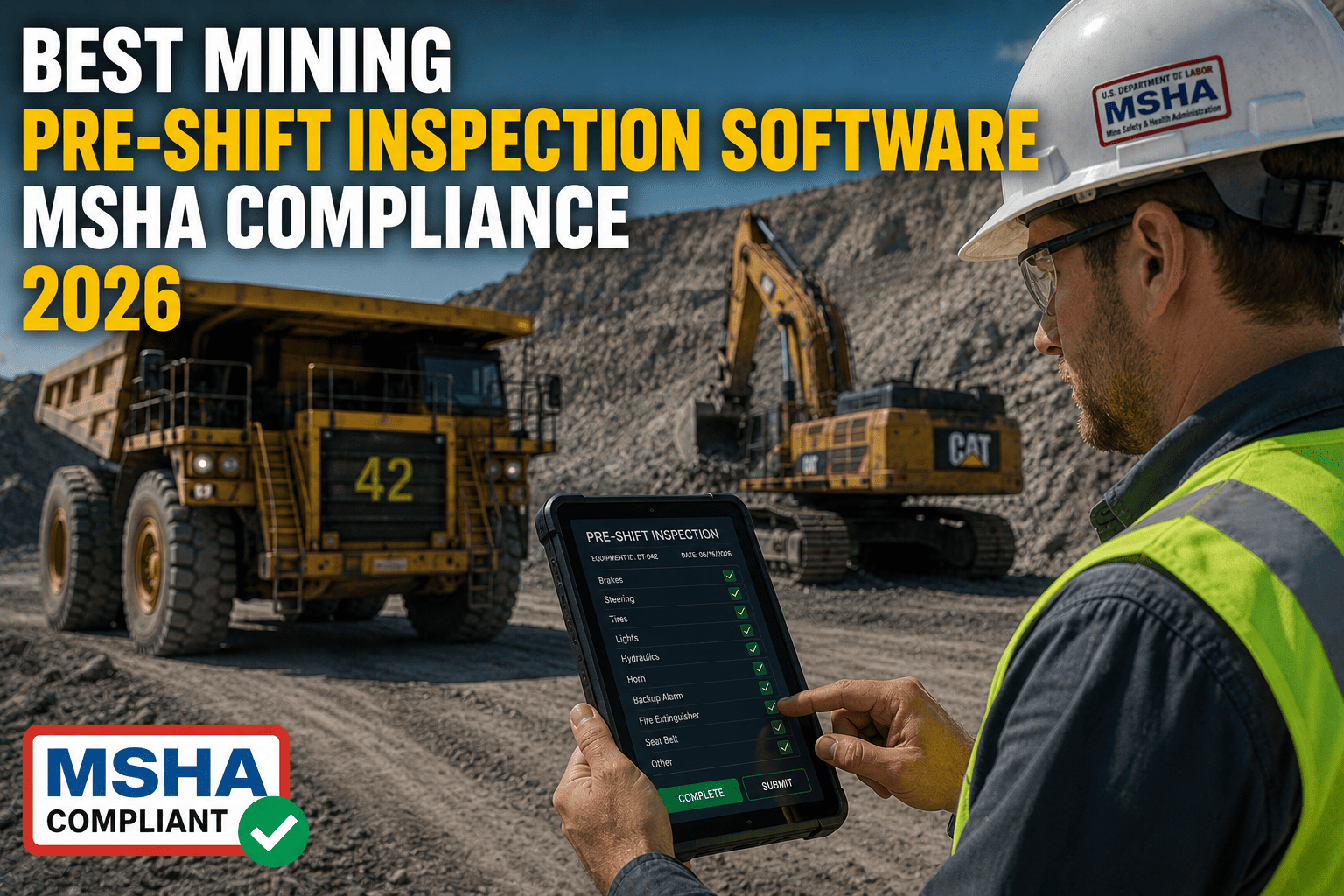
Every shift at a mine site begins with the same legal obligation: inspect the equipment before it moves. Under Title 30 CFR, MSHA mandates that every piece of self-propelled mobile equipment must be examined by its operator before each shift — no exceptions, no shortcuts. Yet for thousands of mining operations across the United States, this critical requirement is still being fulfilled with paper checklists, shared clipboards, and filing cabinets full of forms nobody can search in a hurry.
When an MSHA inspector arrives and requests 90 days of haul truck pre-shift records, you have minutes — not hours — to produce them. When a mechanic on the day shift needs to know what defects the night operator flagged, a paper form sitting in a cab helps nobody. And when a citation is issued for a missed inspection, the fine range runs from $7,000 to $70,000 per violation. The gap between paper and digital pre-shift inspection is not a preference gap. It is a compliance gap with real financial and legal consequences. To see how digital inspections work in practice, start a free trial or book a demo with FleetRabbit today.
MSHA requires pre-shift inspections under 30 CFR §56.14100 for surface mines and §57.14100 for underground — every shift, by the equipment operator, with documented results. Citations for non-compliance range from $7,000 to $70,000 per violation. Digital inspection platforms reduce inspection completion time by 40 to 60%, cut safety incidents by 40%, and produce audit-ready records in one click.
What MSHA Actually Requires — And Where Operations Fall Short
The MSHA pre-shift inspection framework is more specific than most mine managers realise. It is not enough to "do a walk-around." The regulation requires the operator — not a mechanic, not a supervisor — to conduct the inspection. Any safety or health defects must be reported immediately, and equipment with safety-critical defects must be tagged out of service until repaired. All findings must be documented and retained. Incomplete or missing documentation is treated as non-compliance during an MSHA audit, regardless of whether the inspection actually happened.
Surface Mining
All self-propelled mobile equipment must be inspected by the operator before being placed in operation each shift. Defects affecting safety must be reported and equipment tagged until repaired.
Underground Mining
Identical requirement applies underground. MSHA inspects underground mines four times annually versus twice for surface — meaning documentation quality is scrutinised even more frequently.
Coal Operations
Coal mine inspection requirements under Parts 75 and 77 carry additional specificity around methane monitoring, self-rescuers, and belt conveyors — requiring purpose-built checklists, not generic forms.
Where Paper Inspections Fail Operators
Paper-based inspection programmes fail in predictable ways. Forms get lost in dusty cabs. Defects are written down but never reach the maintenance team. Illegible handwriting means records that cannot be interpreted during an audit. There is no way to verify that an inspection was completed on time or that every checklist item was actually checked. And when MSHA asks for a date-range export of all pre-shift records across 30 assets, a paper system has no answer. Digital inspection software eliminates every one of these failure modes.
The Real Cost of Non-Compliance and Missed Defects
The financial case for switching to digital pre-shift inspection software is not subtle. MSHA citations for failing to conduct or document pre-shift inspections rank among the most frequently issued violations in US mining. Repeat Significant and Substantial findings within a 24-month window can trigger Pattern of Violations status — which brings expanded inspections, increased penalty multipliers, and potential withdrawal orders that shut production areas entirely.
Beyond fines, the hidden cost of missed pre-shift defects is equipment downtime. A brake system defect that an operator notices during a two-minute pre-shift check costs a few hundred dollars to repair during a planned maintenance window. The same defect discovered mid-shift after a brake failure can cost $20,000 to $60,000 in emergency repairs, production loss, investigation time, and potential injury costs. Digital inspection software that routes defects directly to the maintenance team the moment they are logged turns pre-shift inspection from a compliance exercise into a genuine preventive maintenance tool.
Core Features Every Mining Inspection Platform Must Have
The market offers dozens of inspection software tools in 2026, but not all of them are built for the specific demands of a working mine site. A generic safety checklist app designed for construction or logistics will miss the mining-specific items MSHA inspectors look for first — ROPS and FOPS structural integrity, fire suppression system status, backup alarm decibel compliance, and mining-specific strobe and lighting requirements. Here is what a purpose-built mining inspection platform must deliver.
Mobile Offline-First Checklists
Inspections must work fully offline — underground, in remote open pits, and on benches with no signal. Checklists load from the app, all responses are stored locally, and data syncs automatically when connectivity returns. Any platform that requires internet to complete an inspection will fail at the mine site.
Mandatory Photo Capture on Critical Items
For tyres, brakes, ROPS structures, fire suppression units, and hydraulic systems, a tap of a checkbox is not sufficient evidence of compliance. The best platforms enforce photo capture on designated items — so the record proves the inspection happened, not just that someone submitted a form.
Automatic Defect Routing to Maintenance
A defect logged on a pre-shift inspection should trigger a work order automatically — no phone calls, no relay through supervisors, no sticky notes on dashboards. Instant defect routing ensures the maintenance team sees every issue the moment it is identified, not at the end of the shift.
Equipment Tag-Out Integration
When a defect is safety-critical, the software must block the equipment from being dispatched until the defect is resolved. Digital tag-out replaces physical lock-out tags with an electronic dispatch block — ensuring no unsafe machine is permitted to operate, and the decision is recorded with timestamps.
Audit-Ready Record Export
When an MSHA inspector requests 90 days of pre-shift inspection records for 30 assets, the answer must be a few clicks — not a filing cabinet search. Records must be exportable by date range, asset, operator, or defect type, with operator signatures, timestamps, and photo attachments intact.
Mining-Specific Checklist Templates
Pre-built templates for haul trucks, loaders, drills, dozers, service vehicles, and conveyors — each aligned to MSHA Part 56/57 requirements. A generic vehicle checklist misses the mining-specific items that MSHA inspectors check first. Templates must be customisable to match your existing SOPs.
FleetRabbit delivers mobile pre-shift inspection checklists built for MSHA compliance — offline-capable, photo-verified, with instant defect routing and one-click audit export. Set up before your next shift. No IT team needed.
Paper vs Digital: The Head-to-Head Reality
Mine managers who have used paper-based pre-shift inspections for years often underestimate how much invisible cost and risk the system carries. The comparison below is not theoretical — these are operational differences that play out on every shift at every site still running paper processes.
Forms lost in dust, rain, or cab clutter
Defects never reach the maintenance team in time
No proof a checklist item was actually checked
Hours spent locating records during MSHA audits
No visibility on inspection completion rates by shift
Unsafe equipment may still be dispatched without awareness
Every inspection stored securely in the cloud instantly
Defects auto-route to work orders the moment they are logged
Mandatory photo capture proves inspection quality
90-day audit export produced in minutes, not hours
Live dashboard shows completion status across every asset
Digital tag-out blocks unsafe equipment from dispatch automatically
What a Complete MSHA Pre-Shift Checklist Covers
One of the most common compliance errors in mining is using a generic vehicle inspection form for heavy mining equipment. MSHA inspectors are trained to check specifically for mining-critical systems that a standard truck form will never include. Every digital inspection template deployed on a mine site must cover all of the following categories, with mining-specific sub-items under each.
Brakes and Steering
Service brakes, parking brake holding on maximum grade, hydraulic brake fluid levels, steering play, power steering fluid, and visible leaks at lines or cylinders.
ROPS and FOPS
Rollover and falling-object protective structures intact, mounting bolts tight, certification tags legible, and no cracks, deformation, or weld repairs that compromise structural rating.
Tyres and Tracks
Tyre pressure, visible cuts, bulges, tread separation, sidewall damage, and lug nut torque. Track tension, link wear, and sprocket condition for tracked equipment.
Fire Suppression
Fire extinguisher pressure gauge in green, inspection tag current, cylinder condition, mounting secure, and — where fitted — automatic suppression system arm indicator functional.
Fluids and Engine
Engine oil, coolant, hydraulic fluid, fuel level, brake fluid, and transmission fluid — levels checked and no visible leaks at connections, hoses, or gaskets.
Backup Alarm and Lights
Audible reverse alarm activates with reverse gear and meets MSHA distance standards. All work lights, travel lights, strobe, and hazard indicators functional before departure.
Cab and Controls
Seat belt condition and function, cab structure integrity, all gauges and warning indicators operational, horn functional, mirrors positioned, and first aid kit present and stocked.
Communications
Radio functional on required mine channels, battery charge adequate, mine-specific programming verified, and emergency contact information visible in cab.
How FleetRabbit Delivers MSHA-Ready Pre-Shift Inspections
FleetRabbit is a fleet safety and compliance platform built specifically for the demands of mining operations. The pre-shift inspection module is not adapted from a logistics tool — it is purpose-designed for the regulatory requirements, equipment types, and operational conditions of surface and underground mining. Sign up today to access pre-built MSHA inspection templates from your first shift, or book a demo to see how the platform handles your specific equipment fleet.
Offline-First Mobile App
The FleetRabbit mobile app is built for offline operation. Operators complete inspections underground, in remote pits, or in dead zones without any internet connectivity. All responses, photos, and signatures are stored locally and sync the moment the device regains signal. No missed inspections due to connectivity.
Mandatory Photo Verification
Configure any checklist item to require a photo before the operator can proceed. Tyres, brakes, ROPS, and fire suppression items can all be set as photo-mandatory — creating a visual record that proves the inspection was performed, not just submitted.
Instant Defect-to-Work-Order Routing
When an operator logs a defect, FleetRabbit automatically creates a maintenance work order, assigns it to the relevant technician queue, and notifies the maintenance supervisor. The defect does not sit on a clipboard — it appears in the maintenance dashboard within seconds.
One-Click MSHA Audit Export
Pull any date range of pre-shift inspection records across any selection of assets in a single export. Records include operator identity, timestamp, all checklist responses, defects flagged, photos attached, and digital signature. Produced in minutes, not hours, in MSHA-accepted formats.
Real-Time Compliance Dashboard
See inspection completion status across every asset in your fleet — by shift, by site, by equipment type. A live dashboard shows which machines have been inspected, which have open defects, and which are tagged out. No phone calls to check if pre-shifts are done.
Implementation: From Paper to Digital Before Your Next Shift
The most common concern mining operations raise about switching to digital inspection software is implementation complexity. The assumption is that a new technology deployment requires weeks of IT involvement, hardware procurement delays, and extensive staff training before anything works. With FleetRabbit, that assumption does not apply.
Step 1 — Asset and Operator Setup
Enter your equipment fleet with asset IDs and current engine hours. Add operators with their role and certification details. For a 20-truck operation, this takes under 25 minutes and can be done via CSV import from your existing equipment register.
Step 2 — Select and Customise Inspection Templates
Choose from pre-built MSHA-aligned templates for haul trucks, loaders, drills, dozers, and service vehicles. Customise to match your existing SOPs or use the templates as-is from day one. Photo-mandatory items are pre-configured based on MSHA priority inspection points.
Step 3 — Configure Defect Routing and Alerts
Set up which defect categories trigger automatic work orders and which supervisors or technicians receive notifications for each equipment type. Configure which defect severity levels activate dispatch blocks — so safety-critical issues prevent machine release automatically.
Step 4 — Go Live
Operators download the FleetRabbit mobile app, log in, and begin completing digital pre-shift inspections from their first shift. Most operations see 100% digital inspection adoption within 2 to 5 shifts as operators adapt to the faster, simpler workflow compared to paper forms.
Frequently Asked Questions
The Bottom Line for Mining Safety and Compliance Teams
Pre-shift inspections are not going away. MSHA is not reducing its inspection frequency or its documentation requirements. What is changing is the technology available to meet those requirements — and the gap between operations using digital inspection platforms and those still running paper is widening every year in terms of compliance outcomes, incident rates, and maintenance efficiency.
The best mining pre-shift inspection software in 2026 is the platform that works offline in your most remote pit, routes defects to your maintenance team the moment they are found, blocks unsafe equipment from dispatch automatically, and produces audit-ready records in minutes when MSHA arrives. FleetRabbit is built to do exactly that — for operations of any size, surface or underground, across the full range of heavy mining equipment.
Every shift you spend on paper is a shift with compliance exposure you cannot afford. FleetRabbit replaces paper pre-shift checklists with a digital system that works offline, catches defects before they become failures, and makes audit preparation a five-minute task instead of a five-hour one. Start your free trial with no credit card required.