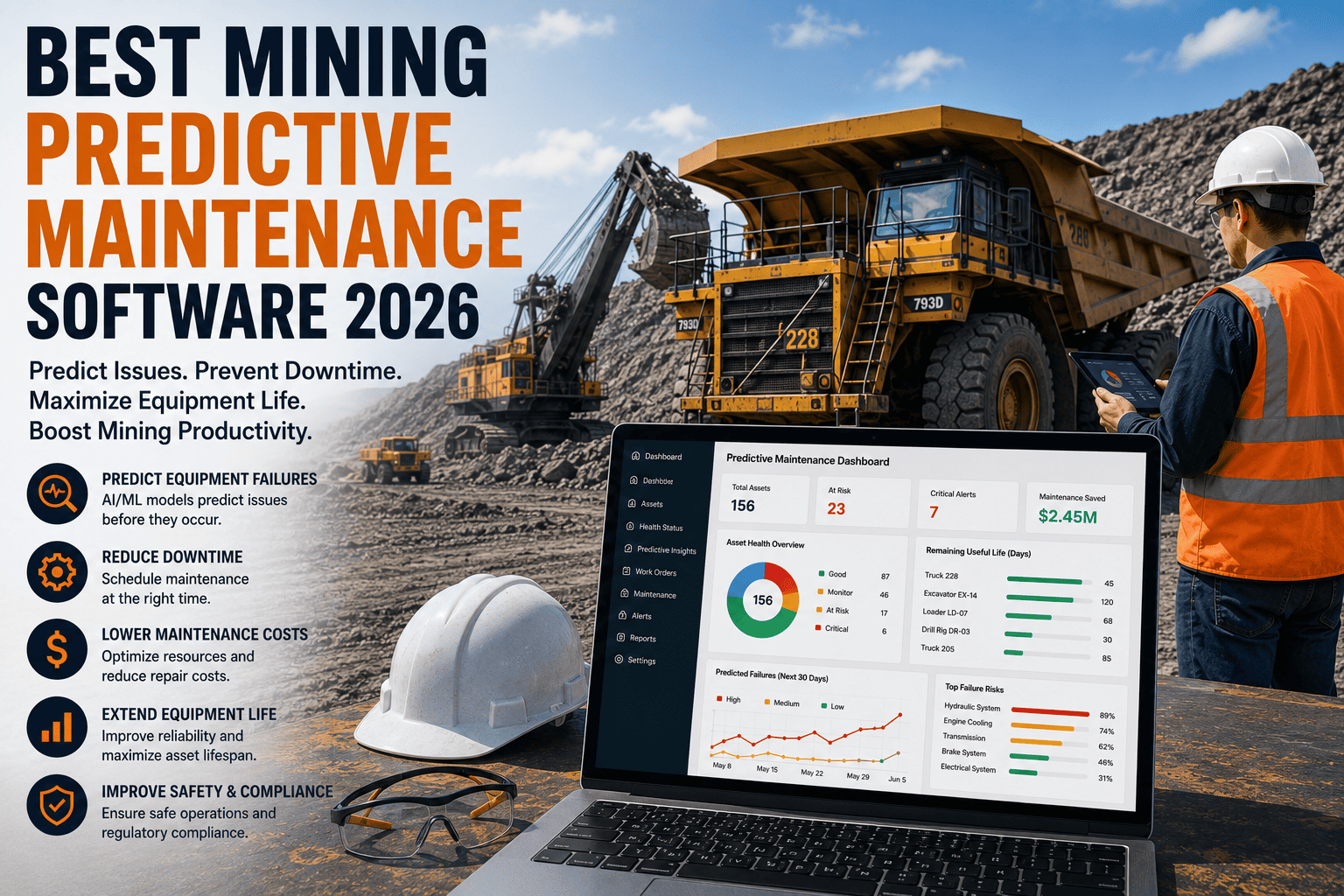
Most mining fleets already have alarms going off constantly. The problem isn't a lack of data, it's that static threshold alerts fire so often that maintenance teams learn to tune them out, and the one alert that actually matters gets buried with a hundred that don't. Mining predictive maintenance software solves that by replacing blanket alarms with intelligent, condition-based alerts that rank severity, learn from every repair outcome, and flag developing faults weeks before they become a haul-road breakdown.
Mining predictive maintenance software uses vibration, oil, thermal, and telemetry data to detect developing equipment faults early, then ranks and routes alerts by severity so maintenance teams act on real risk instead of noise. The best platforms improve detection accuracy over time through a feedback loop and cut unplanned downtime significantly within the first year. Sign up free or book a demo to see it configured against your own fleet data.
Why Most Maintenance Alerts Get Ignored
Before predictive maintenance can help, it has to solve a trust problem. Static threshold alarms treat every reading outside a fixed range the same way, whether it's a minor fluctuation or the start of a bearing failure. Over time, that flattens urgency until every alert looks the same, and the ones that matter get lost.
FleetRabbit ranks every alert by severity and routes it straight to a work order, so your team acts on real risk instead of scrolling through noise. Sign up free to connect your fleet data today, or book a demo to see intelligent alerting in action on your equipment type.
Static Alarms Versus Intelligent Predictive Alerts
The gap between a threshold-based alarm system and a true predictive maintenance platform shows up clearly once you compare how each one handles the same developing fault.
| Behavior | Static Threshold Alarms | Intelligent Predictive Alerts |
|---|---|---|
| Trigger condition | Fires whenever a fixed value is crossed, regardless of context | Learns normal operating ranges per machine and flags real deviation patterns |
| Severity ranking | Every alert looks identical in the notification list | Alerts are ranked by likely fault severity and urgency |
| Root cause detail | Tells you a value is out of range, nothing more | Identifies probable fault type, such as bearing wear or misalignment |
| Learning over time | Static rules never adjust to your equipment or environment | A closed feedback loop refines accuracy using every repair outcome |
| Path to action | Requires a person to notice, interpret, and manually raise a work order | Automatically escalates to a planner and generates a scheduled work order |
How the Detection-to-Repair Workflow Should Work
Detecting a fault early only creates value if it moves quickly and clearly into a scheduled repair. The workflow design matters as much as the underlying sensor data.
Fault Detected and Ranked by Severity
Vibration, oil analysis, thermal readings, and OEM telemetry combine into a single health score, and any deviation gets ranked against how urgent it actually is.
Confidence Scoring
Each alert carries a confidence level based on how closely the pattern matches a known failure signature, helping planners judge urgency at a glance.
Assigned to a Maintenance Planner
High-confidence, high-severity alerts route directly to the person responsible for scheduling, instead of sitting in a shared inbox waiting to be noticed.
Work Order Generation
The system creates the work order automatically, attaching the relevant sensor history so the technician arrives already knowing what to check first.
Scheduled Into the Next Planned Window
Rather than triggering an emergency stop, the repair gets slotted into the next planned maintenance window, keeping the fix off the critical path of production.
Outcome Logged and Fed Back
What the technician found, what was repaired, and whether the fault actually resolved all get logged back into the same system, sharpening future predictions on that exact machine.
FleetRabbit connects fault detection directly to work order creation and captures repair outcomes automatically, so every fix makes the next prediction sharper. Book a demo to see the full detection-to-repair workflow, or sign up now and get your first predictive insight within hours.
Frequently Asked Questions
FleetRabbit turns raw sensor data into ranked, actionable alerts that route straight to a work order, so your maintenance team spends time on real risk instead of noise. Start free today or book a short demo to see it running against your fleet.