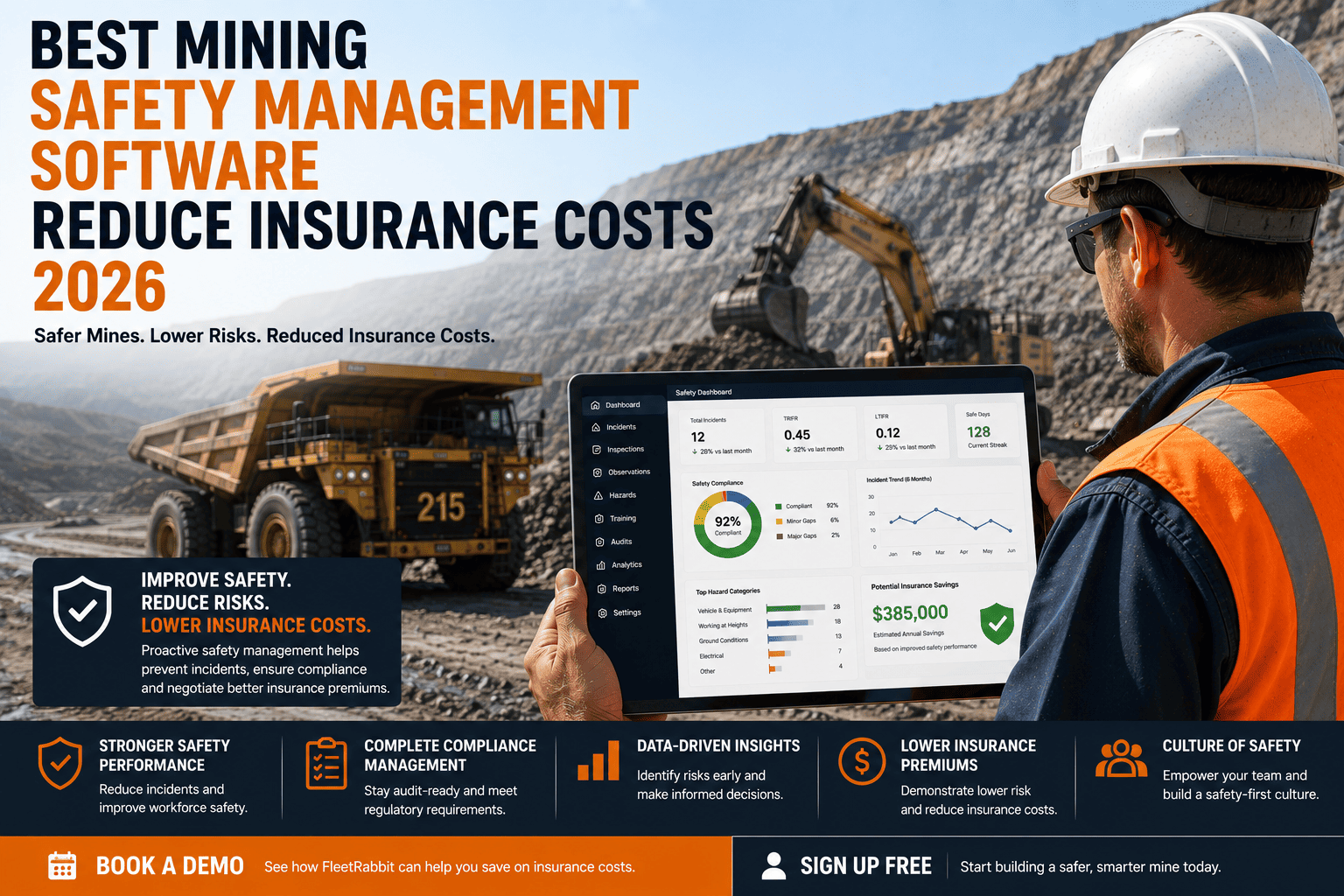
Insurers don't set mining premiums by guesswork anymore. They're pulling incident histories, inspection records, and training documentation straight from your systems, and the mines that can produce clean, complete safety data are the ones walking away with better terms. If your inspections still live on paper and your incident reports arrive weeks after the fact, you're not just carrying more operational risk, you're paying for it every time your policy renews.
The best mining safety management software centralizes pre-shift inspections, incident and near-miss reporting, training records, and compliance documentation into one searchable system that insurers and auditors can trust. Mines using this kind of digital safety program typically see 20 to 40 percent lower incident rates within the first year and unlock better insurance terms because underwriters can verify risk instead of estimating it. Sign up for FleetRabbit to start building that documentation trail today.
Why Your Safety Data Is Now an Insurance Asset
Mining insurance used to be priced almost entirely on historical claims and industry averages. That's shifting. Underwriters are building risk models around continuous data: how often inspections happen, how quickly incidents get logged and closed, whether training records are current, and whether the same hazard keeps showing up on the same equipment without ever being fixed. A mine that can hand an underwriter a clean, timestamped record of all four is negotiating from a completely different position than one that's reconstructing last quarter's incidents from memory and paper forms.
What Underwriters Actually Look For
Risk engineers reviewing a mining policy want to see documented risk management practices, not just a claims-free year. A single quiet year with no digital trail behind it tells an underwriter far less than a documented program showing consistent inspections, resolved near-misses, and current operator certifications across every shift.
Investor and Lender Confidence Follows the Same Data
It's not only insurers watching. Mines with strong digital safety platforms tend to command better project valuations and lower operational risk premiums with lenders and investors too, since the same documentation that satisfies an underwriter also satisfies due diligence.
FleetRabbit centralizes inspections, incident reports, training status, and compliance documentation into one auditable system, giving you the exact evidence underwriters and risk engineers ask for at renewal time. Start your free trial and see your safety data in one place.
The Four Records That Make Up a Mining Safety Program
A mining safety management platform earns its keep by connecting four record types that most operations still manage separately, often across paper, spreadsheets, and disconnected systems that never talk to each other.
| Record Type | What It Captures | Insurance Relevance | Common Gap |
|---|---|---|---|
| Pre-Shift Inspections | Equipment condition checks completed before every shift starts | Shows proactive hazard identification before an incident occurs | Paper checklists that get filed but never reviewed for patterns |
| Incident and Near-Miss Reports | Every event, however minor, logged with time, location, and cause | Demonstrates a culture that surfaces problems instead of hiding them | Near-misses go unreported because there's no easy way to log them |
| Training and Certification Records | Operator competency status, retraining needs, certification expiry | Verifies that only qualified operators are running equipment | Expired certifications discovered only during an audit or claim |
| Compliance Documentation | SOPs, regulatory requirements, and audit trails accessible anytime | Speeds up audits and reduces disputes during claims review | Documentation scattered across departments with no single source |
Turning Safety Data Into Lower Premiums
Collecting data is only half the equation. The mines that actually see their premiums move are the ones that turn that data into visible, repeatable improvement, and can prove it at renewal time.
Close the Loop on Every Hazard
A logged near-miss that never gets resolved is worse for your risk profile than one that never gets reported, because now there's a documented, ignored hazard on record. Safety software that tracks a hazard from report through resolution shows underwriters that identified risks actually get fixed.
Consolidate Multi-Site Data Into One View
Operations running more than one site need a single dashboard covering every asset and every shift, not separate spreadsheets from each location. A consolidated view is what lets you present one coherent risk picture to an insurer instead of several inconsistent ones.
Bring Risk Engineering Audits Into the Same System
Premiums respond well to documented risk engineering audits paired with proactive safety programs. Storing those audit results alongside your day-to-day inspection and incident data means you walk into renewal negotiations with the full picture already assembled.
FleetRabbit gives multi-site mining operations a single, live view of inspections, incidents, training, and compliance across every location, so you walk into your next renewal with a complete, defensible risk record. Book a demo to see it mapped to your sites.
Getting a Safety Program Running Without Slowing Operators Down
The platforms that actually reduce risk are the ones operators use on every shift, not the ones with the longest feature list sitting unused in a back office. Rolling out a mining safety management system works best when it fits into the shift an operator is already running instead of adding a separate task on top of it.
Start With Pre-Shift Inspections
Digital pre-shift checklists are the easiest entry point since operators are already doing the inspection, they just need a faster way to log it and a system that flags recurring issues instead of burying them in a filing cabinet.
Layer in Reporting and Training Next
Once inspections are flowing digitally, near-miss reporting and training record tracking plug into the same system, giving you the complete four-part record insurers and auditors want to see without running four separate tools.
FAQ: Mining Safety Management Software
Every inspection, incident, and training record you're not tracking digitally is evidence an underwriter never sees. FleetRabbit turns your day-to-day safety work into a documented record that supports better insurance terms and fewer incidents. Start your free trial today, no credit card required.