A 200 dollar bearing sitting empty on a storeroom shelf can stop a haul truck that generates 130,000 dollars an hour in production value. That is the uncomfortable math behind mining spare parts inventory, and it plays out on mine sites every single day. Close to 23 percent of unplanned downtime across asset-intensive operations traces back to a part that simply was not there when it was needed, not a diagnostic failure or a skills gap, just inventory that was not visible, not stocked, or not where the work order said it should be. Mining spare parts inventory software exists to close that exact gap, and getting it right in 2026 is one of the highest-leverage decisions a maintenance team can make.
The best mining spare parts inventory software links every part to the specific asset and work order it supports, tracks stock levels and reorder points in real time across every site, and flags critical spares before they run out. Operations using this approach cut stockout-driven downtime significantly and bring carrying costs down toward the 1.5 to 2.5 percent of replacement asset value that best-in-class sites target, compared to 3.5 to 5.2 percent for average performers.
The Hidden Cost of a Missing Part
Storeroom inventory rarely gets attention until the moment a part is not there. By then the cost has already shifted from a purchase order to a production loss, and the two are rarely counted the same way.
When a Small Part Stops a Million-Dollar Machine
A missing seal, filter, or bearing does not care how much the surrounding machine cost. High-production mining assets generate losses of roughly 130,000 dollars per hour during downtime, and the average equipment failure incident now costs approximately 180,000 dollars once repair, labor, and lost production are combined. A stockout turns a routine repair into an open-ended wait.
The Overstock Trap Nobody Talks About
The opposite failure mode is just as damaging. Between 20 and 40 percent of typical maintenance inventory sits as excess or obsolete stock, tying up working capital in parts that will never be used while genuinely critical items still run short elsewhere in the same storeroom. Solving stockouts by simply stocking more of everything just moves the money problem somewhere else.
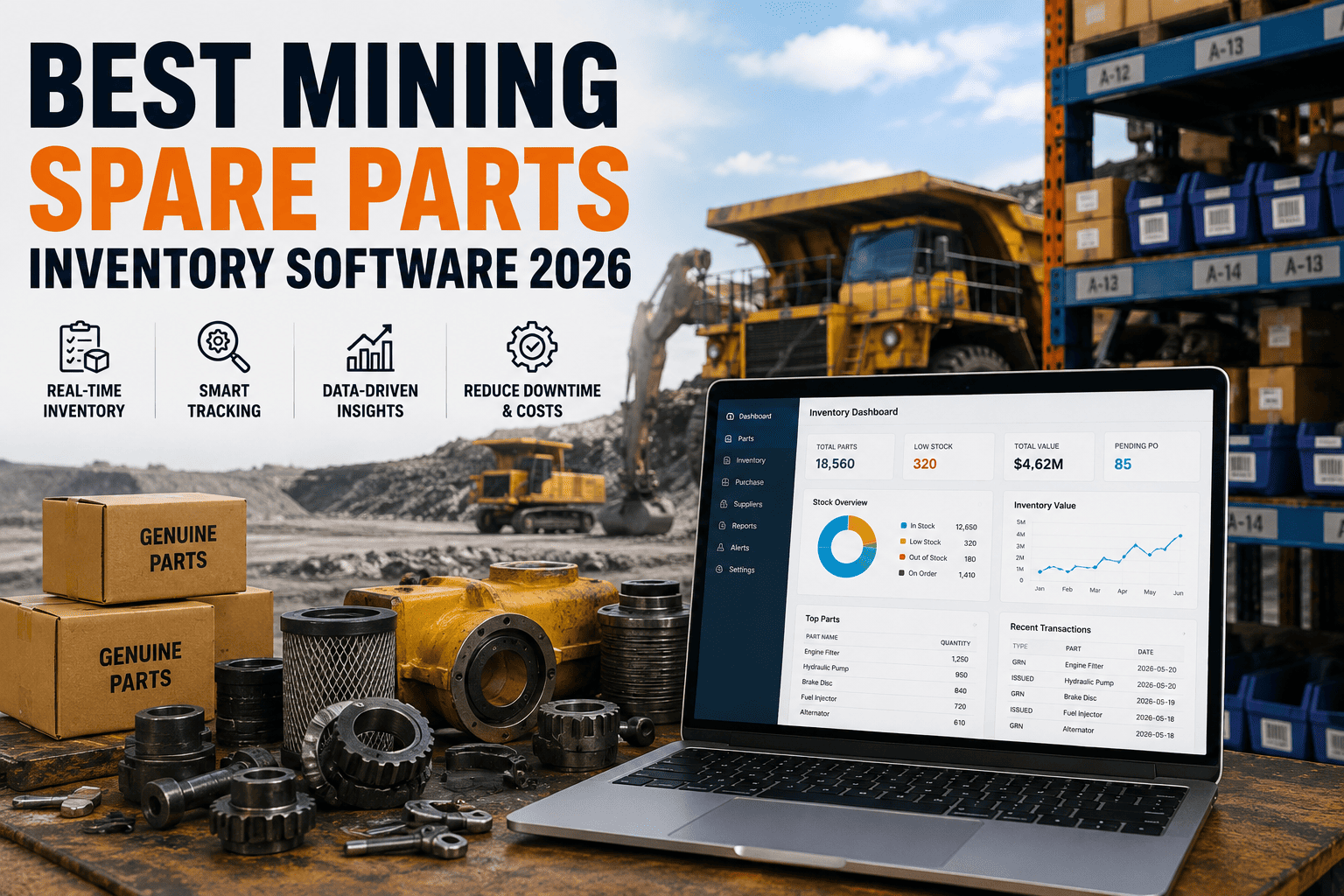
FleetRabbit links every spare part to the specific machine and work order it belongs to, so reorder points trigger automatically and technicians see live stock levels before they even start the job.
What to Look For in Mining Spare Parts Inventory Software
Generic warehouse software was not built for a mine site's mix of high-value critical spares, remote logistics, and unpredictable failure patterns. The right platform is built specifically around those constraints.
| Capability | What It Solves | Impact |
|---|---|---|
| Automated Reorder Points | Manual reordering misses critical spares until it's too late | Orders trigger before stock hits a critical threshold |
| Work Order Linked Parts | Technicians don't know if a part is in stock before starting a job | Live stock status shows before the wrench ever turns |
| Criticality Classification | Every part gets treated the same regardless of failure impact | Vital spares get stocked deeper than low-impact items |
| Multi-Site Stock Visibility | A part sits unused at one site while another site orders emergency freight | Existing stock gets transferred instead of reordered |
| Usage and Demand Forecasting | Reorder quantities based on guesswork instead of real consumption | Stock levels match actual demand patterns per site |
Automated Reorder Points by Criticality
Not every part deserves the same stocking rule. Vital spares tied to high-value, long-lead-time components should carry deeper minimum stock than a common filter that can be sourced locally within a day, and the software should apply that logic automatically rather than leaving it to memory.
Real-Time Stock Visibility Across Sites
A part sitting unused in one storeroom while another site orders it on emergency freight is one of the most avoidable costs in mining maintenance, and it only gets solved when every site's inventory is visible in one shared system.
Work Order Linked Parts Tracking
When a work order automatically checks part availability the moment it is created, technicians stop discovering a stockout mid-repair, and planners get early warning to expedite before the job is even scheduled.
Getting Your Inventory Strategy Right
Fixing stockouts is not about buying more inventory across the board. It is about applying the right stocking discipline to the right category of part.
| Part Category | Stocking Approach | Reasoning |
|---|---|---|
| Vital / Long Lead-Time | Stock deep, monitor continuously | A stockout means weeks of downtime waiting on a replacement |
| Essential / Standard Lead-Time | Stock to demand forecast with reorder points | Balances carrying cost against reasonable repair delay |
| Non-Critical / Low Impact | Stock minimally or source on demand | Low downtime risk means capital is better used elsewhere |
Mine sites that apply this kind of classification alongside automated reorder logic report cutting repair delays by around 40 percent, and one global mining company's spare parts optimization program is projected to save 103 million dollars over 20 years simply by ensuring the right components are available when needed. If you want to see this classification applied against your own current storeroom data, you can book a free demo with FleetRabbit to walk through it live.
FleetRabbit classifies parts by criticality and demand pattern automatically, so your storeroom stocks deep on what actually protects uptime and light on what doesn't.
Benchmarking Your Inventory Performance
Before choosing a platform, it helps to know where your storeroom currently stands against industry benchmarks.
Stockout Rate
Track how often a required part is unavailable when a work order is created. Best-in-class sites drive this number down close to zero through automated reorder points and demand forecasting rather than manual stock checks.
Inventory Carrying Cost
Best-in-class mining operations spend 1.5 to 2.5 percent of replacement asset value on spare parts inventory, while average performers spend 3.5 to 5.2 percent for no additional reliability benefit. That gap represents working capital sitting idle on shelves instead of funding operations.
Emergency Order Percentage
Every emergency purchase costs 3 to 5 times more than a planned one. Tracking what share of your total parts spend goes through emergency channels reveals exactly how much your current stocking strategy is costing in avoidable premiums.
Every stockout on a mine site is a preventable event hiding inside data your team already generates: usage history, lead times, and failure patterns per part. The only question is whether that data lives in a system that acts on it automatically, or in a storeroom clipboard that nobody checks until a technician is already standing next to a broken machine. Fleets that close this gap consistently spend less while breaking down less often.
FleetRabbit gives your maintenance team real-time stock visibility, automated reorder points, and work order linked parts tracking across every mine site. Start free with no credit card required, or see it live on your own inventory data.