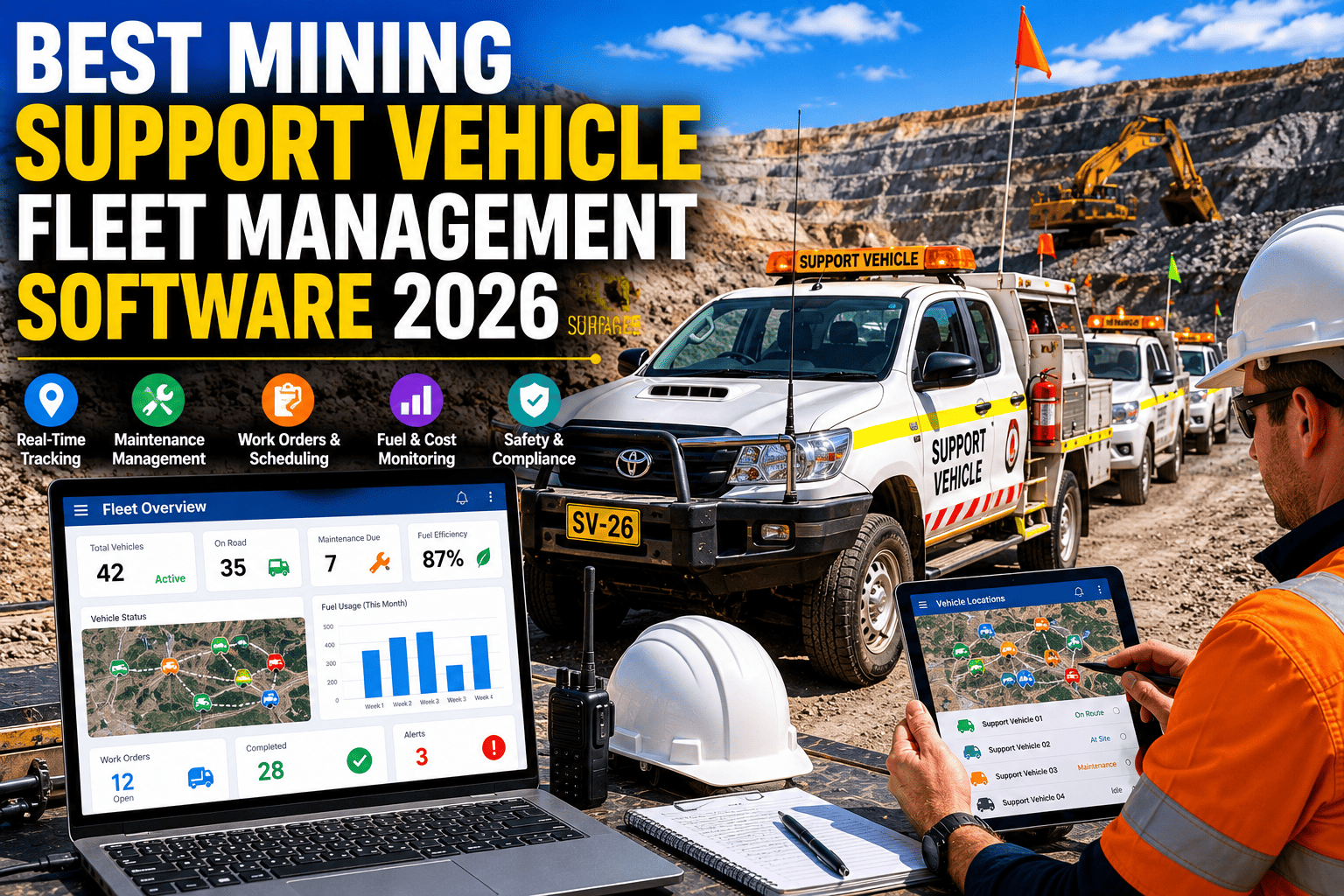
Every mining operation runs on two layers of equipment. The first layer — haul trucks, excavators, drills — gets all the attention. The second layer keeps the first layer alive: water trucks suppressing dust on haul roads, fuel and lube trucks servicing equipment in the field, light vehicles moving supervisors and technicians across site, service trucks responding to breakdowns, and crew transport vehicles running personnel between portal and surface. These are your mining support vehicles, and in most operations, they are the least-managed assets on site. No structured inspection program. No PM scheduling. No fuel tracking. No visibility into where they are or whether they are roadworthy. That blind spot is costing you more than you realize, and FleetRabbit was built to close it.
What Are Mining Support Vehicles, and Why Do They Get Ignored?
Mining support vehicles are every vehicle on site that is not a primary production asset. They are the backbone of day-to-day site operations, but because they do not directly move ore, they are treated as low-priority assets in most fleet management programs. The result is predictable: deferred maintenance, missed inspections, unexpected breakdowns at the worst possible times, and fuel waste that no one is tracking.
The Hidden Cost of Unmanaged Support Vehicles
A broken water truck does not appear in your production loss report, but it destroys haul truck air filters within days, reducing engine life on your most expensive assets. A fuel and lube truck running without consumption tracking bleeds diesel through unauthorized use and inaccurate deliveries that no one reconciles. A light vehicle with a deferred brake inspection is a liability on a haul road shared with 100-tonne trucks. The costs of neglecting support vehicles are real, but they are hidden in secondary damage, safety incidents, and productivity losses that never get attributed back to the vehicle that caused them. Book a demo with FleetRabbit to see how support vehicle management changes the financial picture.
Water Truck Breaks Down
No pre-shift inspection caught a developing hydraulic fault. The truck fails mid-shift on haul road 3.
Dust Suppression Stops on Haul Road
Dust levels rise immediately. Haul truck air filters begin loading with fine particulate within 2 hours.
Haul Truck Visibility Drops
Operators reduce speed on dusty roads. Cycle times extend. Tonnes per shift begin declining.
Air Filters Require Early Replacement
Filters replaced at 40% of normal life. Across 10 haul trucks, that is 20+ premature filter changes this month.
Root Cause Never Identified
The water truck breakdown is recorded. The $8,000 in cascading costs across the haul fleet never gets linked to it.
What Good Support Vehicle Fleet Management Looks Like in 2026
Managing mining support vehicles well in 2026 is not about enterprise complexity. It is about five disciplines executed consistently: pre-shift inspections that actually happen and are recorded, PM schedules triggered on hours or kilometers (not calendar days), fuel consumption tracked per vehicle with anomaly alerts, real-time GPS visibility of every asset on site, and driver behavior monitoring on shared haul roads. Sign up for FleetRabbit and you can have all five running for your support vehicle fleet within a single day.
Digital Pre-Shift Inspections
Every support vehicle must complete a pre-shift inspection before leaving the workshop or yard. Water trucks, fuel trucks, light vehicles, and crew transports each have different inspection requirements. Digital inspection tools with vehicle-specific checklists, mandatory photo capture for defects, and offline capability ensure inspections happen and create an audit-ready compliance record automatically. Paper-based inspection programs have a 40–60% completion rate on average. Digital programs achieve 95%+.
Hours and Kilometer-Based PM Scheduling
Light vehicles on mining sites accumulate kilometers at a rate that makes calendar-based servicing dangerously inaccurate. A vehicle running two 12-hour shifts daily through rough terrain hits 10,000 kilometers in weeks. PM scheduling for support vehicles must trigger on odometer or hours, with site-condition severity adjustments applied automatically. When a service is due, the system generates a work order, checks parts availability, and notifies the maintenance planner before the vehicle goes out on the next shift.
Fuel Consumption Tracking Per Vehicle
Fuel and lube trucks are a significant source of untracked fuel loss on mine sites. Without per-delivery records linked to each vehicle serviced, reconciling fuel issued against fuel consumed by the primary fleet is impossible. Fuel tracking must capture delivery quantities, receiving vehicle ID, operator, timestamp, and location. Anomaly alerts trigger when a support vehicle’s consumption deviates from its baseline, flagging mechanical inefficiency or unauthorized use before it becomes a significant cost.
Real-Time GPS and Geofencing
Support vehicles travel across the entire mine site, often into active blast zones, haul corridors, and restricted areas. Real-time GPS tracking with geofencing alerts ensures supervisors know when a light vehicle enters a haul road during active truck operations, when a service truck drives past its designated zone, or when a personnel transport is overdue from a remote portal. Geofencing for support vehicles is not a luxury — on a site where autonomous trucks operate, it is a safety requirement.
Driver Behavior Monitoring
Light vehicle speeding on haul roads is one of the most common causes of fatal incidents in mining. Driver behavior monitoring — speed profiling, harsh braking, cornering events, and seatbelt compliance — creates accountability without confrontation. Automated scoring and reporting give supervisors objective data for coaching conversations. Operations that implement driver monitoring see significant reductions in near-miss events and traffic accidents on site within the first quarter of deployment.
FleetRabbit Manages Your Entire Support Vehicle Fleet
From water trucks to crew transport, FleetRabbit gives every support vehicle on your site the same inspection discipline, PM scheduling, and fuel visibility that you apply to your primary production fleet. Set up in under a day. No IT team required.
Feature Comparison: What to Demand From Support Vehicle Software
Not every fleet management platform handles support vehicles well. Many are built around haul truck dispatch and production optimization, leaving light vehicles and service trucks as afterthoughts with no vehicle-specific inspection templates and no kilometer-based PM scheduling. Use this comparison to cut through the noise when evaluating platforms. If you want to see how FleetRabbit handles every item below, book a 30-minute demo and we will walk through your specific vehicle types.
| Feature | What Strong Looks Like | What Weak Looks Like | FleetRabbit |
|---|---|---|---|
| Vehicle-Specific Inspections | Separate templates for water trucks, light vehicles, fuel trucks, crew transport with relevant checklist items per type | Generic checklist applied to all vehicles regardless of type | Pre-built templates per support vehicle type, fully customizable |
| PM Trigger Method | Odometer, engine hours, or calendar — whichever comes first, with severity multipliers for harsh conditions | Calendar-only scheduling that ignores actual vehicle usage | Multi-trigger PM with site severity adjustments built in |
| Offline Capability | Full inspection and work order functionality with zero connectivity, auto-sync on reconnect | Requires connectivity to submit inspections; operators revert to paper in the field | Fully offline-capable mobile app, sync on reconnect |
| Fuel Tracking | Per-vehicle consumption tracking, delivery records linked to receiving vehicle, anomaly alerts | Total site fuel tracked only, no per-vehicle breakdown or anomaly detection | Per-asset fuel tracking with consumption baselines and alerts |
| Driver Behavior | Speeding, harsh braking, idling, and seatbelt compliance with automated scoring and coaching reports | GPS location only, no behavioral data or driver accountability features | Driver behavior scoring with shift and weekly summary reports |
| Defect-to-Work Order Flow | Inspection defects automatically route to maintenance queue as work orders without manual re-entry | Defects captured on paper, manually re-entered into a separate maintenance system | One-tap defect-to-work-order creation from inspection screen |
| Compliance Documentation | Timestamped, signed inspection records with photos, exportable for audit on demand | Paper records or scanned PDFs with no searchability or real-time access | Digital audit trail with photo evidence, searchable by vehicle, date, or operator |
Vehicle-Type Spotlight: Managing Each Support Vehicle Category
Water Trucks: The Most Overlooked Critical Asset
Water trucks are often the last vehicles to get maintenance attention because their failure is indirect. They do not move ore, so their downtime does not appear in production reports. But a water truck off the road for four hours during a hot, dry shift means haul road dust levels that spike filter loading rates across the entire primary fleet. Best practice is treating water trucks as tier-one priority support assets with the same inspection frequency and PM scheduling discipline as haul trucks. Sign up for FleetRabbit to apply that discipline automatically.
Fuel and Lube Trucks: Where Fuel Accountability Starts
Fuel and lube trucks carry significant quantities of diesel across the site, dispensing to primary production equipment in the field. Without per-delivery records tied to a vehicle ID and operator, fuel reconciliation is impossible. Common issues include delivery volume discrepancies, unauthorized top-ups, and consumption that never reconciles with production records. Fleet software for fuel trucks must capture delivery records digitally at the point of dispensing, integrate with site fuel management systems, and flag statistical anomalies in consumption patterns within each shift cycle.
Light Vehicles: High Utilization, Low Oversight
Light vehicles on mine sites often accumulate more daily kilometers than any other vehicle category. Geologists travelling to sample sites, supervisors doing pit rounds, and maintenance coordinators responding to breakdowns all cover significant ground on rough, unsealed mine roads. Tire wear, brake degradation, and suspension damage accumulate faster than standard service intervals predict. Kilometer-based PM scheduling with accelerated intervals for mine-condition driving is essential, and pre-shift inspections that include tire pressure, fluid levels, and seatbelt condition should be non-negotiable for all light vehicle operators.
Service and Maintenance Trucks: Reliability Above All
The irony of maintenance truck breakdowns is that they take a repair asset out of the field, compounding the downtime of whatever equipment the truck was deployed to fix. Service trucks carry specialized tools, parts, and fluids that are difficult to source from the workshop at short notice. Tracking service truck utilization — how many breakdowns responded to per shift, average response time, parts consumed per job — reveals whether field maintenance capacity matches site demand and where additional resources are needed.
Crew Transport: Zero Tolerance for Safety Gaps
Personnel transport vehicles carry the most important asset on any mine site: people. Pre-shift brake inspections, seatbelt checks, lighting verification, and tire pressure checks are the absolute minimum. Driver behavior monitoring is particularly important for crew transport vehicles operating on shared haul roads, where speed compliance and intersection stop discipline directly determine incident probability. Any defect that affects passenger safety must prevent the vehicle from being released for shift start until the defect is cleared.
Mining operations typically insure primary production assets meticulously but carry insufficient maintenance discipline for support vehicles. Yet according to industry data, light vehicle and support vehicle incidents account for a disproportionate share of mining fatalities annually. Structured inspection and driver monitoring programs are not just operational improvements — they are the single highest-return safety investment available to most mining operations today.
Implementation Roadmap: From Spreadsheets to Full Visibility
Most mining operations managing support vehicles through spreadsheets, paper checklists, or whiteboard maintenance schedules can move to a fully digital system within a single week. The key is starting with the highest-risk vehicles first and expanding progressively. Here is the proven sequence.
Asset Register and Vehicle Profiling
Upload your complete support vehicle fleet: registration, make, model, current odometer or hours, and vehicle type. Assign inspection templates to each vehicle category. This takes less than a day with FleetRabbit’s CSV import tool and pre-built mining support vehicle templates.
Digital Inspections Go Live
Replace paper pre-shift checklists with digital inspections on mobile devices. Operators complete vehicle-specific checklists before each shift. Defects auto-generate work orders. Aim for 100% digital inspection compliance within the first two weeks of launch.
PM Scheduling Activation
Build out PM schedules for each vehicle type based on odometer intervals, hours, and manufacturer recommendations adjusted for site conditions. The system begins tracking usage against service due dates and triggers alerts before vehicles go overdue.
Fuel Tracking and GPS Activation
Connect fuel delivery records to individual vehicle profiles. Activate GPS tracking for real-time site visibility and geofencing for haul road and restricted zone compliance. Driver behavior monitoring begins generating shift-level reports automatically.
Data-Driven Continuous Improvement
Monthly trend analysis reveals which vehicles have the highest defect rates, which drivers generate the most behavior events, and where fuel consumption is above baseline. Target the highest-impact issues first. Most operations see measurable improvement in availability and fuel costs within 60–90 days.
Frequently Asked Questions
Stop Managing Support Vehicles With Spreadsheets and Paper
FleetRabbit gives every water truck, fuel truck, light vehicle, and crew transport on your mine site the same digital discipline your production fleet deserves. Pre-shift inspections, PM scheduling, fuel tracking, GPS visibility, and driver behavior — all live in under a day. No IT team, no contracts, no credit card required to start.